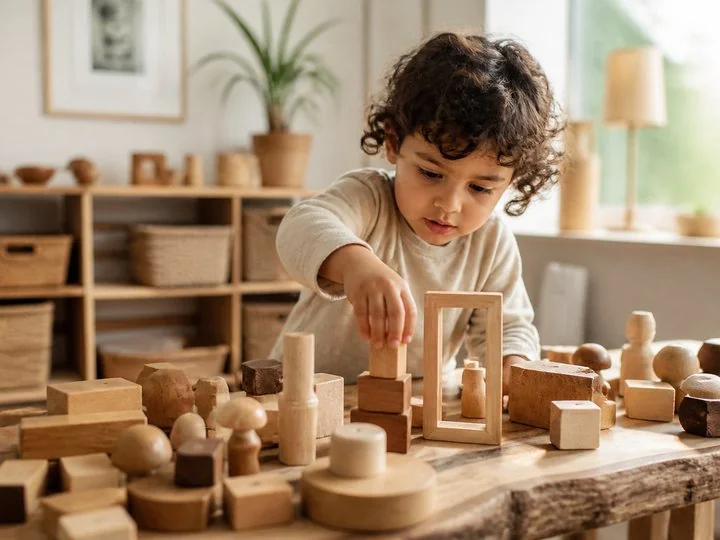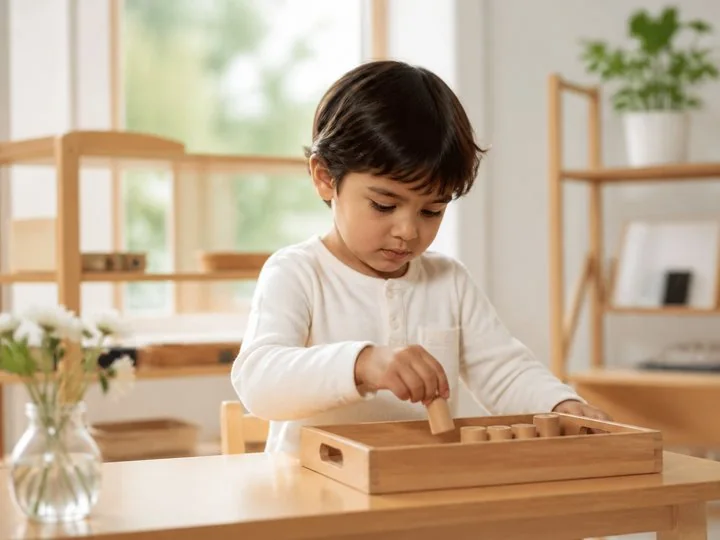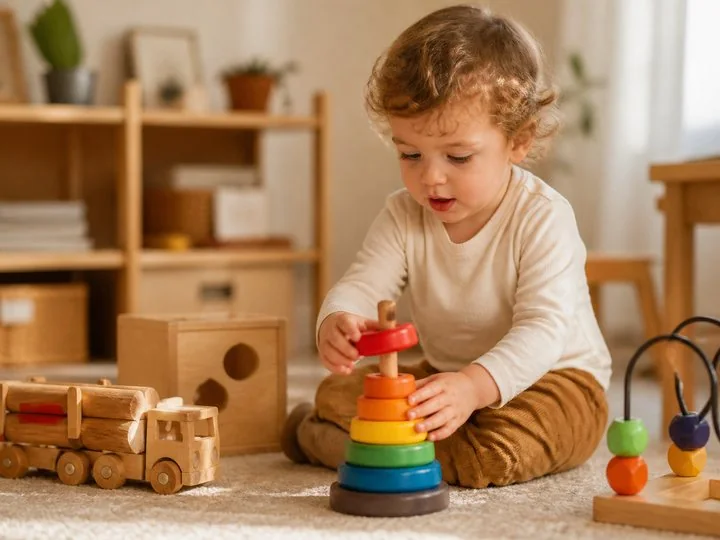
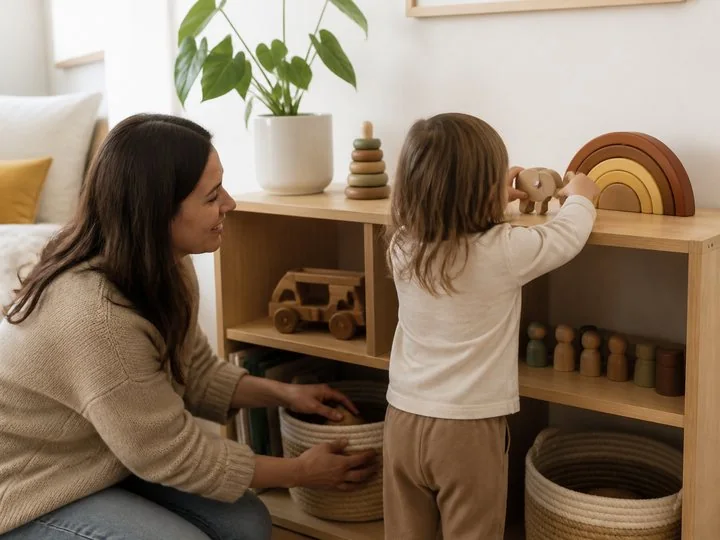
Toy rotation is simply the practice of keeping some toys available and resting others. It can make a crowded play area easier to use and a scattered cleanup easier to finish. It is not a developmental requirement, a test of minimalist parenting, or a guarantee that a child will suddenly play alone for an hour.
The useful version is smaller than the systems often shown online: clear one usable area, preserve the toys that matter, and change a few things only when observation gives you a reason.
Quick answer
There is no research-backed number of toys to display and no proven weekly rotation schedule. One small study found that toddlers played longer with each toy and used toys in more ways when 4 rather than 16 toys were available during a controlled session. That supports trying a less crowded immediate environment. It does not prove that rotating bins every Friday produces lasting developmental benefits.
For a first attempt, offer several distinct ways to play—perhaps building, pretending, moving, making, and solving—without filling every shelf or basket. Keep favorites and ongoing projects. Reassess when play and cleanup stop working, not when a calendar alert appears.
What toy rotation is—and what it is not
In a rotation, children can reach a limited part of the household toy collection while the rest is stored, lent out, or placed elsewhere. The visible group changes over time.
That definition leaves room for very different homes. A family with one living-room basket may rotate three bulky toys. A family with an open shelf may change two trays while blocks and figures stay. An older child may rotate craft kits and board games rather than individual toys.
Rotation is not the same as decluttering. A rested toy is expected to return; an outgrown, incomplete, recalled, or unwanted item needs a separate decision. It is also not the same as taking a toy away as a consequence. If storage feels unpredictable or punitive, the system is working against the calm access it is supposed to create.
What the research actually says
The study most often used to justify toy rotation was published in Infant Behavior and Development. Researchers observed 36 toddlers between 18 and 30 months old in two free-play conditions: one with 4 toys and one with 16. With fewer toys available, the toddlers had fewer separate incidents of toy play, but they played longer with each chosen toy and used individual toys in a greater variety of ways.
That is interesting, modest evidence that the number of choices in the immediate environment can change play behavior. It is not a home toy-rotation trial.
The study did not establish:
- an ideal total number of toys to own;
- how many items belong on every child’s shelf;
- whether toys should change weekly, monthly, or at all;
- whether a rotation increases independent play at home;
- whether the observed differences produce long-term developmental gains; or
- whether the result applies equally to babies, older preschoolers, siblings, or neurodivergent children.
The American Academy of Pediatrics describes play as important for relationships, exploration, language, problem-solving, and self-regulation. Its toy guidance emphasizes active, hands-on, child-led interaction. It does not prescribe a minimalist shelf or rotation schedule. The honest conclusion is uncomplicated: reducing visible clutter may help some children use a space, and families can test that idea without turning it into a developmental rule.
How many toys should be in a rotation?
Use function before number. A basket of 20 large blocks is one building system; it would be unhelpful to count each block as a separate toy. A dollhouse with 40 tiny accessories is also one play system, but its cleanup and safety load is much larger than the label “one toy” suggests.
Begin with enough variety to support the child’s current play and little enough that choices and pieces remain visible. This table is a planning tool, not a required formula.
| Play mode | Examples | Keep available when… | Consider resting when… |
|---|---|---|---|
| Build and connect | Blocks, magnetic tiles, train track | Children combine pieces, rebuild, or use them in stories | Multiple construction sets are being dumped together and none is usable |
| Pretend and represent | Figures, animals, vehicles, kitchen pieces | The objects join changing stories | A large themed set dictates the same short script and is ignored afterward |
| Move the body | Balls, push toys, balance materials | The space supports safe movement | The item blocks the only play area or no longer fits the child’s ability |
| Make and change | Paper, crayons, dough, reusable craft materials | Supplies are fresh, reachable, and easy to reset | Materials are dried out, depleted, or require more supervision than is available |
| Solve and repeat | Puzzles, posting toys, simple games | The challenge is satisfying and voluntarily repeated | The task is consistently too easy, frustrating, or missing essential pieces |
| Comfort and connection | Favorite soft toy, familiar book, family-play game | It provides comfort or is requested often | Usually do not rotate merely to make the shelf look balanced |
If you want a number for the first experiment, choose what fits with breathing room in one defined play area. Try it for several days. The useful question is not “Did I display exactly eight toys?” but “Can my child see choices, start using them, and find their parts?”
A five-step toy rotation that takes less maintenance
1. Choose one problem to solve
Name the friction before moving anything. Is the floor unsafe to walk across? Are puzzle pieces mixed beyond use? Does the child ask for help because nothing has a visible home? Are adults spending too long resetting the room?
“We have too many toys” is harder to act on than “three construction systems are open at once and the pieces cannot be found.” A precise problem also tells you whether rotation helps. Sometimes the answer is a better container, a repair, a lower shelf, or fewer adult-created activities.
2. Make three groups
- Available now: favorites, current interests, active projects, and a workable variety of play modes.
- Resting: complete, safe toys that may be useful later.
- Repair, pass on, or discard safely: damaged, recalled, incomplete, outgrown, or consistently unwanted items.
Do not use the resting group as a way to postpone every decision. If an item returns for two or three rounds and remains unused, investigate whether it is too advanced, too simple, hard to access, or simply not a fit.
Before passing on a toy, check the CPSC recalls database. Recalled products should follow the recall remedy and should not be donated or resold.
3. Preserve anchor materials
Anchor materials are the things other play grows around: blocks, figures, vehicles, fabric, art supplies, a doll, or a beloved animal. They do not need to disappear just because they have been visible for a month.
This is where open-ended toys can be especially useful. A stable block set may connect with a rotating basket of animals one week and cardboard tubes the next. Keeping the anchor makes combinations possible and reduces the sense that the whole room has been replaced.
4. Store complete play systems together
Keep the parts needed to begin in one labeled box, bag, or tray. Use a photo label for a child who does not read yet. “Train set” is a more useful storage category than separate bins for straight tracks, curved tracks, bridges, and vehicles if assembling the category becomes an adult-only job.
Storage should remain dry and accessible to adults while preventing younger children from reaching age-inappropriate pieces. Secure tall furniture to the wall according to its instructions, avoid containers with heavy lids or entrapment risk, and do not place tempting bins where climbing is required.
5. Change the smallest useful amount
Instead of emptying the room, replace one ignored puzzle, one pretend set, or one large movement toy. Then observe. A small change makes it easier to see what affected play and takes less energy to reverse.
How often should you rotate toys?
Rotate when the environment gives you a cue:
- several complete toys have not been used for a week or more;
- a new interest makes a stored material relevant;
- a puzzle or posting task has become consistently frustrating or effortless;
- too many similar sets are open at once;
- pieces can no longer be found or cleanup routinely stalls; or
- the child asks for something in storage.
Weekly, biweekly, and monthly systems all appear in current parenting content and family discussions. None is a research-established optimum. If a monthly reset helps an adult remember, use it as a prompt to observe, not a command to replace everything.
Infants and young toddlers change rapidly, but that still does not require a new shelf on a fixed schedule. A child who repeats the same action may be practicing, not bored. Older preschoolers may keep a construction or pretend world active for days. Protect that continuity.
Real-life problems a perfect shelf does not show
“Does LEGO count as one toy?”
Treat a complete set or compatible collection as one play system, then account for its piece burden. If blocks, magnetic tiles, train tracks, and small bricks create an unusable mix, keep one or two construction systems accessible rather than counting every tub as just “one.” Do not separate pieces a build needs solely to hit a display number.
“My child wants a stored toy”
Let the request be useful information. Retrieve it when practical and invite the child to choose something less used to rest. Rotation is an access system, not a rule that an interesting toy must remain unavailable until Sunday.
“Should the favorite toy rotate?”
Usually no. Comfort objects and strong, sustained interests can stay. Novelty is not more valuable than deep familiarity. A favorite vehicle may become the passenger in a block train, the patient in a pretend clinic, and the object measured in a STEAM activity.
“We have children at different ages”
Build the shared area around materials safe for the youngest child with access. Give older children a table, gated room, closing box used with supervision, or scheduled small-parts session. Never place beads, marbles, magnets, small construction pieces, or other hazards on a low shared shelf to make rotations look equal.
“We have nowhere to store bins”
Use location rather than concealment. A few toys can move from the living room to a bedroom shelf; bulky toys can rotate between rooms; a toy library can create temporary variety; compatible items can be shared with another family. If storage costs more space and attention than the visible toys, a smaller collection may work better than a formal rotation.
“The new rotation was dumped and ignored”
Dumping may be the interesting action, the selection may contain too many pieces, or the toys may not match the child’s current interest. Reset once with fewer loose components. Place one familiar anchor beside one changed material. If play still does not begin, restore the old setup or try a different kind of activity. The shelf does not need to win.
Common toy rotation mistakes
- Replacing everything at once. This removes useful continuity and makes it hard to learn what helped.
- Rotating by adult boredom. Repetition can be meaningful even when it looks unchanged from the outside.
- Hiding favorites without warning. A calm shelf is not worth avoidable distress.
- Using categories that are too precise. A system that only an adult can maintain will become another chore.
- Buying storage before reducing friction. More bins can preserve too many low-value items and consume the space play needs.
- Claiming rotation builds focus or creativity. It may change the immediate play environment; stronger developmental promises exceed the evidence.
If the full system feels heavy, try a one-shelf reset: remove broken and outgrown items, keep two or three reliable play systems, add one current-interest material, and stop. Good play does not require a catalog.
Frequently asked questions
At what age should toy rotation start?
There is no required age. Use it when limiting visible choices solves a real household problem. For babies and toddlers, every accessible item must match current mouthing and movement risks. Older children can help choose what rests and what remains available.
Is toy rotation Montessori?
An orderly, accessible environment with limited choices is compatible with Montessori practice, and the American Montessori Society suggests limiting choices and using low open shelves at home. A branded shelf, exact toy count, and fixed rotation calendar are not required for a family to borrow that useful idea.
How long should a toy stay in storage?
Long enough for the next review, not for a mandatory interval. A few weeks may work for fast-changing toddler interests; months may suit older children and bulky items. Retrieve a requested toy when practical.
Should books rotate too?
They can, but frequently requested books and bedtime favorites benefit from consistency. A library basket can provide changing titles while a small core remains. Do not reduce reading access simply to match the toy shelf.
Does toy rotation encourage independent play?
It may make choices and cleanup more manageable, which can support play initiation. It does not guarantee solitary play. Young children often need connection, modeling, shared play, or help entering an activity; our guide to encouraging independence through play treats that as a relationship skill, not a timer target.
What should I do with toys that never work in a rotation?
Check whether the toy is complete, safe, visible, age-appropriate, and connected to the child’s interests. If it is repeatedly ignored and no younger child will grow into it, pass it on responsibly after checking recalls. Our sustainable toy gift guide includes a fuller secondhand safety checklist.
Sources and evidence notes
- Dauch et al., “The influence of the number of toys in the environment on toddlers’ play”, Infant Behavior and Development (2018).
- American Academy of Pediatrics, “The Power of Play” (2018).
- American Academy of Pediatrics, “Selecting Appropriate Toys for Young Children in the Digital Era” (2019).
- American Montessori Society, “Montessori at Home”, accessed August 11, 2026.
- U.S. Consumer Product Safety Commission, Toy Safety, accessed August 11, 2026.
This article is based on the research and source review recorded in research/toy-rotation-101.md. LWT did not test a toy-rotation system with families, and no cited source establishes a universal toy count or schedule.