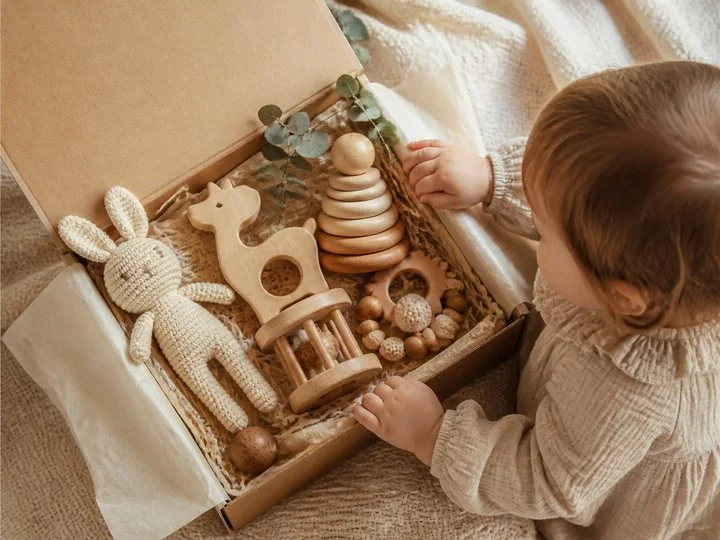
A toy does not become sustainable because it is beige, wooden, wrapped in kraft paper, or described as “conscious.” Environmental impact includes raw materials, manufacturing, transport, packaging, how long the toy remains useful, and what happens afterward. Most shopping pages do not provide enough data for a full life-cycle comparison.
That uncertainty is a reason to ask better questions, not to search for a perfect toy. Start with the child and the household: Will this be used? Does it add a genuinely new play possibility? Can it survive the way this child plays? Can its parts be found, cleaned, repaired, passed on, or recycled through a real program?
Quick answer
Prioritize a long useful life, a good fit, and specific verifiable claims. Buy fewer, better-matched gifts; consider secondhand after a safety check; and treat “green,” “natural,” “non-toxic,” and “planet-friendly” as prompts for more information rather than proof.
The U.S. Federal Trade Commission’s Green Guides say broad, unqualified environmental benefit claims are difficult—often impossible—to substantiate because they can imply many different benefits. A useful product claim should tell you what is better, compared with what, and how much.
A five-question screen before you buy
| Question | Stronger evidence | Weak signal |
|---|---|---|
| Will it be used for long? | Fits a current interest; adapts as skills grow; compatible replacement parts | Bought mainly because it looks educational |
| What exactly is it made from? | Named materials and recycled percentage; certification scope explained | “Earth-friendly materials” with no detail |
| Can it withstand and recover from use? | Replaceable common parts, washable surface, repair guidance | Sealed novelty mechanism likely to be discarded when one part fails |
| Is it safe for this child and home? | Current age label, warnings, traceable maker, recall check | Missing label, unknown magnets/batteries, damaged secondhand item |
| What happens next? | Likely hand-me-down, active resale market, real take-back route | “Recyclable” without local acceptance or disassembly instructions |
No single answer settles the decision. Durable virgin plastic used by several children may have a longer useful life than a fragile product marketed around a renewable material. Material matters, but use matters too.
What common sustainability claims mean
Recycled plastic
Look for a percentage and whether the claim refers to the toy, packaging, or both. “Made with recycled materials” could describe a small portion. Recycled content does not automatically mean the product can be recycled locally at end of life.
FSC-certified wood or paper
Forest Stewardship Council certification concerns forest-based material and chain of custody. Check whether the claim applies to the product, packaging, or selected components. It does not independently assess every paint, glue, labor, transport, or durability question.
Biobased or plant-based plastic
Biobased describes feedstock, not necessarily compostability or biodegradability. A plant-derived plastic may behave like conventional plastic in disposal systems. Look for a named material and end-of-life instructions.
Organic textile
Ask which standard, which fiber, and whether certification covers the finished product or only input material. Filling, dyes, trims, and packaging may follow different claims.
Carbon neutral or climate positive
These claims require careful boundaries, accounting, and information about reductions versus offsets. A badge without accessible methodology is not enough for a confident comparison.
Non-toxic and natural
These are not complete safety specifications. Everything is chemical in the broad sense, and “natural” materials can still present choking, allergen, splinter, contamination, or finish concerns. Look for compliance information, age grading, material details, and relevant test standards.
Gift ideas chosen by play life, not trend
These are categories rather than a ranked product list because the most durable fit depends on what the child already owns.
| Gift direction | Why it can last | Check before gifting |
|---|---|---|
| Compatible expansion for an existing building system | Extends a proven interest without starting another incompatible collection | Exact system compatibility and age/small-parts warnings |
| Durable figures or vehicles | Crosses building, storytelling, outdoor, and sibling play | Scale, material, wheels/parts, current warnings |
| Refillable art setup | Consumables support repeated making without novelty mechanisms | Washability, ingredient/allergen notes, refill availability |
| Quality dress-up basics | Fabric, bags, hats, and simple roles can support many stories | Cord, fastener, flammability, wash and fit considerations |
| Child-sized real tool | Supports practical participation over time | Age-appropriate design, supervision, storage |
| Board game or puzzle with a known audience | Can be shared, lent, and replayed | Actual skill/interest match and replacement-piece policy |
| Outdoor exploration kit | A container, chalk, magnifier, or field notebook supports many outings | Optical safety, cords, small pieces, local context |
| Experience plus a small prop | Creates time together without a large object burden | Access, schedule, sensory and mobility needs |
| Secondhand classic set | Avoids new production and may retain resale value | Recall and condition inspection |
| Repair or completion gift | Returns an existing favorite to usable condition | Official or reliably compatible replacement part |
For toddlers, our wooden toy guide compares current products using manufacturer specifications and trade-offs rather than material alone.
How to evaluate a product page
Read beyond the sustainability landing page. Save or record:
- The exact product name and current model.
- Manufacturer age recommendation and safety warnings.
- Materials by component, not just the headline material.
- Dimensions and piece count when they affect fit or storage.
- The exact environmental claim and its scope.
- Certification name and, where available, searchable certificate or chain-of-custody information.
- Cleaning and care instructions.
- Replacement parts, repair, warranty, or take-back information.
- Packaging details separately from product details.
If a retailer and manufacturer disagree, use the current manufacturer page or contact the company. Do not infer missing facts from a similar model.
Buying secondhand safely
Secondhand is not automatically safe or unsafe. CPSC advises checking recalls and avoiding products that are damaged, missing instructions, or no longer meet current safety expectations.
Before accepting or buying
- Identify the maker and exact model if possible.
- Search the CPSC recall database in the United States, or the relevant national recall system.
- Confirm all essential pieces, guards, fasteners, and instructions are present.
- Inspect for cracks, splinters, rust, peeling coatings, loose seams, exposed stuffing, and trapped grime.
- Treat loose or high-powered magnets, button batteries, water beads, and unknown electrical parts as serious hazards.
- Check that the age grade fits the child who can access the toy, including younger siblings.
- Avoid older painted toys when lead risk cannot be assessed; CDC notes that some older toys and products may contain lead.
Cleaning cannot repair structural damage or make an unknown product compliant. When identity and safety cannot be established, pass.
Make gifting easier for parents
Ask before giving bulky, noisy, app-connected, highly themed, or multi-part toys. A useful question is: “Is there a system they already use, a consumable that needs refilling, or an experience you would welcome?”
Include the receipt, care instructions, and spare parts. Keep packaging only when it serves storage or future resale. Avoid making the recipient perform gratitude for a gift that does not fit their space or values.
If the home is already crowded, a gentle toy rotation may reveal what kind of gift would add a genuinely different play mode.
What we do not claim
LWT has not performed life-cycle assessments or hands-on durability testing on the products discussed across this site. Manufacturer claims describe what a company reports, not an independent environmental ranking. Certifications answer bounded questions; none makes consumption impact-free.
The strongest editorial recommendation may therefore be “use what is already working,” “buy the missing piece,” or “do not add another toy.”
Frequently asked questions
Are wooden toys more sustainable than plastic toys?
Not automatically. Source, finishes, manufacturing, shipping, durability, repair, and use all matter. Wood can be a good material, but the word alone is not a life-cycle comparison.
Is recycled plastic safe for toys?
A current toy sold in your market should meet applicable safety requirements regardless of recycled content. Check the manufacturer’s age grade, warnings, material disclosure, and recall status rather than treating recycled content as proof of safety.
Are secondhand toys sustainable?
They can extend useful life and avoid a new purchase. The benefit does not override recall, damage, missing-part, hygiene, lead, magnet, battery, or age-appropriateness concerns.
Which toy certifications should I look for?
Match the certification to the claim: FSC for forest-based sourcing, for example, or a recognized textile standard for fiber processing. EPA recommends understanding what an ecolabel covers rather than assuming all labels mean the same thing.
Can toys go in curbside recycling?
Usually not as complete products. Mixed materials, electronics, magnets, batteries, and small shapes complicate sorting. Follow local rules and use verified take-back programs; never wish-cycle a toy based only on a recycling symbol.
What is the most sustainable gift for a child who has many toys?
Consider an experience, library or museum membership, consumable art material they already use, repair part, storage solution, contribution to a larger planned item, or time together.
Sources and evidence notes
- U.S. Federal Trade Commission, Green Guides and environmental marketing guidance.
- U.S. Consumer Product Safety Commission, toy safety, recall, resale, magnet, battery, and small-parts resources.
- CDC, guidance on lead exposure from consumer products and older toys.
- U.S. EPA, ecolabel and greener-product guidance.
- HealthyChildren.org, age-appropriate toy safety guidance.
Product-specific claims should always be checked on the current manufacturer page at the time of purchase.