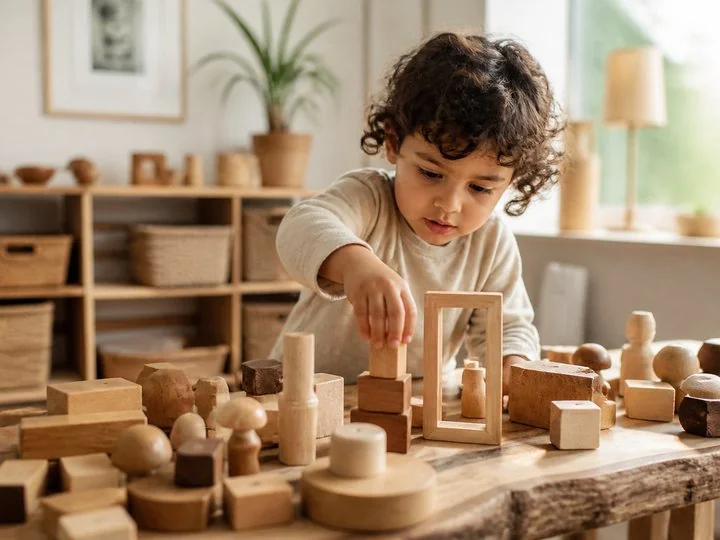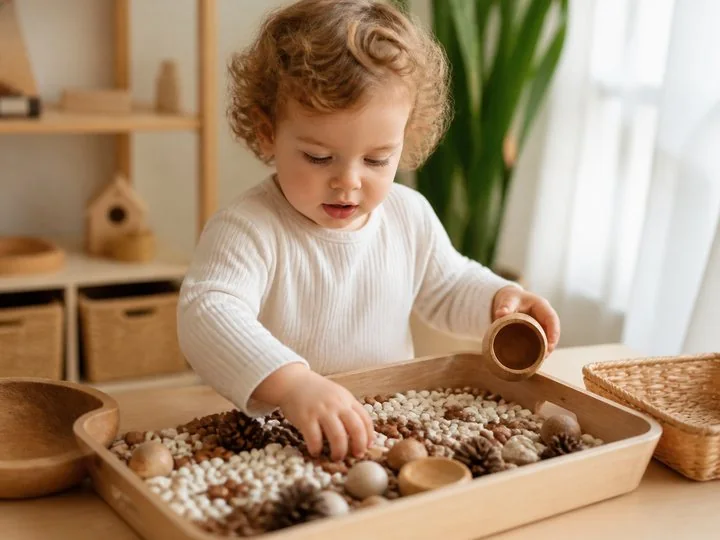
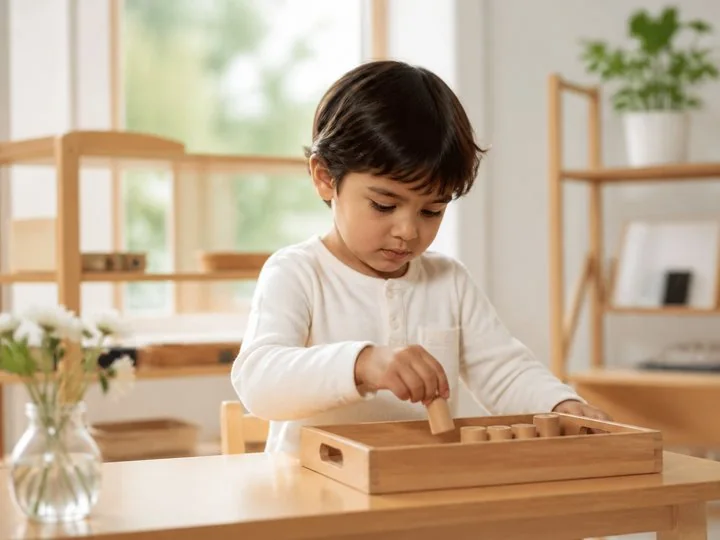
Independent play is not the same as leaving a child alone, and it is not a contest to see whose toddler can play quietly for the longest. It is the growing ability to start an idea, make a choice, stay with manageable difficulty, and seek help when it is genuinely needed.
That capacity develops inside a relationship. A child can be deeply engaged while an adult folds laundry nearby, checks in occasionally, or helps restart a stalled plan. The goal is not emotional distance. It is a gradual shift from “do this for me” toward “stay close while I try.”
Quick answer
To encourage independent play, begin with a familiar activity in a safe, reachable space. Connect for a few minutes, name what the child might do next, then step back to a nearby task. Return when you said you would. If play stalls, give the smallest useful amount of help instead of taking over.
There is no research-backed chart that says a two-year-old should play alone for a particular number of minutes. Temperament, language, sleep, hunger, disability, recent change, and familiarity with the material all matter. Look for small changes—starting without a prompt, trying a second strategy, or continuing while you move a few feet away—rather than a fixed duration.
What independent play can look like
Independent does not necessarily mean solitary. It describes who is carrying the play idea.
| Situation | Is the child leading? | What the adult is doing |
|---|---|---|
| A toddler stacks cups while a parent sits beside them | Yes | Available, but not directing |
| A preschooler builds while an adult cooks within sight | Yes | Nearby and checking safety |
| Siblings invent a train route together | Yes | Outside the play unless invited |
| An adult gives constant instructions for a craft | Not yet | Carrying the plan and decisions |
| A child repeatedly asks the adult what to do next | Partly | The activity may need a clearer entry point |
The American Academy of Pediatrics describes play as a context for warm relationships, exploration, language, problem-solving, and self-regulation. That does not turn every play session into a lesson. It supports a simpler idea: responsive adults and child-led activity can coexist.
Why “just go play” often fails
A child may want independence and still be unable to cross the first few steps alone. The blocks are in a heavy bin. The tape dispenser is impossible to use. The doll’s clothes require adult fingers. The room is full of choices but no visible idea. Or the child needs a brief reconnection after daycare, travel, illness, or a disrupted routine.
Before assuming a child is unwilling, look for friction.
| Friction | What you might see | A smaller fix |
|---|---|---|
| Too many choices | Dumping, wandering, asking for ideas | Offer two familiar starting choices |
| Hard-to-access materials | Repeated requests before play begins | Move a small set to an open basket or low shelf |
| Too many missing pieces | Searching and abandoning | Complete, repair, or rest the set |
| Task is too difficult | Immediate “You do it” | Simplify one step or pair familiar and new materials |
| Adult exit feels abrupt | Following, protesting, restarting | Say where you are going and when you will check back |
| Child needs connection | Clinging after a separation or busy day | Fill the cup first with a short shared ritual |
This is one reason toy rotation can help some homes: not because a small shelf causes independence, but because visible, complete choices can be easier to begin.
Use a connect–begin–step back–return rhythm
1. Connect
Give the child a short period of undivided attention. Read one book, build the first section of track, or listen to the story they are beginning. This is not a reward for later independence; it makes the transition predictable.
2. Begin
Help establish a concrete next action. “You are making a home for the animals. Which room comes next?” is more usable than “What do you want to play?” You can place an empty tray, spread out the paper, or find the first connecting piece without designing the whole outcome.
3. Step back
Move to a defined, nearby task: unload the dishwasher, answer one email, or sit with your own book. For a child new to this rhythm, staying visible may matter more than extending time.
4. Return
Keep the promise. The check-in can be brief: notice what changed, help with a genuine obstacle, and step back again if the child is still engaged. Reliable returns build more trust than disappearing and stretching the separation because play happens to be going well.
Give the least help that keeps the plan alive
Research on autonomy-supportive parenting does not provide a formula for play, but it points toward respecting a child’s initiative while offering structure and responsive help. In practice, use a ladder and stop as soon as the child can continue.
- Pause. A few quiet seconds may be enough for another attempt.
- Describe. “That long block keeps tipping.”
- Ask permission. “Would you like an idea?”
- Point or hint. Indicate a wider base or a matching edge.
- Model one step. Demonstrate, then return the material.
- Help physically. Use hands-on assistance when safety, access, or frustration requires it.
This approach is not about withholding support. A child who asks clearly for connection can receive it. The distinction is between helping the child’s plan continue and replacing it with the adult’s plan.
Choose materials with an easy entry point
The best independent-play material is often one the child already knows. Novelty can attract attention, but it can also require explanation, assembly, or supervision.
Useful choices tend to have:
- a visible starting action, such as stacking, scooping, drawing, connecting, or arranging;
- feedback the child can read without constant correction;
- pieces that are manageable for the child’s motor skills;
- more than one possible outcome; and
- a cleanup system the child can partly use.
Blocks fall or balance. Water fills a cup. A puzzle piece turns. Figures can move into a new story. Open-ended toys can be useful here, but closed-ended materials such as a familiar puzzle or posting toy can also support satisfying repetition.
Make the space say “you can begin”
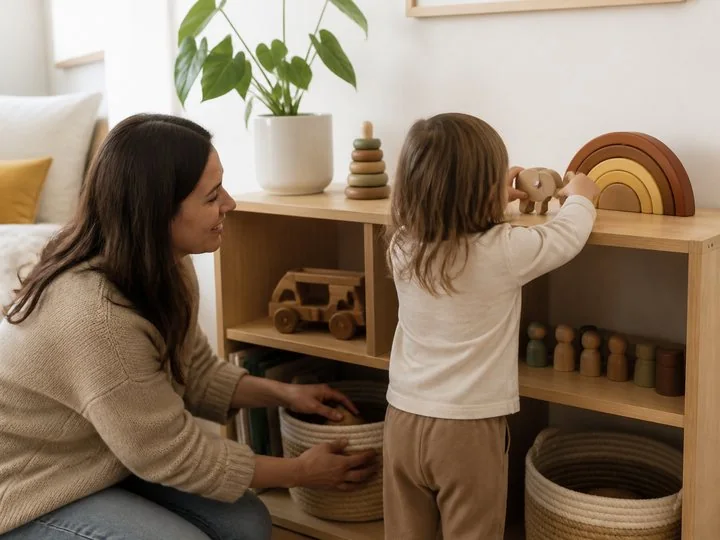
You do not need a Montessori room or matching wooden shelves. Define one safe play zone and remove avoidable adult-only steps.
- Put a small selection within reach rather than stacking several heavy boxes.
- Keep systems together: track with trains, dolls with a few usable clothes, play dough with one or two tools.
- Use broad cleanup categories instead of intricate sorting.
- Protect ongoing work on a tray, board, or agreed corner when possible.
- Place activities requiring supervision out of reach and bring them down intentionally.
For toddlers who still mouth objects, mixed-age homes, or children who climb, safe access matters more than aesthetic access. Small parts and button batteries need secure separation, not a pretty low basket.
Realistic approaches by stage
These are starting approaches, not performance standards.
| Stage | Helpful setup | Adult role | A realistic first sign of progress |
|---|---|---|---|
| Young toddler | One familiar action beside the adult | Stay close, narrate lightly, prevent hazards | Repeats an action while the adult stops joining in |
| Older toddler | Two visible choices in a defined area | Begin together, move a short distance away | Continues through one brief adult task |
| Preschooler | Familiar materials plus a simple invitation | Help name a plan, then check back | Returns to the idea after a small problem |
| Early school age | Longer projects and protected storage | Help with resources, timing, and safety | Plans, pauses, and resumes with less prompting |
Some children prefer company while playing for years. Some move between intense solo focus and frequent bids for interaction. Development is uneven, and a hard week does not erase a skill.
Common situations
“My child only plays if I sit on the floor”
Change one variable at a time. Sit beside the play without participating for a few minutes. Next time, sit in a chair. Later, do a small task within sight. A sudden jump from full participation to another room may be too large.
“My child asks me to play every two minutes”
Make the boundary concrete and short: “I will finish loading these plates, then I will come see the garage.” A visual timer can help some children, but only if it reduces uncertainty rather than becoming a demand to endure distress.
“The toys are immediately dumped”
Dumping may be the play, especially for toddlers. If it prevents other play, offer fewer containers, choose one large-piece set, or put the activity on a mat that shows its boundary. Do not expect complex sorting at cleanup.
“My child gets angry when something is hard”
Regulate before teaching. Name the difficulty, offer closeness, and simplify the next action. Persistence grows from challenges that remain emotionally and physically manageable—not from being left with escalating frustration.
“Siblings interrupt each other”
Create protected space rather than expecting perfect sharing. One child might build on a tray at the table while a younger sibling has large blocks below. Shared pretend-play ideas can be available too, but children do not need to collaborate in every session.
When independent play advice needs adapting
Children with motor, sensory, communication, attention, or developmental differences may need visual choices, adapted tools, help entering an activity, movement before seated play, or an adult nearby for regulation. These supports do not make the play less independent. Independence is having meaningful agency with the access support a person needs.
If a child loses play, language, motor, or social skills they previously used, or you have broader developmental concerns, bring the pattern to the child’s health professional. A content article cannot assess an individual child.
What not to measure
Avoid treating independent-play minutes as a developmental score. Online schedules often present precise targets without a primary source. Duration also hides the quality of the experience: ten absorbed minutes may be more meaningful than forty minutes spent repeatedly seeking reassurance.
Instead, notice whether the child is beginning more easily, making choices, trying another strategy, tolerating a small pause in adult attention, or asking for the specific help they need.
Frequently asked questions
How long should a toddler play independently?
There is no evidence-based duration every toddler should meet. Begin with the amount the child can manage without escalating distress, even if it is very brief, and build a predictable rhythm over time.
Is it okay if my toddler does not play alone?
Yes. Toddlers vary widely, and many prefer proximity. You can practice small moments of child-led play while remaining nearby. Persistent concerns should be considered in the context of the child’s whole development, not a single play metric.
Should I ignore my child so they learn to play?
No. Independent play does not require ignoring bids for connection. Respond, clarify what is needed, and use a dependable return rather than making attention unpredictable.
Are open-ended toys necessary for independent play?
No. Blocks, figures, and art materials can support flexible ideas, but familiar puzzles, books, vehicles, or sorting materials may hold attention too. Fit and familiarity matter more than the label.
Does screen time count as independent play?
Watching a screen can occupy a child independently, but it does not offer the same physical manipulation, self-generated story, or open problem-solving as active play. Families can make separate decisions about media without using it as the benchmark for play skill.
What if independent play only happens when I buy something new?
Try changing the invitation before buying more: pair two familiar sets, move materials to a different surface, preserve an unfinished project, or rest cluttered options. A calmer toy rotation may make old materials easier to see.
Sources and evidence notes
- American Academy of Pediatrics, The Power of Play: A Pediatric Role in Enhancing Development in Young Children.
- National Institutes of Health / PMC, Partners in Play, a randomized trial of an autonomy-supportive parenting intervention.
- CDC, positive parenting guidance for toddlers.
- HealthyChildren.org, guidance on growing independence and active play.
These sources support responsive, child-led play and autonomy-supportive interaction. They do not establish a required number of independent-play minutes by age.