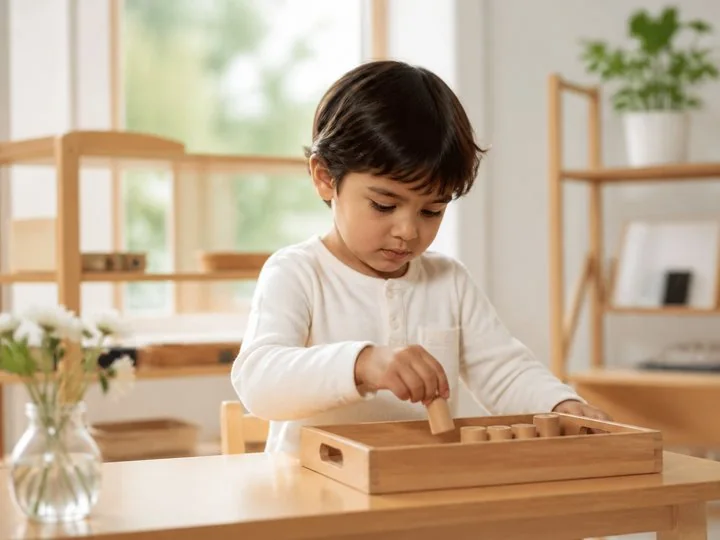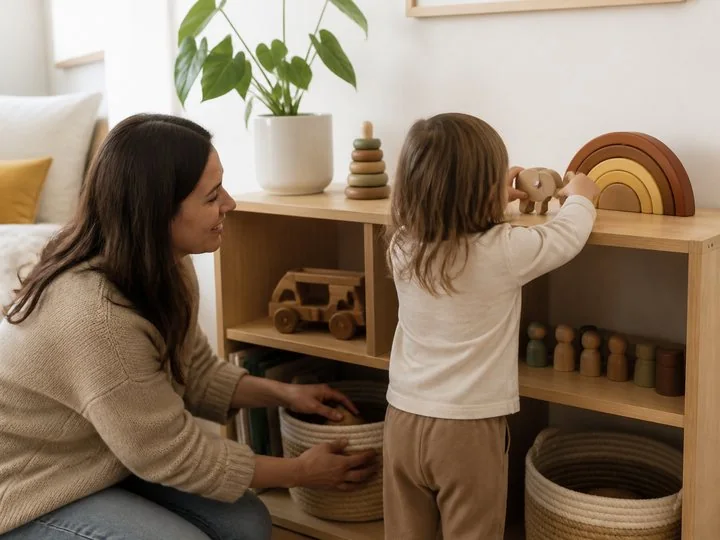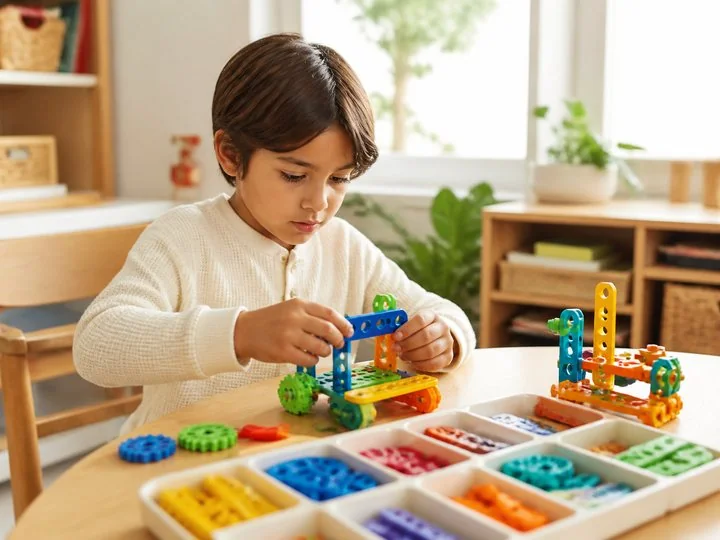
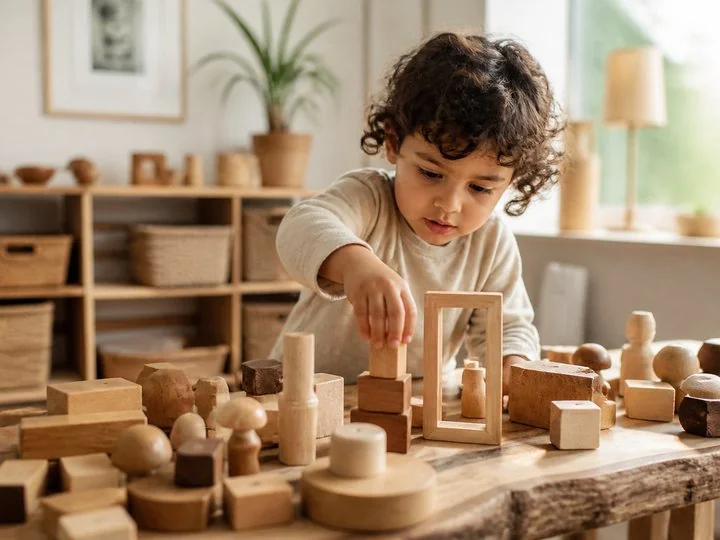
An open-ended toy does not prescribe one finished result. A block can become a wall, phone, bridge, cake, or part of a machine. Fabric can be a roof, river, cape, or wrapping. The child supplies much of the plan.
That flexibility is useful, but the category is often oversold. No toy automatically creates creativity, and a toy with a clear goal is not developmentally inferior. Children benefit from inventing possibilities and from mastering rules, sequences, and precise challenges.
Quick answer
Open-ended toys are materials children can combine and use in multiple ways: blocks, construction pieces, figures, dolls, play fabric, clay, cardboard, and basic art supplies. They can provide opportunities for planning, storytelling, spatial problem-solving, and experimentation because the child chooses the goal.
Research supports play as an important context for learning and relationships. Reviews of block and loose-parts play report promising associations with problem-solving and creative behavior, but they do not show that buying a particular product causes a child to become more creative. Adult interaction, time, space, culture, prior experience, and the child’s interests all shape what happens.
Open-ended and closed-ended are not opposites in value
The distinction describes the structure of an activity, not its quality.
| Material | Structure | What it can offer | Possible limitation |
|---|---|---|---|
| Unit blocks | Many outcomes | Building, balance, representation, stories | Needs space and enough compatible pieces |
| Figures and animals | Many stories | Language, perspective, world-building | Tiny accessories create safety and cleanup issues |
| Clay or dough | Transformable | Sensory feedback, tool use, representation | Needs supervision for mouthing and sensitivities |
| Jigsaw puzzle | One intended solution | Visual matching, persistence, clear feedback | Limited variation after mastery |
| Board game | Shared rules and goal | Turn-taking, strategy, social structure | Can frustrate children not ready for the rules |
| Cause-and-effect toy | Specific action and response | Repetition, prediction, accessible early play | May leave fewer decisions to the child |
A child may complete a puzzle and then use its pieces as pretend cookies. A construction kit may be goal-based while following instructions, then open-ended when it is rebuilt. “Open” is partly a feature of the material and partly a feature of how it is offered.
What research can—and cannot—say
The American Academy of Pediatrics describes play as supporting relationships, language, executive functioning, and self-regulation. Its toy guidance favors hands-on, child-driven materials over products that perform most of the activity for the child.
Research specifically isolating open-ended toys is less definitive. Reviews of loose-parts play find promising outcomes across physical, social, and cognitive domains, but studies vary in quality, definitions, settings, and measures. Many cannot show that the materials alone caused a later skill.
Studies of block play and guided play suggest spatial language, shared problem-solving, and well-timed adult prompts can matter. That is different from claiming blocks raise intelligence. Flexible materials create opportunities to plan, combine, represent, revise, and talk; the whole setting determines how rich those opportunities become.
What makes a flexible toy usable?
An obvious first action
“Be creative” is an intimidating instruction. Stacking two blocks, placing an animal in a box, or making one clay ball gives a child somewhere to begin.
Compatible pieces
Twenty blocks that work together usually offer more combinations than twenty unrelated trinkets. Materials can also cross categories: blocks plus vehicles, figures plus fabric, or cardboard plus tape.
Challenge that can grow
A toddler carries and stacks. A preschooler builds an enclosure. An older child plans a bridge or creates rules for a game. Longevity comes from changing use, not only durable material.
Physical and sensory access
Grip, weight, visual contrast, sound, texture, and connector strength affect who can use a toy. Larger pieces, a nonslip surface, adapted handles, or an adult stabilizing a base may create more agency than choosing the “most open-ended” product.
Fit with space and cleanup
A vast loose-parts collection can shut play down if pieces are impossible to find or reset. Start with one coherent set and a few companions. Our toy rotation guide offers a low-pressure way to reduce immediate clutter.
Examples by age and play need
Age labels are rough planning guides. Follow manufacturer warnings and the child’s actual mouthing, motor, and play patterns.
| Stage | Useful materials | A simple invitation | Watch for |
|---|---|---|---|
| Babies who grasp and mouth | Large nesting cups, soft blocks, infant-safe scarves | Hide and reveal one object | Choking, strangulation, unsuitable fabric |
| Toddlers | Large blocks, chunky figures, boxes, washable crayons | Build a bed for an animal | Small parts, climbing, mouthing materials |
| Preschoolers | Construction sets, dolls, fabric, tape, clay, collage | Make a place where something can happen | Tool safety and younger siblings |
| Early school age | Advanced building, recycled making, simple circuits with supervision | Design, test, change, explain | Sharp tools, batteries, magnets, storage |
For more structured investigation, home STEAM activities can add a problem without dictating a single answer.
Help without taking over
- Observe before suggesting. The child may already have a plan.
- Describe instead of evaluating. “You used three wide blocks at the bottom” carries more information than “Perfect tower.”
- Ask occasional, real questions. “What keeps moving?” can focus attention; a stream of quiz questions cannot.
- Provide missing resources. Tape, a tray, floor space, or a reference photo may unlock the plan.
- Let revisions belong to the child. A falling structure is information unless safety requires intervention.
The same least-help approach supports independent play: pause, name the obstacle, offer a hint, and model only what is needed.
If your child says “I don’t know what to make”
Avoid presenting the entire collection. Put out one base material and one story element. Make a tiny unfinished beginning—two blocks with a gap, a tube beside a ball—and wonder aloud what could happen. Connect to a familiar interest: dinosaurs need shade; cars need a ferry; dolls need somewhere to sleep.
If the child wants to copy a model, let them. Imitation and instructions can build techniques that later become part of original work. Creativity does not require inventing every action from nothing.
Common buying mistakes
- Buying a huge set before knowing whether the child likes the action.
- Treating wood, natural colors, or a premium price as proof of educational value.
- Choosing tiny loose parts for a child who mouths objects or shares space with a baby.
- Assuming more possible uses always means more engaging play.
- Removing every puzzle, vehicle, character, or electronic toy in pursuit of a pure category.
- Confusing an adult’s preferred aesthetic with the child’s access and interests.
If material and repair claims matter, use our sustainable toy gift framework rather than relying on vague “eco” language.
Frequently asked questions
Are LEGO bricks open-ended toys?
Loose bricks can support many designs. A model kit is more goal-directed while instructions are followed, then can become open-ended when rebuilt or combined. Follow all small-parts age warnings.
Are dolls open-ended toys?
They can be. Dolls and figures support many roles and stories. Familiar media characters may initially invite familiar plots, but children often transform those scripts.
Are open-ended toys better than electronic toys?
Not automatically. Consider what the child controls. A recorder may enable storytelling, while a toy that performs after one button press may leave fewer decisions. Safety, access, interest, and social use matter too.
How many open-ended toys does a child need?
There is no recommended number. A coherent set with enough pieces to combine, plus a few story or making materials, is a stronger start than many small sets.
What if my child uses a toy only one way?
Repetition is not failure. Children consolidate skills and scripts before varying them. Add one compatible element if useful, but do not require novelty to prove the toy is worthwhile.
Do open-ended toys improve creativity?
They can provide opportunities for divergent ideas, revision, and representation. Current evidence does not justify promising that a product will cause a lasting increase in creativity.
Sources and evidence notes
- American Academy of Pediatrics, The Power of Play and toy-selection guidance.
- National Institutes of Health / PMC, systematic review of loose-parts play in early childhood.
- ERIC-indexed research on open-ended materials and creative thinking.
- NAEYC resources on playful, inquiry-based learning.
These sources support play opportunities and responsive interaction; they do not support product-level creativity guarantees.