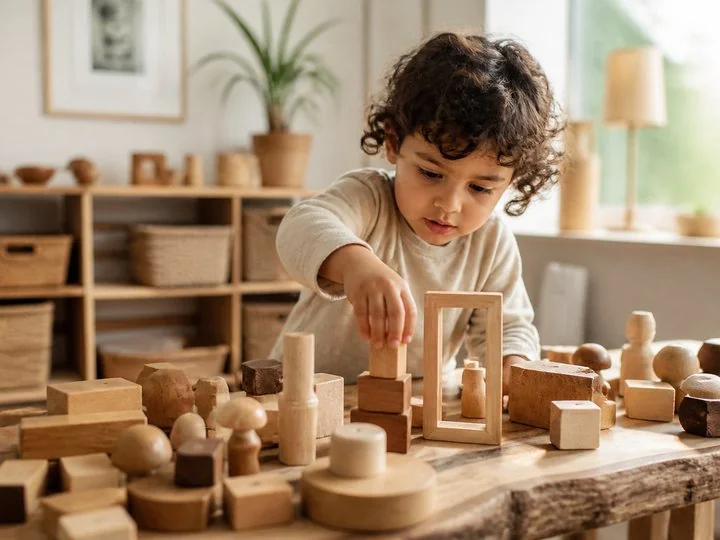
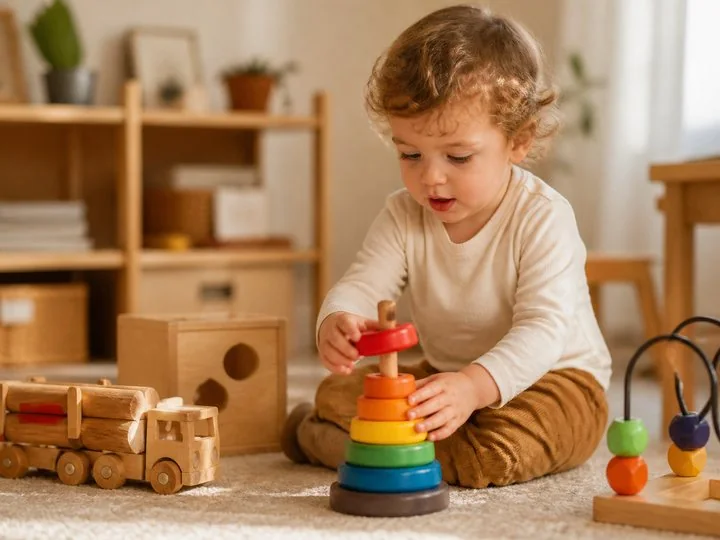
The best wooden toy is not necessarily the prettiest object on the shelf. It is the one a particular toddler can safely grasp, move, repeat, combine, and return to as their play changes.
For this guide, LWT reviewed current manufacturer specifications, age guidance, materials, component counts, care instructions, and available safety information. We then compared how much play each design invites against its storage and cleanup cost. We did not purchase or test these products, so you will not find claims about how they survived drops, how children responded over months, or how the finish feels in hand.
Availability and product details were checked on August 11, 2026. Verify the official product page and current recall information before buying.
Quick picks
- Best first block set: Guidecraft Toddler Unit Blocks, 22-piece set
- Best long-lived building system: Lovevery The Block Set
- Best compact challenge: Hape Creative Peg Puzzle
- Best for push, sort, and pretend play: Melissa & Doug Wooden Shape Sorting Grocery Cart
- Best stationary activity toy: Manhattan Toy Safari Zebra Activity Toy
- Best multi-toy bundle for age two and up: Melissa & Doug Stack, Sort & Pound Collection
Wooden toddler toys compared
| Pick | Official age | Pieces / size | Play style | Storage load | Main trade-off |
|---|---|---|---|---|---|
| Guidecraft Toddler Unit Blocks | 18+ months | 22 chunky blocks | Open-ended building, carrying, balancing | Medium | Purposefully bulky and heavy compared with small tabletop blocks |
| Lovevery The Block Set | 12+ months | 70 pieces; sorter/storage box | Building, ramps, wheels, sorting, pretend play | High | Many pieces and premium positioning; more system than some families need |
| Hape Creative Peg Puzzle | 18+ months | 16 pieces; 7.8 × 4.6 × 7.8 in. listed | Matching, posting, fine-motor repetition | Low | More defined and less transformable than a block set |
| Melissa & Doug Shape Sorting Grocery Cart | 1+ years | 16-piece set; cart plus boards and shapes | Pushing, sorting, puzzles, pretend errands | High floor footprint | Large object; different modes may not all match the same stage |
| Manhattan Toy Safari Zebra | 1–3 years | 11.5 × 5.8 × 13 in. | Spinners, bead tracks, sliding knobs | Medium | Fixed activities offer less reinterpretation over time |
| Melissa & Doug Stack, Sort & Pound Collection | 2–4 years | 100 blocks + 14-piece sorter + 10-piece bench | Building, sorting, pounding | Very high | 124 listed components and three toys create significant reset work |
How we chose the picks
We looked for products that meet a clear play need and whose important facts can be checked on an official page. Selection favored:
- a manufacturer-stated age range that includes toddlers;
- enough specification detail to understand components, materials, dimensions, or care;
- active use rather than passive lights or recorded prompts;
- either flexible play or a well-defined repeatable challenge;
- a realistic reason to choose the product over a simpler household alternative; and
- an honest balance between versatility and the space, pieces, and adult support required.
We did not treat “Montessori,” “educational,” “natural,” or “non-toxic” as proof of quality. Those terms can describe an intention or claim; they do not tell you whether a toy suits your child, whether every material is wood, or whether the design will earn its space.
Best first block set: Guidecraft Toddler Unit Blocks
Best for: toddlers from 18 months who like lifting, carrying, stacking, knocking down, and building on the floor.
Guidecraft’s official listing describes Toddler Unit Blocks as a 22-piece wooden set for ages 18 months and up. The pieces maintain standard unit-block size ratios but are larger and easier for toddlers to grasp than traditional classroom blocks.
Why LWT included it
This is the clearest “do less, better” pick. Every piece belongs to one compatible building language. The set can begin with carrying and two-block stacks, then support enclosures, roads, patterns, and pretend structures. Twenty-two pieces provide real building range without the cleanup load of a 70- or 100-piece collection.
Because the blocks have proportional dimensions, children can notice that two smaller units match a longer one or that the same shapes balance in predictable ways. That creates opportunities to explore size and structure; it is not a promise that the toy will produce a measurable STEM outcome.
Trade-offs
The chunky weight is part of the design and also its main limitation. These are floor blocks, not a light travel set. A toddler who throws hard objects needs close guidance and an appropriate play area. The set does not include wheels, figures, a shape sorter, or a storage cart, so families wanting a self-contained activity may prefer another pick.
Best long-lived building system: Lovevery The Block Set
Best for: a family that wants one broad construction system and has room to store and reset 70 pieces.
Lovevery currently lists The Block Set for 12 months and up. Brand materials describe 70 solid-wood pieces with multiple shapes, wheels, ramps, and a shape-sorting storage box that can also function as a vehicle.
Why LWT included it
The variety gives the set a longer runway than a simple cube collection. A young toddler can fill, dump, roll, and stack; later play can use ramps, vehicles, sorting, patterns, structures, and invented worlds. The storage container is part of the play system rather than a separate purchase.
This is also its clearest advantage over several narrower wooden toys: parts can be recombined instead of leading to one correct result. Families exploring that distinction can read our evidence-aware guide to open-ended toys.
Trade-offs
Seventy pieces are not minimalist in daily use. The set needs a defined home, and returning every shape can become adult work if the full collection is offered before a child is ready. Begin with a subset while preserving compatible pieces, then add more as building expands.
Lovevery’s developmental descriptions are manufacturer claims. LWT has not tested the set and is not concluding that it builds language or problem-solving better than a less expensive compatible block collection.
Best compact challenge: Hape Creative Peg Puzzle
Best for: a toddler from 18 months who enjoys matching, posting, turning, and repeating a visible task.
Hape lists the Creative Peg Puzzle, item E0411, for ages 18 months and up. The official page specifies 16 pieces; wood, water-based paint, and ABS; and a listed product size of 7.8 by 4.6 by 7.8 inches. Care guidance says to clean with a damp cloth, avoid washing, store dry, and keep out of direct sunlight.
Why LWT included it
Not every useful toy must be open-ended. A defined puzzle can be satisfying because a child can see a goal, test orientation, and repeat the action. This product has a smaller footprint and clearer stopping point than a construction system, which may suit a shared living area or a child who prefers predictable tasks.
Trade-offs
The fixed goal gives it less imaginative range than blocks or a push cart. It also combines wood with ABS plastic, a useful reminder that “wooden toy” rarely describes every component. Check the current measurements and contents on the official page for your market; specifications can vary by locale.
Best for push, sort, and pretend play: Melissa & Doug Wooden Shape Sorting Grocery Cart
Best for: a walking toddler who will use a sturdy cart for movement now and pretend errands later.
Melissa & Doug lists the Wooden Shape Sorting Grocery Cart for ages one and up. The 16-piece set includes the wooden cart, a matching-game roller drum, two chunky puzzle boards, 12 shape pieces, and a play cup. The shapes can pass through openings in the cart or fit the two boards, which store in the cart.
Why LWT included it
The product supports several genuinely different actions: pushing, posting, matching, carrying, loading, and eventually pretending to shop or deliver. That gives it more age range than a sorter that only sits on a table. Built-in storage also gives every loose component a visible destination.
Trade-offs
This is furniture-scale compared with the other picks. Measure the play and parking space, not just the shipping box. A child ready to push may not yet care about the puzzles, while a child absorbed in pretend shopping may ignore the shape sorter. “Many modes” is useful only if the family can accommodate the object through those stages.
Push toys are not walking teachers, and no product substitutes for a safe movement environment. Follow the manufacturer’s setup and use instructions and supervise for the child’s balance and climbing behavior.
Best stationary activity toy: Manhattan Toy Safari Zebra
Best for: a one- to three-year-old who enjoys turning, sliding, spinning, and bead-track actions in one stable object.
The official Safari Zebra Activity Toy, item 166530, is listed for ages one to three. Manhattan Toy gives dimensions of 11.5 by 5.8 by 13 inches and describes wood construction with plastic counting beads, mini-abacus tracks, spinners, sliding knobs, and a water-based finish. The page advises surface cleaning and says not to submerge or steam the toy.
Why LWT included it
All activities remain attached, reducing the hunt for separate pieces. The narrow footprint can fit where a walker cart cannot, and several hand actions sit at different heights and angles. That may make it a useful contained choice for a family that does not want another loose-parts system.
Trade-offs
The activities are fixed to the zebra, so the product offers less transformation and story-building than blocks, vehicles, or figures. It also contains plastic components despite the wooden category. Inspect bead tracks, springy parts, knobs, and finish regularly; retire the toy if any component loosens or breaks.
Best multi-toy bundle: Melissa & Doug Stack, Sort & Pound Collection
Best for: a child age two or older when a family wants three classic activity types and can manage a very large piece count.
Melissa & Doug’s Stack, Sort & Pound Collection, item 93685, contains a 100-piece block set, a 14-piece shape-sorting cube, and a 10-piece pounding bench. The official listing places it at ages two to four and gives a product/package listing of 23 by 15.25 by 6.5 inches. One crawl state showed the bundle out of stock, so availability must be checked directly.
Why LWT included it
The bundle makes the trade-off between variety and manageability visible. It covers open construction, matching, and forceful repeated action without electronics. For siblings or a home that can store each toy separately, it may replace several purchases.
Trade-offs
The listed components total 124 across three toys. Putting everything out at once would be a poor fit for many two-year-olds and a substantial cleanup task for adults. The mallet and smaller shapes also make exact age fit and younger-sibling access important. If only one activity is needed, buying one well-matched toy is more efficient than acquiring the bundle because it looks comprehensive.
Which wooden toy fits each toddler stage?
Development is uneven, so use behavior alongside the manufacturer’s minimum age.
| Stage | Common play actions | Better-fit features | Be cautious with |
|---|---|---|---|
| Around 12–18 months | Carrying, filling, dumping, pushing, banging, first stacks | Large pieces, stable push objects, simple containers, attached activities | Loose small parts, hard projectiles, unstable walkers, too many components |
| Around 18–24 months | Repeating posting, short puzzles, taller stacks, transporting | Chunky blocks, visible matching, two-handed actions, simple pretend props | Frustrating precision tasks and mixed-age small pieces |
| Around 2–3 years | Combining systems, building short stories, sorting by an idea, revising structures | Compatible blocks, vehicles, figures, functional pretend tools | Highly scripted products with one short novelty action |
A child may use an object in an earlier way for months. That is not a reason to “teach the correct use” if the actual use is safe. Repetition and reinterpretation are part of the value.
Is wood better than plastic?
Not by itself. A durable plastic vehicle used for years may be a more responsible and valuable choice than a wooden puzzle that is ignored after a week. A wooden toy can include composite board, adhesives, metal fasteners, plastic parts, or a finish that changes how it should be cleaned.
Ask more specific questions:
- Does the manufacturer identify materials and an appropriate age?
- Is the toy easy to inspect for damage?
- Can parts be replaced, contained, or used with toys already owned?
- Does the play range justify the piece count and footprint?
- Will the child use the action now without constant adult demonstration?
- Can the surface be cleaned without damaging it?
- Is a precise environmental claim supported, rather than implied by a natural color palette?
Our sustainable toy gift guide explains why durability, compatibility, secondhand use, and verifiable claims matter more than an “eco” label.
Safety and care checklist
In the United States, children’s toys must meet applicable federal requirements, including third-party testing and certification obligations for toys intended for children 12 and under. Products intended for children under three must not contain or release regulated small parts under applicable testing. That regulatory baseline does not eliminate the need to choose for the individual child.
Before purchase and during use:
- Confirm the exact product, item number, and manufacturer age guidance.
- Search the CPSC recall database in the U.S. or the relevant regulator where you live.
- Inspect edges, corners, joints, wheels, cords, pegs, magnets, and attached components.
- Look for cracks, splinters, swelling, loose hardware, peeling finish, or pieces that have broken smaller.
- Follow the maker’s care directions. Do not soak a toy that is meant to be damp-wiped.
- Separate older-child pieces from babies and toddlers. Supervision is not a reliable storage system.
- Remove damaged toys until the manufacturer confirms a safe repair or replacement.
For a toddler who mouths objects, a few large, intact materials may be more suitable than any high-piece-count set. See our safe sensory play guide for a fuller mouthing and sibling-access screen.
Frequently asked questions
What is the best first wooden toy for a one-year-old?
A large-piece block subset, a stable posting toy, or an age-labeled push-and-sort object can all fit. Choose based on what the child currently does and the available space. From this list, Lovevery’s Block Set and Melissa & Doug’s Grocery Cart begin at 12 months according to their manufacturers, but their size and complexity are very different.
Are painted wooden toys safe for toddlers?
Paint is not automatically unsafe, and bare wood is not automatically safe. Buy age-appropriate products from identifiable manufacturers, review the stated materials and compliance information, inspect finishes for damage, and follow recalls. Stop using a toy if coating peels or wood cracks.
How many blocks does a toddler need?
Enough to repeat current actions with room to grow, but not necessarily the full box at once. A 22-piece chunky set can support substantial floor building. A 70- or 100-piece system offers more variety but also more storage and cleanup. Start with a manageable subset and add compatible pieces.
Are Montessori wooden toys better?
“Montessori” is not a regulated quality grade. A simple, accessible, self-correcting activity can align with Montessori principles, but the label does not verify safety, sustainability, or developmental benefit. Evaluate the actual product.
Can wooden toys be disinfected?
Follow the manufacturer’s instructions. Several official pages reviewed here specify damp-cloth cleaning and warn against washing, submerging, steaming, or prolonged moisture. A toy that must withstand frequent clinical-grade disinfection may need a different material.
Should I buy a block set or a shape sorter?
Choose blocks for flexible, expanding play and a sorter for a compact, repeatable matching challenge. Some children enjoy both, but a useful collection does not need every category at once. A toy rotation can also reveal whether a new category fills a real gap.
Sources and specification notes
- U.S. Consumer Product Safety Commission, Toy Safety and Buying Toys for Children Ages 0–5, accessed August 11, 2026.
- American Academy of Pediatrics, “Selecting Appropriate Toys for Young Children in the Digital Era” (2019).
- Official product pages for Guidecraft Toddler Unit Blocks, Lovevery The Block Set, Hape Creative Peg Puzzle, Melissa & Doug Wooden Shape Sorting Grocery Cart, Manhattan Toy Safari Zebra, and Melissa & Doug Stack, Sort & Pound Collection, accessed August 11, 2026.
LWT did not conduct hands-on testing for this guide. Product details can change; confirm the current official listing, instructions, warnings, and recall status before purchase. The complete source record is in research/best-wooden-toys-for-toddlers.md.