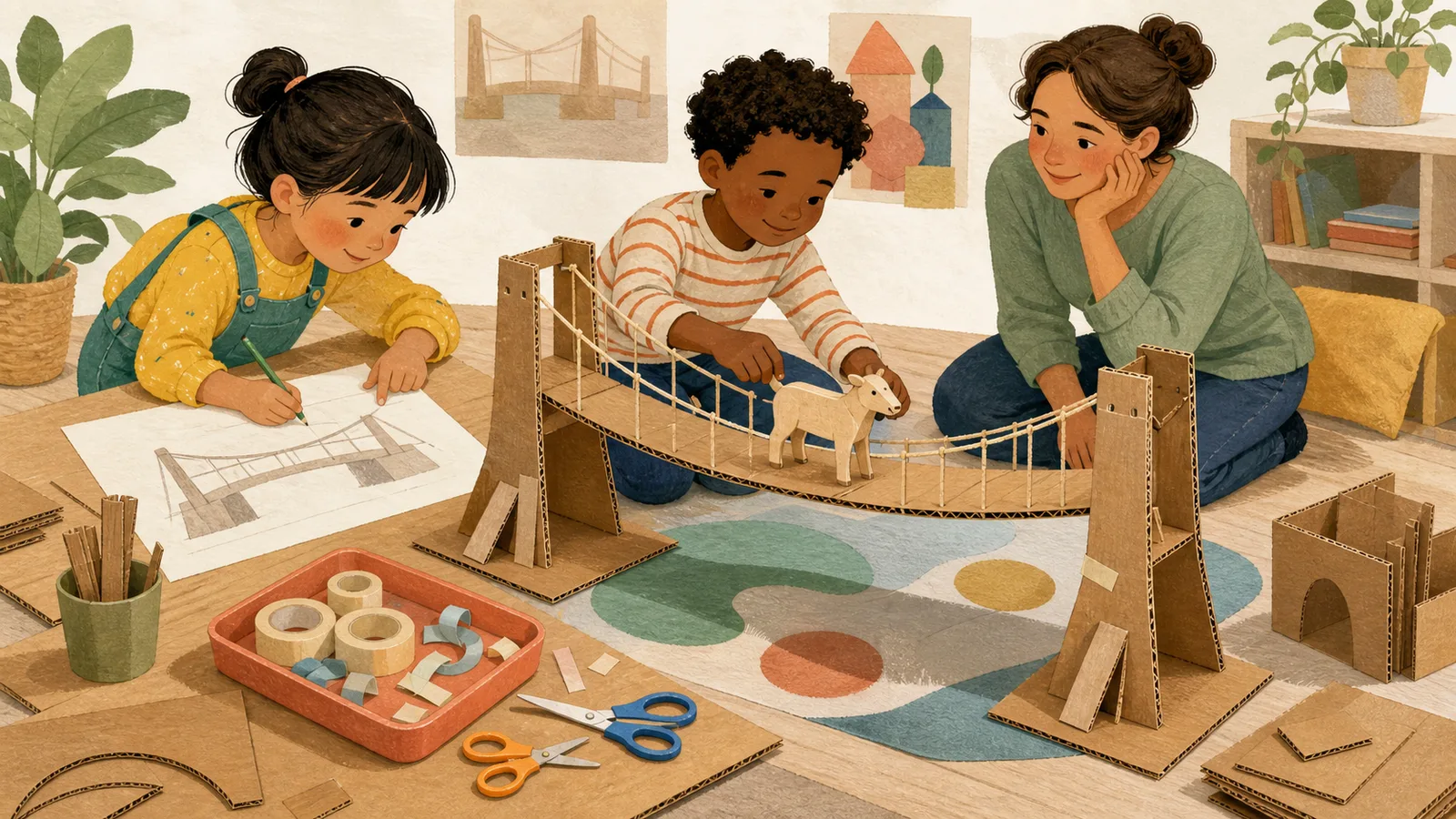
A cardboard engineering challenge needs more than a box and a craft sample. Give children a problem they can understand, a limited set of materials, and a test that reveals something about the design. The first version is allowed to fail; revision is part of the activity.
Prepare the material station
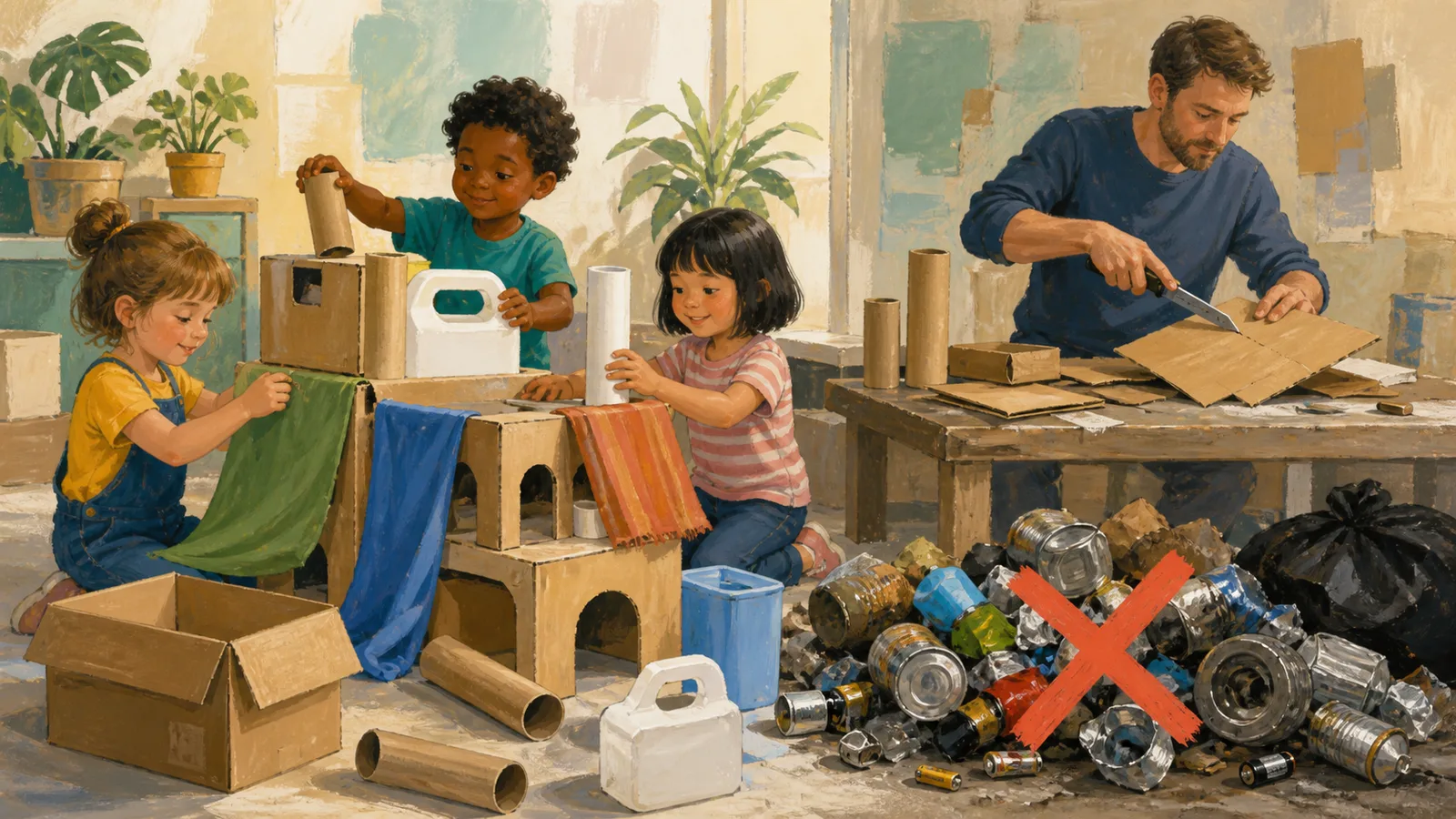
Use clean, dry corrugated cardboard without food residue, strong fragrance, oil, mold, staples, plastic windows, loose labels, or sharp crushed edges. Adults remove hazardous fasteners and make cuts requiring a box cutter.
Offer:
- flat cardboard pieces in several sizes;
- two small boxes or tubes if clean and sturdy;
- short pre-torn pieces of paper or masking tape;
- crayons and paper for optional sketching;
- a ruler or string for comparison;
- child scissors only when the child can use them safely; and
- one modest test object, such as a wooden animal or small paperback.
Avoid hot glue, staple guns, long cords, sharp skewers, and a pile of unknown packaging. Reuse is not automatically safe.
The design loop
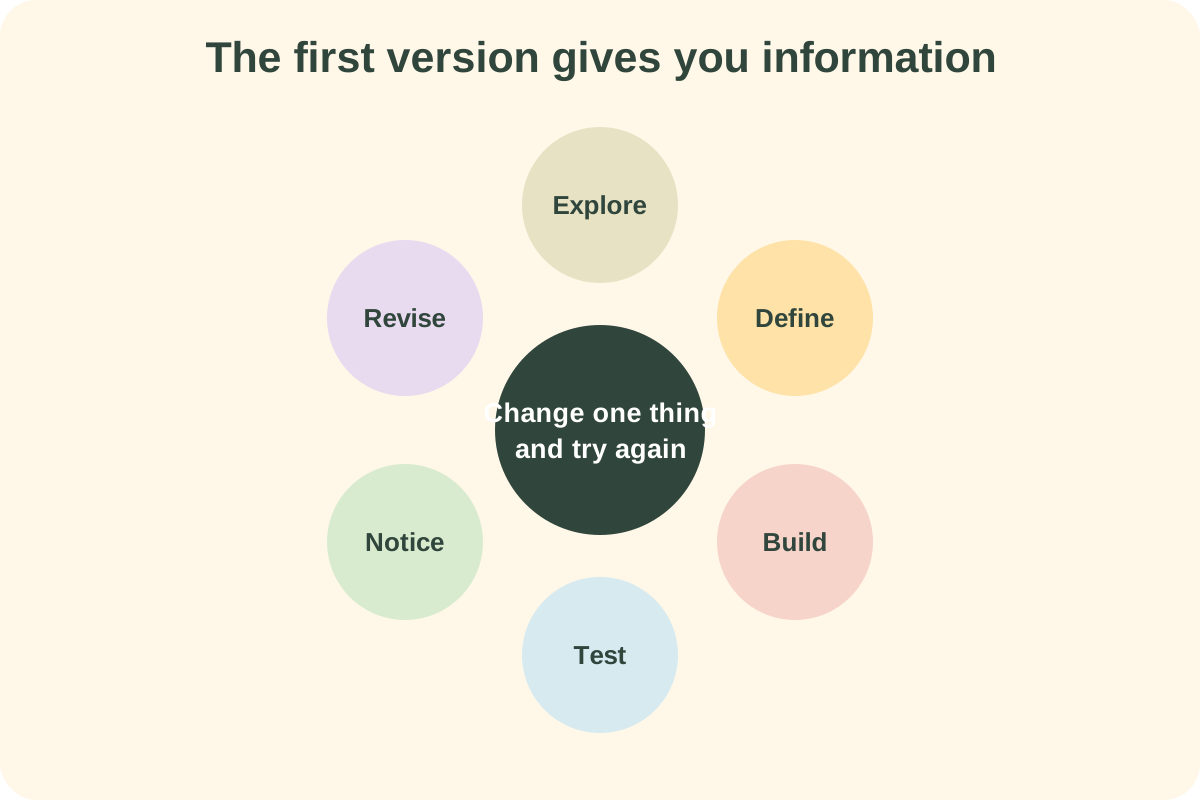
- Explore: bend, roll, fold, tear, slot, and tape scraps.
- Define: who needs what, and what must the design do?
- Build: choose one idea and make a workable first version.
- Test: use the agreed load, distance, height, or motion.
- Notice: identify the exact place that bent, slipped, tipped, or worked.
- Revise: change one feature and test again.
NAEYC describes a similar think–build–try–revise process and recommends tinkering before the formal challenge. A drawing can help, but it should not become an entry requirement for a child who thinks through materials.
Challenge 1: A bridge across a gap
Problem: A toy animal needs to cross between two boxes without touching the floor.
Start with: two supports, cardboard strips, and tape.
Test: Can the animal cross? Does the deck sag or slide?
Make it easier: Shorten the gap and use a folded strip.
Make it harder: Span a measured distance or hold two animals.
Invite children to compare a flat strip, a strip folded into a channel, and two narrow beams. Ask what changed rather than declaring the triangle “strongest” before testing.
Challenge 2: A freestanding tower
Problem: Build above the height of a chosen book without taping the tower to the floor or wall.
Test: Does it stand for ten calm seconds? Can it withstand a light fan made by waving a sheet of paper from a set distance?
Make it easier: Use boxes as units.
Make it harder: Limit the base width or number of pieces.
Keep towers below a safe height, away from faces, pets, and breakables. Large structures use lightweight cardboard, not heavy objects placed overhead.
Challenge 3: A ramp with a landing zone
Problem: Make a large ball or age-suitable vehicle stop inside a marked paper landing zone.
Test: Release from the same start line three times. Does it stop before, inside, or beyond the zone?
Revise: Change one variable—height, surface, side rail, or landing distance.
This is an opportunity to compare, not a physics lecture. “It went farther after the ramp got steeper” is enough.
Challenge 4: A shelter with constraints
Problem: Create a shelter that fits one toy and has an entrance the toy can use.
Test: Does the toy fit, enter, and remain covered from above?
Make it harder: Use no tape, add a removable roof, or make two entrances.
Do not prescribe “a house.” A tube, lean-to, arch, folded shell, or nested box can solve the problem.
Challenge 5: A package protector
Problem: Protect a fragile stand-in—a chalk piece or loosely stacked blocks—from a short, adult-controlled slide down a ramp. Do not use eggs, glass, or messy food.
Test: Does the stand-in remain intact or stacked?
Revise: Add folds, spacing, or crumpled paper as cushioning. Discuss which part absorbs motion without claiming a perfect real-world safety package.
Challenge 6: A playable cardboard game
Problem: Design a game in which a large ball reaches a target by rolling, bouncing, or being guided.
Constraints: The player releases rather than throws; the target is broad; rules fit in one spoken sentence.
Test: Can another person understand how to play without the designer moving every part for them?
This challenge adds a user. Revision may address clarity and fairness, not only structure.
Adult jobs and child jobs
| Adult keeps | Child may use when ready | Everyone can do |
|---|---|---|
| Box cutter, hot glue, staple removal, difficult punctures | Child scissors, short tape, ruler, hole punch designed for paper | Fold, hold, draw, test, compare, describe, revise |
Age does not guarantee tool control. Demonstrate one tool, set a work zone, and stay close enough to intervene. If the adult must complete every joint, change the connector: slots, folded tabs, short tape loops, or clothespins may restore child control.
What to say when it fails
Avoid “It didn’t work.” Name the local event:
- “The deck bent in the middle.”
- “The tower leaned where these seams met.”
- “The ramp moved before the car reached the bottom.”
- “The roof covered the animal, but the entrance is too narrow.”
Then ask, “Which part do you want to change?” The child may also choose to stop. Persistence is not demonstrated by forcing a tired child through endless revisions.
Our building challenges by age offers other constraint types, and STEAM at home explains why a useful question matters more than decorating an activity with a science label.
Small-space cleanup
Define a project footprint before building: one tray, one floor mat, or one side of a table. Save only what fits there. Photograph a large design if the child wants a record, then flatten usable pieces and recycle or discard contaminated cardboard according to local rules.
Store flat sheets behind a shelf and connectors in one closed box. Do not accumulate every package “for a project”; keep only clean shapes that solve known building needs.
Frequently asked questions
Is cardboard really an engineering material?
Yes for an age-appropriate design challenge. It has grain, layers, stiffness, flexible joints, and several ways to strengthen or fail. The activity models parts of a design process; it does not simulate professional engineering standards.
Should children sketch first?
Offer the option. Some children plan through drawing; others need to manipulate scraps before an idea becomes visible. A quick verbal plan also counts.
Can a five-year-old use a box cutter?
Keep box cutters as an adult tool. Child-safe cutting tools and scissors still require demonstrated control and close supervision.
How much help is too much?
Help with a tool boundary, hold a difficult joint if asked, or restate the problem. If you choose the design, make every cut, and troubleshoot every failure, the child is watching your project.
Is recycled cardboard always sustainable?
Reuse can extend a material’s life, but collecting excess, adding non-recyclable tape and paint, or using contaminated packaging complicates disposal. Use a modest amount and plan the end of the project.
Sources and research note
Screen packaging with the recycled-material maker guide and use the broader inquiry loop in STEAM activities at home.
The design sequence and emphasis on iteration draw from NAEYC’s Build It activities, cardboard challenge, block engineering discussion, and inclusive engineering-design guidance. PBS Kids resources provide family-setting context for child-led box design. These sources support a design process, not a claim that one activity causes future STEM achievement.