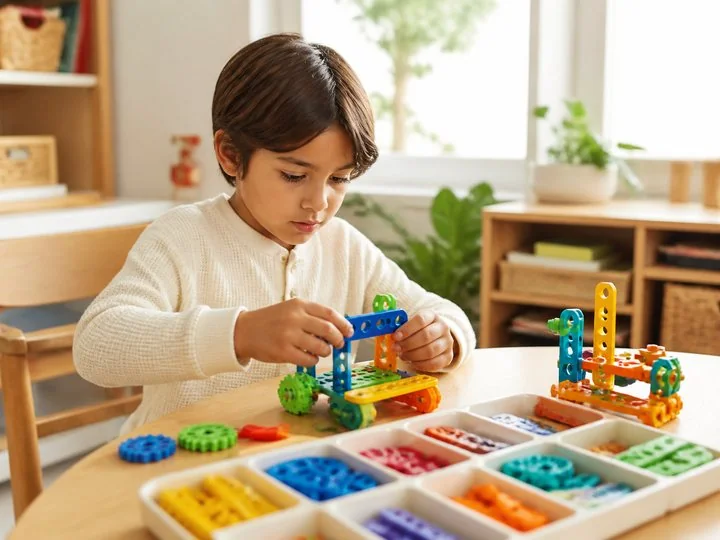
Good home STEAM does not require a subscription box, a perfect result, or a miniature classroom. It begins when a child wonders why something rolls, balances, floats, changes, sounds different, or could work better—and gets a chance to test an idea.
STEAM stands for science, technology, engineering, arts, and mathematics. Every activity does not need to force all five into one afternoon. A ramp can offer engineering and measurement; shadow tracing can connect observation, geometry, and drawing.
Quick start: a six-part inquiry cycle
- Wonder: Name a real question.
- Predict: What might happen, and why?
- Make or test: Change one thing when possible.
- Notice: Look, listen, feel, count, or measure.
- Change: Revise the design or test another condition.
- Explain: Draw, demonstrate, photograph, or tell what happened.
NAEYC guidance emphasizes questions that help children observe and reason. The aim is not to make them guess the answer in the adult’s head. “What changed when the ramp got higher?” is stronger than “Did the car go faster?”
Choose an activity
| Activity | Main idea | Prep | Starting stage |
|---|---|---|---|
| Cardboard ramp lab | Slope, motion, fair tests | Low | Preschool+ |
| Paper bridge | Structure, load, revision | Low | Preschool+ |
| Foil boat | Buoyancy, capacity, design | Low | Preschool+ |
| Shadow tracker | Light, position, time | Low | Preschool+ |
| Sound detective | Vibration, material | Low | Toddler with adult+ |
| Ice rescue | State change, heat transfer | Low | Preschool+ |
| Seed window | Growth, measurement | Medium | Preschool+ |
| Sink or float | Prediction, properties | Low | Preschool+ |
| Balance sculpture | Shape, stability | Low | Preschool+ |
| Paper spinner | Air resistance, variables | Low | School age; adult cuts for younger children |
| Pattern walk | Classification, representation | None | Preschool+ |
| Package redesign | Engineering, user needs | Medium | School age |
1. Cardboard ramp lab
Lean cardboard against books and roll the same car or ball from the same line. Raise the ramp, lower it, or change the surface with a towel and foil. Ask what should remain the same for a fair comparison. Preschoolers can place tape markers; older children can measure and make a table.
2. Paper bridge challenge
Span two books with one sheet of paper. Test how many identical objects it holds. Fold, roll, or layer the paper and test again. A flat sheet failing is not the end—it provides information about shape and stiffness.
3. Foil boat challenge
Give each child the same-sized piece of foil. Shape a boat, float it in a shallow basin, and add identical counters one at a time. Compare a narrow form with a wide base.
Supervise water continuously and empty it afterward. Small counters are inappropriate for children who mouth objects; use large blocks or adult-controlled weights.
4. Track a shadow
Place a toy outdoors and mark the end of its shadow with chalk at two times. Notice length and direction. Indoors, move a flashlight around a stationary figure. Never look at the sun; the investigation is about light and shadow, not staring toward the source.
5. Become a sound detective
Tap safe household objects gently with a wooden spoon: a box, metal pot, plastic container, and folded towel. Sort sounds with the child’s own words—ringy, soft, short, deep.
Keep volume comfortable and never strike close to an ear. AAP guidance warns that loud toys and prolonged high-volume sound can damage hearing; distance and lower volume reduce exposure.
6. Rescue an object from ice
Freeze a large washable object in water. Offer room-temperature water, droppers, salt for older children who will not taste it, and safe tools. Compare which change affects melting. Do not use boiling water or sharp tools.
7. Make a seed window
Place a fast-germinating bean against a clear container with damp paper towel, or plant according to packet directions. Draw or photograph roots and shoots from the same viewpoint over several days.
Seeds can be choking or poisoning hazards, and damp setups can mold. Keep them from children who mouth objects, wash hands, and discard moldy materials.
8. Predict sink or float
Choose water-safe household objects. Predict, test one at a time in shallow water, then sort by result. Avoid announcing a simple visual “rule”: material, trapped air, and shape interact. Supervise continuously and choose objects too large to choke.
9. Build a balance sculpture
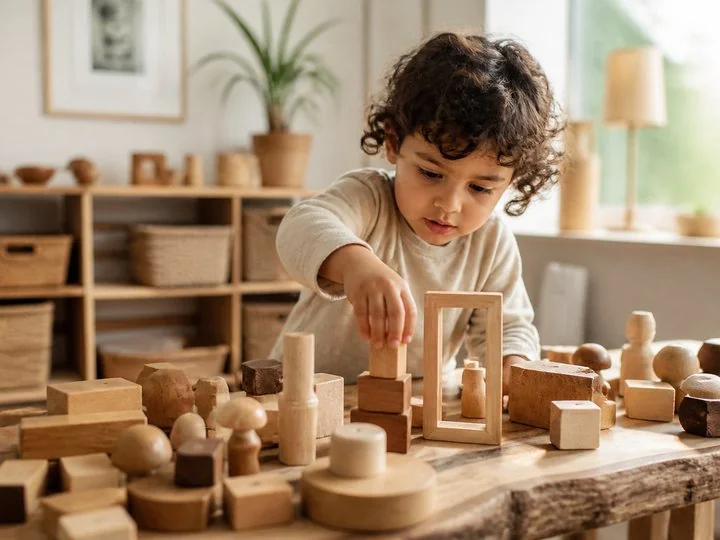
Use blocks, cardboard tubes, cups, or clean containers to build outward and upward. Mark the point just before a structure tips. Ask what could widen or lower the base. This pairs naturally with open-ended materials.
10. Test a paper spinner
Cut identical paper strips, fold blades in opposite directions, and add a paper clip at the bottom. Drop from the same safe height. Change one feature—paper size, clip count, or blade length. Adults should cut when children cannot do so safely; keep clips away from mouthing children.
11. Take a pattern walk
Look for repeating shapes, colors, spacing, or movement in paving, fences, leaves, windows, and signs. Photograph or sketch examples, then recreate one with blocks or marks. Children classify, compare, represent, and explain—not only count.
12. Redesign a package
Choose a clean cardboard package that is awkward to open, store, or reuse. Define the user: a younger sibling, a person with one hand available, or someone needing large labels. Sketch, prototype, test, and revise. Remove staples, sharp edges, plastic film, and food residue first.
Adapt the same challenge by age
| Younger children | Older children |
|---|---|
| Offer two materials and one visible action | Let them define criteria and constraints |
| Compare more/less, near/far, held/fell | Measure, graph, or calculate averages |
| Record with a photo or the child’s words | Keep a design notebook |
| Change one condition with adult help | Decide which variables to control |
| Repeat immediately | Explain surprises and plan a new test |
Questions that keep thinking with the child
- What do you notice?
- What makes you think that?
- What should we keep the same?
- What could we change?
- How could we record it?
- What surprised you?
- Who does the design need to work for?
- What would you try next?
Use questions sparingly. A child absorbed in testing does not need a running interview.
Common STEAM traps
The result must match the photo. That turns design into compliance. Define the problem, not the appearance.
The adult fixes every failure. Model safe tool use, but let structures fall and predictions be wrong. Evidence becomes useful when the child can act on it.
Every activity needs a lecture first. Children can observe before hearing vocabulary. Add accurate words when they clarify something encountered.
The activity requires a kit. Kits can provide specialized parts, but household tests support the same inquiry habits. Buy only when the question requires a resource.
A dramatic reaction equals deeper learning. Spectacle is fun; learning depends on prediction, observation, comparison, and revisiting.
Frequently asked questions
What is the difference between STEM and STEAM?
STEAM explicitly includes the arts. Art can mean design, representation, pattern, sound, or communicating an idea—not decorating a finished science task.
What age should STEAM activities start?
There is no formal starting age. Babies and toddlers explore cause and effect, space, texture, and sound. The label matters less than safe, responsive opportunities to notice and act.
Must I explain the science before we begin?
No. Begin with observation and honest uncertainty. Research a question together afterward rather than inventing an explanation.
What if the experiment does not work?
Treat the outcome as data. Check the setup, compare differences, and decide whether to repeat or redesign. A failed prediction can produce more reasoning than a rehearsed success.
Are STEAM kits worth buying?
They can be useful when they provide specialized, reusable parts and clear safety information. A kit is less valuable when it allows one assembly or performs the interesting step for the child.
How do I support a child who avoids mess?
Mess is not required. Try ramps, shadows, paper structures, patterns, or sound comparisons. Our sensory play guide also includes low-pressure alternatives.
Sources and evidence notes
- NAEYC, resources on inquiry, questioning, and playful learning.
- National Institutes of Health / PMC, research on family tinkering, storytelling, and engineering talk.
- Peer-reviewed reviews of early-childhood engineering and STEM learning.
- American Academy of Pediatrics, guidance on play and noise exposure.
These sources support inquiry processes and adult facilitation. The individual household activities have not each been shown to produce a specific developmental outcome.