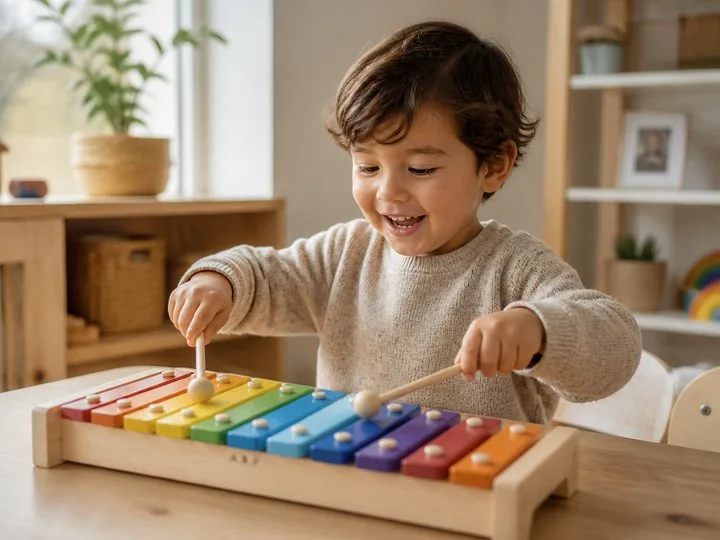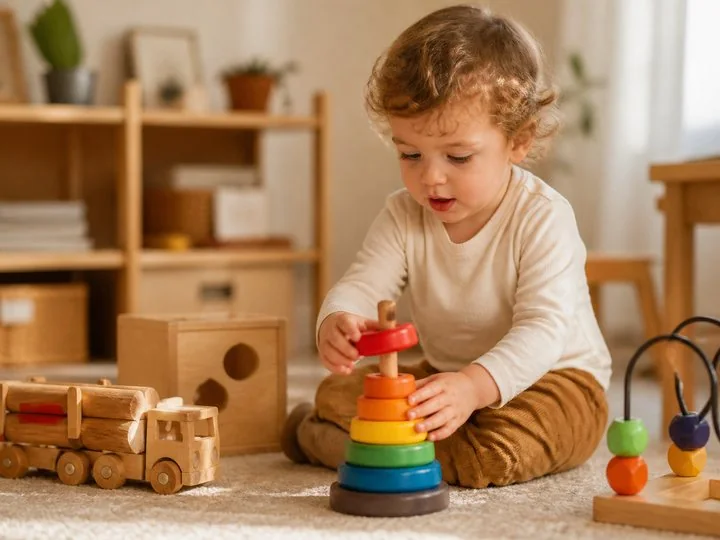
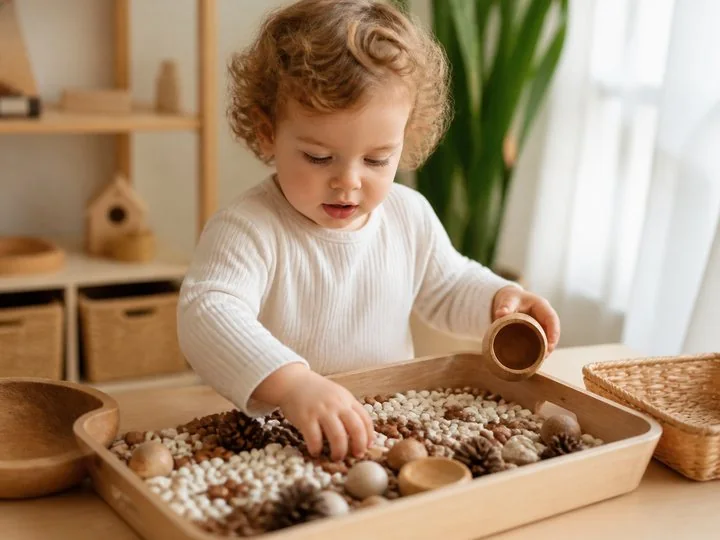
Sensory play does not need rainbow rice, a themed bin, or an hour of setup. A baby turning a cool metal cup, a toddler carrying a cushion, and a child listening for rain are already exploring texture, temperature, weight, movement, sound, and cause and effect.
For children who still mouth objects, move quickly, or share space with an older sibling, simpler is often safer and more usable. Choose one or two large materials, stay close, and let the child decide how much contact feels interesting.
Quick answer
Good sensory play for babies and toddlers starts with an individual safety check, not an attractive filler. Ask whether the child mouths objects, whether every component is large and intact, whether allergies are relevant, whether water requires your undivided attention, and whether another child could bring small pieces into reach.
Then offer a short invitation: two contrasting cloths, cups in a shallow tray of water, a sturdy sound pair, a cushion path, or a walk to notice wind and surfaces. Stop if the material is damaged, enters the mouth, or overwhelms the child.
What counts as sensory play?
Children receive sensory information all day. Play can bring attention to several kinds of input:
- Touch: smooth, rough, wet, dry, warm, cool, soft, or firm surfaces.
- Movement and balance: rocking, crawling, carrying, pushing, turning, or changing height.
- Body position and effort: noticing how much force it takes to lift a cushion, pull a basket, or press dough.
- Sound: locating, comparing, repeating, and changing sounds.
- Sight: following shadows, reflections, colors, motion, and objects that appear and disappear.
- Smell and taste: everyday food experiences, when developmentally appropriate and managed as eating rather than as a guarantee that an activity is safe.
This wider definition matters. A child can have a sensory-rich day through dressing, bathing, eating, walking, carrying groceries, splashing outside, and music play. Families do not need to manufacture a special “sensory diet,” and an ordinary home activity should not be presented as treatment.
Run this safety screen first
Age labels are a starting point. The safer choice depends on what this child does now and who else can enter the space.
| Check | Ask | Safer response |
|---|---|---|
| Mouthing | Does the child lick, bite, chew, or run with materials? | Use a few large, intact, age-labeled objects; avoid loose fillers and anything that can break into small parts |
| Water | Can an adult stay within arm’s reach and give full attention? | Use a small amount in a stable container, remain in touch-supervision range, and empty it immediately after play |
| Allergy and skin | Is there a food, latex, fragrance, plant, or skin-sensitivity concern? | Use known materials, avoid fragranced products, wash shared tools, and follow the child’s medical guidance |
| Mobility | Can the child tip the container, climb, throw, or carry the setup? | Put the activity on the floor or another stable surface and remove hard or heavy projectiles |
| Siblings and pets | Could a younger child or pet reach an older child’s pieces? | Use a separate controlled zone and store all small components securely when the session ends |
| Condition | Are there cracks, loose seams, swelling, mold, peeling finish, or damaged seals? | Remove the item; do not rely on supervision to make a damaged material safe |
The U.S. Consumer Product Safety Commission’s small-parts rules specifically address choking, aspiration, and ingestion hazards for children under three. A household object is not exempt from physics because it was placed in an activity tray.
“Taste-safe” is not the same as safe
Food-based play is often described as safe because a child can eat the material. That label leaves out several questions: Could the piece obstruct the airway? Is the texture hard or sticky? Is there an allergy? Has the food sat at room temperature? Could the child swallow a large quantity? Is it appropriate for the child’s current feeding skills?
Treat food as food. Seat and supervise a child as you normally would for eating, follow individualized feeding guidance, and do not use an edible filler to make divided attention acceptable.
Do not use water beads for children
LWT does not recommend water beads for sensory play. These superabsorbent polymer beads can expand after being swallowed and may cause intestinal blockage; they can also be aspirated or placed into an ear or nose. The CPSC has warned that injuries can be severe and difficult to detect and has urged families and child-care settings to keep water beads away from babies and small children.
A federal water-bead toy standard was approved in 2025. That action does not turn water beads already in homes into a suitable toddler material, nor does “non-toxic” mean harmless if swallowed.
If a child may have swallowed or inserted a water bead, seek immediate professional guidance rather than waiting for symptoms. In the United States, contact Poison Help at 1-800-222-1222 and follow emergency advice; elsewhere, use the local poison center or emergency service.
Also avoid loose dry rice, beans, pasta, beads, pom-poms, marbles, small stones, button batteries, high-powered magnets, and similar small items for a child who mouths materials or where a younger child can gain access. Homemade activities do not undergo the use-and-abuse testing required of age-graded toys.
Sensory play ideas by age and stage
The ranges below are practical starting points, not milestones. Stay with the child and adjust for current ability.
| Stage | Good starting format | Examples | Main caution |
|---|---|---|---|
| Sitting baby | 1–2 large objects presented on the floor | Cloth pair, cool spoon and wooden ring, sealed sound toy | Mouthing, rolling away, damaged seams or finishes |
| Crawling baby | A clear movement destination | Cushion edge, mirror placed securely at floor level, object under a light cloth | Falls, unstable furniture, loose fabric near sleep spaces |
| Young toddler | One simple action with large tools | Cups in water, push basket, large-object wash | Constant supervision, tipping, slippery floor |
| Older toddler | A choice of actions and simple pretend context | Dough and roller if appropriate, nature wash, sound matching | Small parts, allergy, forceful throwing, sibling access |
12 low-prep sensory invitations
1. Two-texture basket
Place two or three large, washable objects with distinct surfaces in a shallow basket: a textured cloth, silicone brush made for the child’s age, smooth wooden ring, or stainless-steel cup. Inspect every item first. Let the child pick up, bang, carry, or ignore it.
Useful language stays descriptive: “That cup feels cool,” or “You rubbed the bumpy side.” There is no need to quiz the child on texture words.
2. Cloth reveal
Partly cover a familiar, appropriately large toy with a lightweight cloth while both are awake and playing on the floor. The child can pull, uncover, cover again, or move on. Keep play cloths out of the sleep space and supervise so fabric does not cover the face.
3. Cushion route
Place one or two firm cushions on a clear floor for crawling over, stepping around, or pushing. Stay close and keep the height low. The interesting input comes from changing pressure and effort, not from building a dramatic obstacle course.
4. Laundry push
Put a few soft items in a stable laundry basket and invite a walking toddler to push it across a clear floor. Adjust the load so it moves without tipping. Remove long straps or cords and stop if the basket becomes a climbing object.
5. Cup-to-cup water
Use a stable shallow tray, a small amount of water, and two unbreakable cups. The American Academy of Pediatrics recommends close, constant, arm’s-length touch supervision for toddlers around water. Put the phone away, keep a towel ready, and empty the tray as soon as play ends.
6. Wash a sturdy toy
Offer a damp cloth and one hard, washable toy approved for water contact. This combines pressure, temperature, and a purposeful action with less spill than a full bin. Follow the manufacturer’s care instructions; many wooden toys should be wiped, not soaked.
7. Sealed sound comparison
Choose two age-labeled sound toys or instruments with intact factory seals. Shake one, pause, then the other. Compare quiet and louder without bringing the sound close to the child’s ear. Avoid homemade containers filled with small items for children who could open, crack, or bite them.
For more rhythm and listening games, use our preschool music activities when they fit the child’s stage.
8. Quiet sound walk
Sit near an open window or walk outside and notice one sound at a time: a bird, footsteps, an elevator, wind, or rain. A child can point, turn, copy, or simply listen. This works for children who dislike messy textures and costs nothing to reset.
9. Shadow follow
Use daylight to notice a hand or toy shadow on the wall or ground. Move slowly and let the child change the distance. Do not use high-powered lights or direct a flashlight into anyone’s eyes.
10. Large-object posting
Use an age-labeled posting toy, or place large soft balls into a wide open container with no lid. Reaching, releasing, listening for impact, and retrieving create a repeatable sensory-motor loop. Skip improvised slots if they create sharp edges or require small objects.
11. Outdoor texture stop
On a walk, pause beside safe surfaces: smooth stone, tree bark, grass, a wooden bench, or a puddle touched with a boot. Check for sharp objects, pesticides, irritating plants, animal waste, and traffic. Our all-year outdoor play guide has more weather-aware ideas.
12. Large-piece dough play
For an older toddler who no longer mouths handfuls, use a large amount of commercially labeled dough appropriate for the child’s age, plus one broad roller or cup. Check allergens and supervise. Keep the dough as one mass rather than dividing it into bead-sized pieces. Stop if it enters the mouth or becomes mixed with debris.
How to make sensory play lower-mess
- Start with less material than you think you need. The action can be repeated without filling the container.
- Put water on a washable floor and place the towel within reach before starting.
- Offer one tool, not a full kitchen drawer.
- Use a rimmed tray to define the work area, but assume a toddler can still empty it.
- Choose wipeable, intact materials that already belong in the home.
- End while the reset is still manageable. A five-minute exploration is not a failed activity.
A useful setup should not demand two hours of preparation and cleanup for two minutes of play. If a walk, bath routine, or helping with laundry meets the same need, choose the version your family can repeat.
What if a child will not touch the material?
Do not push a hand into a texture or frame avoidance as failure. A child may watch, approach later, use a spoon, touch with one finger, or decline entirely. Offer distance and control:
- place the material beside, not on, the child;
- provide a familiar tool such as a cup or brush;
- reduce the amount and number of textures;
- keep a dry towel or clean area available; and
- model once, then wait without repeated prompting.
Preferences vary. The goal of ordinary play is a safe, voluntary experience—not increasing tolerance on an adult’s schedule.
What the evidence can—and cannot—tell us
Research reviews describe relationships between sensory processing and how children participate in play. It is reasonable to offer varied, enjoyable opportunities to move, touch, listen, and investigate.
It is not reasonable to promise that a generic sensory bin will improve intelligence, language, focus, feeding, autism symptoms, or emotional regulation. Clinical sensory integration is a distinct occupational-therapy approach. The AAP has described evidence for its effectiveness for autism as limited and inconclusive and recommends that families understand those limits.
If sensory responses routinely interfere with eating, sleep, dressing, hygiene, movement, learning, safety, or family life—or if a child loses skills—bring concrete observations to the child’s pediatrician or qualified clinician. A website activity list cannot assess the reason or prescribe treatment.
Frequently asked questions
Are sensory bins safe for one-year-olds?
Many popular fillers are not appropriate for a mouthing one-year-old. Use a container only as a boundary for a few large, intact objects, and supervise at arm’s length. A texture basket, water cups with touch supervision, or movement play is usually simpler than loose filler.
Is dry rice safe for toddler sensory play?
Not for a child who mouths or may inhale small materials, and not where a younger sibling can access it. “Uncooked food” does not remove choking, aspiration, allergy, or hygiene risks. Choose large age-appropriate objects instead.
What sensory play is good for a child who hates mess?
Try sound walks, shadows, cushion movement, pushing laundry, dry cloths, or a tool that keeps hands away from a texture. A child does not need messy hands to participate in sensory-rich play.
How long should sensory play last?
Follow engagement rather than a timer. Two attentive minutes can be enough for a baby or toddler. End when the child turns away repeatedly, throws unsafely, mouths the material, becomes distressed, or when the adult can no longer supervise fully.
Can sensory play help a toddler calm down?
A familiar movement or texture may feel pleasant to an individual child, but responses differ and ordinary play should not be sold as a regulation treatment. Notice the child’s actual response and avoid universal “calming” claims.
Do I need to buy sensory toys?
No. Safe household routines, outdoor experiences, movement, water with direct supervision, voices, and music already provide varied input. When buying, prioritize age fit, inspectability, and usefulness over the word “sensory.” Our wooden toddler toy guide explains the same principle for product selection.
Sources and evidence notes
- U.S. Consumer Product Safety Commission, new federal safety standard for water beads (2025).
- U.S. Consumer Product Safety Commission, statement on water-bead dangers (2023).
- U.S. Consumer Product Safety Commission, Small Parts and Choking Hazard Labeling FAQs, accessed August 11, 2026.
- American Academy of Pediatrics, “Drowning Prevention for Curious Toddlers”, updated 2023.
- American Academy of Pediatrics, “Sensory Integration Therapy”, updated 2019.
- Roberts et al., “Relationship between play and sensory processing: a systematic review” (2010).
This article is educational and is not a substitute for individualized medical, feeding, or occupational-therapy advice. The complete source review is recorded in research/sensory-play-little-explorers.md.