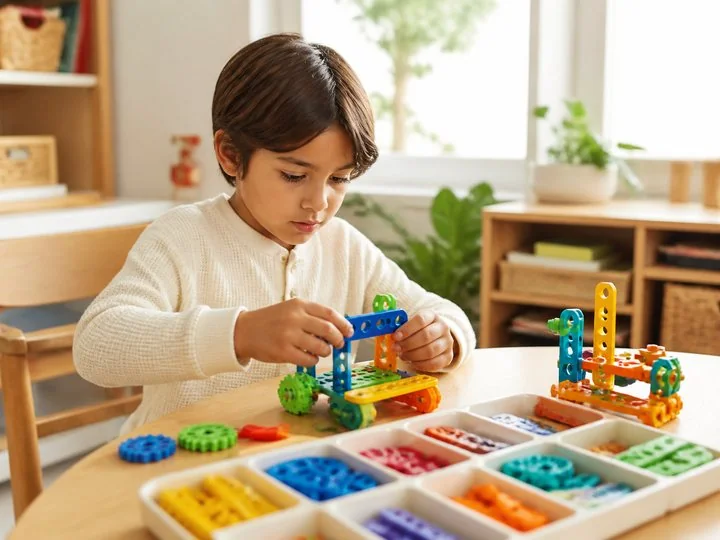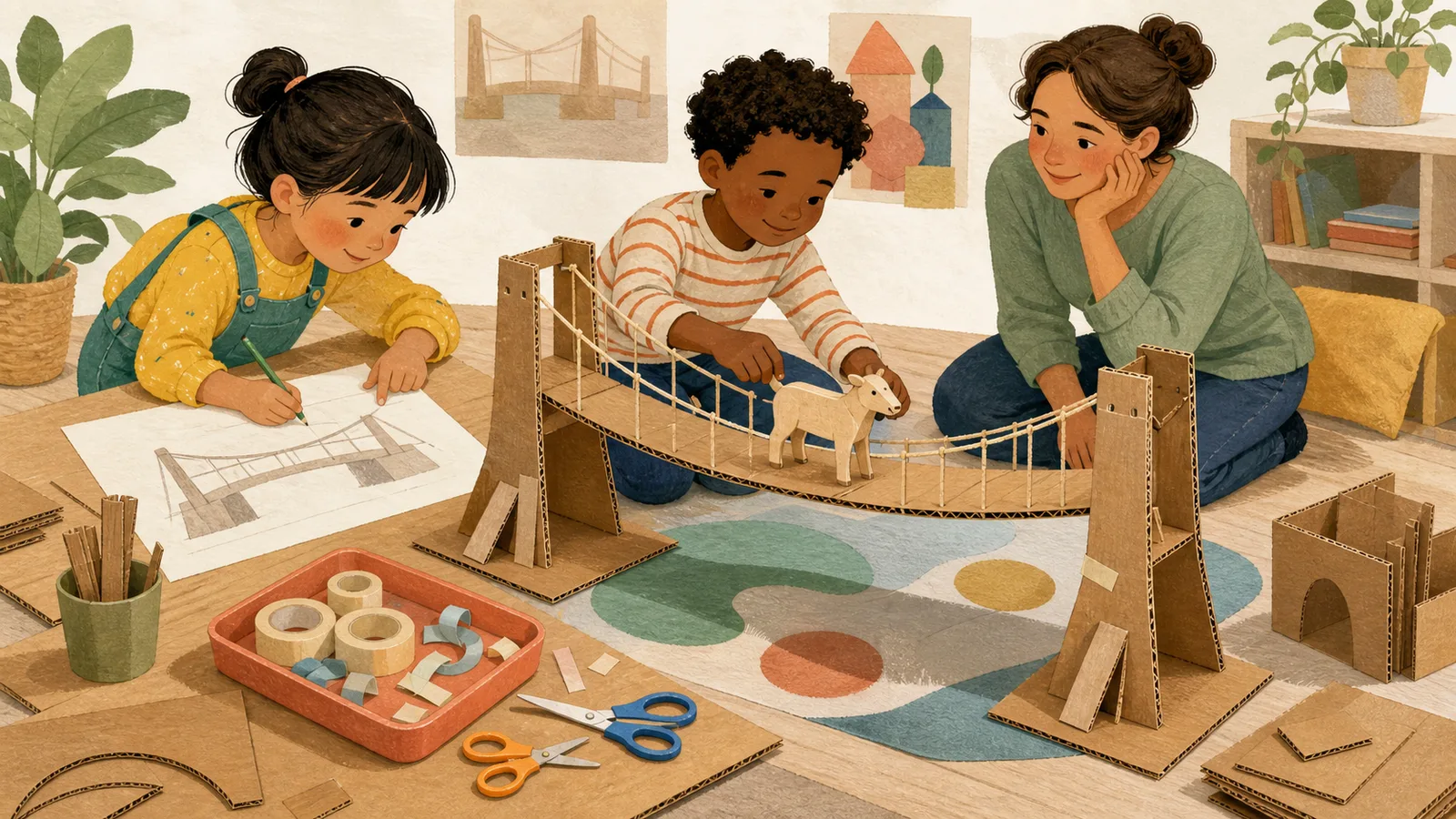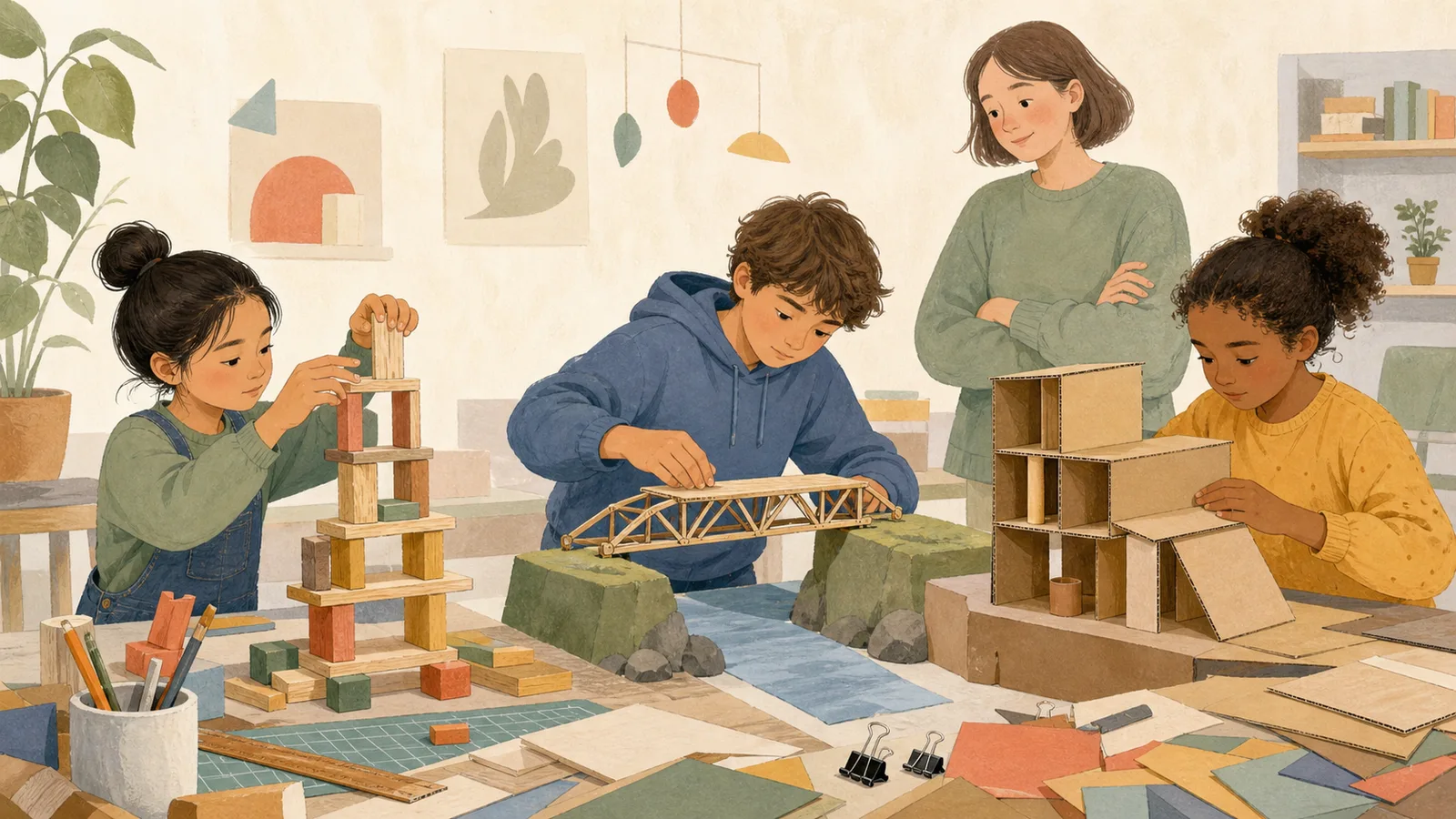
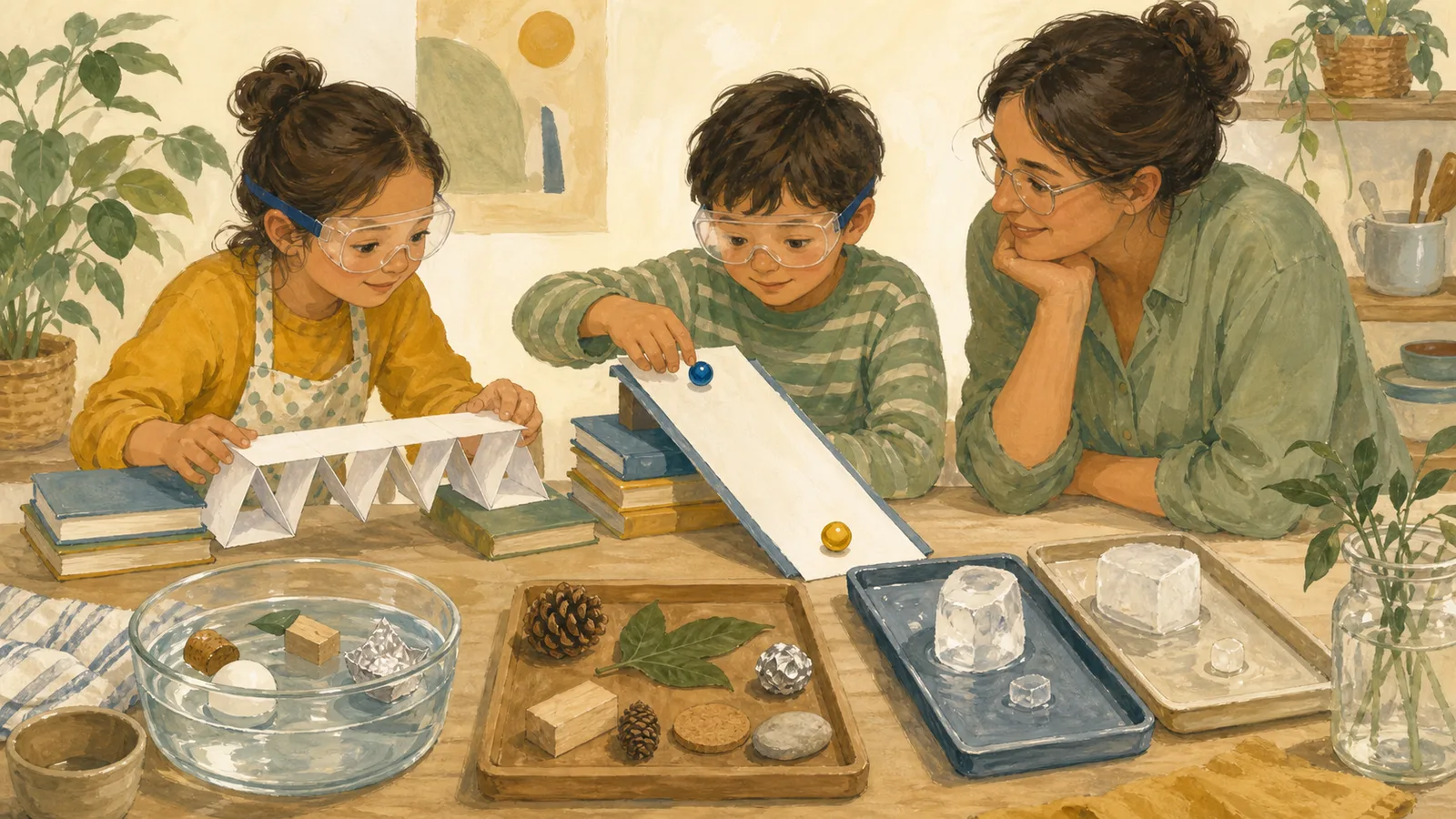
A foaming reaction can be entertaining, but an experiment begins with a comparison: What will we change? What will stay similar? What will we observe? These six investigations use ordinary materials and produce evidence a child can see, hear, draw, or count.
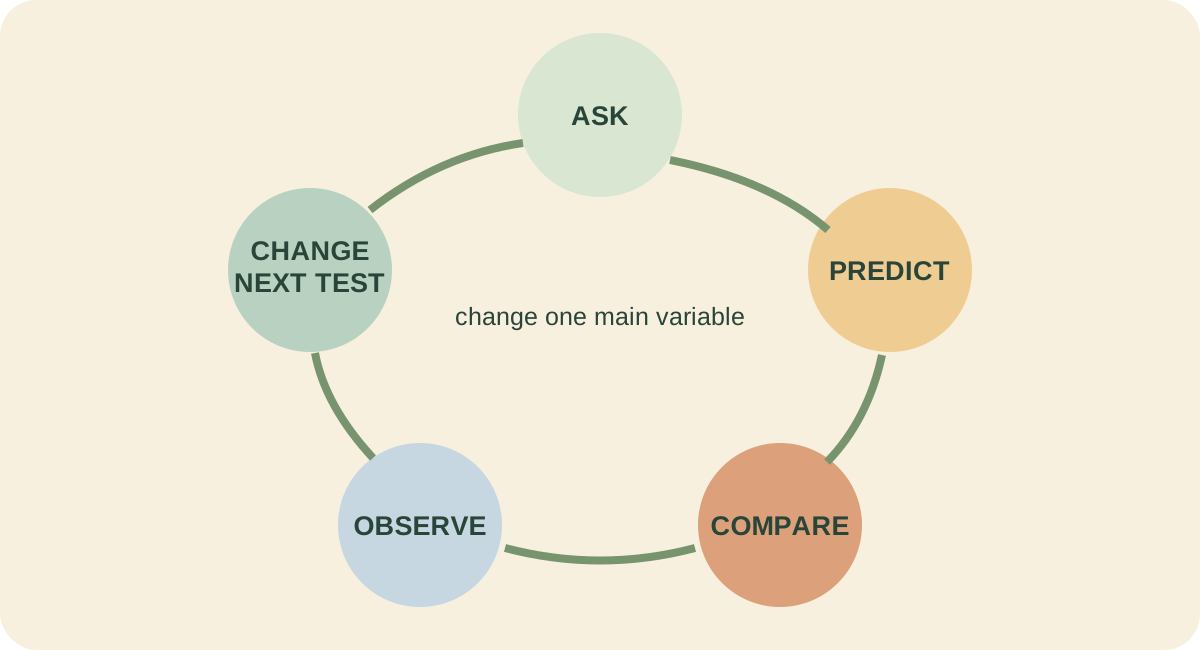
Screen every activity first
Before gathering materials, ask:
- Could anyone ingest, inhale, cut, burn, shock, or launch something?
- Does it involve pressure, flame, medication, household chemicals, microbes, people, or animals?
- Can an adult supervise the whole process and manage spills?
- Is the child able to use the tools safely today?
If the answer creates doubt, choose another investigation. “Kitchen science” is not synonymous with harmless. Keep cleaners, medicines, batteries, sharp tools, heat, glass, and unknown mixtures out.
1. Which paper bridge holds more?
Materials: two identical sheets of paper, two equal stacks of books, large identical blocks as loads.
Question: Does changing paper shape change how much the bridge can support?
Place one flat sheet across the same gap each time. Add blocks one at a time near the center. Repeat with a sheet folded into an accordion. Keep gap, paper, load placement, and block type as similar as practical.
Record: draw each bridge and tally the blocks held before bending substantially. Do not use heavy books as test loads where they could fall on feet.
This connects to our cardboard engineering challenges and broader building variables by age.
2. Ramp surface and travel
Materials: one board or stiff cardboard ramp, one large ball, books for a stable support, fabric and smooth paper.
Question: How does the surface change how far the same ball travels?
Use one release line and do not push. Run three trials on bare ramp, fabric, and smooth paper. Mark stopping positions with removable tape or blocks.
Watch for: accidental changes in ramp height and release force. If the ball rolls into a walkway, add a low barrier and clear the area.
3. Ice in two places
Materials: two equal ice cubes, two identical plates, timer, paper and pencil.
Question: Which location melts the ice faster?
Choose two safe locations with one meaningful difference, such as shade and indirect sun. Observe at regular intervals. Do not place ice on electrical devices or hot surfaces.
Record: trace the puddle edge or draw cube size. Discuss why the test cannot prove a universal rule about every sunny and shady location.
4. Floating object redesign
Materials: shallow water in a stable basin, towels, two pieces of foil of equal size, a small number of identical large counters that are not choking hazards for anyone present.
Question: How does foil shape change the load it can hold before water enters?
Make one compact shape and one broad tray. Add counters one at a time. Keep hands away from mouths and empty the basin immediately after play. If younger siblings are present, replace counters with large identical blocks or supervise in a separate inaccessible area.
5. Shadow distance
Materials: flashlight controlled by an adult, one opaque toy, plain wall or paper.
Question: What happens to shadow size when the toy moves closer to the light?
Keep flashlight and wall fixed. Move the toy between marked positions. Never shine the light into eyes. Trace or photograph the shadow at each position if the child wants a record.
6. Cup-string sound—with a safer alternative
Traditional cup telephones use taut string, which creates entanglement and trip hazards. For a low-risk sound comparison, instead tap the same broad spoon gently against a cardboard box, plastic bowl, and wooden surface.
Question: How does the material change the sound?
Use one gentle tapping motion and listen from the same position. Describe pitch, loudness, ring, or duration without requiring technical vocabulary. Stop if any sound is uncomfortable.
Keep it investigative
Ask for a prediction, but do not grade it. A surprising result is useful evidence. Use phrases such as:
- “What should we keep the same?”
- “How could we check that again?”
- “Which result is hard to explain?”
- “What would you change next time?”
Avoid explaining the conclusion before the child observes. The guided-play comparison can help decide when one prompt supports attention and when it becomes a quiz.
Adapt for different children
- Let one child release while another marks results, then switch.
- Use photographs, drawings, objects, gesture, or spoken notes to record.
- Stabilize containers on non-slip mats.
- Reduce trials from three to two when attention fades.
- For an older sibling, invite measurement or a new controlled variable rather than giving them all leadership.
- For a child who wants free building, let the formal comparison end after one test.
Demonstration or experiment?
A demonstration shows a phenomenon: ice melts, a shadow appears, foil floats. It becomes an investigation when the child compares conditions and uses observations to answer a question. Both can be worthwhile. Calling them accurately prevents the “scientific method” from becoming decorative vocabulary.
Our larger STEAM activities at home guide covers how art, engineering, math, and science can connect without forcing every activity into all five letters.
Frequently asked questions
Should a five-year-old write a hypothesis?
No formal sentence is required. A spoken prediction, gesture, drawing, or chosen object can record what the child expects.
Is baking soda and vinegar safe?
The familiar open-container reaction uses common materials, but any activity still needs adult control, eye protection as appropriate, no tasting, ventilation, and no sealed vessel. This guide uses alternatives with simpler cleanup and comparison.
Can children experiment with mold or bacteria?
Do not culture unknown microorganisms at home. Choose observations that do not intentionally grow potentially harmful microbes.
What if the experiment “fails”?
Check the setup and describe what occurred. A ramp result with scattered stopping points may lead to a better release method. Failure to produce an expected spectacle is not failure to investigate.
Sources and research note
Activity design was informed by the Exploratorium’s Science Snacks and teacher-developed, content-checked activities, Science Buddies’ elementary resources and teacher guide to project safety, the Laboratory Safety Institute’s Safe Science at Home, and CPSC home childproofing guidance.