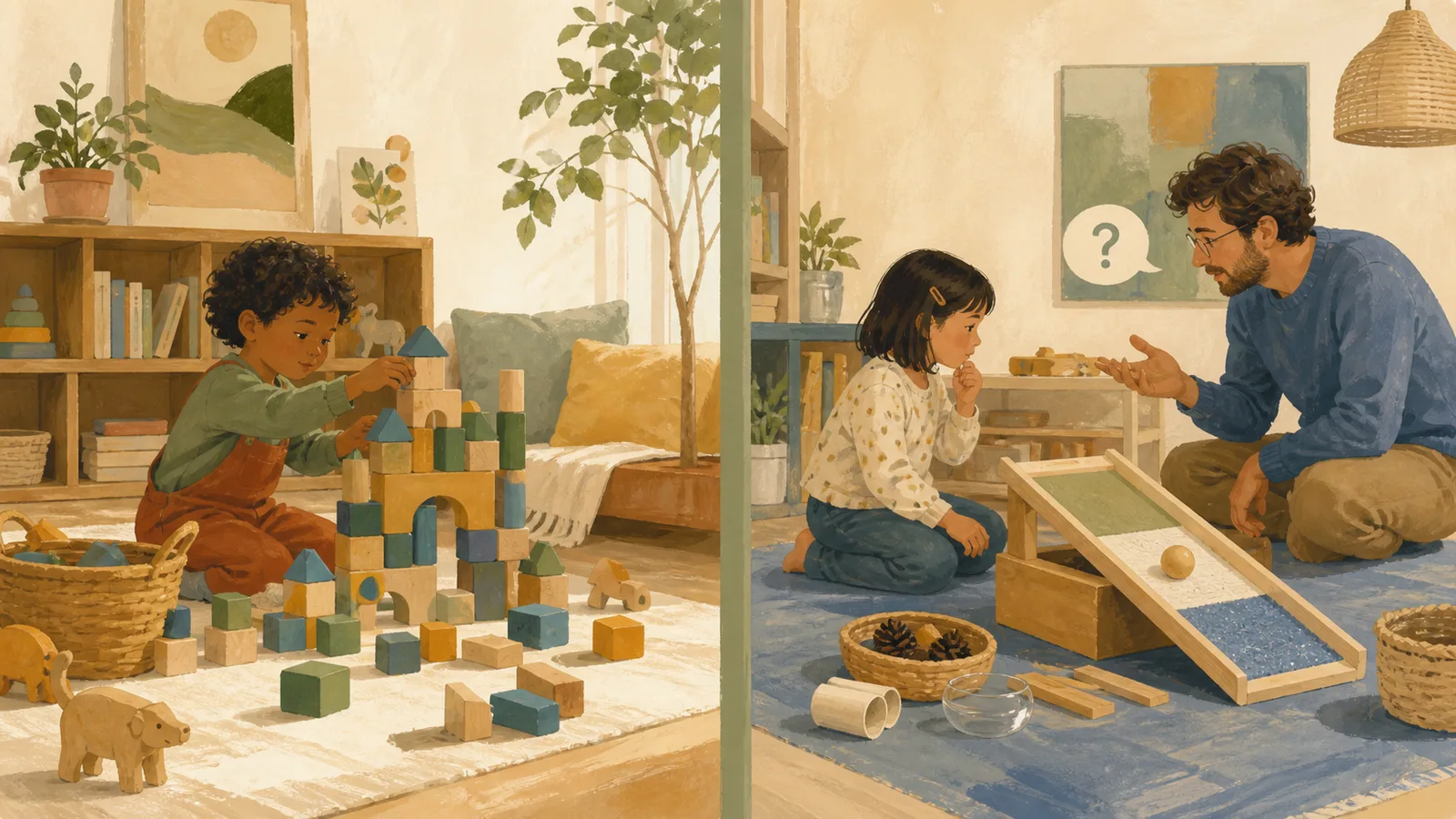
Free play and guided play differ mainly in where the goal comes from. In free play, the child decides what to do and how. In guided play, an adult has a learning goal but protects meaningful child choice in the action, strategy, or direction. Direct instruction places more of both goal and method with the adult.
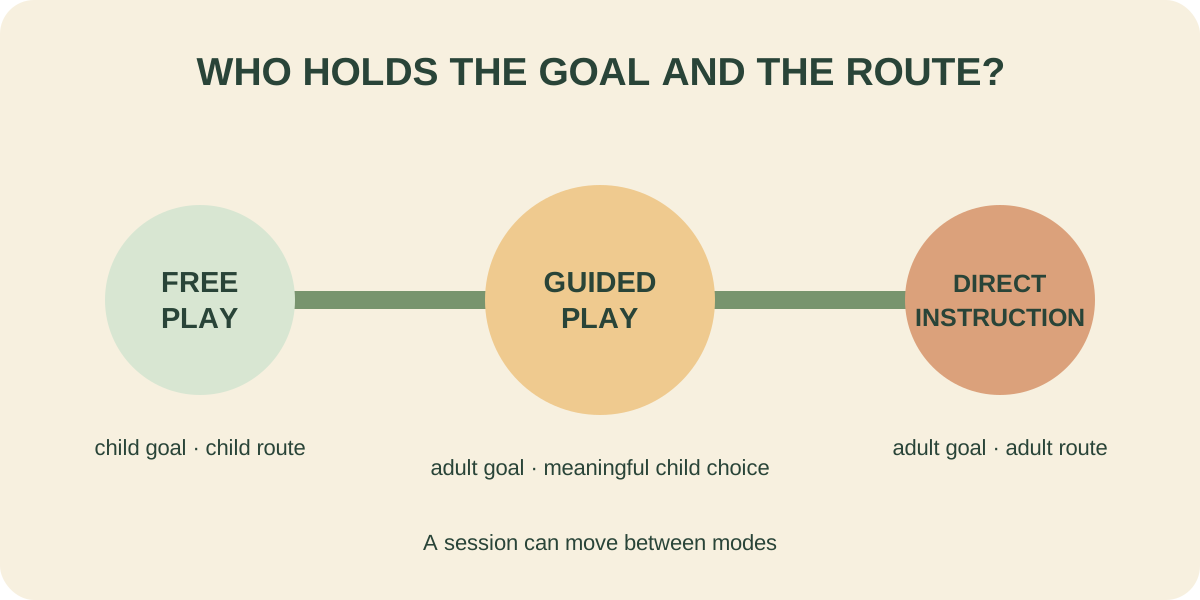
Three modes, each with a job
| Mode | Who sets the goal? | Who controls the route? | Useful when |
|---|---|---|---|
| Free play | child | child | inventing, exploring interests, practicing self-directed choices |
| Guided play | adult frames a learning goal | child retains meaningful choices | exploring a concept through action and feedback |
| Direct instruction | adult | mostly adult | safety, tool use, concise conventions or information |
The same session can move between modes. An adult directly shows how to hold scissors safely, frames a guided problem about joining cardboard, then leaves the child to build freely.
The same blocks, three approaches
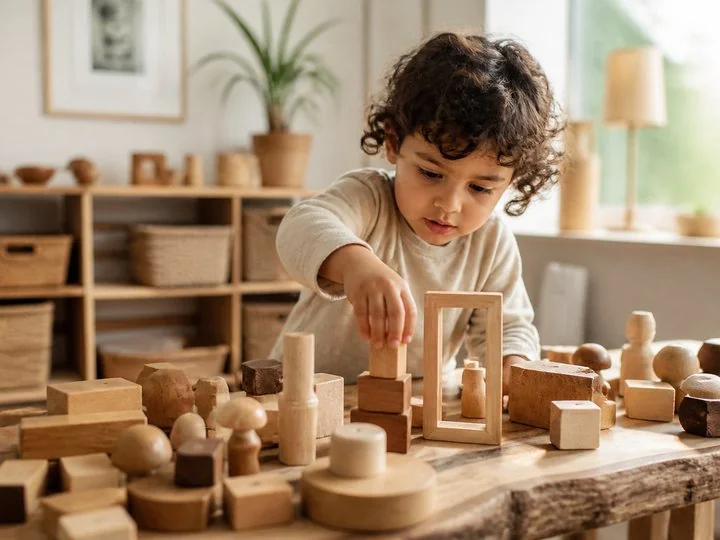
Free play
The blocks are available. The child builds a garage, carries every piece to the sofa, or does not use them. The adult responds to invitations but does not insert a curricular target.
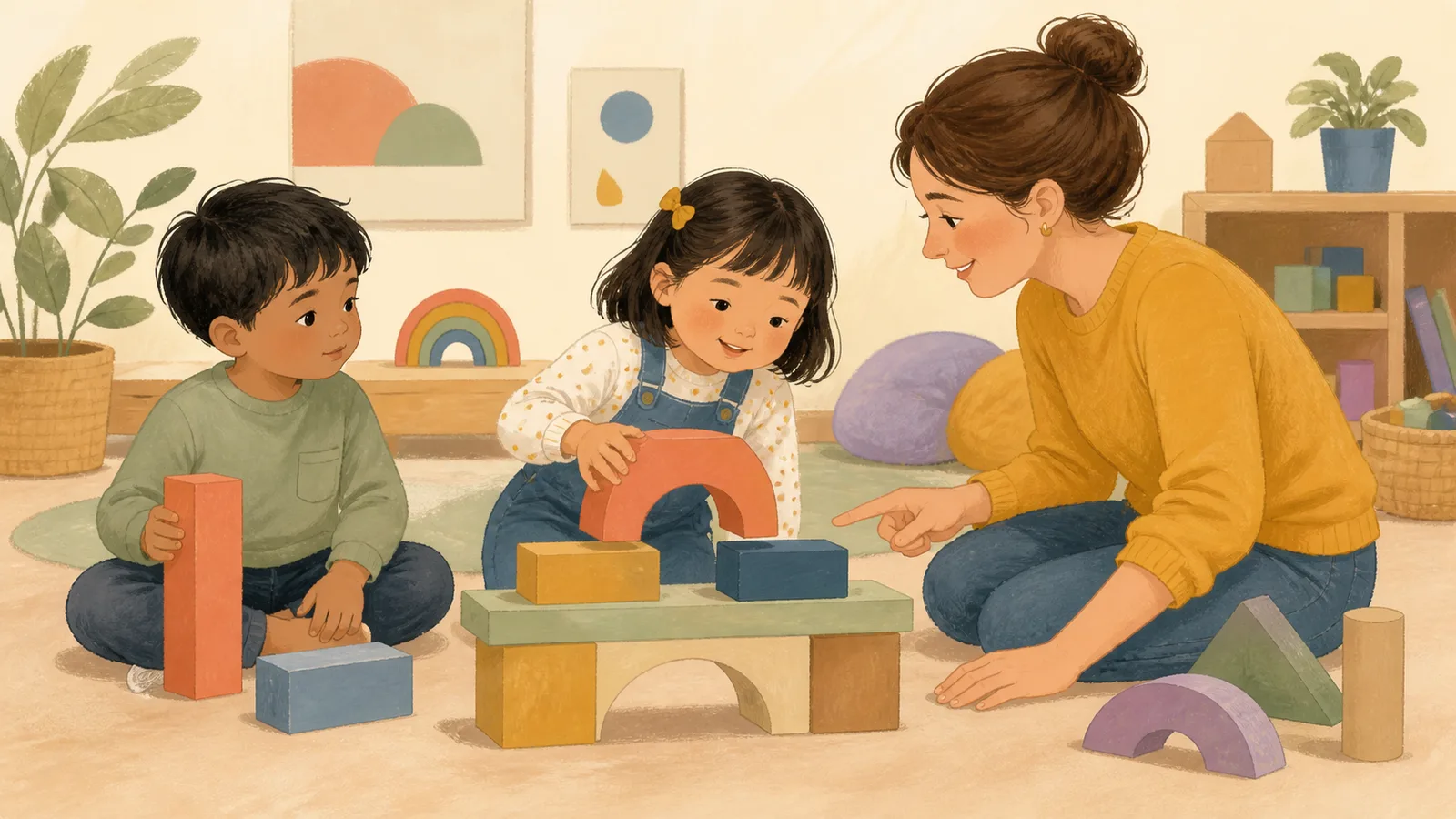
Guided play
The adult wants the child to compare stability. They provide the same blocks on a firm surface and say, “The animal needs a tower that stays up when the table gets one gentle tap. What could we try?” The child chooses base, height, pieces, test, and revisions.
Direct instruction
The adult demonstrates that a heavy block may hurt if thrown and establishes the rule that blocks stay below shoulder height. Or they explain the conventional word “base.”
All three can belong in a healthy play life. The problem begins when adults call a worksheet, quiz, or predetermined craft “guided play” merely because the materials look playful.
A quick test for genuine guidance
Ask:
- Does the child have a real choice that changes what happens?
- Can more than one strategy or answer be acceptable?
- Is the adult’s prompt connected to what the child notices?
- Can the child refuse, redirect, or stop?
- Is feedback available through the material, not only adult approval?
If every turn requires guessing the adult’s hidden answer, the activity is closer to instruction. That may still be appropriate—but naming it accurately helps adults choose intentionally.
What helpful guidance sounds like
Start with observation: “The long block bends in the middle.” Then use the lightest prompt that keeps the investigation moving:
- invite attention: “What changed?”
- introduce a contrast: “This ball is heavier.”
- add a constraint: “Can the bridge leave space for the boat?”
- offer vocabulary: “That middle support is a pier.”
- recall the child’s plan: “You wanted both animals to fit.”
Avoid continuous questions. Our guide to spatial language during block play shows how description and waiting can support conversation without turning play into an oral exam.
When free play is the better choice
Stay out when the child is deeply engaged, testing their own idea, recovering from a manageable failure, negotiating successfully, or using materials in a safe unexpected way. Adult efficiency is not the objective.
Free play also protects interests adults would not have selected. Transporting every block may look unrelated to a tower goal, yet it may be the child’s current investigation. The open-ended toy guide explains why a flexible material does not need an adult-defined output.
When direct teaching is kinder
Do not make a child “discover” that a real tool cuts skin, a hot pan burns, or medicine is not a prop. State safety rules plainly. Demonstrate unfamiliar equipment before handing it over.
Direct explanation is also efficient for arbitrary conventions: which recycling bin your building uses, how a board-game turn works, or where a library book is returned. Exploration can follow.
What the evidence actually says
A 2022 systematic review and meta-analysis compared guided play with free play and direct instruction. It found some evidence favoring guided play for particular outcomes, including aspects of early math, shape knowledge, and task switching, but effects differed by outcome and comparison. The evidence did not establish guided play as universally superior.
Studies also vary in how they define guidance, who provides it, how much agency remains, and what “learning” measure is used. A short researcher-designed activity is not the same as a family’s entire play day.
The reasonable conclusion is not “guide all play.” It is that light adult framing can be useful when a specific concept matters and the child can still act as an agent.
A household rhythm
You do not need percentages or a schedule. Protect substantial stretches where children choose the activity. Use guided moments when curiosity and a useful goal meet. Teach directly when safety, clarity, or access requires it.
If a child resists prompts, return control: “You have another plan. Show me.” A learning objective can wait. Our at-home STEAM guide offers investigations that can move between all three modes.
Frequently asked questions
Is Montessori guided play?
Not as a single category. Particular Montessori activities may involve demonstration, structured materials, independent choice, and defined use. Evaluate the actual interaction rather than the label.
Does guided play reduce creativity?
The answer depends on how much agency and possibility remain. A broad problem can invite invention; a hidden single answer can narrow it. Research does not support a blanket claim either way.
How many questions should an adult ask?
There is no ideal count. Ask one that serves the child’s investigation, then allow enough silence for action. Descriptive comments can replace many questions.
Can guided play be independent?
An adult can design an environment or leave a challenge and step away, but guidance usually includes some responsive framing. Once the child adopts or changes the goal independently, the mode may shift.
Sources and research note
The core evidence is the 2022 systematic review and meta-analysis of guided play, available in open-access form, supported by the conceptual paper Guided Play: Where Curricular Goals Meet a Playful Pedagogy and a Frontiers review. Developmental context comes from NAEYC’s DAP principles and the AAP’s Power of Play.