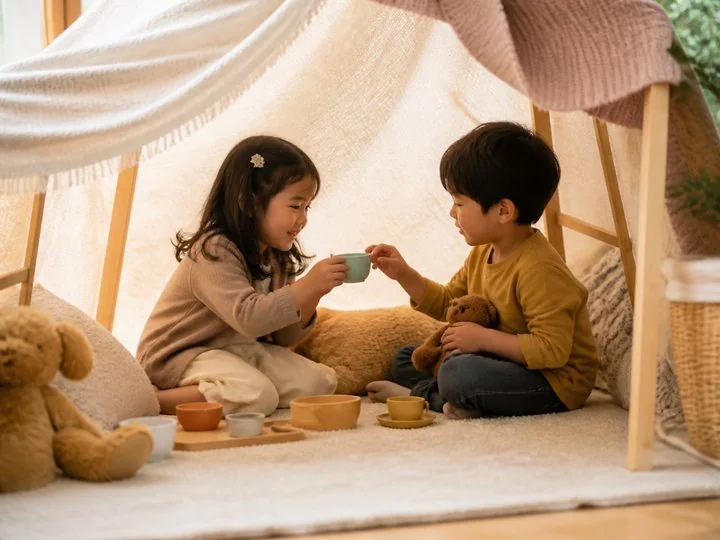
Rainy-day pretend play does not need a themed kit or a living room transformed before breakfast. A chair can be a bus; a box can be a clinic; paper can become tickets, menus, maps, or messages. The most durable setup gives children a reason to begin and room to change the idea.
Quick answer
Choose one familiar place or problem, add three to five props, and begin with a single action: a customer arrives, an animal needs help, or a package has the wrong address. Join long enough to make the play legible, then follow the child’s version.
If a child does not want to act, offer another way in. They can build the setting, sort supplies, draw signs, control a vehicle, make sound effects, or be the audience. Pretend play is an invitation, not a required performance.
Pick an idea by energy and prep
| Idea | Basic props | Energy | Easy entry role |
|---|---|---|---|
| Cardboard delivery depot | Boxes, paper, tape | Medium | Sorter or driver |
| Stuffed-animal clinic | Soft toys, cloth, paper | Calm | Receptionist |
| Cushion bus | Chairs or cushions, tickets | Medium | Passenger |
| Indoor campsite | Blanket, flashlight, books | Calm | Map maker |
| Café | Cups, paper menu, play food | Medium | Customer |
| Weather station | Window, paper, pencil | Calm | Reporter |
| Lost-and-found office | Household objects, basket | Calm | Label maker |
| Construction site | Blocks, vehicles, tape roads | Medium | Engineer |
| Puppet newsroom | Socks or figures, paper | Medium | Camera operator |
| Museum | Toys or art, labels | Calm | Curator |
| Animal rescue | Figures, boxes, cloth | Medium | Habitat builder |
| Laundry spaceship | Basket, foil, paper controls | Active | Navigator |
| Post office | Paper, envelopes, bag | Medium | Stamp designer |
| Shadow theater | Flashlight, wall, figures | Calm | Sound designer |
| Tiny-world flood rescue | Blocks, blue fabric, vehicles | Medium | Bridge builder |
1–5: Familiar worlds with one twist
Cardboard delivery depot
Write picture or color addresses on boxes and matching locations around the room. Deliver by wagon, basket, or hand. Older children can make route maps and packing slips; toddlers can move one large box between two places.
Stuffed-animal clinic
Choose two patients, cloth bandages, a notepad, and a safe pretend instrument. The problem can be simple: the bear cannot sleep or the rabbit hurt a paw. Avoid wrapping anything tightly around a child or animal.
Cushion bus
Line up chairs or floor cushions, make tickets, and choose destinations. A child who does not want a speaking role can hand out tickets or announce stops with a sound.
Indoor campsite
Drape a blanket over a table only if it is stable and ventilated. Pack books, soft toys, and a flashlight. Make weather sounds, draw a trail map, or tell one-sentence stories. Never place fabric near heaters or lamps.
Café with an unusual customer
Use a few cups, plates, and paper menus. Then introduce a toy customer who eats only triangle-shaped foods or needs a quiet seat. The constraint gives the story somewhere to go without scripting its ending.
6–10: Jobs, systems, and shared plans
Weather station
Observe the actual window, make symbols, and give a report. This can stay pure pretend or connect with measurement in our home STEAM activities.
Lost-and-found office
Collect safe objects and invent who lost each one. Children can make tags, ask descriptive questions, and match owners. Keep real keys, medications, batteries, and important belongings out of the game.
Construction site
Tape a road boundary on the floor and add blocks and vehicles. Give one problem: a bridge must leave space for a boat, or a house needs a ramp. Let the child decide the design.
Puppet newsroom
Socks, paper puppets, or figures can report on a missing snack, a dinosaur sighting, or tomorrow’s weather. Children who dislike acting can draw the backdrop or operate a pretend camera.
Living-room museum
Select five objects, arrange them, make labels, and lead a tour. The child decides what makes the collection meaningful. Ask permission before including another person’s possessions.
11–15: Bigger problems for mixed ages
Animal rescue center
Build habitats from boxes, paper, and blocks. Decide what each animal needs. Keep the distinction between pretend and real animal care clear; do not handle wildlife.
Laundry-basket spaceship
Add paper controls and a destination. The basket stays on the floor—no pushing on stairs, lifting children, or enclosing babies. Older children can plan fuel, supplies, and a repair.
Post office
Draw or dictate messages, fold paper, sort by room or name, and deliver with a bag. Check bags and cords for entanglement risk and keep personal addresses private.
Shadow theater
Aim a flashlight at a blank wall and move hands or large figures between. Keep brightness comfortable and never shine into eyes. Add a narrator or simple instruments from our music play guide.
Tiny-world flood rescue
Use blue fabric rather than real water, then build routes for figures and vehicles. This offers storytelling plus construction without wet cleanup. A younger child can move large animals while an older child maps the rescue.
What research says about pretend play
Pretend play creates opportunities to use symbols, negotiate roles, narrate sequences, and manage a shared imaginary frame. The AAP includes pretend among valuable forms of child-led play.
However, a major review of the evidence concluded that strong claims about pretend play causing broad improvements in creativity, intelligence, executive function, or social skill were not established. Newer studies and meta-analyses continue to examine associations and possible mechanisms, but the evidence is more nuanced than “pretend play makes children smarter.”
That does not make pretend play unimportant. It means we can value the language, joy, relationship, and problem-solving visible in the play without attaching unsupported promises.
Help a child who says “I don’t know how”
Use the smallest possible beginning:
- Place: “This box is the animal clinic.”
- Problem: “The dog cannot find a bed.”
- Prop: Offer cloth, a small box, and paper.
- First action: “I’ll be the person bringing the dog in.”
Then wait. If the child corrects you, that is excellent evidence they own the story. If they repeat one script, repetition is not a failure; familiarity often makes variation possible later.
Adult boundaries that preserve the play
- State safety and household limits plainly: no climbing on the table, no tape on walls, no real food unless offered.
- Do not turn every role into a lesson or moral test.
- Let villains, danger, and rescue remain symbolic while stopping real hitting or frightening playmates.
- Ask before entering a child’s established world.
- Give a transition warning before cleanup and preserve a small project when practical.
These boundaries can support more independent play because children know what they may control.
Frequently asked questions
At what age does pretend play begin?
Simple symbolic actions often emerge in the second year, then become longer and more social. Development varies. Follow the child’s observed interests rather than requiring a particular script.
What if my child prefers building to role-play?
Building can contain imagination without acting. Offer a practical story problem—someone needs a bridge—then let construction remain the main activity.
Is repeating the same story a concern?
Usually, no. Repetition can support mastery and predictability. Look at the child’s broader communication and play, and discuss concerns with a health professional if skills are lost or you notice wider developmental changes.
Should adults correct unrealistic pretend play?
Correct immediate safety misinformation when needed, but a banana can remain a telephone. If the child asks a factual question, answer it honestly without taking over the story.
How can siblings of different ages play together?
Give complementary roles and separate unsafe pieces. The older child might draw routes while the younger child delivers large boxes. Do not make the older child responsible for supervision.
Are pretend-play kits necessary?
No. Familiar household props and open-ended toys often travel across more stories. A kit can still be worthwhile when the child loves the theme and its parts are safe and usable.
Sources and evidence notes
- Lillard et al., The Impact of Pretend Play on Children’s Development: A Review of the Evidence.
- American Academy of Pediatrics, The Power of Play and toy-selection guidance.
- Recent peer-reviewed studies and meta-analytic work on pretend play and development.
- Parent community threads used only to identify practical questions about scripts, adult participation, and reluctant players.