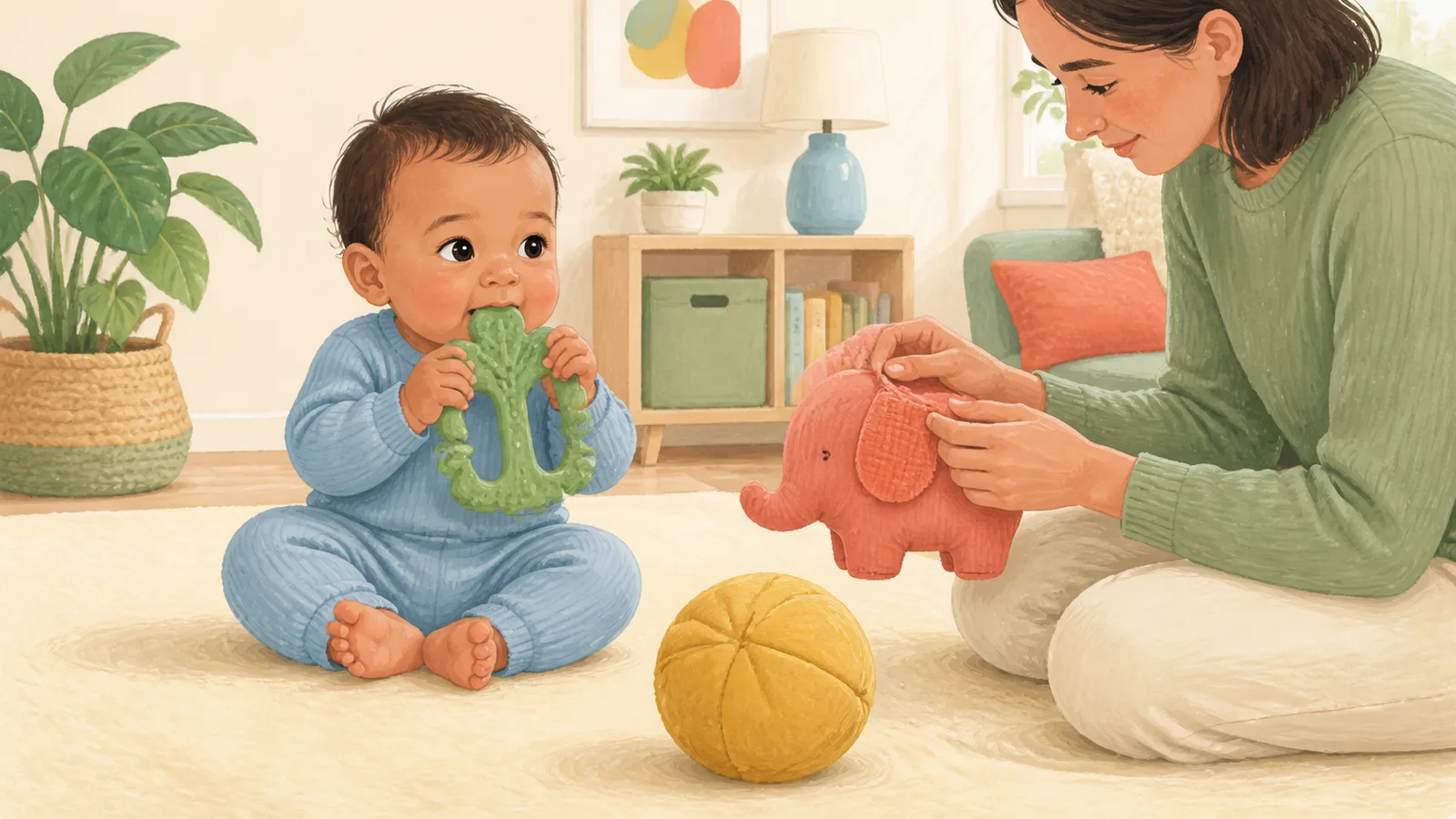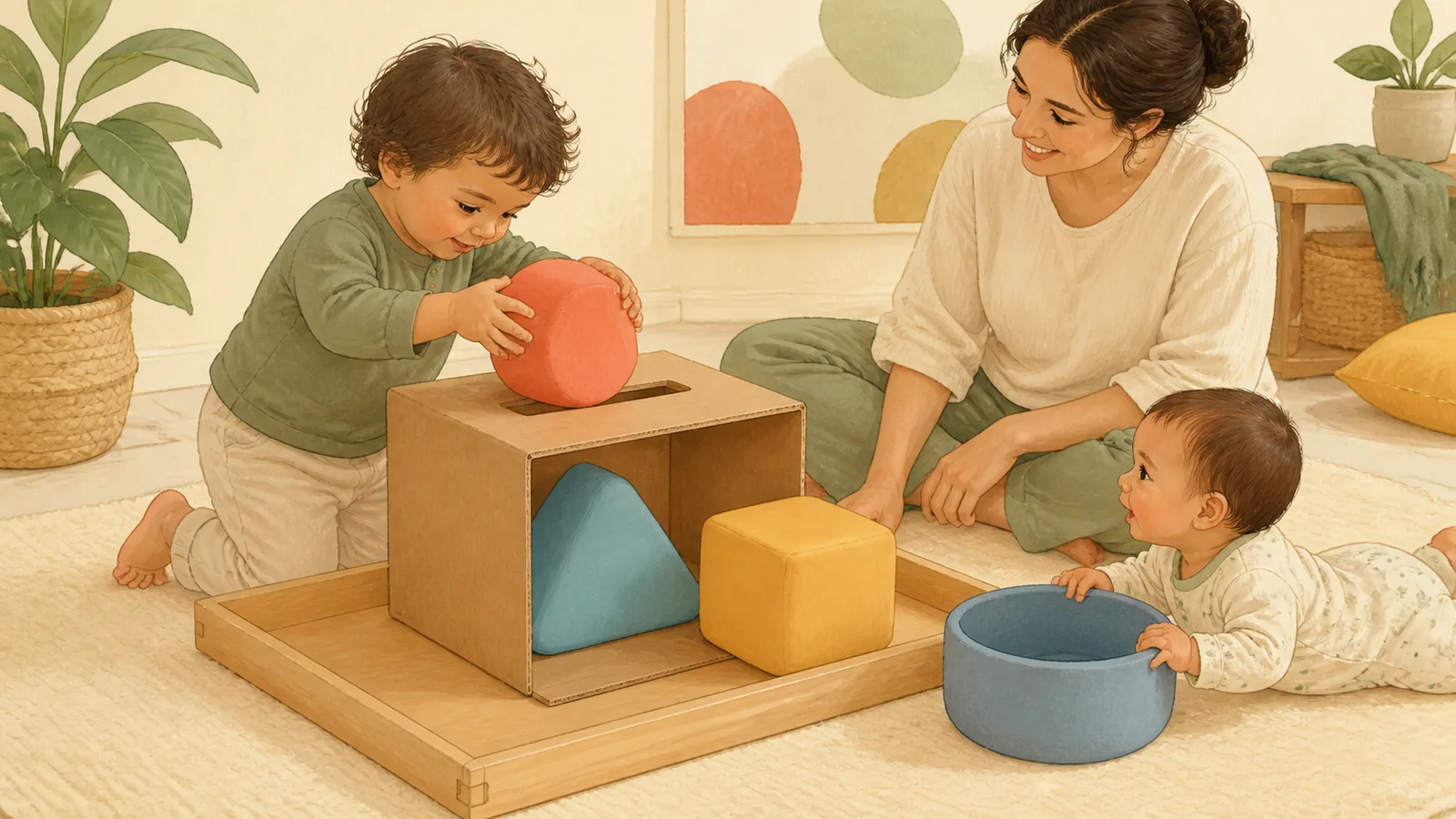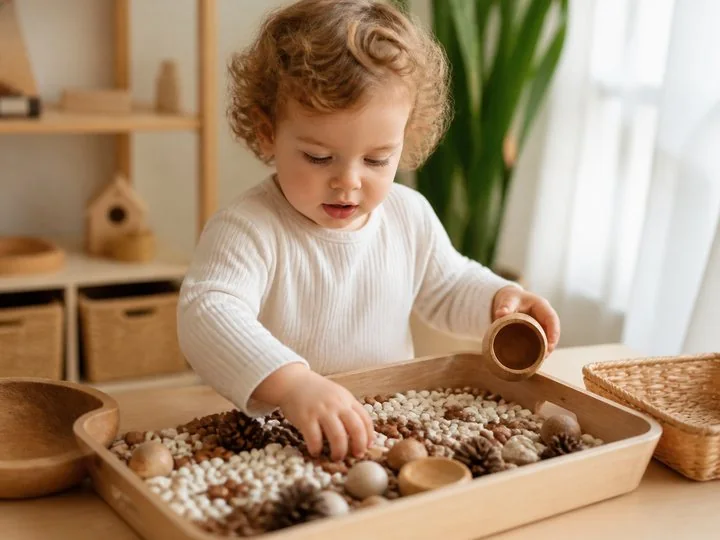
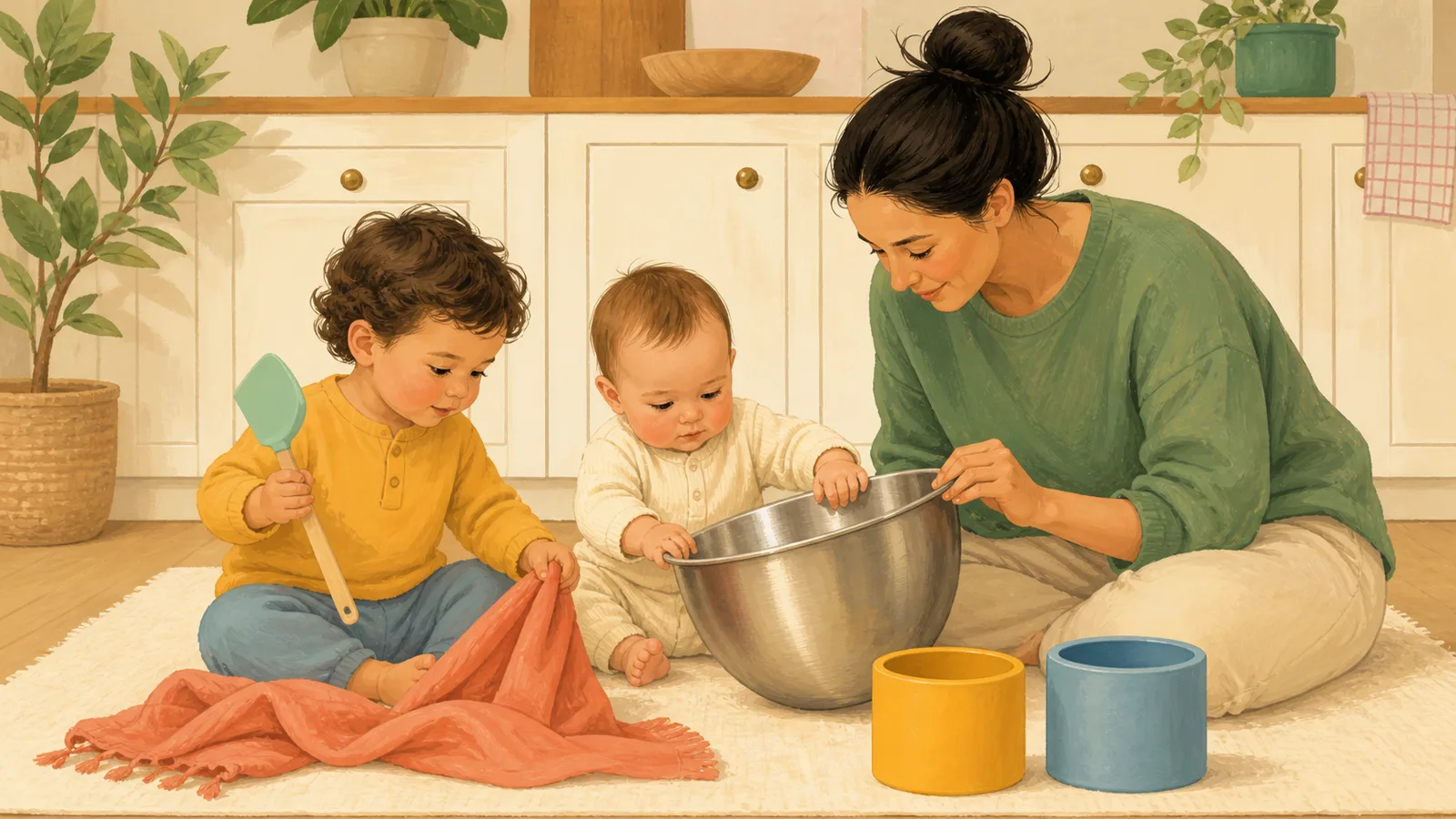
A stainless-steel bowl can become a mirror, drum, container, hat, and mixing vessel. It may offer more play than a complicated toy. But “found at home” does not mean “safe for a baby,” and “too big to swallow” is not a complete assessment.
Use household objects when the exact item passes a safety screen, the setup suits the child’s current actions, and an adult can supervise. Do not copy a treasure-basket photo without checking every object yourself.
The six-question household-object screen
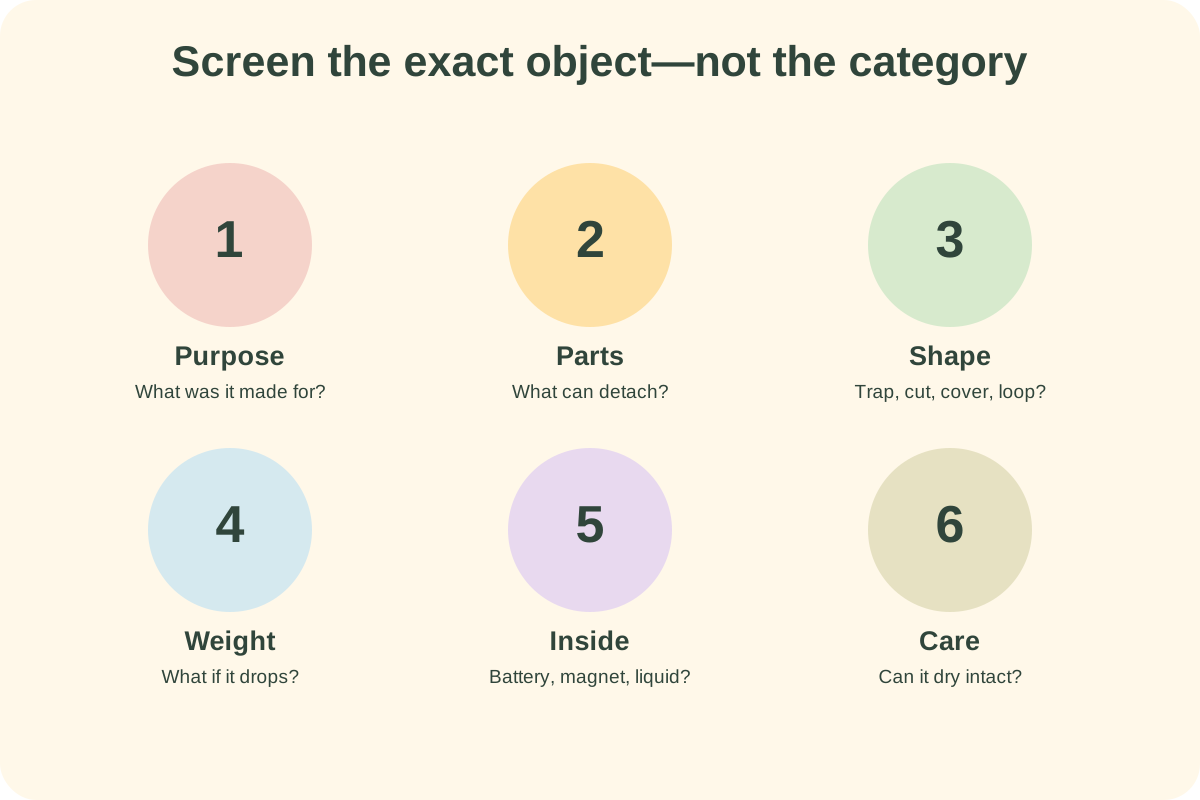
1. What was this object designed to do?
A food-contact bowl has a known ordinary purpose. A key fob, remote, detergent cap, cosmetics container, or medication bottle contains materials and mechanisms never designed for play or repeated mouthing. “Clean” cannot change that intended use.
2. What can detach after bending, biting, or dropping?
Pull gently at handles, decorative grips, rubber feet, lids, labels, stitched edges, and glued pieces. Consider damage, not just new condition. A whisk with welded loops may seem robust until a wire bends; a wooden spoon can splinter after dishwasher cycles.
3. Can its shape trap, cut, cover, or loop?
Check finger-sized holes, narrowing tubes, sharp rims, long handles, rigid rings, loose fabric that can cover the face, and loops that can go around the neck. An object can be too large to swallow yet still create an entrapment or strangulation hazard.
4. Is it too heavy or hard for likely play?
A baby may bang a metal cup into the face. A toddler may throw a heavy bowl or stand on an upside-down container. Test the object at the height and surface where play will happen. Lighter is often easier to manage in mixed-age play.
5. What is hidden inside?
Exclude anything with button batteries, accessible batteries, magnets, springs, sharp mechanisms, gel, unknown liquid, fragrance, pellets, loose weights, or electronics. A taped battery cover is not a safe repair.
6. Can it be cleaned and dried without damage?
Trapped water, peeling finishes, swollen wood, rust, and degraded adhesives can turn a good candidate into a discard. Use the maker’s care guidance where available and reinspect after washing.
A practical yes / pause / no table
These are starting categories, not approvals for every version.
| Object | Usually worth considering | Pause and inspect | Keep out of play |
|---|---|---|---|
| Bowls and cups | Large, light, smooth, intact, stable | Heavy metal, chipped enamel, narrow openings | Glass, cracked plastic, sharp rims |
| Utensils | One-piece silicone or smooth sturdy wooden spoon | Whisk, slotted spoon, removable grip | Sharp, hinged, peeling, splintered, damaged |
| Cloth | Small washable tightly woven cloth, controlled by adult for babies | Long scarf, fringe, loose weave | Plastic bags, drawstrings, neck loops |
| Containers | Large open-top nesting container | Tight lid, finger hole, rigid tube | Airtight entrapment space, chemical/medicine packaging |
| Paper and cardboard | Large sturdy box for an older toddler, supervised | Torn paper for a child who mouths it | Staples, tape pieces, coated food packaging |
| Electronics and hardware | None needed | None | Remotes, keys, coins, earbuds, chargers, magnets, batteries |
For babies who mouth everything, use the stricter process in why babies mouth toys. A toddler who no longer mouths may still throw, climb, carry, or dismantle an object, so “outgrown choking” does not mean “no hazards.”
Five setups with ordinary materials
Bowl, cup, and cloth
Place one large bowl, one easy-grip cup, and a short washable cloth on the floor. A baby may touch surfaces and place the cloth in and out. A young toddler may cover the bowl, hide the cup, or pretend to mix.
Keep long fabric out of infant use. Stop if the cloth covers the nose and mouth or becomes a pulling game around the neck.
Nest and unnest
Offer three containers with visibly different sizes and broad smooth openings. Let the child discover whether they fit. Avoid correcting every mismatch; turning, trying, and rejecting are the substance of the activity.
This setup leads naturally to posting and container play once a child can intentionally release objects.
Kitchen sound lab
Use one light bowl, one one-piece utensil, and one soft surface. Invite a tap, then pause. Change the surface under the bowl to compare sound. Remove the setup if sound becomes uncomfortably loud or banging becomes unsafe.
Do not provide pan lids, heavy pots, glass, or utensils with damaged handles merely because adults use them in a kitchen.
Cardboard in, cardboard out
For an older toddler who is not eating paper, use a clean sturdy box without staples, loose tape, plastic film, or sharp cut edges. Add two or three large toys already appropriate for the child. The box is a container, tunnel for a vehicle, or home for a figure.
Food and shipping boxes may carry residue, fragrance, dust, or coatings. Select rather than assume. Discard when wet, crushed, chewed, or shedding layers.
Laundry matching
With an older toddler, place two socks, two washcloths, and a small open basket on the floor. Match, carry, hide, or pretend to wash. Avoid adult garments with drawstrings, hooks, coins in pockets, detergent residue, or small detachable decorations.
Mixed-age sibling reality
The youngest child’s access determines what can stay in a shared floor area. An older sibling may be perfectly ready for coins in a pretend shop or small beads in a project, while those objects remain unacceptable around a mobile baby.
Create a real boundary:
- high table or gated room for small-part play;
- closing container stored out of reach;
- adult count-in/count-out routine for high-risk pieces; and
- shared basket containing only objects suitable for the youngest child.
Do not ask an older child to provide the only safety control. They can help reset, but the adult designs the environment.
Cleaning and rotation
Wash objects according to their material and original instructions. A food-safe silicone utensil may tolerate ordinary dishwashing; wood may crack or swell; fabric may need machine washing and full drying; cardboard is generally replaced rather than sanitized.
Use a small collection. Household-object play loses its advantage if every cabinet tool migrates to the floor. A bowl, two cups, a cloth, and a spoon are enough for several combinations. Return adult tools before cooking so play objects do not move between raw-food tasks and a child’s mouth.
If objects begin to crowd the room, use the decision process in our toy rotation guide: solve a specific access or cleanup problem instead of buying more bins.
When this approach does not work well
Skip household-object play when the adult cannot stay nearby, when the child is in a strong throwing or climbing phase and every candidate becomes hazardous, when the only available items have unknown coatings or parts, or when separating an older sibling’s materials is not feasible.
A purpose-made, currently compliant toy may be the simpler choice. “Open-ended” and “low waste” do not outrank safe construction or a setup the family can actually maintain.
Frequently asked questions
Are wooden spoons safe for babies?
Not as a category. Inspect the exact spoon for splinters, cracks, coatings, glued joints, weight, and shape. Kitchenware is not automatically tested as an infant toy. A suitable infant-labeled object may be preferable for frequent mouthing.
Can babies play with stainless-steel bowls?
A light, smooth, intact bowl can be considered during close floor supervision. Check the rim, weight, temperature, stability, and how hard the child bangs it. Do not use a heavy bowl overhead or near tile edges where a drop could injure.
Are play scarves safe?
Short cloths can support supervised peekaboo and container play. Long scarves, fringe, loose weave, drawstrings, and neck loops need stricter control and are not for unsupervised infant access.
Can I use empty food containers?
Often the cap, seal, tear strip, foil, printed film, residue, or narrow opening creates the problem. Select a plain large container only if it can be fully cleaned, has no detachable component, and suits the child’s likely use. Never use medicine, chemical, nicotine, alcohol, or detergent packaging as a toy.
Is supervision enough for keys or a remote?
No. Keys may contain lead or small attachments and can injure the mouth; remotes and key fobs can contain batteries and detachable buttons. Use a purpose-made alternative.
Sources and research note
Safety decisions in this guide use the CPSC toy safety center, small-parts rules, button-battery guidance, and magnet safety center, alongside AAP toy-selection guidance. Research on infant object exploration and mouthing of toys and non-toys informs the behavioral context but does not certify any household object as safe.