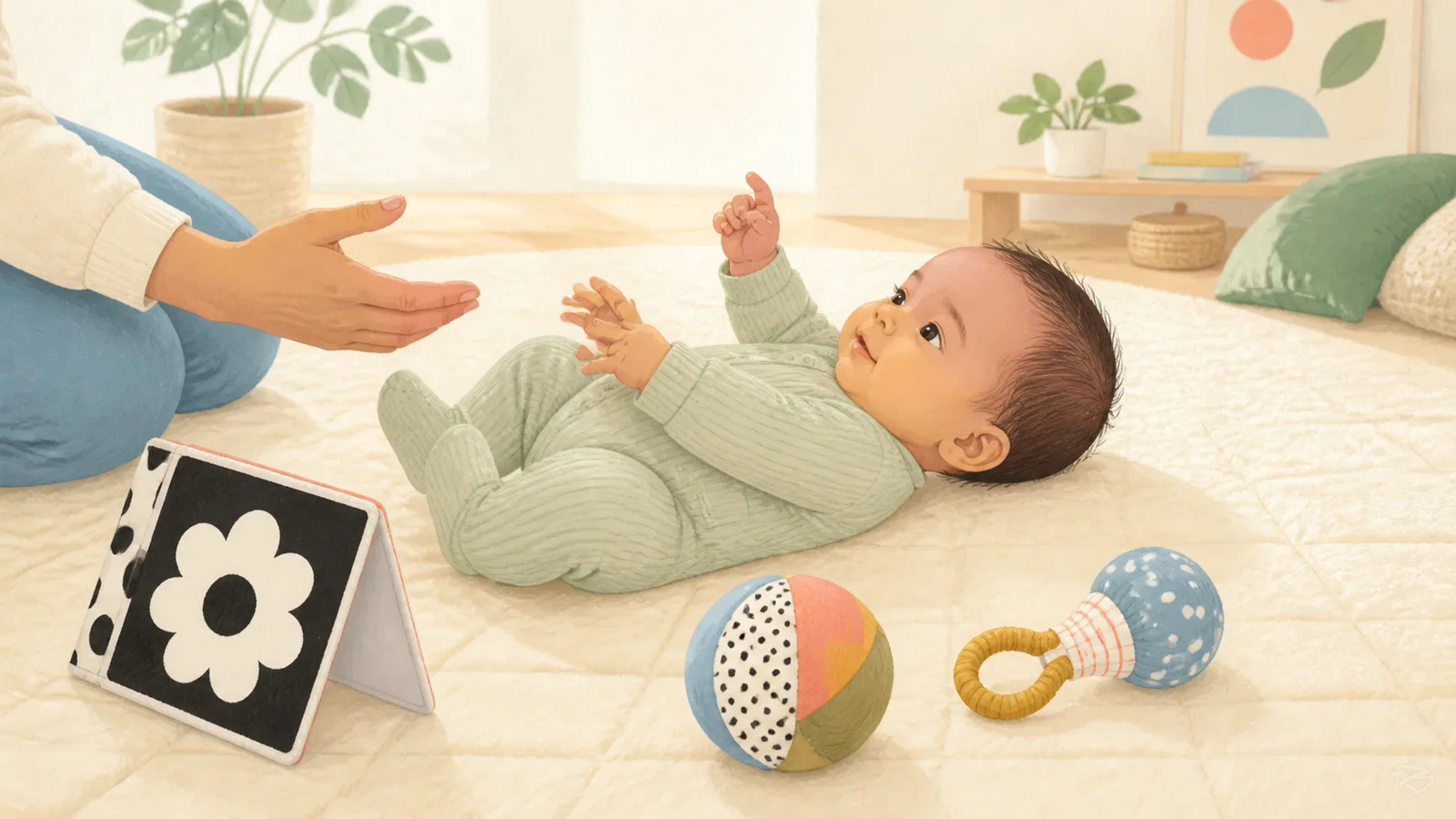
A baby’s first toy does not need to teach colors, count words, play music, or promise a developmental head start. In the earliest weeks, the most useful “play materials” are often a familiar face, a voice, a safe place to move while awake, and one simple object to look at.
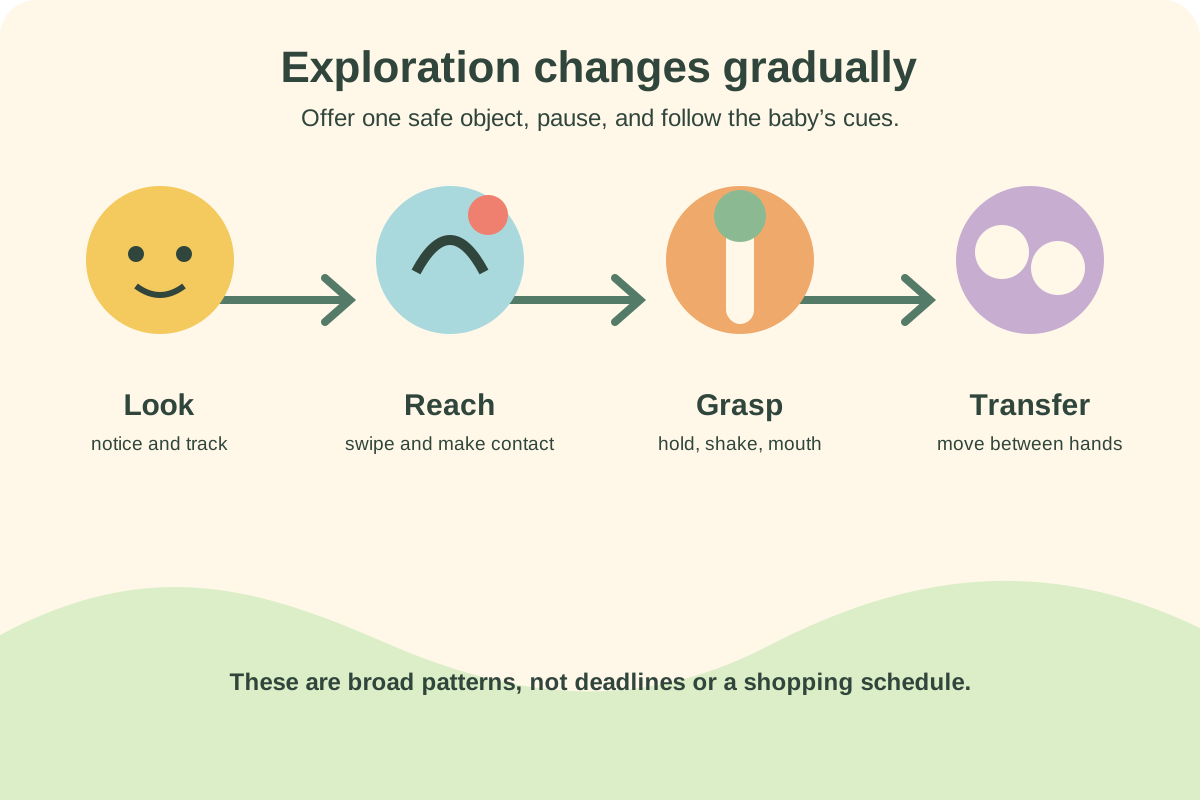
As reaching and grasping emerge, toys can make exploration easier. The useful question is not “Which product unlocks the next milestone?” It is “What can this baby notice and do with this object safely today?”
Quick answer: what toys are useful from birth to six months?
For the newborn period, start with very little: a washable contrast card or cloth book, a soft sound made by an adult, and uncluttered floor time. From roughly three to six months, many babies become more interested in easy-grip rattles, light fabric toys, textured cloths, unbreakable mirrors made for floor play, and soft balls that move slowly.
These are broad stages, not deadlines. Follow the product’s current age label and the baby in front of you. A baby who turns away, stiffens, arches, fusses, or closes their eyes may need less input, a different position, or a break—not a more stimulating toy.
| Approximate stage | What may be interesting | Useful toy qualities | Adult’s role |
|---|---|---|---|
| Newborn weeks | Faces, voices, light and dark boundaries, slow movement | Simple, lightweight, visually clear | Hold, talk, pause, and watch for fatigue |
| Around 2–3 months | Tracking, batting, longer alert periods | One visible target, washable mat, low play-gym object used while awake | Place within sight but not against the face; change position rather than adding clutter |
| Around 3–4 months | Reaching, grasping, bringing hands together | Easy-grip shape, light weight, secure one-piece construction | Offer near the midline and let the baby choose whether to reach |
| Around 4–6 months | Mouthing, transferring, rolling, repeated cause and effect | Safe-to-mouth surfaces, varied texture, slow movement | Inspect often, narrate simply, and retrieve without turning play into a test |
The table describes common changes, not a checklist a baby must complete. If you have concerns about movement, vision, hearing, feeding, or development, a toy guide cannot assess them; bring the observation to the child’s health professional.
Six toy types that earn their space
1. A washable high-contrast card or cloth book
Strong visual boundaries can be easy to notice in early play, but “black and white” is not a magical developmental category. A simple card is useful because an adult can hold it at a comfortable distance, move it slowly, stop when the baby looks away, and pack it flat.
Choose a baby product with colorfast printing and intact edges. A paper card belongs in an adult’s hand, not loose with a mouthing baby. A cloth version should have secure stitching and care instructions you can realistically follow.
Try holding one image still before moving it. Constant waving may be harder to follow than a calm target. You can also use the visual contrast already available in a room: a window frame, a striped shirt, or your face against a plain wall.
2. An easy-grip rattle
A good first rattle is light enough to move accidentally, large enough not to be a small-part risk, and shaped so a small hand can close around it. The sound should be gentle at close range. Electronic volume, flashing lights, and a recorded vocabulary lesson are unnecessary.
Before every hand-me-down or resale purchase, look for cracks, gaps, loose end caps, peeling finishes, or a damaged battery compartment. A sealed rattle can still deteriorate after repeated drops and washing. If liquid enters a product that is not designed to be submerged, follow its care guidance rather than assuming the inside will dry cleanly.
For sound play, the adult can shake once, wait, and answer the baby’s movement or vocalization. That pause turns noise into a back-and-forth exchange.
3. A baby-safe mirror for supervised floor play
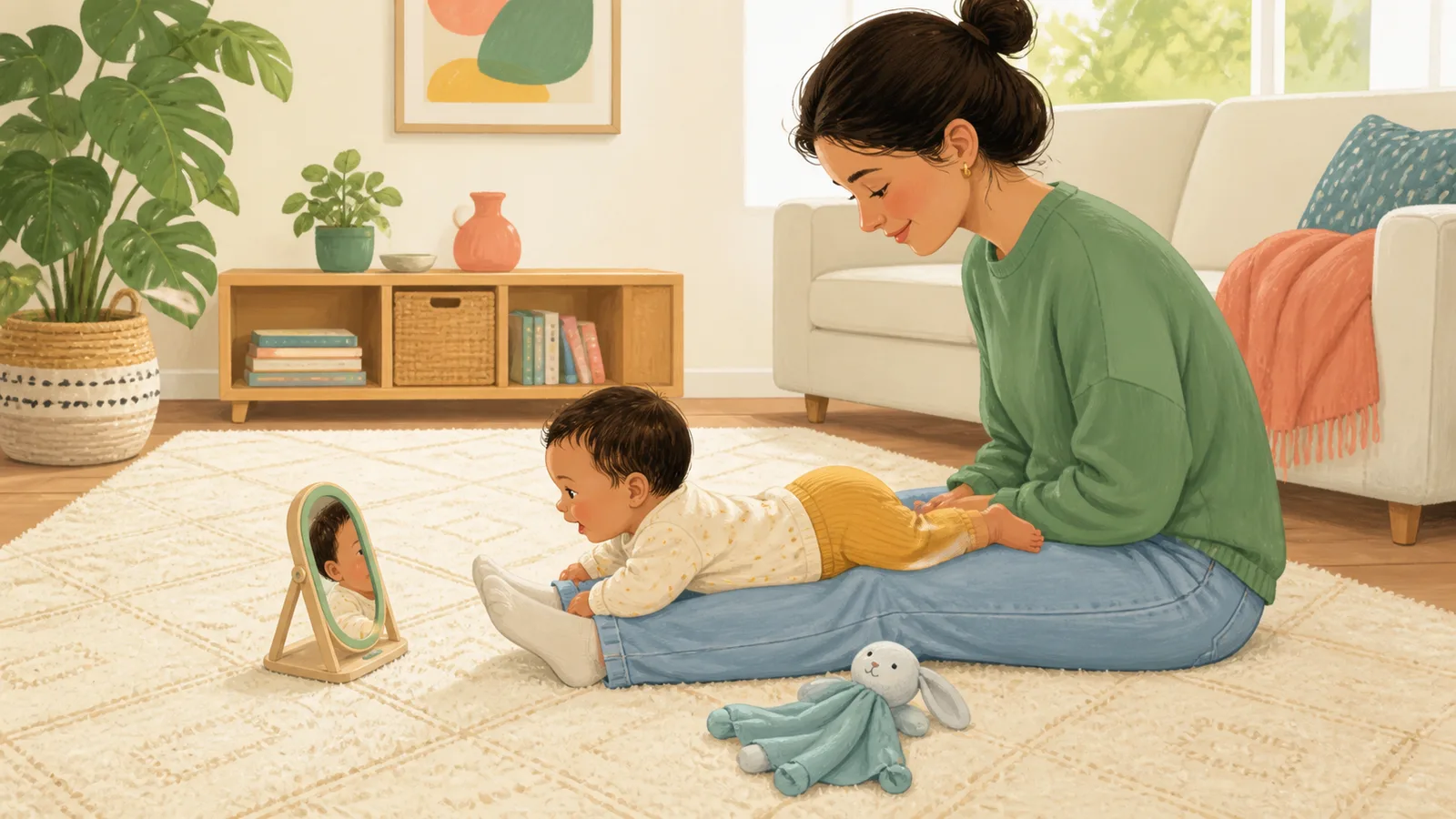
An unbreakable mirror can support face-to-face floor play and make tummy time more interesting. It should be a product designed for infant use, with no glass, sharp frame, loose film, unstable stand, or heavy component that can fall.
Place it on the floor during awake, supervised play. It is not a sleep-space accessory. Babies do not need to “recognize themselves” for the mirror to be worthwhile; changing reflections, light, and faces can be interesting without a developmental claim attached.
4. A soft fabric ball
A light, slow ball invites looking first and action later. An adult can roll it across the baby’s field of view, place it within an emerging reach, or gently roll it away after contact. Later, the baby may grasp, mouth, squeeze, or chase it.
Avoid pom-poms, glued decorations, pellet fillings that could escape through a seam, long cords, and pieces sized like a small ball. The Consumer Product Safety Commission treats small balls as a particular choking concern. “Soft” does not automatically mean suitable for an infant.
5. A simple play gym used only while awake
A play gym can create a defined floor-play space, but it is optional and has a short practical season in many homes. Look for a stable frame, secure connections, a washable mat, and hanging objects positioned so they do not rest on the baby’s face. Remove or change the setup when a baby can pull strongly, roll into the frame, or use it in a way the instructions do not support.
Do not move a sleeping baby into a gym, add pillows or positioners, or treat the mat as a safe sleep surface. For the same visual and reaching play, an adult can hold one object over an ordinary blanket on the floor—while remaining present—without buying a large structure.
6. A textured cloth or soft one-piece teething object
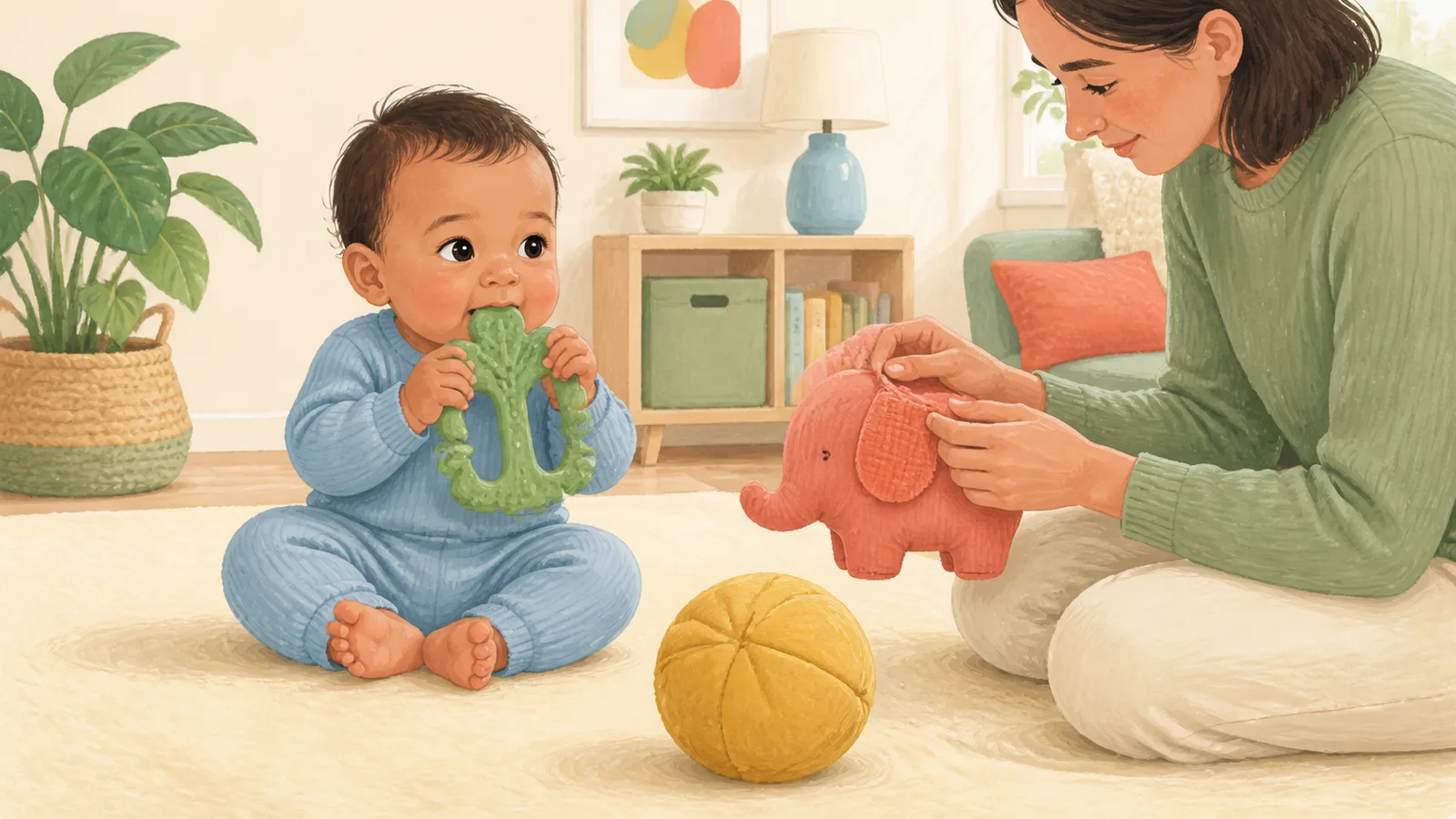
Mouthing is exploration, not a bad habit a toy must stop. A washable textured cloth can be squeezed, pulled, transferred, and brought to the mouth. A teething object may be useful when it is one-piece or securely constructed, intact, easy to clean, and labeled for the baby’s age.
Do not improvise with jewelry, key rings, remote controls, strings, water beads, or objects containing accessible batteries or magnets. A household item can look sturdy while containing a component never designed for repeated chewing and dropping. For more detail, see our guide to why babies mouth toys and how to set a safer exploration zone.
What makes a toy suitable at this age?
The label “sensory,” “Montessori,” “STEM,” or “educational” does not answer the essential questions. The American Academy of Pediatrics advises families to consider how a toy may actually be used or misused, the child’s abilities, and the supervision needed. The CPSC similarly tells families to follow age guidance and check for hazards such as small parts.
Use five filters:
- The action is available. The baby can notice, touch, grasp, mouth, or move the object without an adult performing the entire effect.
- The scale is appropriate. No component is a small part, and the overall shape does not create an avoidable obstruction or entrapment risk.
- The construction stays intact. Seams, fasteners, rings, coatings, and enclosed components withstand the toy’s intended use.
- The care routine is realistic. You know whether to wipe, surface wash, machine wash, or avoid immersion.
- The toy does not replace interaction. It gives the baby something to explore while leaving room for a caregiver’s voice, face, and response.
“BPA-free,” “non-toxic,” and “natural” are incomplete descriptions. They do not tell you whether a piece can detach, a sound is uncomfortably loud, a finish is damaged, or the product is being used outside its instructions.
A 60-second infant-toy safety check
Run this check when a toy arrives, after a hard drop, after washing, and whenever it comes out of storage.
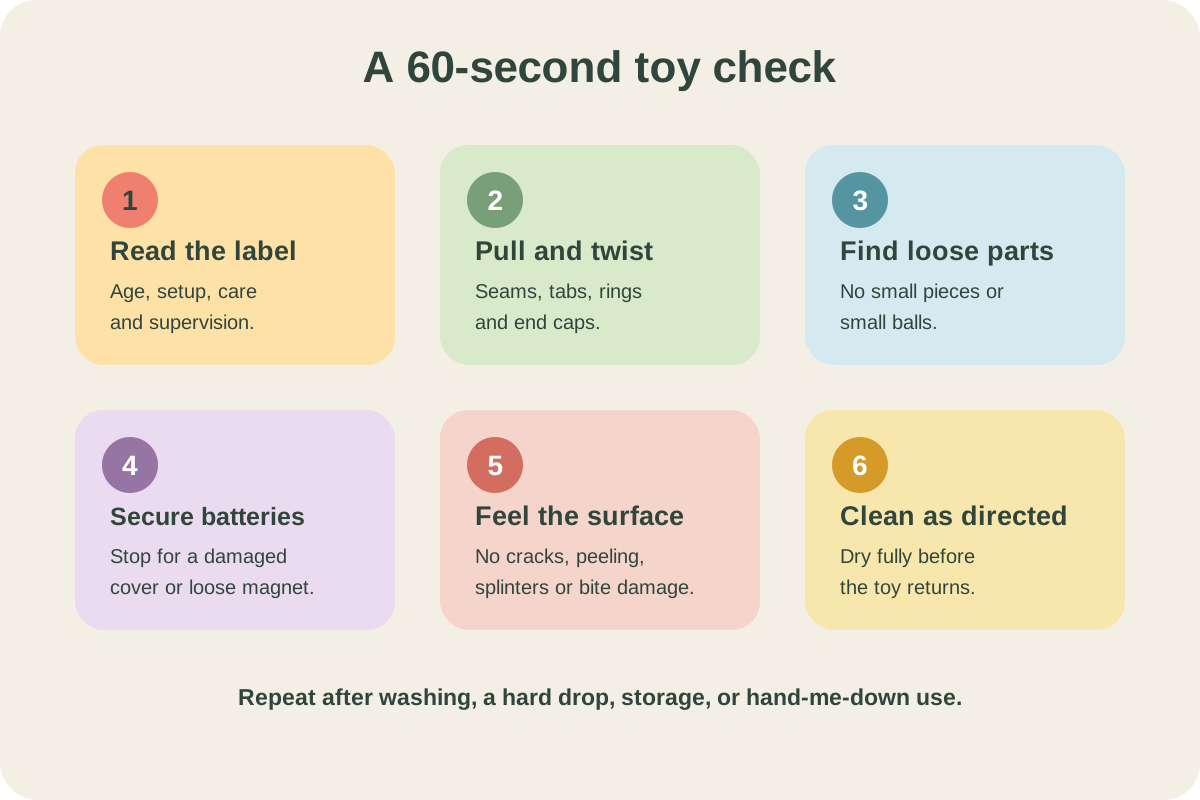
- Read the current age label and instructions. Age grading considers safety and how the toy is intended to be used; it is not merely a skill suggestion.
- Pull and twist likely failure points. Check knots, ribbons, rings, stitched tabs, glued eyes, wheels, end caps, and attachments.
- Look for small components. Keep small parts and small balls away from children under three. Do not rely on a homemade size test as a substitute for compliant age grading.
- Check batteries and magnets. Battery compartments should be secured as designed. Stop using an item if a cover is missing or damaged. Loose high-powered magnets are a severe ingestion hazard.
- Feel the whole surface. Retire products with splinters, cracks, sharp burrs, peeling coatings, exposed filling, or bite damage.
- Clean exactly as directed. A surface-wash toy may trap water if submerged; a fabric toy may need complete drying before reuse.
Check the CPSC recalls database for used products and whenever a product warning reaches you. A recalled toy should follow the stated remedy and should not be donated or resold.
A small-space starter set
You can cover the first six months with a small, overlapping group:
- one washable contrast card or cloth book;
- one light easy-grip rattle;
- one soft fabric ball;
- one textured cloth or suitable teething object;
- one baby-safe floor mirror; and
- a blanket or mat for supervised awake play.
That is not a required shopping list. One object may cover several roles, gifts may arrive later, and an adult’s songs and expressions require no storage. Keep only one or two objects within immediate reach at first. A pile of toys can obscure the one a baby was trying to track and creates more items to inspect.
For families managing a larger collection, the principle in our realistic toy rotation guide still applies: change the environment to solve a real problem, not to meet a display quota.
What not to buy yet
A toy that promises a milestone
No particular toy is required for sitting, speaking, reading, or becoming “smarter.” A product can offer a way to practice an action; it cannot guarantee an outcome. Treat milestone language as marketing unless a precise claim is backed by relevant evidence.
A complicated electronic activity center
Large electronic centers often do many things for the child and take up substantial floor space. If the baby cannot yet reach or control most features, the adult is operating an entertainment system. A simple object plus responsive conversation often creates a clearer exchange.
Small objects saved for “supervised use”
Close supervision is valuable, but it does not transform a choking or ingestion hazard into an infant toy. Keep beads, marbles, older siblings’ construction pieces, loose magnets, button batteries, and broken components physically separated.
Sleep-space toys
The AAP’s safe-sleep guidance calls for a firm, flat sleep surface without soft objects or loose bedding. Ordinary toys, stuffed animals, positioners, play-gym attachments, and sensory objects belong in awake play, not in the crib or bassinet. Hanging crib toys should be removed when the baby begins pushing up on hands and knees or by five months, whichever comes first, according to AAP toy-safety guidance.
How to play without turning it into a lesson
Offer one experience, then leave a little silence. A newborn may simply look. An older baby may swipe several times before making contact. That is the play.
Try these short exchanges:
- Hold a card still, notice where the baby looks, then slowly shift it a small distance.
- Shake a rattle once out of reach, pause, and answer any vocalization with your voice.
- Roll a soft ball slowly across the floor during tummy time.
- Place an easy-grip object near the baby’s hands and allow accidental contact to become intentional over time.
- Copy a coo or facial expression and wait for the baby’s next turn.
For more position changes and low-pressure ideas, use our tummy time play guide and floor play ideas before crawling. Short, repeated opportunities usually fit infant life better than a scheduled “activity session.”
Frequently asked questions
Do newborns actually need toys?
No. A safe environment and responsive interaction are enough to begin. A simple visual object can be convenient, but the AAP explicitly cautions that a certain toy is not needed for a child to reach a milestone.
Are black-and-white toys better for newborns?
High-contrast boundaries may be easier to notice than subtle designs, which is why these images are common. They are not required, and more contrast does not mean more development. Your face, a window edge, clothing patterns, and ordinary light-dark boundaries can also be interesting.
How many toys should a three-month-old have out?
There is no evidence-based number. One clear object within comfortable sight or reach can be enough for an exchange. Add variety across the day rather than surrounding the baby with every option at once.
Can babies use wooden toys?
Material alone does not determine suitability. An infant toy needs compliant age grading, safe proportions, smooth intact surfaces, secure construction, and care instructions. A heavy block designed for an older toddler is not automatically suitable because it is wood. Our wooden toy guide covers material and construction trade-offs for later stages.
When should I replace a baby toy?
Replace or retire it when a part loosens, a seam opens, the surface cracks or peels, a battery cover fails, cleaning cannot restore it safely, the product is recalled, or the baby begins using it outside the intended setup. A toy can also rest simply because it no longer interests the child.
Are noisy toys bad for babies?
Sound can be playful; uncontrolled loudness is the concern. Prefer low, gentle sound and adult-controlled distance. If a toy feels uncomfortably loud close to your ear, do not place it close to a baby’s. Stop if the baby startles repeatedly or turns away.
Sources and research note
This guide is based on public guidance from the American Academy of Pediatrics on selecting toys, its safe-toy checklist, the CPSC Toys Safety Education Center, the CPSC’s small-parts guidance and button-battery guidance, plus public-health play guidance from the NHS. LWT did not hands-on test or rank commercial products for this article. The recommendations compare toy types and observable design features rather than promising developmental results.