
Cause-and-effect play begins wherever a baby can notice, “When I do this, something changes.” A kick moves fabric. A hand hits a bowl and makes a sound. A dropped ball falls. A vocalization brings a caregiver’s warm reply.
The clearest experiences have a short delay, a repeatable relationship, and feedback that is interesting without overwhelming the baby.
Physical and social effects
Research on infant contingency often uses controlled tasks in which an infant action changes a sight or sound. These studies show that even young infants can learn some action-outcome relationships. They do not mean a baby understands causality in an adult, verbal sense.
Daily life adds social contingency. A baby looks, gestures, kicks, babbles, or pauses; an attentive adult notices and responds in a related way. Harvard’s “serve and return” framework describes these responsive exchanges as a key part of the child’s environment of relationships.
The two forms overlap. When a baby bangs a spoon and an adult says, “That was loud,” the baby receives both an acoustic consequence and a human response.
What it can look like across the first year
These are possibilities, not milestone deadlines:
- Early months: repeated looking, sucking, kicking, or arm movement may change what the baby sees, hears, or feels.
- Middle months: reaching, swiping, grasping, banging, and rolling make physical effects easier to repeat.
- Later months: dropping, filling, pushing, opening, closing, and simple gestures can produce longer action chains.
Development is uneven. A baby may detect one relationship but lack the motor control to repeat it neatly. Another may repeat the movement without caring about the outcome an adult expected.
Six simple play experiences
1. Copy and pause
When an alert baby makes a comfortable sound or movement, respond once, then pause. Let the baby’s next action guide you. This is a conversation, not an imitation drill.
2. Bowl sounds
For a baby sitting securely and ready to handle objects, offer an age-suitable lightweight bowl and broad wooden or silicone spoon under close supervision. Different surfaces change the sound. Keep volume gentle and inspect every object.
3. Slow ball roll
Roll a large age-appropriate ball down a very shallow cardboard ramp or between two adults. Later, position the ball where the baby can release it. A consistent path makes the result legible.
4. Container drop
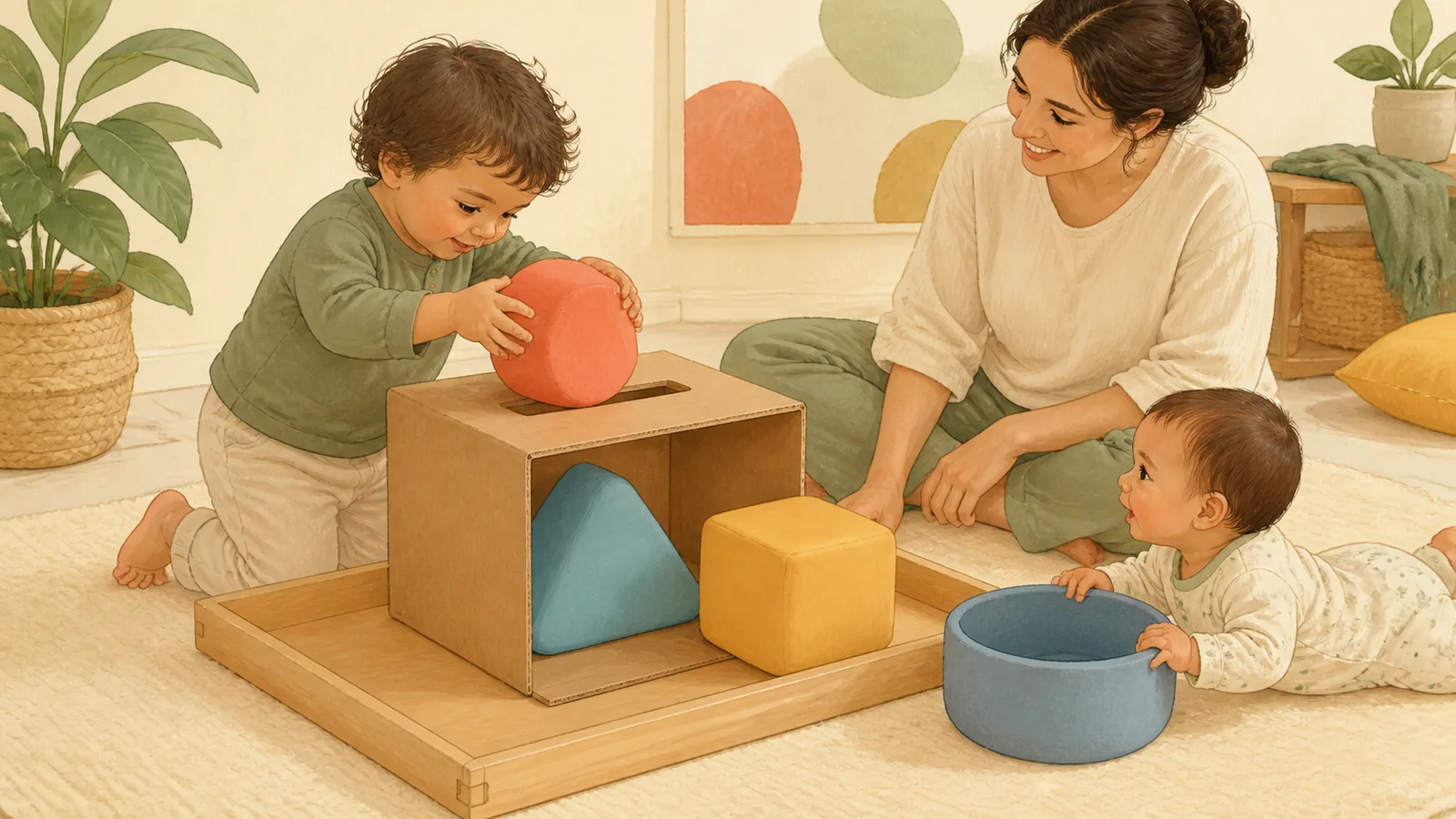
Use a wide, shallow container and one large suitable object. The baby releases it, hears it land, and retrieves or asks for it. Our posting and container play guide shows how to increase the challenge without rushing to narrow slots.
5. Fabric reveal
Place a light cloth partially over a familiar toy while the baby is awake and supervised. Leave an easy edge to pull. Never leave loose fabric with a sleeping baby or use it in an unattended sleep space.
6. Push and move
Put a large soft ball or lightweight block within reach. A push changes its position. Place it close enough that a small action works before increasing distance.
Why dropping happens again and again
Dropping produces reliable information about gravity, sound, surfaces, distance, and adult response. It also practices release. The baby may be exploring one or all of these.
You do not need to retrieve forever. Offer two or three safe objects on a washable floor, move the high chair away from fragile areas, or say, “One more return, then they stay down.” Predictable limits preserve the relationship without turning an adult into a toy dispenser.
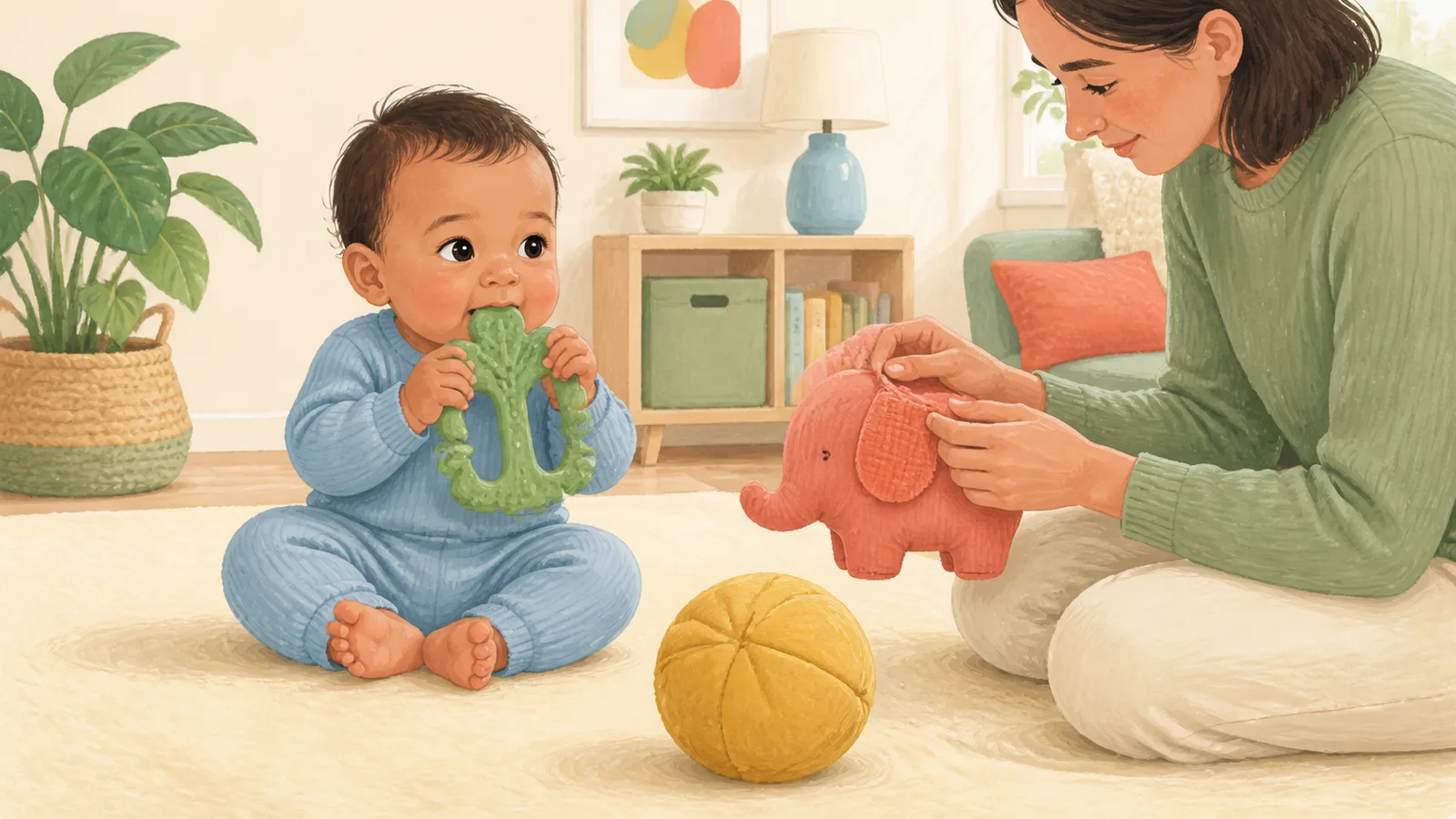
Mouthing often accompanies this exploration. The guide to why babies mouth toys covers material inspection and choking boundaries.
Are electronic cause-and-effect toys better?
Not by default. A button that triggers a light and sound is a contingency, but extra flashing, music, and unrelated speech can make it less obvious which action caused which response. Electronic toys also introduce battery-compartment, sound-level, and breakage considerations.
Choose feedback that is:
- immediate enough to connect;
- proportional to the action;
- repeatable but not automatic;
- controllable by the child; and
- easy to stop when the child looks away or becomes distressed.
A wooden spoon, ball, flap, or responsive face can meet these criteria without electronics.
When to simplify
If the baby startles, turns away, arches, fusses, or cannot locate the source, reduce intensity and number of effects. Use one object on a plain surface. Slow your response. Allow a long pause.
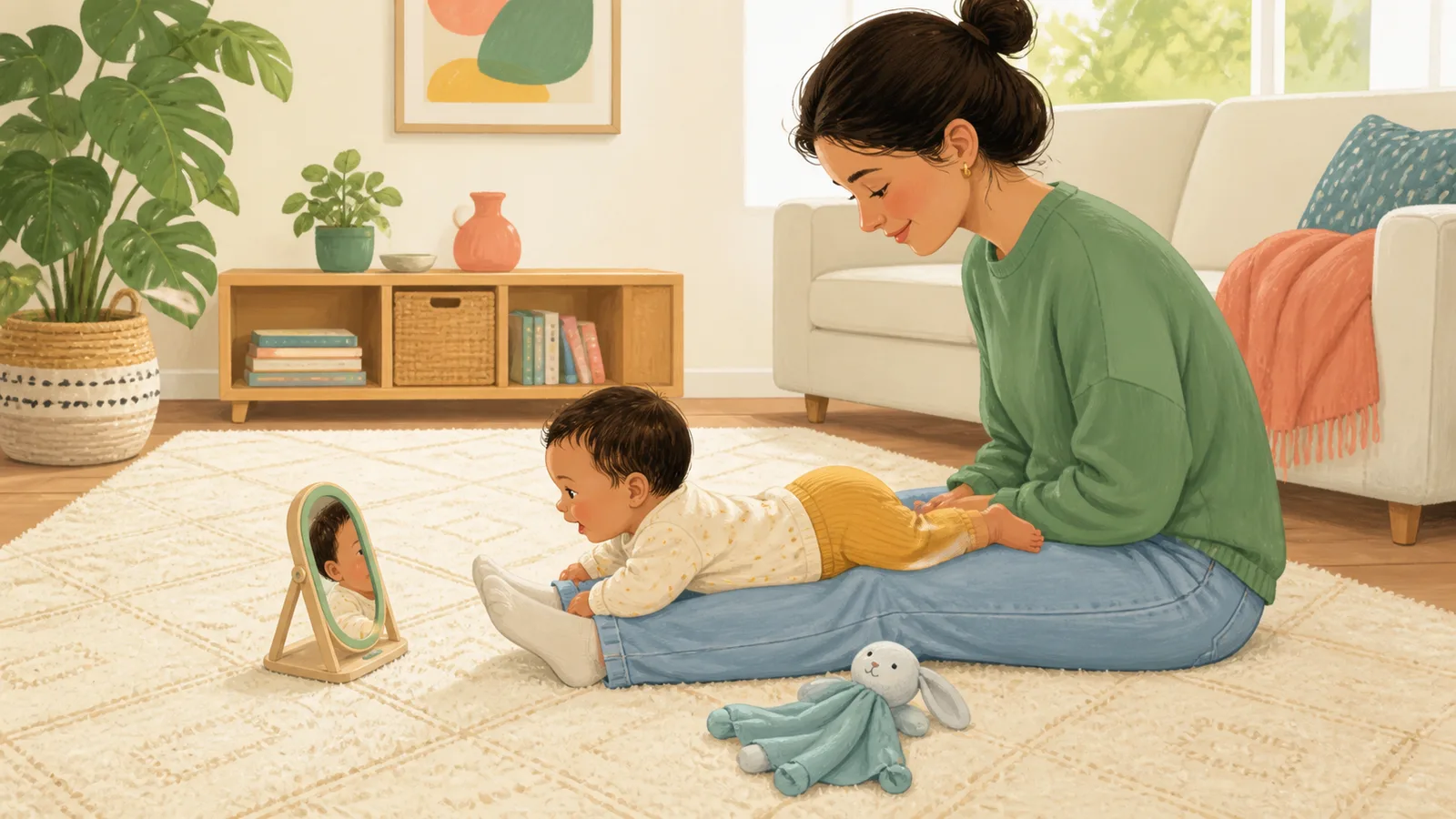
If the baby cannot yet reach comfortably, adjust position rather than repeatedly moving their hand through the action. Our tummy-time play ideas offer several awake positions so play does not depend on one posture.
An important research-safety boundary
Classic contingency studies sometimes connected infant limb movement to a mobile under controlled research conditions. Do not reproduce this by tying a ribbon, cord, elastic, or toy to a baby’s wrist, ankle, crib, or sleep space. Entanglement and safe-sleep risks outweigh the value of copying a laboratory paradigm. Daily play offers many untethered alternatives.
Frequently asked questions
When do babies learn cause and effect?
Research finds sensitivity to some contingencies in early infancy, while the actions and relationships babies can control expand across the first year. There is no single moment when all cause-and-effect understanding arrives.
Is peekaboo cause-and-effect play?
It can include predictable sequence and social contingency, especially as the baby signals for repetition or begins to reveal the face. It also involves anticipation and interaction.
Does a baby need a busy board?
No. A busy board can offer mechanical actions if age appropriate and securely constructed, but ordinary objects and responsive interaction provide many clearer relationships.
Why does my baby press a button without watching the result?
The movement itself may be interesting, the feedback may be too delayed or intense, or attention may have shifted. Do not require the “correct” response; simplify and observe.
Sources and research note
This article draws on the 2025 review A Quarter Century of Research on Infant Contingency Learning, a study of contingency learning and infant reactivity, and a research review of contingent interaction, attention, and language. Social context comes from Harvard’s serve-and-return guidance and the AAP clinical report The Power of Play. Safety criteria follow the CPSC toy safety center.