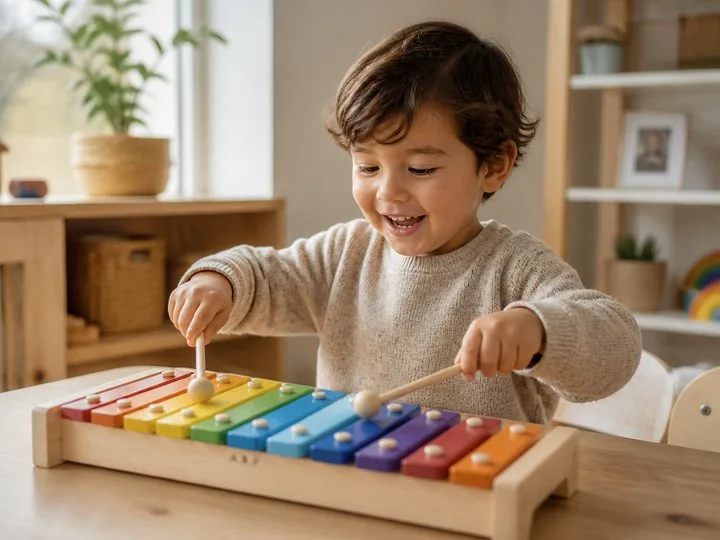
Preschool music play can be loud, but it does not have to be. A child can explore rhythm by walking, melody by echoing two notes, and sound by drawing what they hear. The goal is participation and attention—not a perfect beat or public performance.
Quick answer
Start with a game that lasts one song or a few turns. Use a clear contrast—fast and slow, sound and silence, high and low—and let the child lead a round. If noise is difficult for anyone in the home, use body movement, scarves, finger taps, humming, headphones only at safe levels, or sound-making in another room.
Pick an activity
| Activity | Main idea | Noise | Materials |
|---|---|---|---|
| Copy my clap | Rhythm and turn-taking | Medium | None |
| Walk the beat | Pulse and movement | Low | Music optional |
| Freeze and melt | Start/stop, body control | Medium | Music or singing |
| Sound map | Listening and representation | Quiet | Paper, pencil |
| Kitchen sound sort | Timbre and material | Adjustable | Safe utensils and containers |
| Name rhythm | Syllables and pattern | Low | None |
| Scarf conductor | Tempo and dynamics | Quiet | Scarves or ribbons without long cords |
| Story soundtrack | Representation | Adjustable | Voice or instruments |
| Mystery sound | Auditory attention | Quiet | Household objects |
| Water-level tones | Pitch observation | Low | Adult-supervised glasses and water |
| Homemade shaker test | Material and design | Adjustable | Sealed containers |
| Draw the music | Sound-to-mark connection | Quiet | Paper, crayons |
| Call and response | Memory and social exchange | Adjustable | Voice or instrument |
| Family sound walk | Environmental listening | Quiet | None |
Rhythm and movement games
1. Copy my clap
Clap a two- or three-beat pattern and invite an echo. Then let the child lead. Use knees, shoulders, or quiet fingertip taps for variety. If copying is frustrating, clap together first.
2. Walk the beat
Choose a comfortable steady song or sing one. Walk, sway, or roll a ball on the pulse. Change the movement rather than speeding the music beyond safe movement.
3. Freeze and melt
Move while sound plays, freeze when it stops, then “melt” slowly to the floor. Children who dislike sudden stops can watch a visual cue or control the pause themselves.
4. Name rhythm
Tap the syllables in family names, foods, or favorite animals. Combine two names into a pattern. Keep pronunciation natural; the point is noticing rhythm in language, not drilling phonics.
5. Scarf conductor
Move a scarf high, low, quickly, slowly, broadly, or in tiny motions while another person hums or taps to follow. Avoid long cords and supervise fabric around young children.
Listening and sound games
6. Make a sound map
Sit by an open window, in a hallway, or outdoors. Mark each sound with a shape or line and place it roughly where it came from. There is no correct symbol system.
7. Sort kitchen sounds
Tap a cardboard box, wooden spoon, metal pot, and plastic container gently. Sort them as ringing, short, soft, deep, or any words the child invents. Never strike close to an ear.
8. Mystery sound
Hide one safe object behind a screen and make a gentle sound. Let the child guess, then reveal and compare. Use only a few familiar choices so the game is about listening, not tricking.
9. Family sound walk
Walk a short route and find a repeating sound, a far sound, a human-made sound, and a natural sound. Stay aware of traffic; listening should not reduce situational awareness.
Make and represent music
10. Create a story soundtrack
Choose a familiar story and add three cues: footsteps, weather, and a character sound. The child can narrate, perform, or direct. This pairs well with rainy-day pretend play.
11. Compare water-level tones
An adult fills sturdy identical glasses with different water levels. Tap gently with a wooden utensil and notice pitch. Keep glass and water under direct control; use sturdy plastic containers if breakage is a concern, though the sounds will differ.
12. Test homemade shakers
Place different large fillers in securely closed containers and compare the sound. Seal containers so they cannot open during play, inspect every time, and keep dry rice, beans, beads, and caps from children who mouth objects. A commercial age-rated instrument may be safer.
13. Draw the music
Play or sing a brief piece and draw lines that match how it feels—long, bouncy, crowded, sparse. Compare two contrasting selections. Do not evaluate whether the picture looks musical.
14. Call and response
Sing two comfortable notes or tap a short phrase; the child answers with the same or a different phrase. Treat their variation as a musical reply, not an error.
What music research can say
Music training has been studied in relation to language, executive function, social interaction, and motor coordination. Recent systematic reviews and meta-analyses report some positive effects, but results vary with study design, training intensity, comparison group, age, and outcome measure. Far-transfer claims—such as music making children generally smarter—remain contested.
A song at home is also not equivalent to a structured multi-month training program studied in a trial. The defensible promise is immediate: music play offers a shared way to listen, move, imitate, invent, and take turns. Those experiences are worthwhile without attaching an IQ claim.
Hearing-aware music play
The AAP warns that excessive sound from personal listening devices, concerts, fireworks, speakers, and noisy toys can damage hearing. Risk depends on loudness, duration, and distance.
- Keep speakers and instruments away from ears.
- Use the lowest comfortable volume and shorten louder activities.
- If adults must raise their voices to communicate at close range, reduce the sound or move away.
- Check electronic toys before handing them to a child; a speaker can be much louder at ear level.
- Use hearing protection designed and fitted for the situation when high noise cannot be avoided.
- Seek medical advice for pain, ringing, muffled hearing, or concern after a loud event.
Quiet participation is still music. A child can conduct, arrange picture cues, move a scarf, tap fingers, or watch before joining.
Adapt for different needs
Children with hearing differences can participate through vibration, visual rhythm, movement, signed songs, and accessible instruments, guided by their family and specialists. Children sensitive to sound may need predictability, control of the stop signal, lower-volume materials, distance, or a quieter parallel role. Never use sudden sound as a surprise test.
For children seeking stronger movement, combine rhythm with a safe march, push-pull action, or outdoor route. Our outdoor play guide offers options beyond the living room.
Frequently asked questions
Do preschoolers need music lessons?
No. Lessons can suit an interested child and family, but singing, moving, listening, and playful exploration at home are meaningful forms of music participation.
What instruments are best for preschoolers?
Choose age-rated, durable instruments that can be used at a comfortable volume and do not release small parts. Simple shakers, hand drums, rhythm sticks used with space, and keyboards with volume control can work.
How long should a music activity last?
Stop while engagement remains positive. A few focused turns may be enough. There is no required duration for these games.
Is background music good for play?
It depends. Some children enjoy it; others find it distracting or tiring. Try play with and without music and observe rather than assuming constant sound is enriching.
Can music help with language development?
Songs can offer repetition, rhythm, shared attention, and playful sound patterns. Research is promising in some contexts, but a music activity is not a treatment or a guaranteed language intervention.
What if my child refuses to sing?
Offer non-vocal roles: conducting, movement, instrument choice, sound mapping, or listening. Participation should not depend on performing for adults.
Sources and evidence notes
- Recent PubMed- and PMC-indexed systematic reviews and meta-analyses of music training and children’s executive functions.
- American Academy of Pediatrics / HealthyChildren.org, guidance on noise exposure and hearing protection.
- PBS Kids for Parents, developmentally oriented music-play suggestions.
- Parent discussions used only to identify practical concerns about noise, lessons, and reluctant singers.