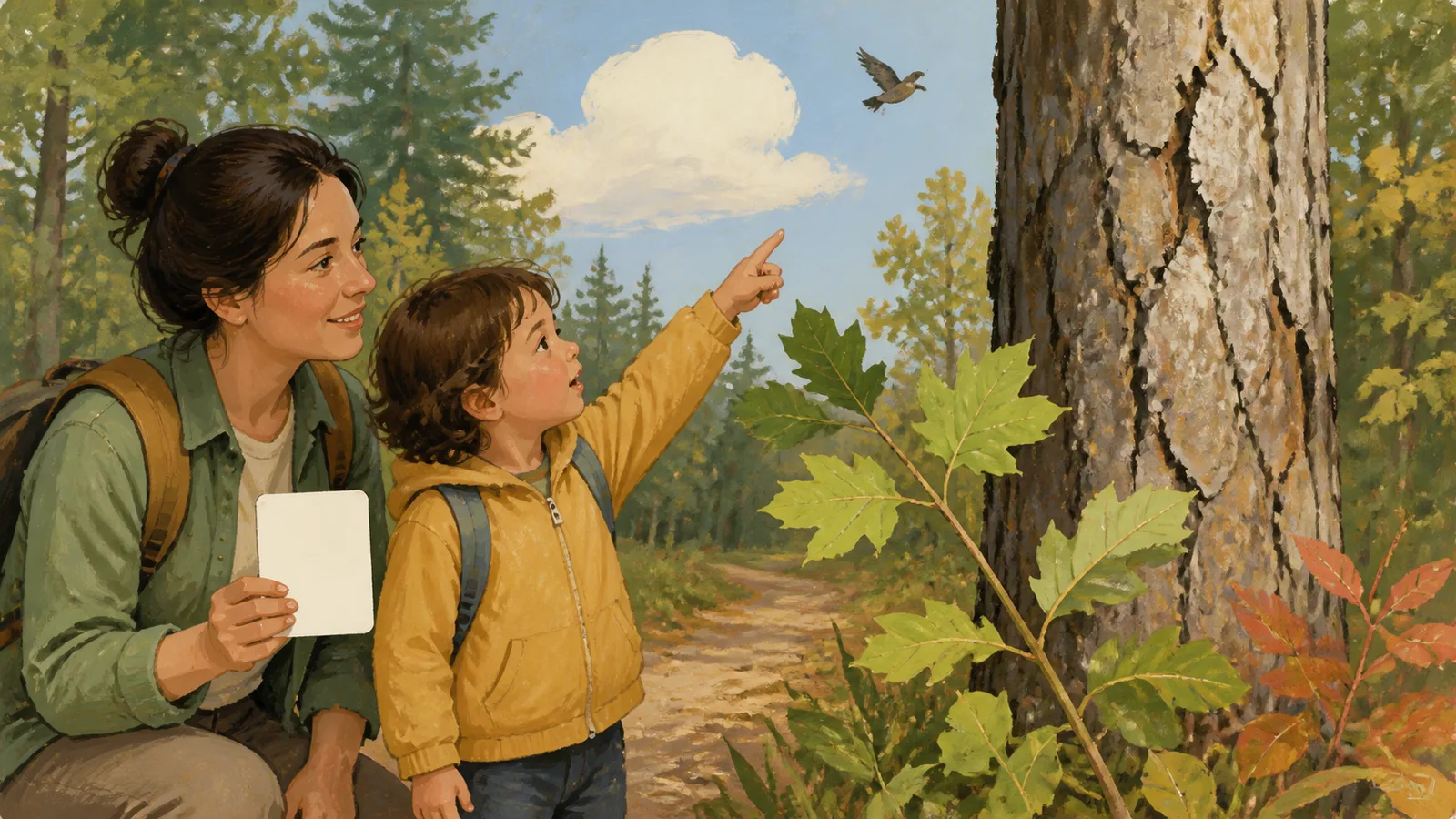
A preschool nature hunt works better as an invitation to notice than a race to fill a bag. Say each prompt aloud, let the child interpret it, and leave natural objects where they are.
A ten-prompt hunt you can use anywhere
Find something that:
- moves without anyone touching it;
- makes a sound;
- has more than one color;
- is taller than your hand;
- makes a shadow;
- feels rough when an adult says it is safe to touch;
- is shaped like a line, circle or spiral;
- shows that an animal was nearby;
- has changed since your last visit;
- you want to remember.
These prompts work on a sidewalk, courtyard, beach overlook, park path or window view. They avoid promising that every child will find a pine cone, red flower or particular bird.
Four ways to “collect” without taking
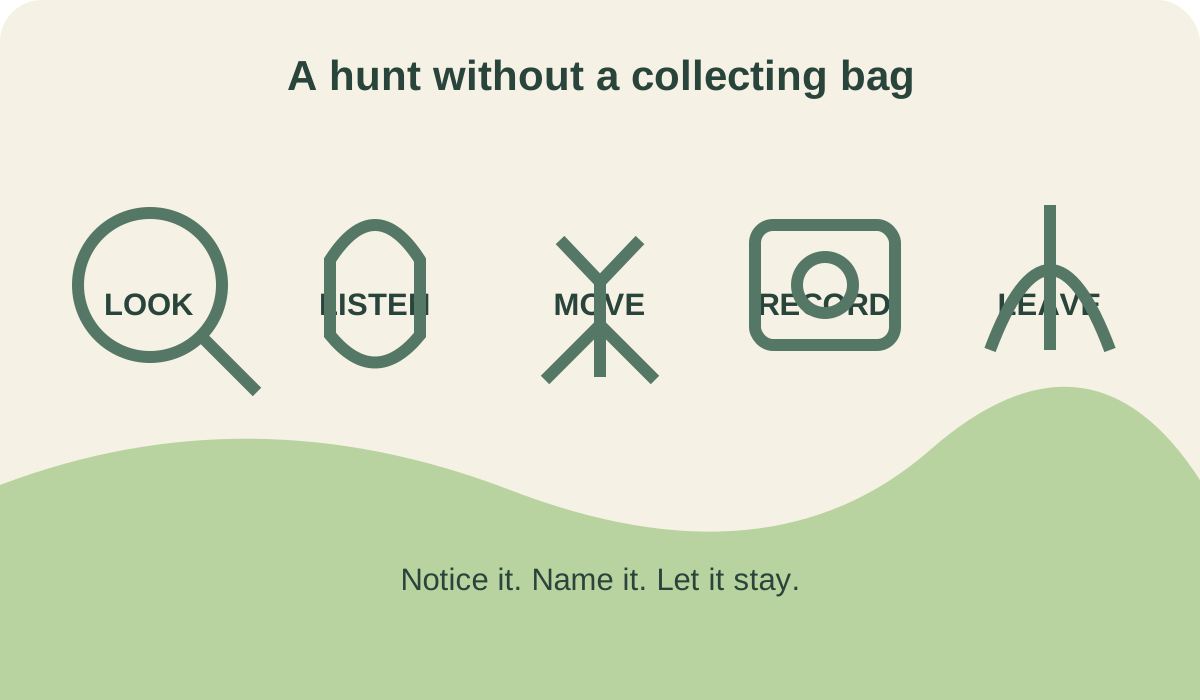
Point and name
The simplest version needs no supplies. Take turns pointing. An adult can add precise but ordinary words—edge, underneath, beside, flutter, damp—without turning every find into a quiz.
Photograph
The adult can hold the device while the child chooses the frame. Take one image per prompt rather than documenting the entire walk. Never step off a safe path or approach wildlife for a closer picture.
Sketch
Bring one clipboard, paper and a thick pencil. A mark, invented symbol or dictated sentence counts. The drawing is a memory tool, not a test of realism.
Move like the find
Sway like grass, stretch like a branch or take tiny steps like an insect. This version works well when stopping to draw is frustrating. For a compact paved area, pair it with the movement formats in our small outdoor-space guide.
Set the boundary first
Before saying “go,” name the physical limit: stay on this side of the path, stop at every driveway, and ask before touching. Adults remain responsible for traffic, water, cliffs, unstable ground, weather and other site hazards.
Do not taste unknown plants or mushrooms. Keep distance from nests, dens and wildlife; never feed animals. If a child finds a feather, flower, rock or shell, admire it where it is. National Park Service and Leave No Trace guidance supports leaving natural and cultural objects in place.
The all-year outdoor-play guide covers heat, cold and changing conditions. When the challenge is climbing or balancing rather than observing, use the risk-versus-hazard process in our risky-play explainer.
Adapt the hunt
For a two-year-old, offer two choices: “Can you find something moving or something yellow?” For ages five to seven, invite a relationship: “Find something that gives shelter” or “find evidence of water.” An older sibling can be the prompt reader, but should not correct every answer.
For low vision, emphasize sound, temperature, safe textures and scents that can be noticed without close contact. For limited mobility, define the search area from an accessible path and bring distant details closer with binoculars. For children who prefer predictability, show three prompts before leaving and allow the same route each time.
If language is emerging, gestures and matching are valid participation. The aim is shared attention, not a vocabulary performance.
Let the child design round two
After three or four adult prompts, ask the child to invent one. Their category may be wonderfully specific: “something a tiny dragon could hide under.” Follow it if it stays within the site boundary. Child-made prompts add imagination without pretending the hunt must deliver a developmental outcome.
Stop when the child starts running indiscriminately, repeatedly asks to collect, or loses interest. A four-find walk is complete. Return another day and notice what changed.
Frequently asked questions
Can children pick fallen leaves?
Rules vary by place, and even fallen material can serve habitat or be protected. A look-and-leave practice is simple, respectful and works everywhere.
What if we live in a city?
Search for shadows, wind, birds, weeds through pavement cracks, clouds, bark, water marks and animal tracks. “Nature” is not limited to wilderness.
Should I print a checklist?
Only if it helps your child. Spoken prompts, three hand-drawn symbols or a photograph can reduce paper and reading demands.
Sources and research note
The no-collection approach follows the National Park Service Leave No Trace principles, Leave No Trace guidance to leave what you find, and NPS wildlife-viewing practices. Prompt design was informed by Early Science Matters and NAEYC’s developmentally appropriate practice principles. Plant warnings use Poison Control.