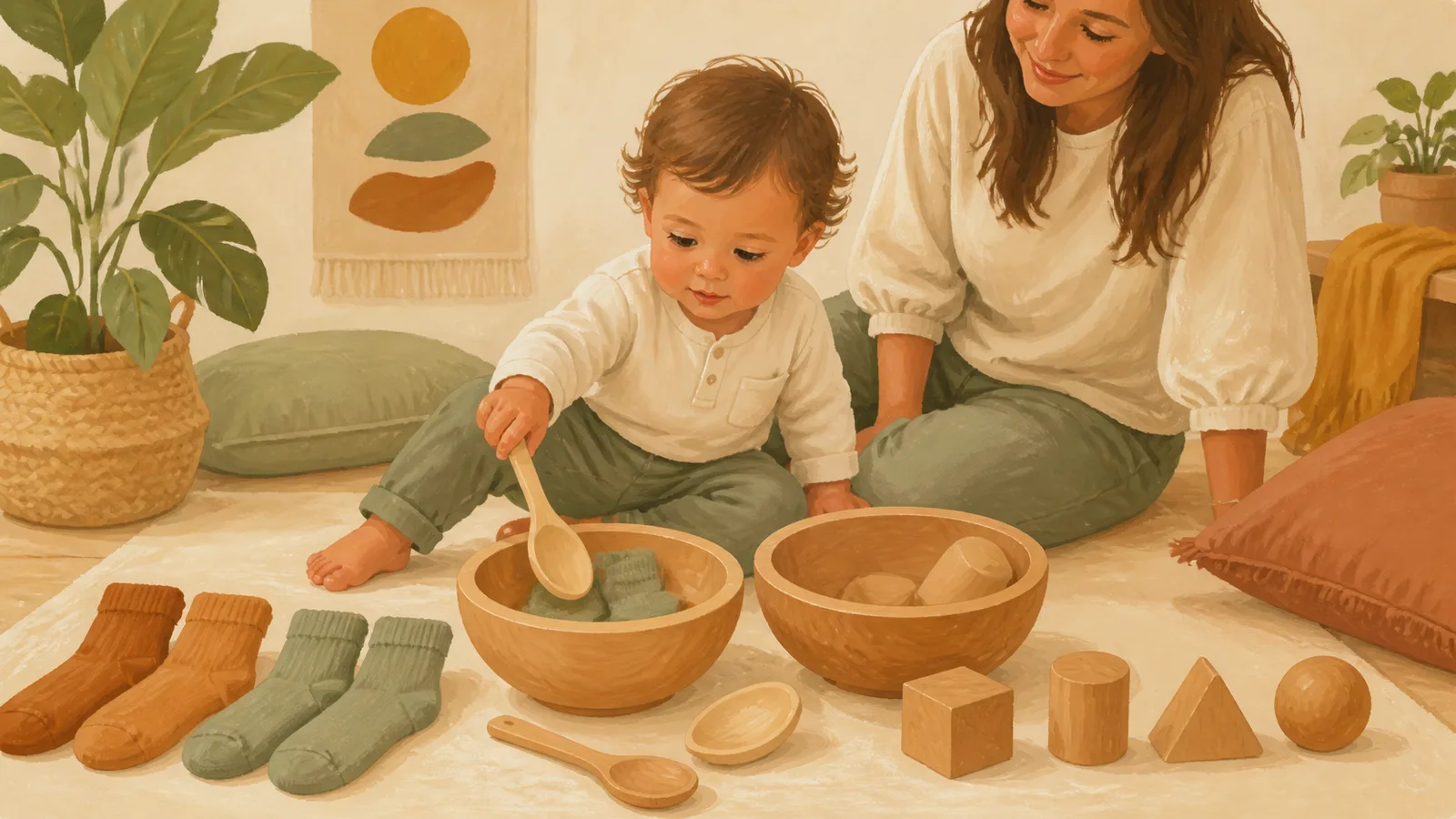
For a one-year-old, “put the red ones here and blue ones there” may combine too many problems: notice color, understand the words, remember the rule, inhibit random dropping, grip the object, and place it accurately. Begin with differences the child can see and actions they can already control.
Four tasks adults often call sorting
| Task | Example | Hidden demand |
|---|---|---|
| Matching identical objects | put the second spoon beside the first | scan and recognize sameness |
| Grouping by obvious type | socks in one bowl, wooden spoons in another | hold one category boundary |
| Fitting | rotate a circle into one opening | align hand, object, and space |
| Following a named rule | “all the red blocks here” | understand language and maintain adult’s rule |
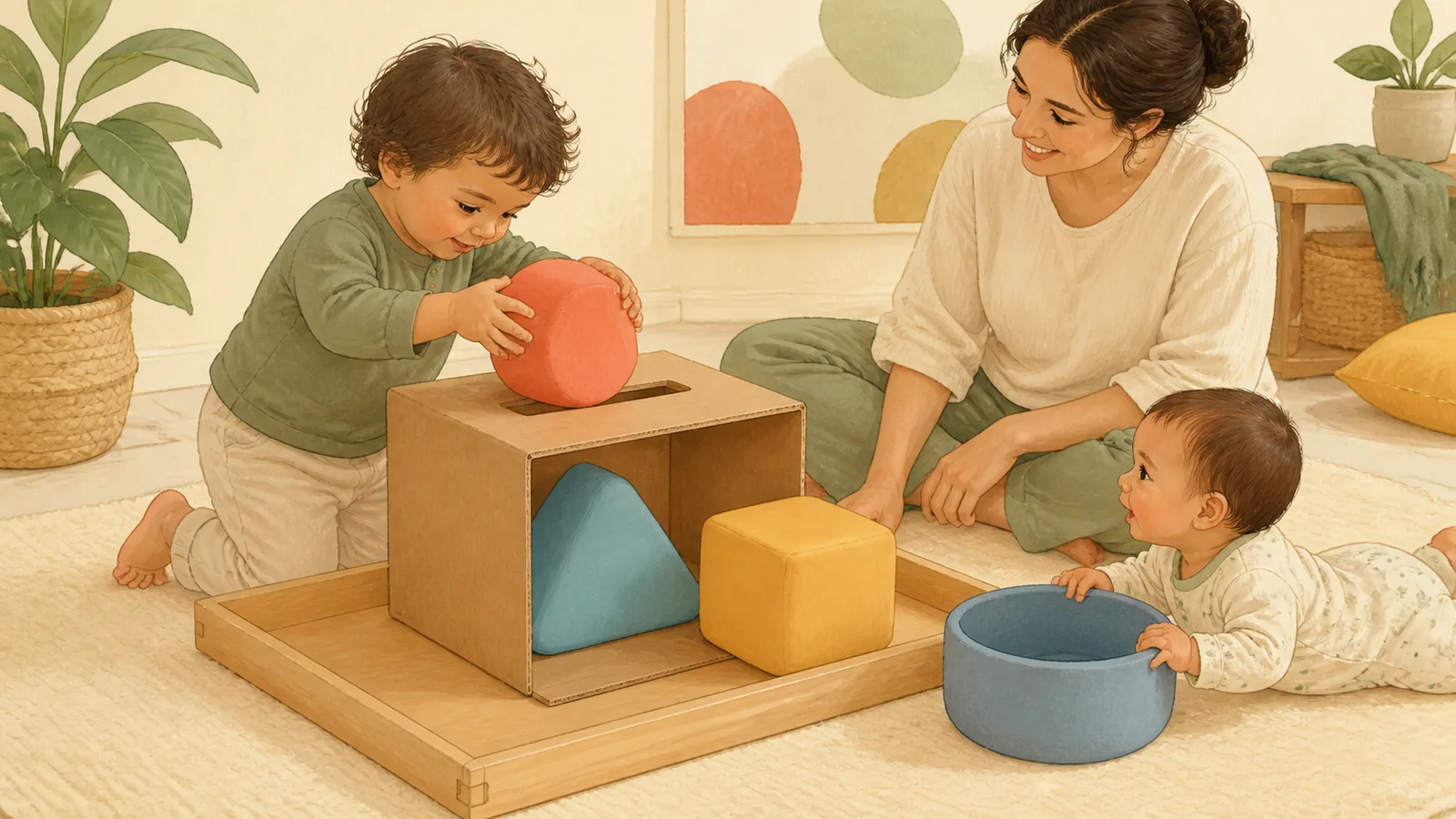
A child may succeed at one and ignore another. A shape sorter is not simply a category test; it adds rotation, depth, posting, and often a lid that moves.
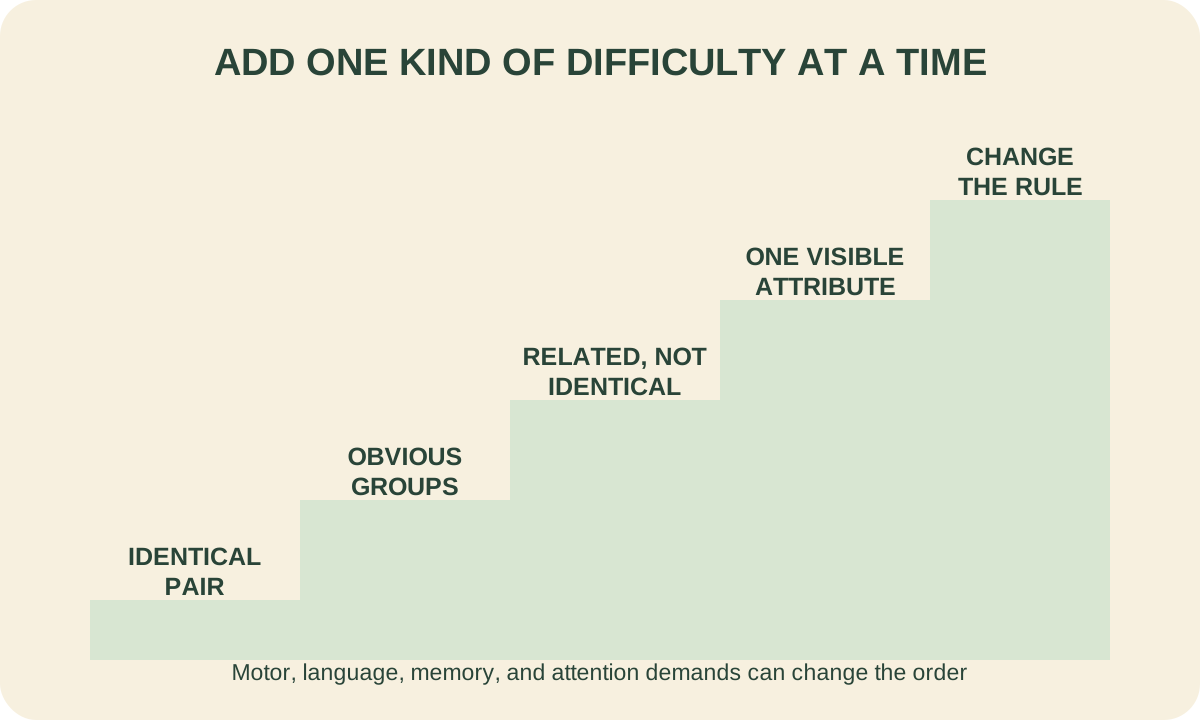
A gentle difficulty ladder
Step 1: Find the other one
Place one large sock and one wooden spoon in front of the child. Hand them a matching sock and say, “Another sock.” Do not require placement. Looking, touching, or carrying it toward the first can show recognition.
Step 2: Choose between strong contrasts
Use two large, safe categories that differ in material, shape, and function—for example, soft socks and broad wooden spoons. Put one of each in separate wide bowls and offer another object.
Step 3: Group without a verbal test
Begin placing objects yourself slowly, then pause. The child can continue, dump both bowls, or invent another arrangement. Avoid repeatedly asking, “Where does this go?”
Step 4: Match related, not identical, items
Pair two different socks, two spoons of different sizes, or two toy animals. Now the child must recognize a broader relation rather than exact appearance.
Step 5: Sort by one visible attribute
Use blocks that are identical except for a very different color or size. Demonstrate the rule once. Color words may accompany the action, but correct naming is not required.
Step 6: Change the rule later
An older toddler may sort the same objects first by color, later by shape. Do not switch mid-task merely to catch an error. Flexible reclassification is more complex than one stable grouping.
Six household play ideas
All materials must be large, intact, clean, and suitable for the child’s current mouthing behavior.
- Laundry pairs: two pairs of clearly different adult socks.
- Kitchen families: broad wooden spoons and silicone spatulas in separate bowls.
- Lid-free containers: match two large containers to two visibly different locations; omit tricky lids initially.
- Block partners: pair identical large blocks before trying color groups.
- Toy and picture: match one familiar large toy to a clear photo of that exact toy; this is harder than object-to-object matching.
- Room delivery: carry two familiar objects to their real locations—a washcloth to the bathroom basket and spoon to the kitchen container—with adult accompaniment.
Our safe household-object guide provides a six-part inspection. Avoid coins, buttons, bottle caps, pom-poms, beads, dried foods, magnets, and other small loose parts.
If the shape sorter causes tears
Remove the lid and let the child drop shapes into the open container. This isolates release and containment. Next, offer only the easiest opening and corresponding piece. Stabilize the box so it does not slide. Finally, add a second strongly contrasting shape.
If a piece reaches the correct hole but will not rotate, acknowledge the motor problem instead of repeating the shape name. A shape sorter can be cognitively recognized and physically difficult.
The progression in posting and container play moves from open containers to narrower orientations. It can be more satisfying than introducing a many-hole cube at once.
Filling, dumping, and lining up are not mistakes
A toddler may put every object in one bowl, carry them away, dump them, or form a line. These actions investigate containment, movement, sound, and arrangement. Our toddler play-schema guide helps adults respond to repeated patterns without assigning a rigid label.
If you want to keep a sorting option available, leave two bowls beside the objects but do not constantly reset the child’s work. The child can discover or ignore the affordance.
Talk about what is visible
Use short descriptions: “Two socks,” “This spoon is long,” “You put both soft ones there.” Contrast words—same/different, big/small, soft/hard—may be more useful than turning every session into color naming.
Research has found relationships between categorization and naming, but language and categorization influence one another in complex ways. Naming more objects during a task does not guarantee the child will sort them, and silent sorting does not mean no thinking occurred.
What the research tells us
Laboratory studies have found spontaneous basic-level sorting in some 18-month-olds and developmental patterns from 12 to 30 months. Children in group studies generally categorized high-contrast sets before lower-contrast sets. Performance depends on the objects, instructions, scoring rule, familiarity, and motor demands.
These findings justify starting with obvious contrasts. They do not create a home deadline or prove that sorting practice accelerates intelligence.
When to ask a professional
Disliking a shape sorter or ignoring a color game alone is not a developmental diagnosis. If you have broader concerns about loss of skills, movement, hearing, vision, communication, interaction, or everyday problem-solving, record specific examples and discuss them with the child’s healthcare professional. Use standardized screening rather than a toy as the test.
Frequently asked questions
Should a one-year-old sort by color?
Some older one-year-olds may group strongly contrasting colors, but it is not a universal requirement. Start with identical objects or obvious categories and avoid requiring color words.
Is matching easier than sorting?
Matching one identical pair usually has fewer category and memory demands than sorting several objects into two groups. The motor setup can reverse that difficulty, so observe the whole task.
How many objects should I offer?
Begin with two examples already placed and two to four objects to explore. Add more only when the pattern remains clear and interesting.
Do flashcards help?
Real object-to-object matching is more concrete. Picture matching can be offered later as another form of representation; flashcards are not necessary.
Sources and research note
Evidence comes from research on basic-level sorting in 18-month-olds, object categorization from 12 to 30 months, and verbal labels during sorting by 16–23-month-olds. Practical context comes from Harvard’s games and activities guide, a Head Start science guide, and CPSC small-parts guidance.