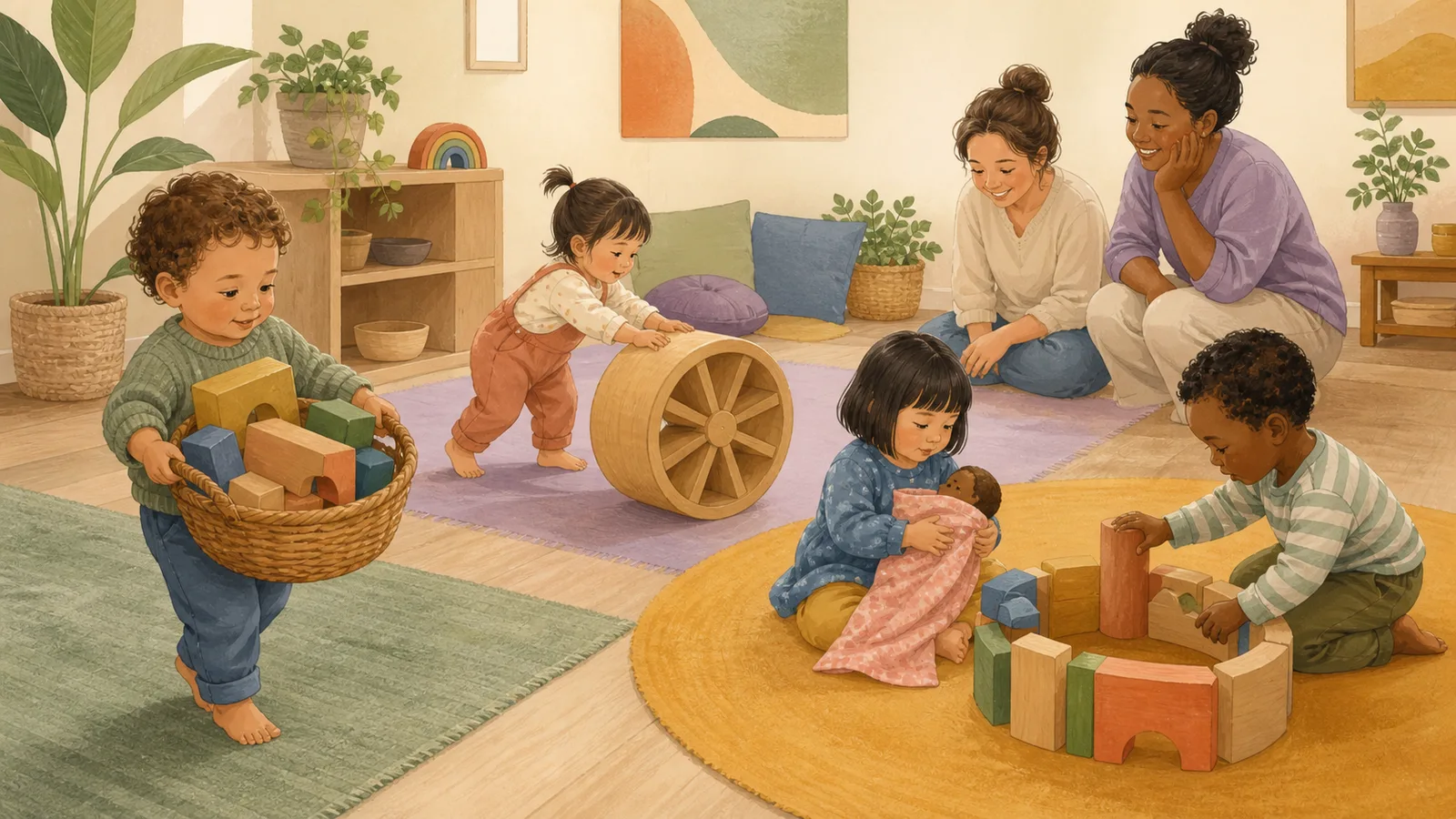
If a toddler carries every block into the hallway, drops spoons from the high chair, wraps animals in cloth, or spins every wheel, adults may describe the pattern as a play schema. The term can be useful: instead of asking how to stop an apparently random behavior, you ask what action the child is repeating and where that action can happen safely.
It can also be overused. A schema is not a diagnosis, a fixed personality, or proof of what a child’s brain “needs.” Lists vary, patterns overlap, and one afternoon of throwing does not reveal a child’s developmental profile.
A practical definition
In early-years education, schema language refers to recurring patterns of action and thought that children use across materials and situations. A child may transport sand, toy animals, socks, and cups. Another may make boundaries with blocks, tape, cushions, or drawn circles.
The valuable part is the observation:
The child keeps moving a group of objects from one location to another.
The less useful leap is:
This child is a Transporter, so every activity must fit that identity.
Observe over time, keep alternatives open, and use ordinary words when they are clearer.
Eight common patterns—and what to offer
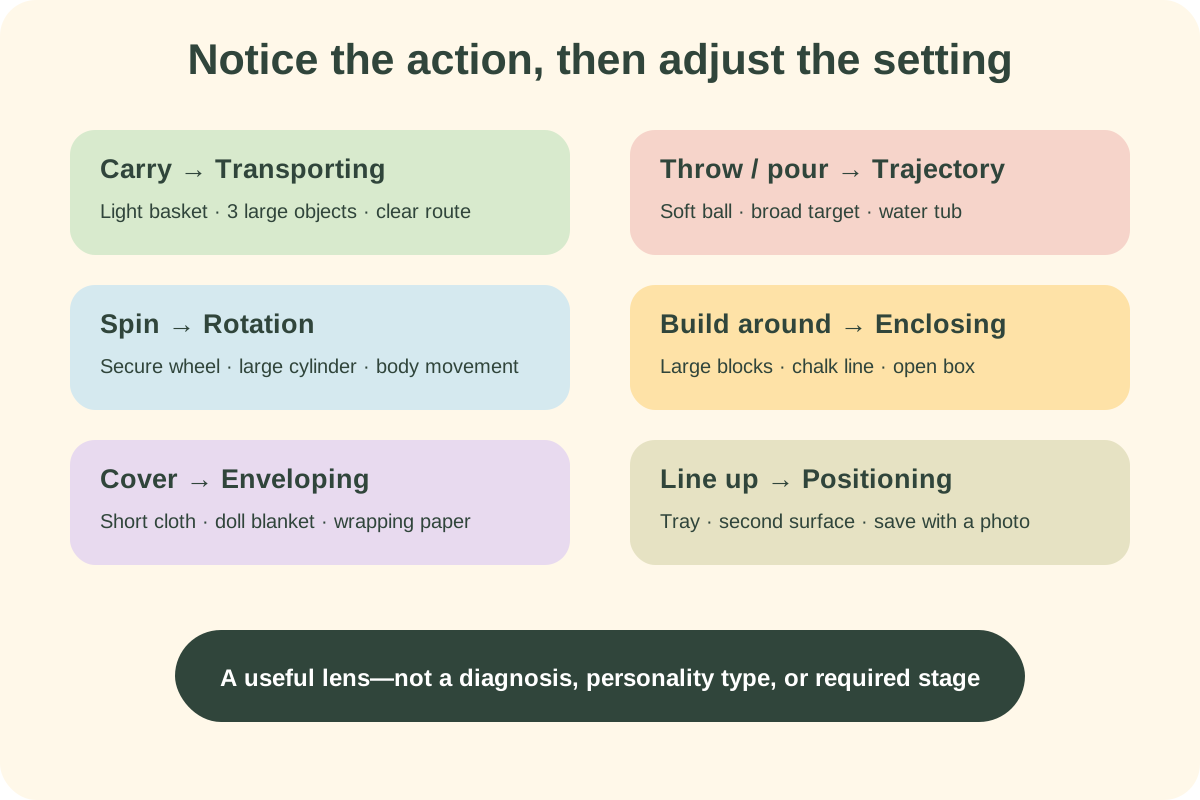
Transporting: carrying things between places
You may see a child fill a bag, move blocks to another room, load a vehicle, or carry handfuls of sand.
Offer a small basket with comfortable handles, a wagon used on a clear route, laundry to carry, or three large objects to deliver between two mats. Limit the quantity if every shelf is being emptied. Keep the action—carrying—while reducing the reset burden.
Avoid bags with drawstrings, containers the child can climb into, and access to fragile or hazardous household items.
Trajectory: exploring how things move through space
Dropping food, throwing blocks, pouring water, rolling cars, and jumping can all involve paths and forces. Calling this “trajectory” may help an adult redirect without expecting the child to stop being interested in motion.
Offer soft balls to roll or throw toward a laundry basket, scarves dropped from standing height, water poured in a tub, or chalk lines for running. The safe replacement should preserve direction and movement. Handing a quiet puzzle to a child who wants to throw usually misses the point.
Rotation: turning and circling
The child may spin wheels, turn knobs, rotate containers, make circles, or spin their body. Offer large wheeled toys with secure wheels, a salad spinner used by an adult and toddler together, ribbon-free dancing, round dough tools, or large screw-top toys designed for the age.
Check fingers around gears and hinges. Stop body spinning near hard furniture or when the child becomes unsteady.
Enclosing: making a boundary around something
A block fence around animals, a chalk circle, a ring of cushions, or a box “house” can all express interest in inside and outside.
Offer large blocks, tape lines placed by an adult, hoops used flat on the floor, or open boxes without staples and plastic film. Do not create containers that close or can trap the head or body.
Enveloping: covering or wrapping
The child covers a doll, hides objects under cloth, wraps a block, paints a surface completely, or climbs under a blanket.
Use short cloths, doll blankets, paper for wrapping large boxes, washable paint, or peekaboo with an adult controlling fabric. Avoid plastic bags, long scarves, cords, and heavy blankets over a young child.
Connecting and disconnecting
Joining train cars, taping cardboard, linking large rings, making long block roads, then pulling everything apart can be the repeated action.
Choose connectors large enough for the child, with no pinch points or loose magnets. Masking tape can be satisfying for an older toddler under supervision; pre-tear short pieces and remove discarded sticky loops.
Positioning: arranging and ordering
The child lines up vehicles, places animals in exact spots, or creates repeated patterns. You do not need to disrupt the line to encourage creativity. Add a second surface, photograph an arrangement before cleanup, or offer a tray that preserves it temporarily.
Lining up objects alone does not diagnose a developmental condition. Discuss the child’s broader communication, play, sensory, or daily-life pattern with a qualified professional if you have concerns.
Orientation: viewing from another angle
The child hangs upside down, peers through legs, lies under a table, or turns objects to inspect every side. Offer a low stable climbing setup appropriate for the child, mirrors secured for use, tunnels, or floor-level viewing. Furniture climbing needs firm boundaries because an interest label does not reduce fall or tip-over risk.
How to observe without turning play into a taxonomy exercise
For several days, write only what you can see:
- action: carrying;
- material: large blocks;
- location: playroom to hallway;
- repeat: four trips;
- friction: basket too heavy, doorway crowded;
- possible response: fewer blocks and a clear delivery mat.
That record is more useful than “transporting schema confirmed.” It tells you what to change and whether the change worked.
Look for the pattern across different materials. A child who moves one basket during cleanup may simply be helping. A child who repeatedly relocates toys, shoes, food containers, and stones may be especially interested in moving collections—but you still do not need to label the child.
Redirect the object, preserve the action
| If the child is… | Unsafe or unworkable version | Preserve the action with… |
|---|---|---|
| Throwing | wooden blocks near people | soft balls toward a broad target |
| Transporting | glassware or adult tools | socks, large blocks, or empty light containers |
| Enveloping | plastic bags or long cords | short cloth over a doll or large box wrapped in paper |
| Rotating | twisting appliance knobs | age-suitable turning toy or rolling a large cylinder |
| Enclosing | locking self inside a bin | block fence, chalk boundary, or open-ended cardboard house |
| Connecting | loose magnets or electrical cords | large links, blocks, train cars, or supervised short tape pieces |
State the boundary and the available action: “Blocks stay low. Balls can fly into this basket.” That is more concrete than “Use gentle hands” when the central interest is force and trajectory.
Small-space and mixed-age adaptations
In a small home, mark a transport route between two rugs instead of allowing every object to move between rooms. Use three items, not a full shelf. For trajectory play, roll socks into a laundry basket rather than throwing across the room. For enclosing, use tape or a scarf laid flat rather than a large cardboard structure.
In mixed-age homes, base shared floor materials on the youngest child’s access. Older children’s magnets, beads, connectors, and craft tools need a separate high work zone and closed storage. A toddler’s urge to transport makes loose older-child parts especially likely to migrate.
Our realistic toy rotation guide can help reduce the number of pieces available without removing versatile anchor materials. Open-ended toys work well because the same blocks can support positioning, enclosing, connecting, and pretend play.
When the schema lens is not helpful
Set the label aside when:
- it makes adults ignore hunger, fatigue, frustration, imitation, or a need for connection;
- it becomes an excuse for unsafe behavior;
- it encourages buying specialized kits instead of adjusting ordinary materials;
- adults interrupt absorbed play to classify it;
- one action is used to make claims about intelligence or future ability; or
- a family has a concrete concern that needs professional assessment.
The framework should make observation calmer and responses more practical. If it makes play feel like a test, it has stopped doing useful work.
Frequently asked questions
Are play schemas evidence based?
Schema theory has a long history in education, and schema language appears in some early-years curricula and professional resources. The popular fixed lists and claims found online are less standardized. Direct causal evidence that supporting a named schema produces specific developmental outcomes is limited.
Can a toddler have more than one schema?
Yes, if you use the framework loosely. A child can transport objects, arrange them in a line, enclose them, then throw one. Behaviors overlap and interests change.
How long does a play schema last?
There is no validated timetable. Repeated interests may appear intensely, fade, return, or change form. Respond to what is happening now instead of waiting for a stage to finish.
Is dumping every toy a schema?
It may involve trajectory, transporting, or simply enjoying the immediate effect and easy access. Reduce the number of pieces, offer a dedicated fill-and-dump setup, and observe what the child repeats next. Our posting and container activity begins with dumping rather than treating it as failure.
Should I buy toys for a child’s current schema?
Usually not. First change how existing materials are presented. A basket, cloth, ball, blocks, open box, water, and outdoor space can support many repeated actions.
Sources and research note
This article treats schemas as an observation tool, drawing on schema descriptions in Welsh early-years curriculum guidance and broader Development Matters guidance. Research on infant object behaviors and object exploration in childcare environments supports cautious discussion of repeated and increasingly complex exploration. Parent and educator forum threads informed the practical questions, not factual claims. No named schema is presented as a diagnosis or proven developmental intervention.