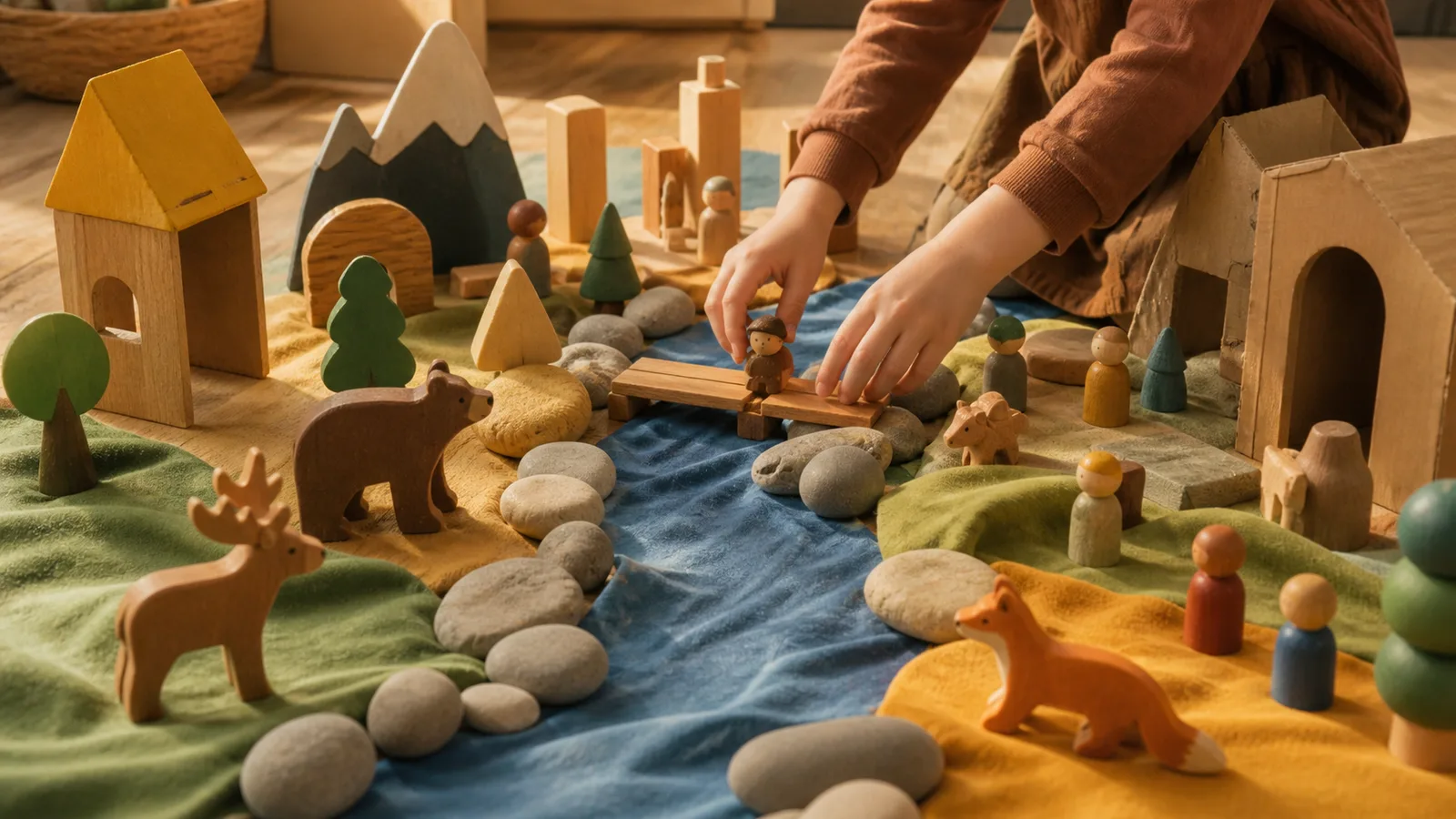
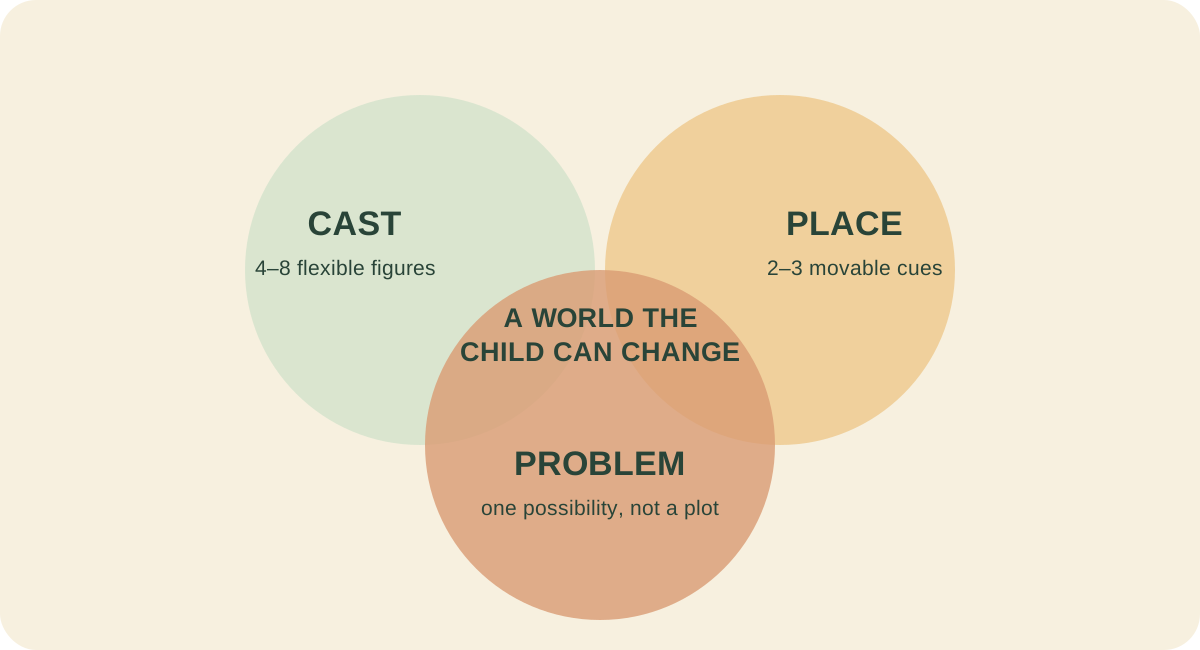
A small world is a story space children can change. It might fit on a tray, rug, low table, or patch of floor. The useful ingredients are not perfect miniature scenery; they are a manageable cast, movable places, and enough uncertainty for something to happen.
Start with cast, place, problem
Cast
Choose four to eight figures with different possible roles. People and animals can coexist if the child wants them to. Vehicles count as characters when children give them motives or voices.
Place
Use two or three flexible terrain cues: a fabric river, blocks as buildings, a cardboard tunnel, a bowl as a pond. Everything should remain movable. Glue and elaborate decoration belong in a model-making project, not every small-world invitation.
Problem
Suggest one situation rather than a plot: the bridge is closed, one animal is far from shelter, the market has moved, or the train cannot reach its stop. The child may ignore it. That is an invitation working as intended.
For smaller-scale building around figures, the magnetic tiles versus wooden blocks guide explains how enclosure, connection, and stability differ.
How closely should scale match?
Exact model scale is unnecessary. What matters is whether the relationships required by play are workable.
| Relationship | Check | Common frustration |
|---|---|---|
| Figure and doorway | Can a main figure pass through? | every building is unusable |
| Figure and vehicle | Can it sit, stand, or ride symbolically? | vehicle holds only one unrelated set |
| Animal and enclosure | Can the boundary contain it visibly? | fences disappear beside huge animals |
| Hand and accessory | Can the child place and retrieve it? | tiny props require constant adult help |
| Storage and scenery | Can major pieces nest or lie flat? | fixed landscape consumes a shelf |
One giant and one tiny character can be an excellent story. Mismatched scale becomes a problem only when it blocks the action the child wants.
A ten-minute setup
- Put down a neutral base—a rug or bare table is enough.
- Add one route with fabric, tape suitable for the surface, or two rows of blocks.
- Place one structure that is incomplete.
- Add five figures and one vehicle or carrying object.
- Leave one figure just outside the scene.
Then stop. A child who immediately removes everything may be transporting or sorting before narrating. Do not rebuild behind them. Our play-schema guide gives another lens for repeated moving, enclosing, lining, or covering actions.
Skip the filler unless it earns its place
Social images often show rice, beans, sand, water beads, stones, or shredded paper filling a tray. Filler can add texture, but it is not required for symbolic play. It also changes the activity’s risk, cleanup, accessibility, and storage.
For households with children under three—or any child likely to mouth items—avoid small loose pieces. Water beads pose a serious ingestion hazard and do not belong in an accessible children’s play setup. A smooth fabric field conveys water or grass without scattering.
If sensory exploration is the actual goal, set it up and supervise as sensory play rather than assuming the miniature figures make every filler safe.
Storage reality
Store by compatibility, not theme. One shallow figure box, one vehicle box, and a flat folder for fabric or cardboard scenery make recombination easy. Avoid keeping ten complete worlds in ten bulky bins.
Photograph a child’s important arrangement before reclaiming shared floor space. Offer a small “save shelf” for one active scene and a clear end time for the rest. If a fixed building is rarely used, replace it temporarily with blocks and see whether editability changes the play.
The same materials can also become a doctor or veterinary clinic or support the broader open-ended pretend prop library.
Adults: join through consequences, not narration
If invited, take one figure and respond to what the child established. Ask only the questions needed to understand the shared world. Avoid adding a lesson, moral, or dramatic disaster to every quiet scene.
A light prompt can create consequence: “This animal cannot reach the bowl because the path is narrow.” The child can solve it, redefine the animal, move the bowl, or abandon the problem.
When a child directs every line, decide whether you can participate. You can say, “Tell me my first job, then I will play this character in my own way,” or set a time boundary. Shared pretending requires negotiation from everyone, including adults.
Adaptations
- Motor access: use larger figures, stable bases, fewer pieces, and raised trays.
- Visual access: increase contrast between figures and base; reduce clutter.
- Language: accept gesture, sound, movement, and private narration as meaning.
- Quiet play: use fabric terrain and wooden figures rather than noisy bins.
- Mixed ages: separate miniature accessories; build the shared world from pieces safe for the youngest.
- Older children: invite mapping, political systems, logistics, recurring history, or model-making while respecting private worldbuilding.
What development claims deserve caution
Small-world play offers opportunities for symbolic representation, narrative, spatial arrangement, and interaction. It does not follow that buying miniature figures causes language, empathy, or executive function. Pretend-play research contains associations and plausible mechanisms, but broad causal claims remain unsettled.
Choose a small world because it fits how the child likes to tell, arrange, build, and revisit stories—not because a product promises accelerated development.
Frequently asked questions
What age is small-world play for?
It depends on component safety and the child’s interests. Preschoolers may use larger figures in simple scenes; older children can sustain complex worlds. Follow each item’s age grading and guard younger siblings from miniatures.
Do I need a tray?
No. A tray creates a boundary and moves easily, but a rug, table, shallow box lid, or floor area can work.
Why does my child only line up the figures?
Lining up may be satisfying in itself or part of an unspoken queue, family, or route. Describe what you see without insisting on dialogue. Offer one adjacent object and observe.
Are realistic figures better?
They can make familiar roles legible. Abstract figures may take more identities. A small mix is often more flexible than a huge themed cast.
Sources and research note
The evidence context comes from peer-reviewed reviews of pretend-play outcomes, pretend-play definition and progression, and symbolic play and language. Practice guidance comes from Penn State Extension, the AAP’s pretend-play overview, and CPSC toy and small-parts guidance.