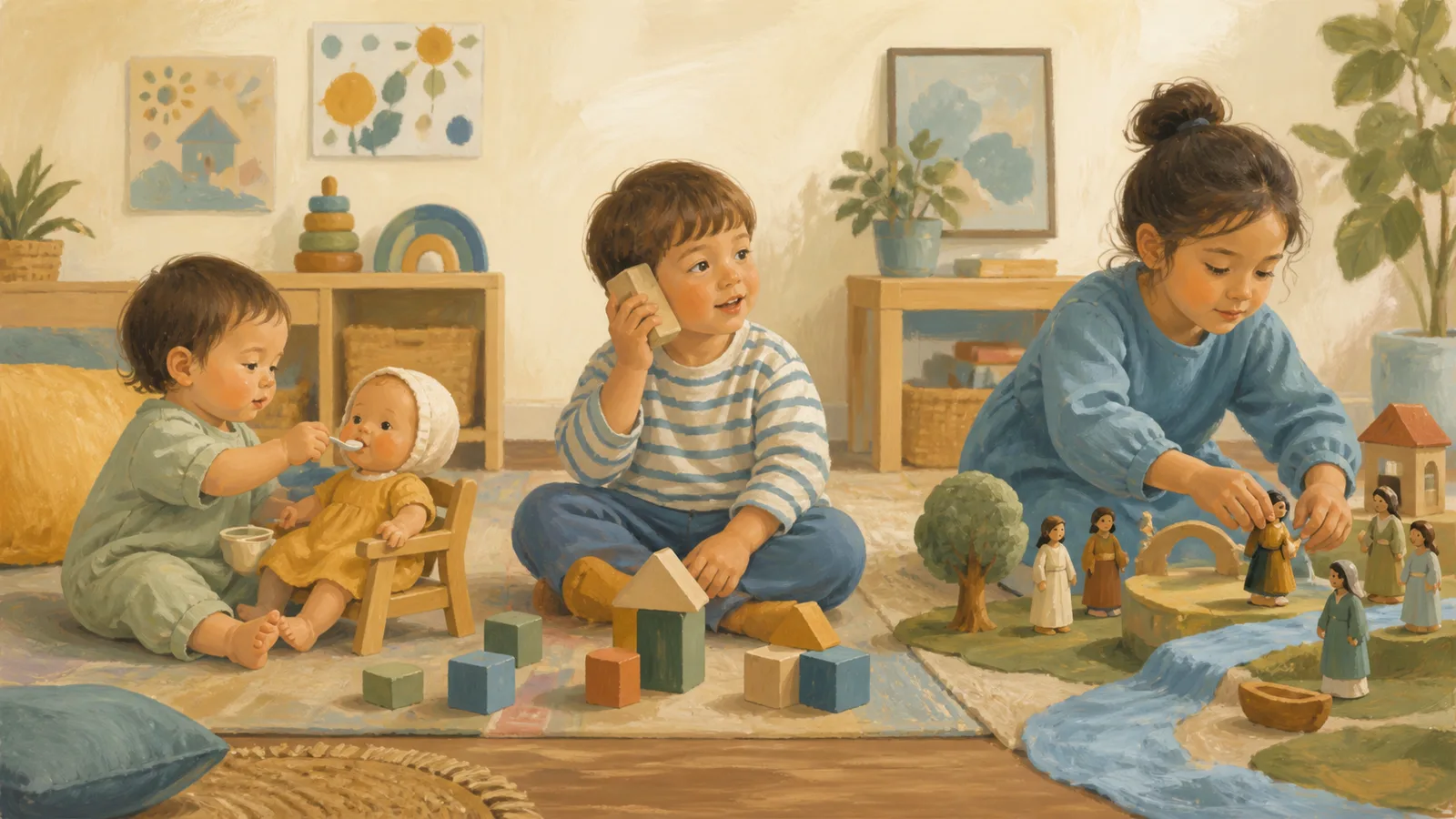
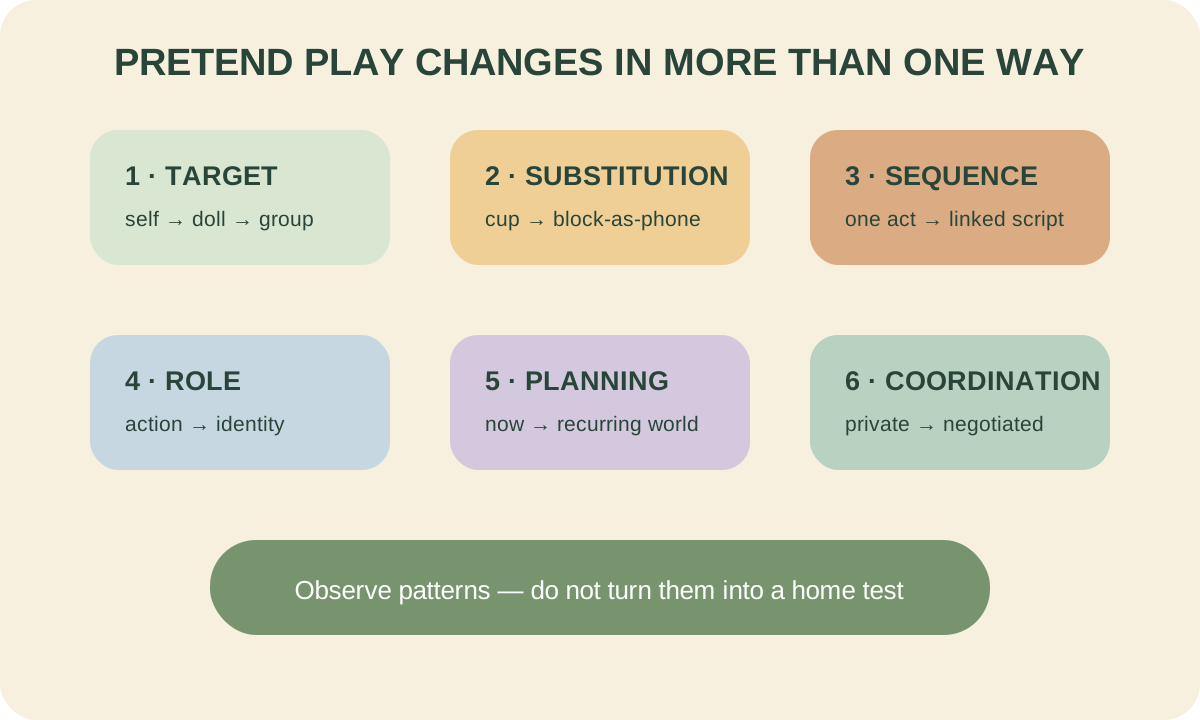
Pretend play usually becomes more complex, but it does not move through one tidy staircase. Researchers use different definitions and coding systems. A more useful home guide is to watch six things change: who receives the action, what objects represent, how actions link, which roles appear, how far ahead the child plans, and how people coordinate the imagined world.
The six dimensions
1. From self to someone else
An early pretend action may be self-directed: lifting an empty cup to the mouth or pretending to sleep. Later, a child may feed a doll, make an animal drive, or assign an adult a role. This shift is often called decentering because the action is no longer centered only on the child.
2. From real object to substitution
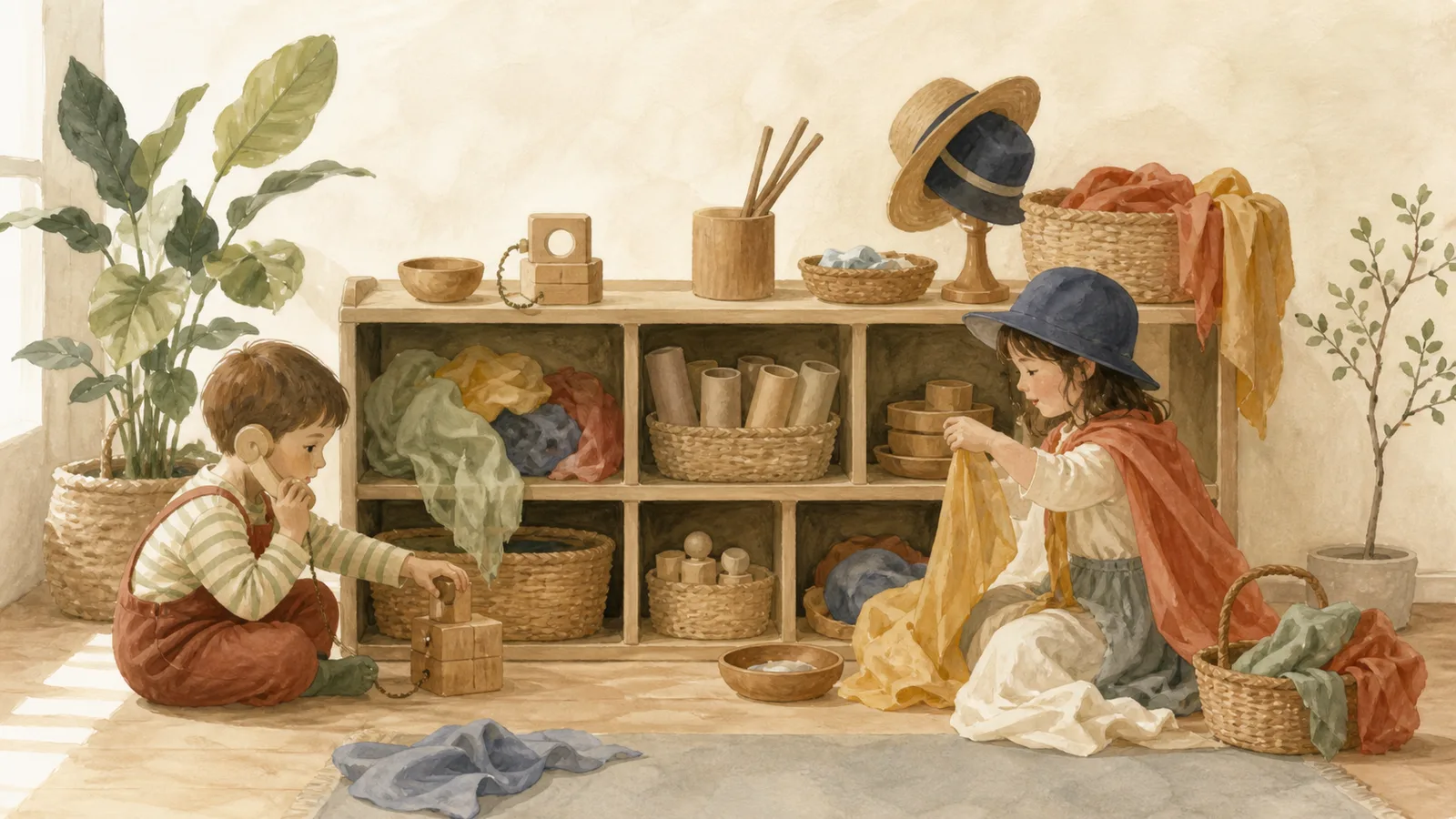
A toy spoon used as a spoon is pretend when the food is imaginary, even though the object keeps its ordinary identity. Using a block as a phone adds object substitution. Eventually a gesture or spoken agreement may stand in for a missing object.
Do not turn substitution into a test. A child who prefers realistic props may create detailed, sustained stories without often turning one object into another.
3. From one action to a sequence
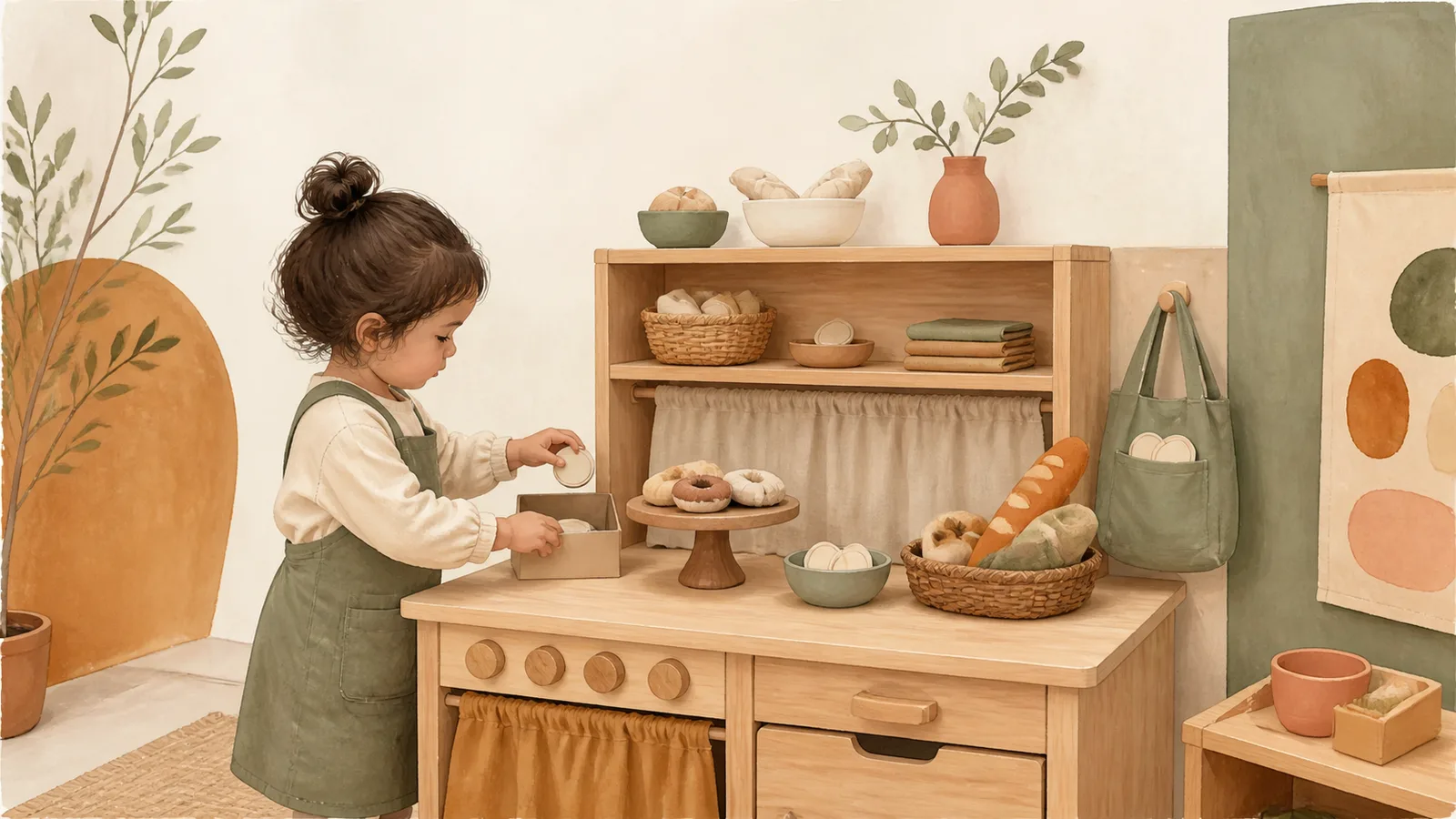
Stirring an empty bowl is one pretend act. Stirring, serving, feeding a doll, cleaning the bowl, and packing leftovers creates a linked sequence. Familiar routines often supply the earliest scripts. New combinations appear as experience, memory, language, and play partners change.
4. From action to role
The child may first perform actions without naming a character. Later they become the driver, doctor, dragon, shopkeeper, narrator, or several roles in quick succession. A hat or bag can mark the role, but a full costume is not required.
Our open-ended prop guide shows how one small collection can support role changes without prescribing a finished story.
5. From immediate idea to a plan
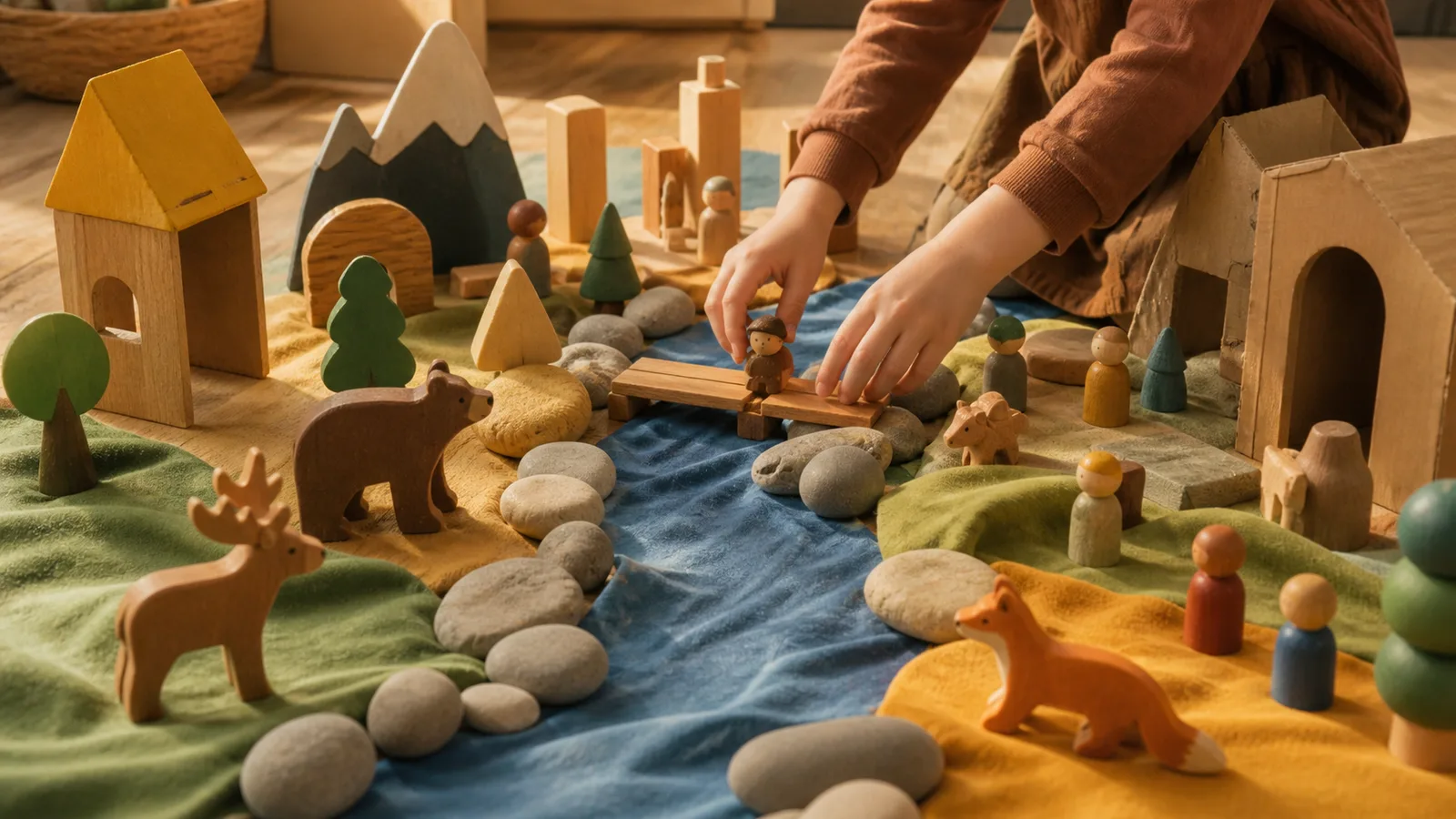
Planning may be as brief as “You be the baby.” More elaborate play can involve setting a place, distributing roles, explaining rules, building scenery, and preserving a story across sessions. Older children’s planning sometimes becomes more visible than the enactment itself.
6. From private meaning to negotiated world
Two children must establish what an object is, which events are possible, and what happens next. They may spend more time negotiating than acting. That is not necessarily failed play; maintaining a shared imaginary frame is difficult work.
A flexible progression, not deadlines
| Often observed form | What it may look like | A useful adult response |
|---|---|---|
| Familiar pretend action | drinks from an empty cup | mirror the action once |
| Action directed outward | feeds a doll or adult | add one responsive sound or phrase |
| Object substitution | block becomes a phone | accept the child’s meaning |
| Linked script | cooks, serves, cleans | offer one missing tool if requested |
| Role and rule play | assigns driver and passenger | clarify boundaries, not the plot |
| Planned world | maps, props, recurring characters | protect time and storage when practical |
Age ranges in popular charts should be treated as broad observations. Culture affects familiar scripts; opportunities and materials affect what adults see. Language, motor access, sensory preferences, disability, and whether a child feels watched also shape the performance.
What counts as pretend?
These all can count:
- a toddler making a sleeping sound for a doll;
- a child silently moving figures through an invented event;
- lining up vehicles as a ferry queue with no dialogue;
- repeating the same clinic scene every day;
- narrating a fantasy while drawing rather than dressing up;
- designing rules and maps for a game that is played briefly; and
- an older child privately writing, constructing, or role-playing a shared world.
Parten’s familiar “stages of play” describe social participation—solitary, parallel, associative, cooperative—not a developmental sequence of symbolic pretense. The two frameworks answer different questions and should not be collapsed into one milestone chart.
How adults can support the next move
Start from the child’s current action and add one small possibility:
- If the child stirs, place a cup nearby.
- If the doll eats, wonder where it will sleep.
- If a block is a phone, let another block ring.
- If roles are disputed, suggest two jobs with equal agency.
- If planning consumes playtime, offer a stopping point and a place to save the plan.
Model once, then pause. Questions such as “What is that?” can feel like a quiz when the child already knows. Descriptive comments—“That long block is the runway”—show you understood without demanding performance.
For concrete story entry points, try a play-kitchen problem or a simple small-world cast, place, and problem.
What research actually supports
Pretend play and language, social competence, self-regulation, and other skills are related in many studies. Relationships may reflect shared underlying abilities, supportive environments, responsive adults, or reciprocal influence. A child who communicates more easily may sustain shared pretending; pretending may also create opportunities to communicate. Observational association alone cannot decide the direction.
A major review found the evidence did not support many broad claims that pretend play causes development. More recent meta-analytic work reports positive associations with social competence but still calls for stronger evidence about causality. That makes pretend play worth supporting as a meaningful form of childhood activity—not a treatment or guaranteed route to a skill.
When a concern deserves a broader conversation
One child may dislike dolls but build fictional worlds with vehicles. Another may reproduce routines without dialogue. Avoid using this article to diagnose or score them.
If you are concerned about several aspects of development—communication, loss of skills, social connection, movement, hearing, play, or everyday participation—write down specific observations and discuss them with the child’s healthcare professional. CDC milestone resources can help organize observations, but a checklist does not replace developmental screening or individual assessment.
Frequently asked questions
When does pretend play start?
Simple pretend actions often emerge during the second year, but timing and form vary. Use broad milestone guidance alongside the child’s whole development rather than waiting for one signature scene.
Does feeding a doll count as pretend play?
Yes, when the action represents an imagined feeding. It does not need dialogue, a full story, or object substitution.
Is solitary pretend play normal?
Yes. Social participation and symbolic complexity are separate dimensions. A child can create rich private pretense and later coordinate with others—or prefer solitary forms.
When do children stop pretend play?
There is no fixed stopping age. Visible preschool role play may become private worldbuilding, performance, construction, writing, tabletop games, or other symbolic forms. See our role-play ideas for older kids.
Sources and research note
This guide is based on reviews of pretend-play definition and measurement, developmental outcomes, symbolic play and language, and pretend play and social competence, plus an observational study of symbolic play as a language context. CDC 30-month and 3-year pages provide broad surveillance context, not a pretend-play diagnostic tool.