
“Educational” tells you how a toy is being sold, not what your child will learn. A useful claim names a specific action and outcome, matches the child’s age, and points to evidence that actually studied the product or a genuinely comparable activity.
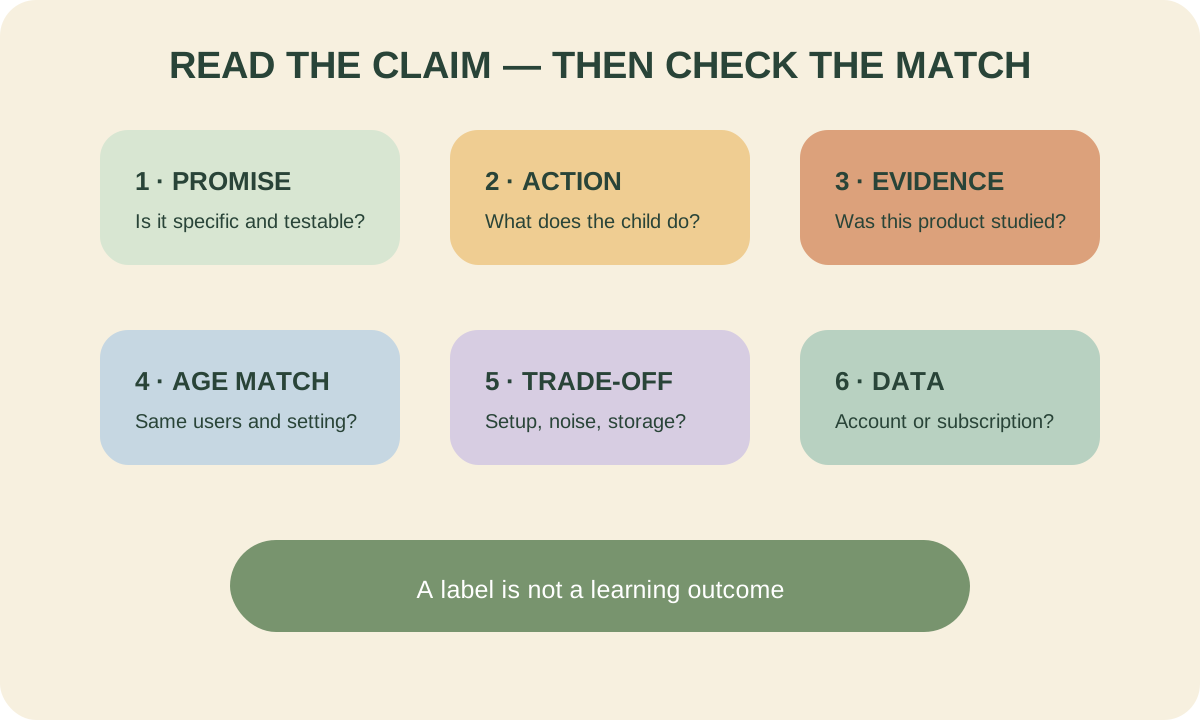
The six-question claim audit
1. What exactly is promised?
“Supports learning” is too broad to test. “Children practice combining quantities to ten while playing” describes an opportunity. “Boosts intelligence” or “builds brain power” demands much stronger evidence than packaging usually provides.
Rewrite the claim in plain language. If it becomes meaningless, do not pay extra for it.
2. What does the child actually do?
Ignore lights and curriculum names for a moment. Does the child arrange, compare, remember, build, narrate, draw, negotiate, move, listen, or choose? How many meaningful actions are available after the novelty fades?
A toy may say 100 words while giving the child only one action: press. A plain block set may support many actions but should not therefore be advertised as a guaranteed creativity intervention.
3. What evidence supports this product?
Look for a published study, sample age and size, comparison condition, measured outcome, duration, funding, and whether the exact product was used. A vague “research-backed” badge, advisor biography, or bibliography about general child development is not product evidence.
Under U.S. truth-in-advertising principles, objective claims should be truthful, non-deceptive, and supported. That legal principle does not create a government seal for every toy described as educational.
4. Does the evidence match the child and outcome?
A study with preschool classrooms does not necessarily predict independent home use by a toddler. Near transfer—improving the exact skill practiced—is different from far transfer to intelligence, school achievement, or creativity.
If a number game improves performance on a similar number task, that cannot justify “improves all math.” Our board-game evidence guide explains how mechanics and measured outcomes need to align.
5. What are the trade-offs?
Check setup, adult dependence, volume, batteries, replacement pieces, frustration, storage, durability, and whether the toy has only one correct sequence. A toy can offer real practice and still be a poor fit for your home.
6. What data or ongoing costs are involved?
For connected toys, examine account requirements, microphone or camera use, recordings, location, child profile data, advertising, content moderation, subscriptions, offline function, security updates, and deletion controls. “Screen-free” does not necessarily mean internet-free, data-free, or subscription-free.
Common labels decoded
| Label | What it may mean | What it does not guarantee |
|---|---|---|
| Educational | designed or marketed around a skill | measured learning, school transfer, quality |
| STEM | science, technology, engineering, or math theme/action | authentic inquiry or age fit |
| Montessori | inspired by materials or aesthetics | affiliation, certification, or fidelity to a classroom approach |
| Sensory | noticeable texture, sound, light, or movement | suitability for every sensory profile |
| Expert designed | someone advised or was employed | independent product testing or outcome evidence |
| Interactive | product responds to input | meaningful human interaction or child agency |
The “researched category” shortcut
Marketing often moves through three steps:
- Research finds an association or effect for a broad activity.
- A product contains something resembling that activity.
- The product is described as delivering the broad outcome.
Each step needs examination. Research on caregiver-child conversation cannot prove that a talking toy develops language. Research on block play cannot prove that every block-shaped product improves math. Research on music interaction cannot prove that passive playback accelerates speech.
The guided versus free play guide also shows why adult setup, agency, feedback, and context are part of an activity—not incidental packaging around a product.
Better purchase questions
Ask:
- Can the child understand how their action changes the material?
- Can the challenge grow without replacing the toy?
- Is more than one strategy possible?
- Can the child use it without continuous adult troubleshooting?
- Does it invite interaction with people rather than impersonating a relationship?
- Can pieces be replaced, cleaned, stored, and inspected?
- Would a book, ordinary material, outdoor experience, or shared game offer the same practice?
Our open-ended toy article separates flexibility from unsupported creativity claims. The wooden-toy guide likewise explains why material and appearance do not automatically establish sustainability or educational value.
Red flags
- percentages without a linked study;
- brain images used as decoration;
- “clinically proven” with no named outcome or trial;
- testimonials presented as evidence;
- a study on a different product or age;
- claims that shame ordinary play;
- “Montessori certified” without identifying the certifying body;
- guaranteed reading, IQ, concentration, or milestone acceleration;
- urgency tied to a supposed developmental window; and
- an app required to unlock core play after purchase.
Simple toys are not magic either
The AAP advises choosing toys that foster supportive interaction, pretending, problem-solving, and physical activity and cautions against using digital toys as replacements for human engagement. That is a useful orientation, not proof that every wooden block or doll produces a particular result.
Buy for a good fit between child, action, environment, and family. The learning opportunity lives in repeated activity and relationships—not the adjective on the box.
Frequently asked questions
Is “educational toy” a regulated certification?
Not as a universal U.S. certification category. Specific advertising claims remain subject to truth-in-advertising rules, but the word alone does not guarantee evidence or quality.
Are Montessori toys officially certified?
Many commercial products use “Montessori” descriptively without school or organizational affiliation. Check who makes the claim and what concrete design features it refers to.
Are electronic toys bad for learning?
Not categorically. Evaluate the action, feedback, content, adult/peer interaction, volume, privacy, and what the device replaces. Flashing or speaking does not establish educational value.
What is the best proof a toy works?
For a narrow outcome, strong evidence would study the exact product or close intervention, suitable participants, a meaningful comparison, validated measures, and relevant duration. Even then, fit and transfer need judgment.
Sources and research note
Consumer standards come from the FTC’s Advertising and Marketing Basics and Admongo advertising-literacy materials. Toy-selection guidance comes from the AAP clinical report Selecting Appropriate Toys for Young Children in the Digital Era and its family summary. General safety checks use the CPSC toy safety center. LWT did not hands-on test products for this article.