The best toy storage for a small home is not necessarily a matching set of bins. It is an arrangement that lets your child reach suitable play materials, carry them to where play happens, and return them without climbing or handling an awkward container.
Start by deciding what may be freely accessible. Check each toy’s current age grade, warnings, and instructions rather than relying on a retailer’s age filter or an “educational” label. Anything requiring adult setup or supervision belongs in controlled storage. In a mixed-age home, toys and loose components unsuitable for the youngest child need a separate plan.
Then make the reset modest. A system that depends on detailed sorting, perfect stacking, or daily toy rotation may create more work than it removes. Fewer available materials and broader categories are valid choices.
Start with the play and reset problem
Before buying storage, watch one ordinary stretch of play. Notice where your child chooses toys, where pieces travel, and where cleanup stops.
Ask:
- Which toys are used frequently enough to deserve convenient space?
- Does play happen beside the storage, or do toys move to another room?
- Can your child see an option without emptying several containers?
- Are containers difficult to open, carry, or fit back into place?
- Which toys are consistently left out because they are awkward to store?
- How much floor or wall space can storage occupy without disrupting the room’s other uses?
- Who actually resets the space, and how much effort can that person repeat?
Measure the available location as it is used, not just as an empty rectangle. Account for doors, drawers, walking routes, seating, and the space needed to remove a container. A bin that technically fits under a table may not be useful if a chair must be moved every time it comes out.
You may find that the first fix is not another organizer. It could be:
- removing toys that are no longer used;
- storing occasional materials elsewhere;
- reducing the number of pieces available at once;
- moving a frequently used toy closer to the play area;
- combining categories that nobody wants to sort separately;
- giving an awkward large toy its own parking place.
Not every toy needs an individual container. A wooden vehicle may be easier to park directly on a shelf, while a set of loose figures needs containment.
Set the access line by readiness and supervision
There is no universal shelf height that works by age. Reach, balance, mobility, toy weight, and furniture design all affect whether a location is usable.
Divide the room into two practical zones:
Child-accessible storage is for materials your child may use in that room without adult setup. The child should be able to remove and return them without climbing, reaching overhead with a heavy load, or pulling down other objects.
Adult-controlled storage is for anything that needs supervision, contains components unsuitable for another child in the home, or is not manageable from the available shelf position.
Use a simple placement test
For each toy or container, observe whether your child can:
- See or identify it. A toy can be accessible without being fully exposed, but its location needs to make sense to the person using it.
- Remove it without climbing. Do not treat shelves, drawers, or nearby furniture as steps.
- Carry it steadily. A large, flexible, overfilled, or heavy container can be difficult even when it sits within reach.
- Set it down without a complicated maneuver. Watch for lids, tight clearances, and containers that require two hands while the child is balancing.
- Return it without lifting overhead. The reset should not be harder than taking the toy out.
Test the arrangement with the actual contents. An empty basket may be easy to handle and unwieldy once filled with blocks.
For freestanding shelves, cabinets, and other furniture, follow the exact manufacturer’s assembly, placement, loading, and anchoring instructions for the model and market you own. Do not improvise mounting hardware or assume that low furniture cannot tip. If the instructions are missing, obtain the current documentation before putting the unit into use.
Match the container to the way the toy moves
Choose storage according to the toy’s shape, number of pieces, and path to the play area. The smallest possible bin is not always the most space-efficient choice if pieces snag or the child must dump everything to find one item.
| Storage form | Often useful when | Main trade-off to check |
|---|---|---|
| Open shelf | An object is stable, easy to identify, and used as one piece | Uses visible space and may not contain loose parts |
| Shallow tray | Several pieces are used together near the storage area | Needs enough clearance to lift or slide out level |
| Small open bin | Loose pieces need to travel as a group | Can become heavy or turn into an unsorted catch-all |
| Drawer | The room needs less visible storage | Contents may be difficult to scan, and the drawer must remain easy to operate |
| Lidded container | Contents need adult-controlled access or protection specified by their instructions | Opening and replacing the lid adds work; container details require their own safety review |
| Vertical holder or assigned wall area | Lightweight, awkwardly shaped items do not stack well | Installation, projecting parts, and the item’s removal path must be assessed |
These are starting points, not product recommendations. Check the dimensions, weight limits, instructions, and warnings of any storage item before use.
Plan for awkward toy types
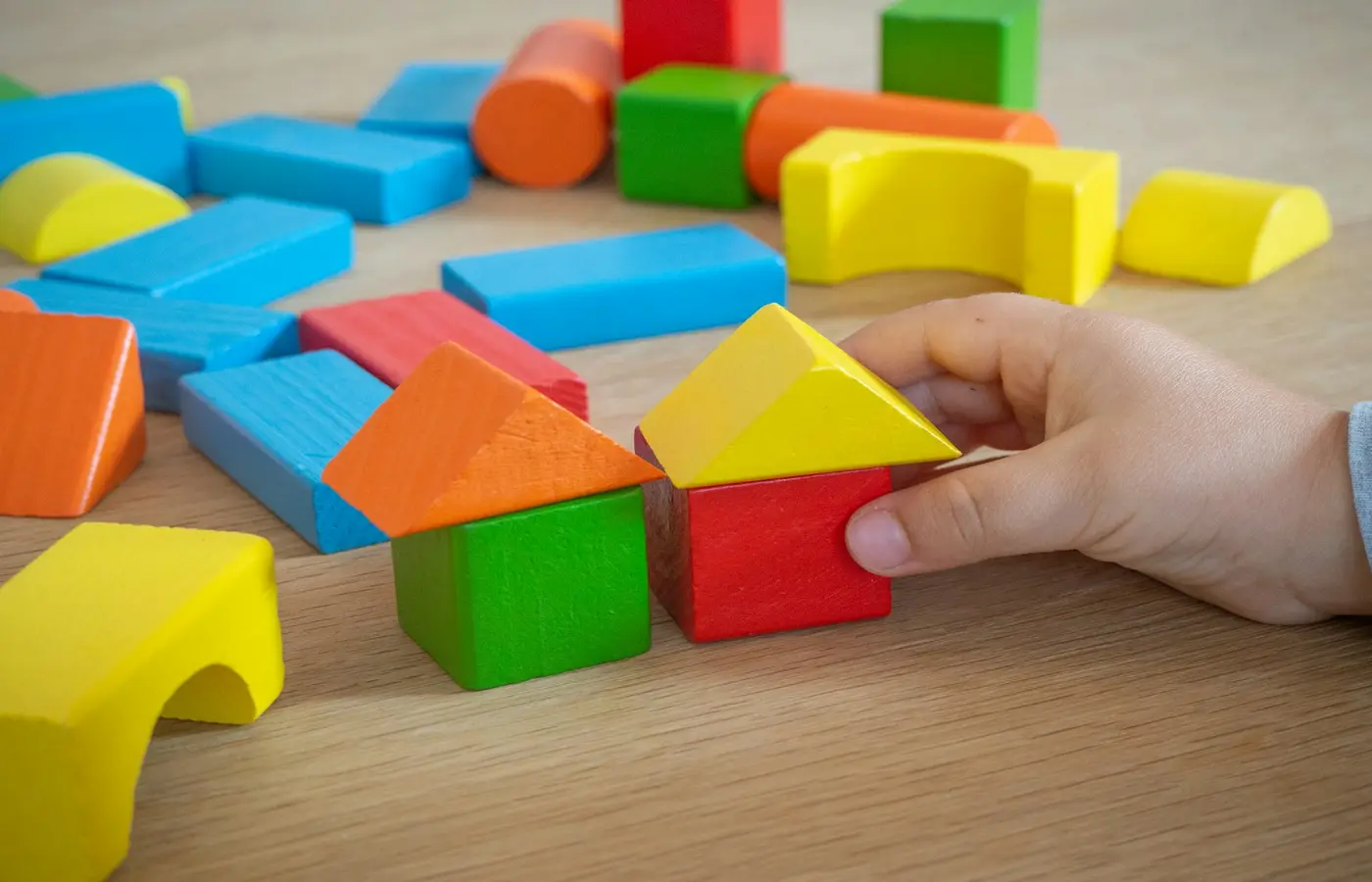
Blocks and construction pieces: Use a container that remains manageable at its normal fill level. If returning pieces requires careful color or shape sorting, consider broader categories unless sorting is itself wanted play.
Puzzles: Decide whether the child carries one puzzle or several. Flat shelf storage keeps each puzzle separate, while a shared container may save space but make pieces harder to match. Follow any instructions that affect how a puzzle or its components should be stored.
Long vehicles and large toys: A marked parking area may work better than a deep bin. Check that parked items do not narrow a walking route.
Dress-up clothes: Favor a method that matches how the clothes are chosen. A few frequently used pieces may be easier to see on accessible supports; a larger collection may need broad contained categories. Any support or furniture still needs installation and loading appropriate to its instructions.
Art materials: Separate freely available materials from those requiring adult involvement according to their labels and instructions. Store tools, liquids, and small components in the appropriate controlled zone rather than treating all art supplies as one category.
Sets with many components: Keep together only what needs to be together for use. If one missing piece does not stop play, a broad category may be easier to maintain than several fitted compartments.
Separate restricted materials in mixed-age homes
When children of different ages or readiness levels share a room, storage has to work for the child who should not access an item—not only for the child who uses it.
Review the packaging and current instructions for toys and loose components. If an item carries a small-parts warning, an age restriction, or a requirement for adult supervision, do not place it in the shared child-accessible zone merely because an older child can use it.
Create an adult-controlled area and decide where supervised play will happen. The complete path matters:
- Where does the older child obtain the material?
- Where can it be used without loose components spreading through shared play areas?
- Where do unfinished pieces wait?
- Who checks and returns the set?
- What happens if cleanup is interrupted?
Magnets, button or coin batteries, water beads, tools, and other specifically warned-about materials require hazard-specific guidance and exact product instructions. Do not rely on a high-looking shelf as the entire control plan, and do not assume every product within a broad category carries identical warnings.
If you cannot maintain separation reliably in the current room, it is reasonable to store that material elsewhere or pause its use. The older child does not need every suitable toy continuously available.
Choose how much visual access the room can handle
Open storage makes options visible, but a shared living room or bedroom may also need to support meals, rest, work, or conversation. Concealed storage reduces what adults see, but it can add steps for finding and returning toys.
Think of visibility as a sliding scale rather than a choice between fully open shelves and fully closed cabinets:
- Display a few broad play options and contain the rest.
- Keep frequently used objects visible while placing loose pieces in nearby bins.
- Use open containers inside furniture that can be closed when the room changes purpose.
- Give in-progress play one defined tray, mat, or parking place.
- Use a picture, object cue, word, or color only if it is meaningful to the person expected to use it.
Labels are optional. They do not rescue a container that is too heavy, a category that is too detailed, or a location that cannot be reached. Adapt the cue to your child’s vision, language, memory, and motor access rather than expecting one labeling method to fit everyone.
A tidy-looking room is not evidence that the play setup is working. Nor does visible play mean the system has failed. The useful question is whether the room can shift between its necessary activities with an acceptable amount of effort.
Build a reset the household can repeat
Define the smallest reset that makes the room usable again. That might mean clearing the walking route and returning loose pieces to two broad bins—not restoring a display exactly as it began.
Try this sequence:
- Choose the stopping point. Decide what must be put away and what may remain in progress.
- Return large objects first. Their parking places define the space left for smaller materials.
- Use broad categories. “Blocks,” “vehicles,” and “pretend food” may be manageable where narrower sorting is not.
- Assign adult tasks openly. A child does not have to perform every step for the arrangement to be useful.
- Observe the point of friction. Change the storage rather than repeatedly insisting on a step the setup makes difficult.
If your child can take toys out but not return them, check the mechanics before assuming unwillingness. The return slot may be too precise, the bin too full, the shelf opening too tight, or the category unclear.
Possible adjustments include:
- removing a lid when controlled access is not required and the container is appropriate for open use;
- using fewer categories;
- reducing the quantity available;
- replacing one large load with smaller manageable groups;
- moving the container closer to the place where the toy is used;
- letting an adult handle the final lift or closure;
- abandoning a rotation schedule that requires too much tracking.
Toy rotation does not automatically save space because the off-rotation toys still need storage. It is useful only if you have a suitable controlled location and the swapping work feels worthwhile. A smaller total toy supply may be simpler.
Common questions about toy storage for small spaces
Are open shelves or closed bins better?
Neither is universally better. Open shelves suit stable objects that benefit from being visible and easy to take individually. Closed or concealed storage can make a shared room feel calmer to its users and contain loose components, but it adds opening and searching steps. Many homes benefit from a mixture: visible large toys, portable bins for loose pieces, and adult-controlled storage for restricted materials.
How should toys be stored when younger and older children share a room?
Base freely accessible storage on what the younger child may access safely, using exact product warnings and instructions. Put the older child’s restricted materials in adult-controlled storage and provide a defined place and reset plan for using them. A nominally higher shelf is not a substitute for evaluating access, climbing, furniture stability, and what happens to loose pieces during play.
What if my child can take toys out but cannot reset the system?
Make the return action easier. Test the loaded container, remove unnecessary sorting, reduce the amount inside, and observe whether the child can align or lift it comfortably. You can also divide the work: the child gathers pieces while an adult returns a container to controlled storage.
Does toy rotation save space?
Only if the reserve materials have a workable storage location. Rotation may reduce what is visible, but it can also shift clutter elsewhere and add adult work. You do not need a rotation system if keeping fewer toys or using broader categories works better.
The most useful next step is to choose one frequently messy category and follow its real path: where it is selected, carried, used, paused, and returned. Change the container or location only after you identify the step that is failing.