
A toy that seems quiet in a shop may sound very different when it is dropped on a hard floor, repeats the same prompt, or gets tipped from a storage bin before breakfast. For apartments and homes with shared walls, it helps to choose for the toy’s whole pattern of use—not simply a “quiet” label.
The short version: consider what makes the sound, where play will happen, how often the sound repeats, and whether the child can use the toy safely without adult help. A brief musical sound with a reliable volume control may fit your home better than a supposedly silent set of hard pieces that gets dumped, rolled, and thrown.
Quietness does not establish age appropriateness or make a toy suitable for independent use. Check the current age grade, warnings, instructions, battery access, piece size, and supervision requirements for the exact toy. Those conditions take priority over convenience, especially if you are choosing something to leave out in the early morning.
Start with the sound that travels through your home
Before shopping, spend a few minutes noticing which play sounds cause difficulty in your particular space. You do not need a sound meter or a perfectly silent room. A simple household audit is more useful than a generic promise on a package.
Listen for four parts of play:
- Sound made by the toy: music, speech, beeps, rattles, clicks, squeaks, or instrument notes.
- Impact from movement: jumping, rolling, bouncing, knocking into furniture, or dropping pieces on the floor.
- Repetition: a button pressed every few seconds, a repeated electronic prompt, or a structure built and dismantled many times.
- Setup and cleanup: bins being dragged, lids snapping, pieces being poured out, and materials being swept back into storage.
Also note when and where noise matters. The best option for daytime play in a living room may not suit a bedroom beside a sleeping sibling. A rolling toy may be manageable on one surface but disruptive on another. Building construction, room layout, furnishings, play style, and proximity to other people all affect what your household notices.
If possible, identify one early-morning play zone and one daytime zone. This does not need to become a complicated schedule. It can be as simple as keeping rolling, jumping, and instrument play for later while leaving out drawing materials, a small pretend-play setup, or a limited number of connecting pieces.
Use six checks before choosing a toy
A useful quiet-toy comparison looks beyond the loudest single sound.
| Check | What to examine | Possible friction |
|---|---|---|
| Sound type | Speech, music, beeps, clicks, rattling, or impact | A soft but sharp or repetitive sound may still bother someone nearby |
| Controls | Physical volume switch, mute option, off switch, or no electronic sound | Controls may be difficult for a child to use or may reset after power-off |
| Floor impact | Dropping, rolling, bouncing, jumping, or collisions | The toy may be quiet in the hand but disruptive during active use |
| Repeatability | How quickly and easily the same sound can be triggered | One acceptable sound can become tiring when repeated continuously |
| Storage and cleanup | Number of pieces, container material, lids, and dumping | Cleanup may be louder than the main activity |
| Independent-use fit | Warnings, setup, frustration, and required supervision | A quiet activity may still require an awake adult |
1. What kind of sound does it make?
Do not focus only on maximum volume. Consider the character and timing of the sound. A toy that plays a long sequence after one touch creates a different household experience from one that makes a brief click when two pieces connect.
For non-electronic toys, imagine the full action: carrying, stacking, knocking down, sorting, rolling, and putting away. Hard pieces handled gently may be unobtrusive, but the same pieces can make substantial cleanup noise when poured into a rigid container.
2. Can the sound be controlled reliably?
For an electronic toy, inspect the current instructions rather than relying on front-of-box language. Look for:
- A true mute setting rather than one lower-volume setting
- A clearly accessible off switch
- Startup and shutdown sounds
- Automatic prompts when the toy is left alone
- Whether volume settings remain in place after the toy is switched off
- Battery or charging requirements
Do not assume a feature exists unless it is documented for that exact model and market. If quiet use depends on an adult changing the setting every time, it may not work as an independent early-morning option.
3. What happens when it meets the floor?
Some play is noisy because of motion rather than a speaker. Ride-on toys, balls, wheeled toys, indoor jumping equipment, and large construction pieces can create repeated bumps or collisions.
Think about the likely route through the room. Is there enough open space to prevent constant contact with doors and furniture? Will a child naturally roll the toy toward a shared wall? Does play involve climbing or jumping? A product’s own sound level does not answer these questions.
A rug or suitable play surface may reduce some clatter in a particular room, but it should not be treated as soundproofing. It also needs to lie flat, remain compatible with the toy’s instructions, and avoid creating a slipping or tripping problem.
4. How repeatable is the sound?
Children often explore cause and effect by doing the same thing again: pressing, striking, dropping, opening, closing, dismantling, and rebuilding. Repetition is part of the play, not misuse by default.
Choose with that repetition in mind. Ask whether the sound remains workable after the twentieth button press or block drop. If not, the toy may be better assigned to a daytime place than restricted in a way that makes its main action unavailable.
5. How noisy is storage?
Large quantities of loose pieces add options, but they also add dumping, sorting, and cleanup. You can often simplify without buying anything:
- Offer one shallow tray of pieces instead of a full bin.
- Rotate materials rather than keeping every part accessible.
- Separate especially hard or noisy pieces for daytime use.
- Choose a container that can be opened and closed without a sharp snap.
- Put the container on the play surface before pieces are returned.
Keep all original labels and instructions available, and do not transfer materials into storage that could be mistaken for food or that allows restricted items to become accessible.
6. Can it be used with the supervision your household needs?
“Quiet” and “safe to use alone” are separate judgments. Before leaving out an activity while adults or siblings sleep, consider whether the child can start, use, and stop it within the manufacturer’s directions.
Check the exact toy for small parts, accessible batteries, magnets, cords, projectiles, climbing or fall risks, charging requirements, and any stated need for adult supervision. Consider practical readiness too: can the child manage the pieces without frequent help, accept the play boundary, and put the activity down if it becomes frustrating?
Independence varies by child, setting, and day. There is no need to turn early-morning solo play into a milestone. If the safe choice requires you to be awake, choose a simpler activity or store it until later.
Compare the whole play pattern by toy type
Active play
Indoor active play can include carrying, crawling, balancing, stretching, pushing, or moving through a simple route. It does not have to mean jumping or riding.
When considering active toys, account for the child’s movement as well as the equipment. Look at required floor space, approved surfaces, possible collisions, storage bulk, and supervision instructions. A compact item is not necessarily quiet if its main action involves repeated landing or rolling.
For earlier hours, you might offer a route based on stepping around floor markers, carrying soft objects between two places, or copying slow animal movements. Keep pathways clear and avoid improvised climbing arrangements.
Instruments and rhythm play
An instrument’s sound depends partly on how it is played. Striking, shaking, scraping, and blowing invite different levels of force and repetition. Rather than expecting a child to use an exciting instrument silently, decide when full instrument play is realistic.
A quieter route to rhythm might involve clapping softly, tapping hands on knees, moving scarves to a beat supplied by the player, or arranging picture cards into repeating patterns. These invite some of the same actions—making and repeating a sequence—without claiming to provide identical musical or developmental outcomes.
Do not add homemade padding, cover openings, or alter an instrument unless its instructions explicitly allow that change. An adaptation that reduces sound could interfere with intended use or introduce loose material.
Electronic toys
Electronic toys deserve a documentation check because controls are not always obvious from packaging. Review instructions for default volume, mute and off settings, automatic speech, timers, battery access, charging, and whether settings persist.
Consider adult work as well. A rechargeable toy that must be collected and charged each night may be a poor fit even if its lowest setting is acceptable. A battery-powered toy is not suitable for unsupervised use merely because the battery compartment appears closed; follow its age grade, warnings, and fastening instructions.
If repeated prompts are the main problem, the quieter substitute may be the non-electronic version of the action: posting cards through a slot, matching pictures, pretending with figures, or operating simple doors and latches on an age-appropriate toy. The goal is to preserve what the child is doing, not to duplicate every feature.
Building and connecting materials
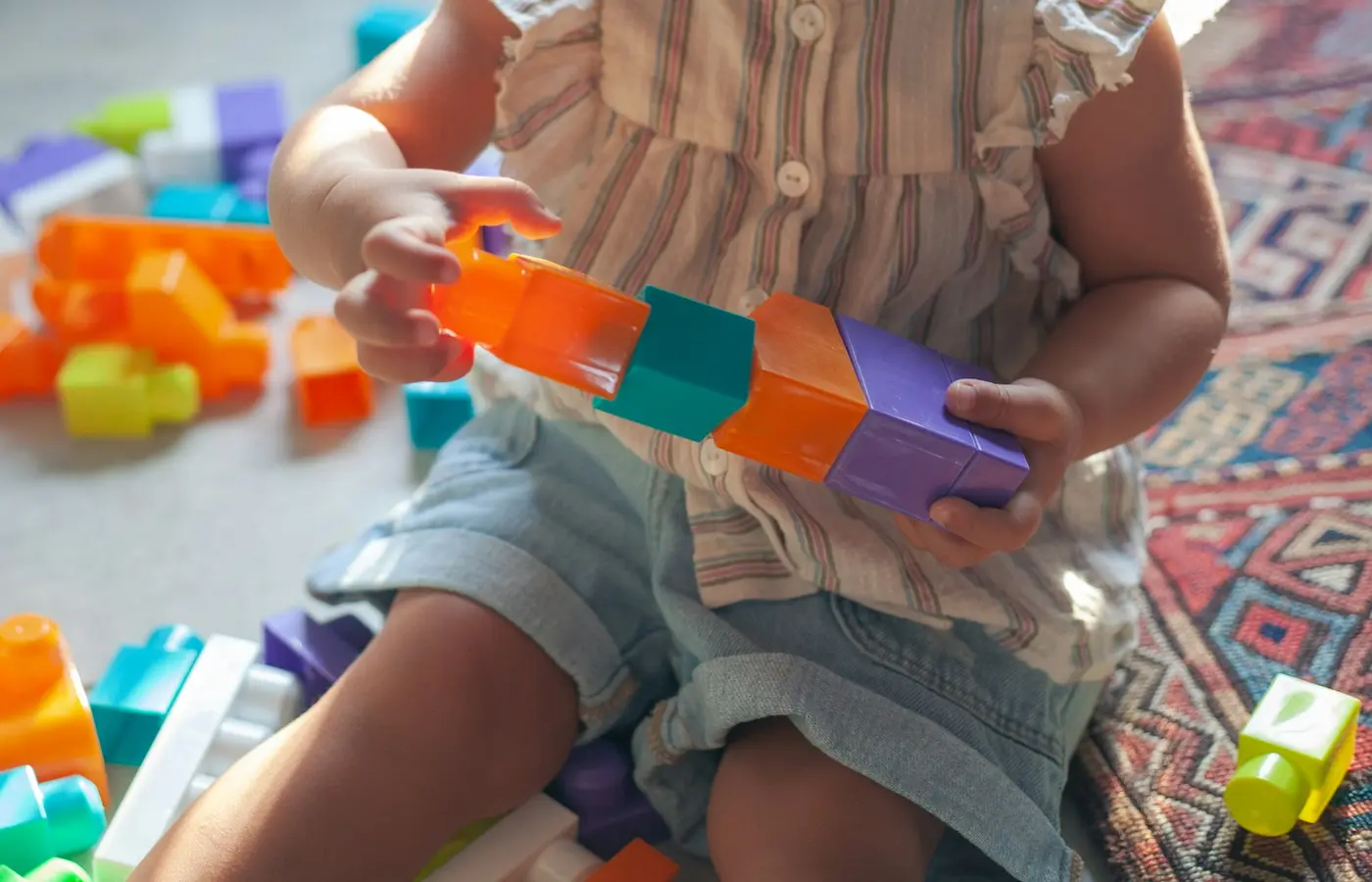
Building play includes much more than stacking a finished structure. A child may sort, line up, connect, carry, dismantle, or repeatedly test what falls. Each action has its own sound pattern.
Before choosing a set, consider:
- The sound of two pieces connecting
- What happens when a structure falls
- Whether pieces roll under furniture
- How many pieces are needed for satisfying play
- The sound of returning pieces to storage
- Piece size and the product’s age grade
You may be able to make an existing set easier on the household by offering fewer pieces on a contained play surface. That is often more effective than asking for gentle handling throughout an activity built around construction and collapse.
Look for a quieter route to the same action
Quiet play does not have to mean sitting still, completing a worksheet, or concentrating for a long period. Start with the action the child is seeking and change the sound-producing part where possible.
- Carrying: move soft toys, fabric squares, or other age-appropriate lightweight objects between baskets.
- Balancing: follow a clear floor path or hold a pose instead of using raised equipment.
- Making rhythms: clap, pat knees, move to a visual sequence, or use an electronic track at a household-approved setting.
- Building: use a smaller selection of compatible pieces on a contained surface.
- Sorting: sort a limited number of larger pieces into shallow containers rather than dropping many objects into a deep bin.
- Pretending: prepare a small scene with a few figures or household-role props rather than an electronic playset.
- Posting: use an age-appropriate posting toy that does not release pieces into a resonant container.
- Connecting and dismantling: offer a few pieces that can be joined by hand without hammering or launching.
Any substitute still needs its own safety check. Avoid treating ordinary household objects as automatically suitable toys, particularly if they are small, breakable, corded, magnetic, battery-powered, or likely to be mouthed.
Plan for floors, storage, cleanup, and sleeping neighbors
A workable setup reduces the number of corrections you need to give. Where feasible, locate early play away from sleeping areas and shared boundaries. Keep enough clear floor space for the intended action, and store daytime-only toys out of sight if their main use is difficult to contain quietly.
An early-morning basket might contain only two or three familiar choices. Familiarity matters because a complicated new toy may require setup, explanations, or help even if it makes no sound. Choose materials the child already knows how to use within current safety directions.
Plan the ending too. If cleanup would wake everyone, it may be reasonable to leave a contained activity on its tray until later. You do not need to make immediate tidying the price of play. The important limits are keeping walkways and doors clear, protecting sleep spaces, and preventing younger children or pets from accessing unsuitable pieces.
A final selection rule
Before choosing a quiet toy for an apartment, picture one complete cycle: the child finds it, starts it, repeats the main action, asks for help, stops, and puts it away. Include every beep, drop, roll, collision, charging task, and storage sound in that picture.
If the cycle fits the room, time of day, current safety instructions, and supervision you can provide, the toy may suit your household. If only the advertised sound fits, keep looking—or simplify something you already own.