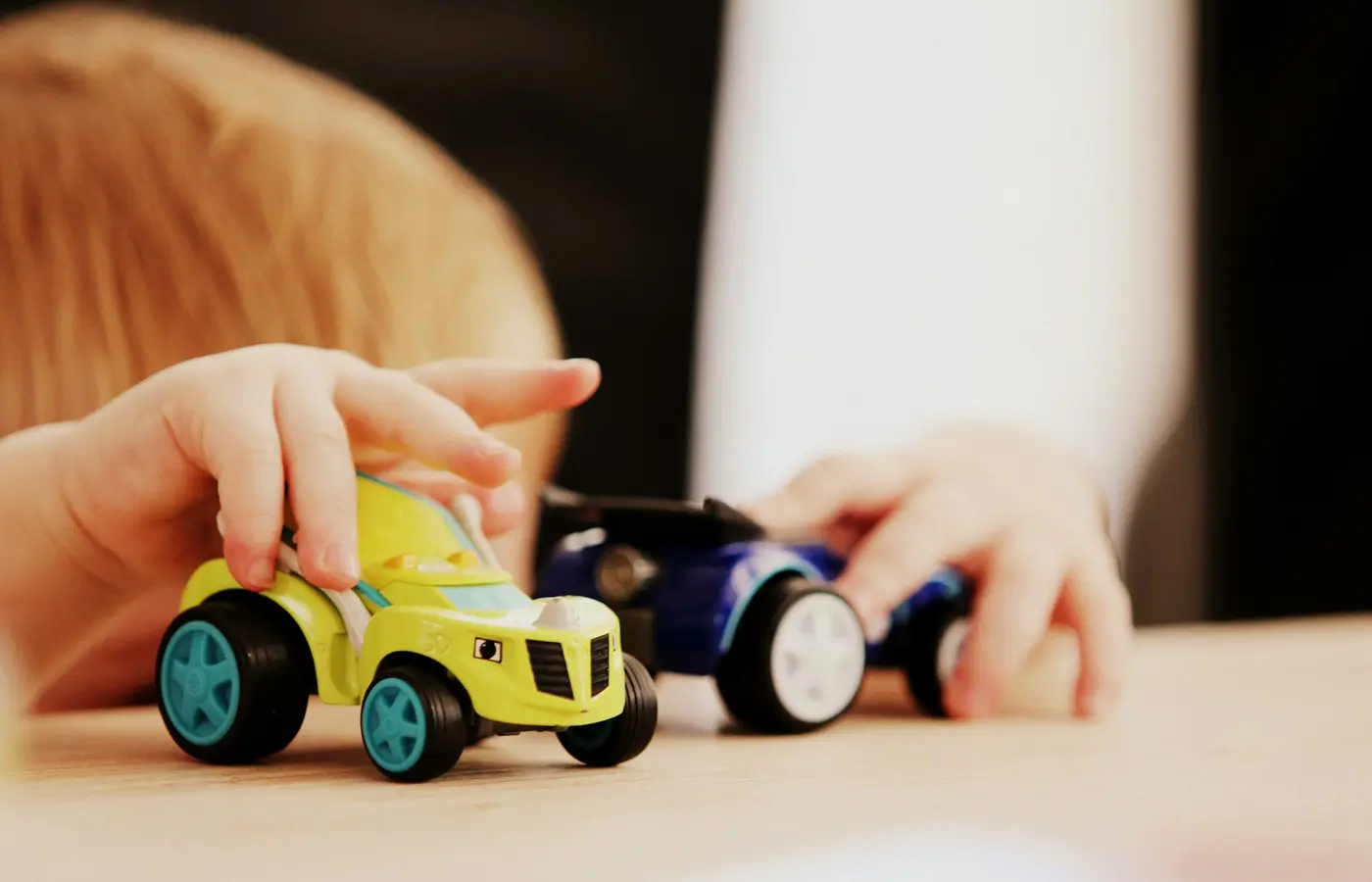
A toy can break in a way that is merely disappointing, such as a missing wheel on a vehicle for an older child. Or it can change the toy into something that no longer belongs in play: a loose magnet, an open battery compartment, a sharp plastic edge, or stuffing that a young child can pull out.
The useful first step is not deciding whether the toy was expensive, beloved, or repairable. It is to pause play and identify what changed. Remove the toy from reach while you look it over, especially if younger children, children who mouth objects, or pets may encounter the loose or damaged part.
As a general rule, consider a repair only when the manufacturer provides a replacement part or explicitly supports the repair in its instructions or warranty materials. If damage creates access to batteries, magnets, small pieces, sharp edges, filling, wiring, or another safety feature, retirement or replacement is usually the clearer choice. A repair should restore the intended design, not create a workaround that only looks secure for the moment.
First, pause play and identify what changed
Put the toy aside before trying to snap it back together, tighten a screw, or apply tape. This gives you a chance to assess the actual condition rather than the visible break alone.
Health Canada advises caregivers to check toys regularly for tears, leaks, and loose, broken, or damaged parts; it also advises throwing away broken toys. The Australian Competition and Consumer Commission (ACCC) similarly notes that toys that are broken, brittle, tearing, or falling apart can become a choking risk.
Look at the toy in good light and check both the break and the surrounding areas. Ask:
- Did a piece come off, crack, split, or become loose?
- Is there a sharp point, jagged plastic, exposed wire, or rough broken edge?
- Can a child reach stuffing, foam, beads, a battery, a magnet, or a small internal component?
- Does the toy still assemble and work as its instructions describe?
- Has the material become brittle, sticky, warped, torn, or leaky?
- Is a closure, cover, strap, hinge, wheel, or fastener no longer doing its job?
- Who is likely to use or find this toy now, including a younger sibling who may use it differently?
This is not a test of whether a child can be careful enough. A child who used a toy safely yesterday may be tired, curious, hurried, or playing alongside a younger child today. The child’s age, mouthing habits, play style, and level of supervision all matter.
If you cannot tell whether a change affects safe use, leave the toy out of play while you find the original instructions, warranty information, or manufacturer contact details. The U.S. Consumer Product Safety Commission (CPSC) encourages adults to choose and maintain toys with safety in mind in its toy safety guidance.
Retire the toy when damage creates a direct hazard
Not every scuff calls for replacing a toy. Cosmetic marks on a sturdy item may not change how it functions. But some kinds of damage create a direct hazard or make the toy’s condition too uncertain to judge.
Take the toy permanently out of play when it has any of these problems:
- A loose piece that a child could mouth, swallow, or insert in their ear or nose.
- Cracked or broken plastic that leaves sharp or pointed edges.
- A torn soft toy that exposes stuffing, pellets, foam, squeakers, or other filling.
- A foam item that is tearing, crumbling, or shedding pieces.
- A loose, missing, cracked, or exposed magnet.
- A leak from a battery, water-filled component, or other internal material.
- Exposed wiring, damaged electrical components, or a powered toy that behaves unpredictably.
- A broken protective cover, closure, restraint, or other part that was designed to limit access or protect fingers.
- A toy that no longer works as intended and cannot be restored with documented manufacturer guidance.
A small break can matter more than it looks. For example, a crack in a plastic shell may eventually release a piece during rough play. A torn seam may expose filling only after a child pulls at it. A missing cover may turn an ordinary toy into one with accessible parts.
The ACCC kids’ toys guide recommends checking whether toys are broken, brittle, tearing, or falling apart, because these conditions can create a choking risk. That is particularly relevant for toys shared among children of different ages. A construction set that remains appropriate for an older child may be unsafe to leave accessible when a younger child can reach loose pieces.
Retiring a toy does not mean you have failed to make it last. Sometimes the safest choice is simply to stop asking a worn item to do a job it can no longer do reliably.
Treat batteries, magnets, and powered parts as a higher-stakes check
Battery-operated toys, magnetic toys, and electronic items deserve extra caution because the risk may not be visible from the outside.
Battery compartments and powered toys
Stop using a toy if its battery compartment is damaged, its cover is missing, its closure no longer holds, wiring is exposed, or the toy becomes unusually hot. Do not assume that tape over a compartment restores the protection that the original design provided.
Health Canada notes that batteries can cause injuries or fires when used or handled incorrectly, and advises following manufacturer instructions for battery-powered toys. CPSC guidance for businesses explains that battery-operated toys have product-specific requirements involving child access to batteries, labeling, and overheating. Those requirements underscore why a damaged battery door or closure is not a minor cosmetic issue.
If a toy uses a button cell or coin battery, an accessible battery is especially urgent. CPSC warns of the serious dangers associated with button cell and coin batteries in its Reese’s Law information. That federal announcement also explains that requirements can differ between general consumer products and toys covered by the Toy Standard. In practical home terms: do not try to infer that one fix will be suitable for every toy.
If a child may have swallowed or inserted a button battery, seek immediate medical attention. Health Canada gives the same instruction for button batteries and magnets. Do not wait to see whether symptoms develop.
Loose or damaged magnets
A magnet that has come loose, cracked, or become reachable through a broken toy is a reason to remove the entire toy from play immediately. Keep any loose magnets away from children while you assess the item.
If a child swallows or inserts a magnet, seek immediate medical attention, as Health Canada advises. This is not a situation for home troubleshooting or waiting for the toy to be repaired.
When a repair may be reasonable
There is a narrow middle ground between replacing every damaged toy and improvising repairs. A repair may be reasonable when it is supported by the manufacturer and restores the toy’s intended assembly without introducing new uncertainty.
Consider repair only if all of the following are true:
- The manufacturer provides a replacement part or documented repair direction. Check the instructions, warranty materials, or official support information first.
- The repair restores the original function. It does not change how a closure, connection, moving part, or protective feature works.
- No safety-critical feature is damaged. The repair does not involve a battery compartment, magnet housing, protective cover, electrical component, restraint, or component that limits access to small parts.
- The toy can be reassessed afterward. Once reassembled, check for loose parts, sharp edges, pinching points, unstable connections, and changed function.
- The toy remains suitable for the children who may access it. An older child may understand that a piece is fragile; a younger sibling may not.
The Toy Association advises families to read instructions and save directions, warranties, and assembly hardware in its toy safety and age-grading statement. That is useful not because a saved screw or instruction sheet proves a repair is safe, but because original documentation is the best place to look for toy-specific replacement parts, assembly information, and warnings.
If documentation is unavailable, unclear, or does not address the damage, replacement or retirement is the safer default for a children’s toy. A repair that seems sturdy in an adult’s hand may behave differently after pulling, dropping, chewing, throwing, or repeated use.
Repairs that should not bypass the original design
It is tempting to make a quick fix when a child is upset or a favorite toy is difficult to replace. But some common workarounds can change access, strength, or function in ways that are hard to verify at home.
Avoid treating these as dependable repairs:
- Taping a battery compartment shut.
- Gluing a small part back on without manufacturer guidance about the part and attachment method.
- Replacing a missing screw, clip, strap, latch, or fastener with a mismatched substitute.
- Disabling a cover, closure, sound, movement, or protective feature so the toy can keep working.
- Using a toy after a magnet housing, electrical cover, or other protective component breaks.
- Assuming a repaired toy is appropriate for the same age range simply because it was originally sold that way.
Tape may peel, glue bonds may fail, and substitute hardware may fit differently from the original component. None of those observations mean every repaired household item is unsafe. They do mean that children’s toys have a particular challenge: their parts may be pulled, twisted, mouthed, dropped, and shared in ways an adult repair cannot reliably predict.
CPSC’s toy safety business guidance explains that toy safety requirements are product-specific and that not every provision applies identically to every toy. That is another reason not to rely on a general online repair trick as proof that a particular toy has been restored safely.
Replace, retire, or keep parts out of play
Once you decide the toy should not return to play, choose the least complicated next step that keeps loose or hazardous components away from children.
Replace
Replacement may make sense when the toy serves a real purpose in your home, a manufacturer-supported replacement part is available, or an equivalent simpler option would be easier to maintain. Before replacing it, consider what the child actually used it for. Was it the specific toy, or the activity of carrying dolls, rolling objects, building tracks, sorting pieces, pretending, or making sound?
Often, the play can continue with a different material already at home. A broken electronic sorter may not need an identical replacement if a bowl, safe household containers, and large objects support the same urge to fill, empty, carry, and sort under supervision.
Retire
Retirement is the appropriate answer when a toy has a direct hazard, a safety feature has failed, the repair is uncertain, or keeping it usable would require ongoing adult monitoring. Set it aside promptly rather than leaving it on a shelf for a later decision, where it can drift back into play.
Do not pass along a damaged toy as though another family could safely make use of it. The next household may have a younger child, different supervision needs, or no knowledge of what has changed.
Keep only genuinely safe, intended parts
Some toys include components that remain intact after another part breaks. Still, preserve a piece only if it remains safe and usable for its intended purpose on its own. Do not turn fragments, detached wheels, loose magnets, broken electronics, or unknown small components into loose-play materials.
Keep retired items and loose components where younger children cannot access them while you decide what to do next. Local disposal and recycling rules vary for batteries, electronics, plastic, foam, and other materials, so follow the relevant local guidance rather than assuming all toy parts belong in the same bin.
Quick answers to common repair questions
Can I glue a broken toy back together?
Only consider it if the manufacturer explicitly supports that repair or supplies the appropriate replacement part or method. Do not rely on glue for a small piece, protective cover, battery compartment, magnet housing, or other component that could become accessible during play. If the bond fails, the break may create a choking, sharp-edge, or access hazard.
Should I keep using a toy with a broken battery compartment?
No. Remove it from play. A broken or missing battery cover, damaged closure, exposed battery, exposed wiring, leakage, or overheating is a reason to stop using the toy and consult the manufacturer’s instructions. Do not use tape as a substitute for the original compartment design.
What should I do if a toy magnet comes loose?
Remove the toy and magnet from children’s reach immediately. If a child may have swallowed or inserted a magnet, seek immediate medical attention. Do not return the toy to play unless the manufacturer provides a suitable, documented remedy.
Can I use tape to repair a child’s toy?
Tape may seem useful for a temporary household fix, but it should not substitute for a designed closure, attachment, or protective component on a children’s toy. It can peel away or change how a part functions. For a toy with any possible small-part, battery, magnet, sharp-edge, or access concern, retirement or manufacturer-supported replacement is the safer choice.
Sources and research note
This guidance is based on general toy-safety information from regulators and industry guidance. It does not approve a specific repair, restore a toy’s original compliance status, or replace the manufacturer’s instructions for a particular model.
- Health Canada: Safety tips for specific toy types — Canadian caregiver guidance on inspecting toys, following instructions and age labels, battery safety, and urgent action for swallowed or inserted magnets and button batteries.
- U.S. CPSC: For Kids’ Sake — Think Toy Safety — U.S. consumer toy-safety publication on selecting and maintaining toys with safety in mind.
- U.S. CPSC: Toy Safety Business Guidance — U.S. product-specific guidance, including battery-operated toy considerations.
- U.S. CPSC: Making Families Safer from Button Cell or Coin Battery Dangers — U.S. information on button cell and coin battery risks and regulatory scope.
- ACCC Product Safety: Kids’ toys guide — Australian consumer guidance on sturdy construction, age grading, and damage that may create choking risks.
- The Toy Association: Statement on Toy Safety, Age Grading and Small Parts — Industry guidance on retaining instructions, warranties, and assembly hardware.
When a toy breaks, let the hazard—not the original price or the child’s disappointment—make the decision. If the repair cannot clearly restore the toy’s intended design with manufacturer support, choose retirement, replacement, or a different way to continue the play.