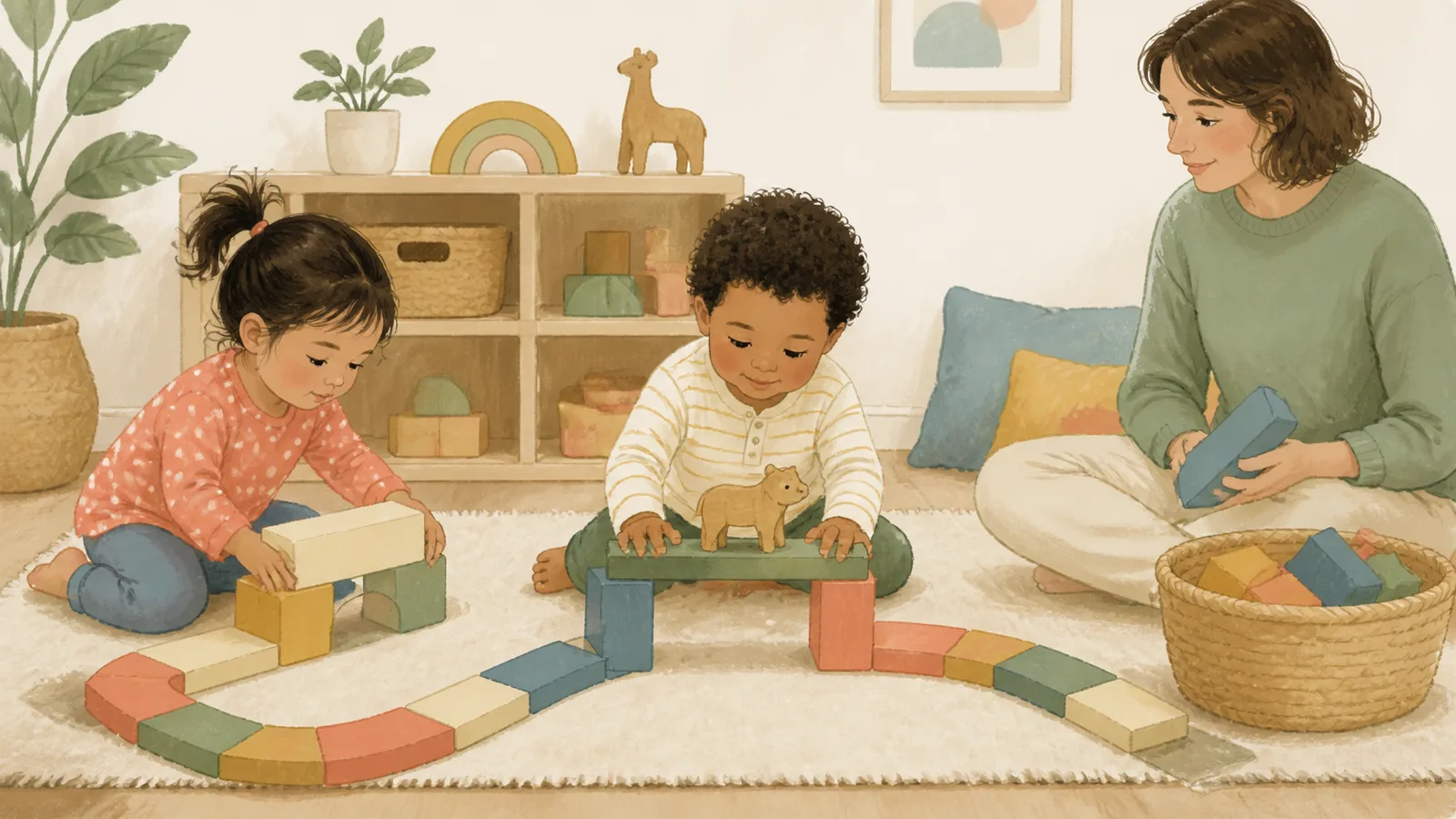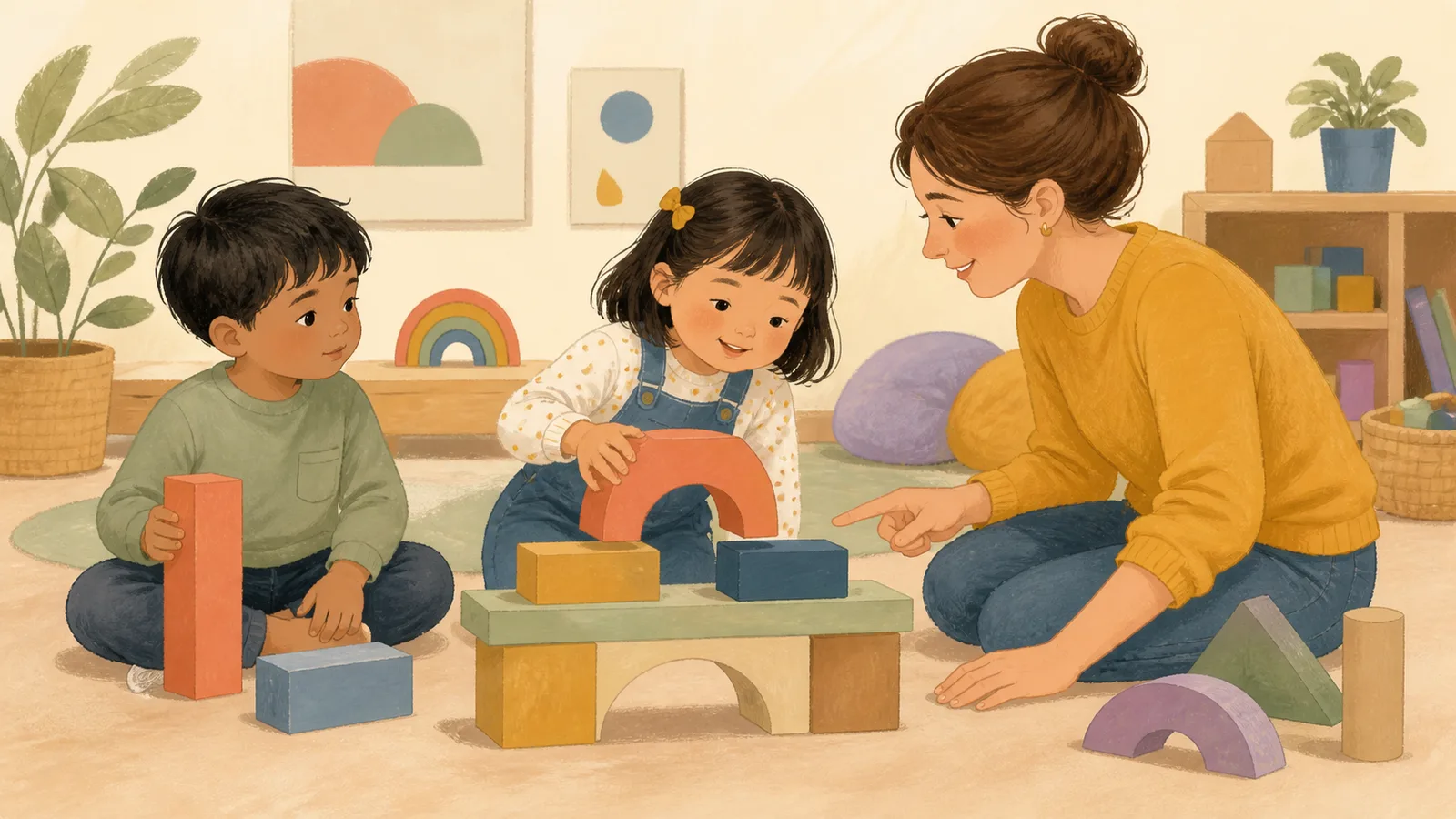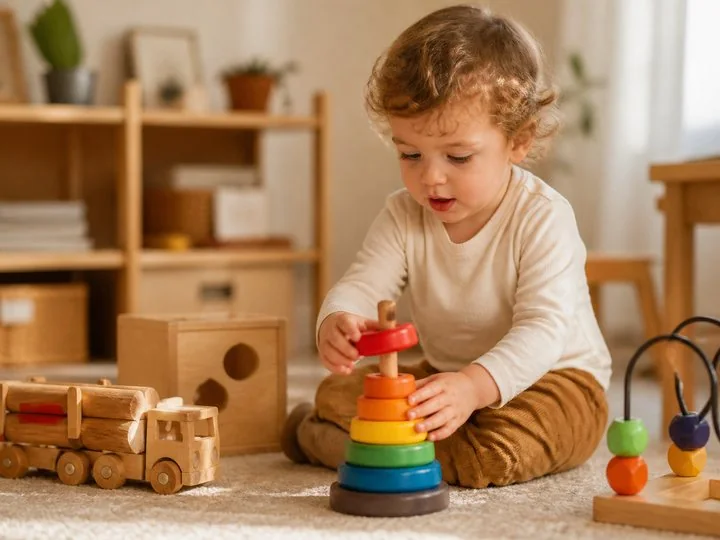
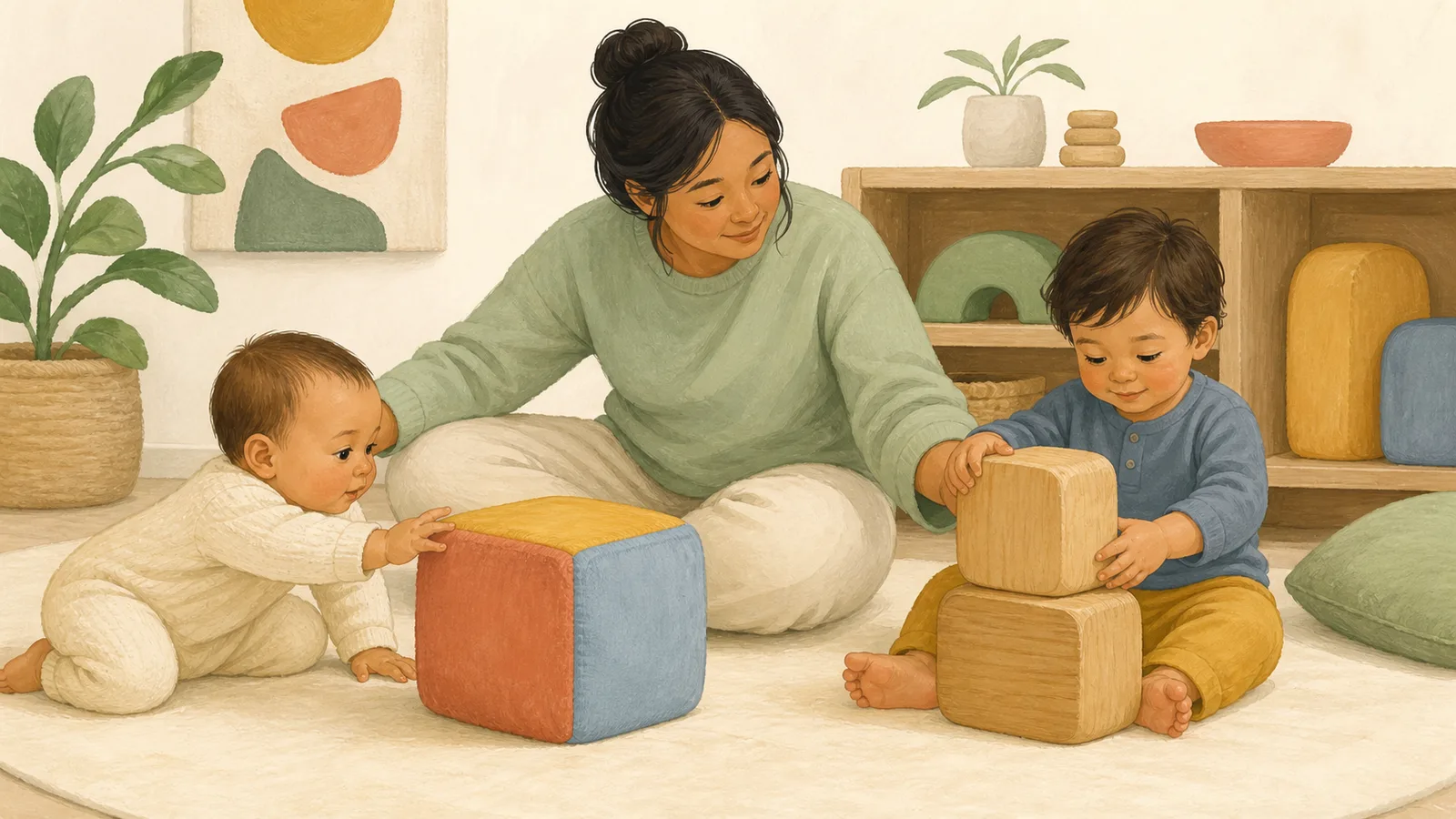
The best first blocks are not necessarily wooden, colorful, or marketed as educational. They are large enough for the child’s age, light enough for the way the child drops and bangs, easy to grip, intact after repeated use, and consistent enough to stack when stacking begins.
For a baby, one soft block may be an object to look at, squeeze, mouth, and push. A young toddler may carry six blocks for weeks before building a tower. That is still block play.
Quick comparison
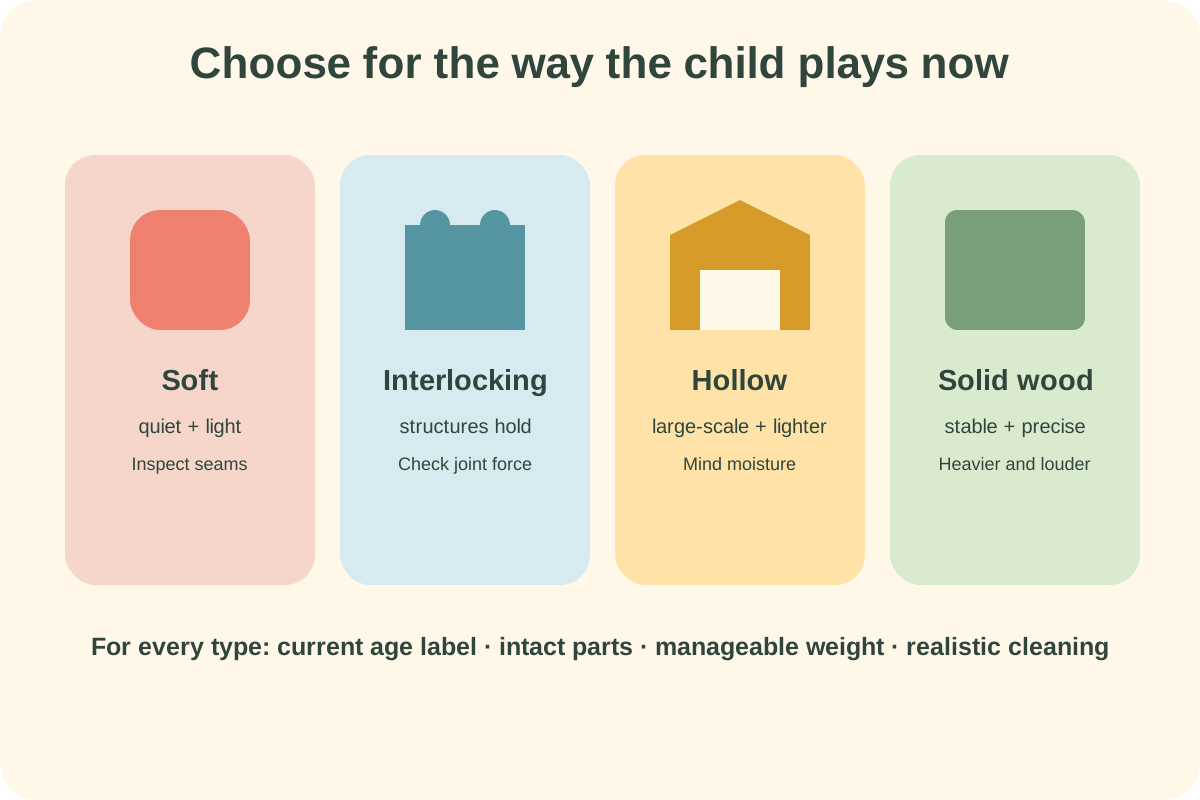
| Block type | Best for | Main strength | Trade-off |
|---|---|---|---|
| Soft fabric or foam | Early handling, quiet rooms, frequent dropping | Light and quiet | May compress or stack less precisely; seams and foam need inspection |
| Large lightweight interlocking | Children who enjoy connecting and taking apart | Structures stay together | Connection force may frustrate; plastic joints and magnets require careful condition checks |
| Hollow cardboard or lightweight wood | Large-scale builds with less lifting weight | Big structures from fewer pieces | Moisture and crushing can shorten life |
| Solid wooden unit-style blocks | Balancing, predictable proportions, long-term construction | Stable surfaces and repeatable geometry | Heavy, noisy, expensive, and less suitable for uncontrolled throwing |
No category is automatically safe. Follow the exact product’s current age label and inspect its construction.
Seven tests for a first set
1. Piece size
Blocks accessible to a child under three must not create a small-parts hazard. Do not mix older siblings’ miniature bricks, magnetic components, marbles, wheels, or decorative loose parts into a baby’s floor set.
Large scale also improves grip and makes pieces easier to find. “Jumbo” is marketing language; verify actual dimensions and age grading.
2. Drop test—without actually claiming a lab test
Imagine the heaviest piece falling from the child’s hand onto a bare foot, wood floor, glass table, or younger sibling. A substantial unit block behaves differently from a fabric cube. If the room makes that risk hard to manage, choose a lighter set or use a rug and smaller number of wood pieces.
3. Surface and edges
Check every face, corner, seam, printed coating, sticker, and joint. Wood should remain smooth and intact. Fabric seams should not release stuffing. Foam should not tear or expose bite-sized fragments. Plastic should not crack around connection points.
4. Grip
A block should offer at least one comfortable grasp. Oversized cubes can be difficult for small hands despite being safe in size. Rectangular prisms, arches, cylinders, and thinner blocks may be easier to pick up but introduce different rolling and stacking behavior.
5. Predictable geometry
Repeated dimensions help children discover relationships: two small units span one longer unit, flat faces stack, cylinders roll, and arches bridge. A novelty set with twenty unrelated shapes can be visually appealing but harder to combine.
6. Cleaning fit
Choose a material that suits your home. Fabric may be machine washable but needs full drying. Solid unfinished wood is generally wiped, not soaked. Cardboard resists only limited moisture. Electronic or magnetic blocks may trap water if submerged. Follow the maker’s care directions.
7. Storage and expansion
Can the entire useful set fit in one container the child can access? Will a compatible expansion exist later, or does every new package introduce another scale? Longevity often comes from a coherent system, not sheer piece count.
What block play looks like before a tower
Early block play may include:
- looking and mouthing one suitable piece;
- holding a block in each hand;
- banging two together;
- transferring, dropping, or rolling;
- filling and dumping a basket;
- carrying blocks between locations;
- knocking down an adult’s short tower;
- placing one block on another; and
- lining pieces along a surface.
NAEYC’s toddler block guidance describes construction as changing over time and notes that bridge building often appears later than simple stacking. These are observations, not deadlines. Avoid counting blocks in a tower as the single score of progress.
If a child currently loves moving pieces rather than stacking them, the transporting and trajectory patterns in our play-schema guide may help you organize a safe carrying route or rolling area.
How many blocks are enough?
Begin with enough pieces to repeat an action without creating an overwhelming cleanup. For a young toddler, 8–16 large coherent pieces can support carrying, filling, lining, knocking down, and short structures. This is a practical starting range, not a research-established optimum.
Add pieces when the child repeatedly reaches the limit of the current set: the road cannot extend, the enclosure cannot close, or a shared build needs more material. Do not add merely because a package calls itself a starter set.
Keep special accessories modest. Figures and vehicles can extend stories, but too many themed pieces can turn a flexible building set into a sorting burden.
Wood, foam, fabric, or plastic?
Choose soft blocks when…
the child is still dropping everything, the room has hard surfaces, noise matters, or the blocks will be used near a younger baby. Check seams and internal filling after every wash.
Choose solid wood when…
the child can handle the weight safely, predictable balancing matters, and the family wants a durable system. Our broader wooden-toy guide explains finishes, certifications, and why wood is not automatically the sustainable choice.
Choose large interlocking blocks when…
the child enjoys connection and wants structures that move without collapsing. Try the connection yourself: a tight joint can turn play into repeated adult assistance. For magnetic constructions, inspect every enclosure and follow age guidance; missing or loose magnets are a severe hazard.
Choose hollow blocks when…
large-scale construction is the goal but solid weight is impractical. They suit arches, roads, walls, and child-height structures while storing less efficiently.
Adult support without taking over
Sit nearby and build one small thing. Narrate spatial relationships in ordinary speech: “The long block is under the bridge,” or “You turned the arch around.” Research on block-play language suggests the context invites words about location, dimension, shape, and orientation.
Do not quiz every color and shape. Our guide to spatial language during block play shows how to describe, wonder, and wait while preserving the child’s plan.
If the child knocks down your structure, treat that as expected unless someone could be hurt. Build shorter, ask before joining the child’s construction, and create a protected shelf for a project that needs to remain overnight.
Mixed-age play
Shared blocks should be safe for the youngest child who can reach them. Older children can use smaller bricks or complex magnetic sets at a high table, behind a gate, or during a scheduled session with closed storage afterward.
Do not rely on sorting by color or asking an older sibling to notice every escaped piece. Use distinct containers and count high-risk components. When possible, give older children a large-block challenge so everyone can build with the shared safe set at the same time.
Frequently asked questions
When can a baby play with blocks?
When the exact block is labeled and suitable for the baby’s age and current use. Early play may be looking, grasping, mouthing, and pushing rather than building. One or two large light pieces are enough to start.
Are wooden blocks safe for a one-year-old?
Some are, when age graded accordingly and intact. Consider size, weight, edges, finish, and whether the child throws or mouths. A wooden set intended for preschoolers is not made suitable by supervision alone.
Are foam blocks a choking risk?
They can become one if foam tears or a child bites off pieces. Follow age guidance, inspect bite marks and seams, and retire damaged pieces. Softness does not eliminate ingestion hazards.
Why does my toddler only knock blocks down?
Knocking down provides immediate information about force, sound, movement, and cause and effect. Build short towers the child can safely topple, then leave loose blocks nearby without requiring reconstruction.
Do blocks teach math?
Block play can provide opportunities to compare size, count, balance, make patterns, and use spatial language. Studies have found associations and some positive intervention results, but a block purchase does not guarantee later math outcomes. The quality of play and interaction matters.
Sources and research note
This guide draws on NAEYC resources about toddler block construction and what children can explore in block play, observational research on spatial language during block play, and a 2025 study of block-play interventions and early skills. Safety criteria come from the CPSC toy center and small-parts guidance. LWT did not hands-on test or rank commercial block sets.