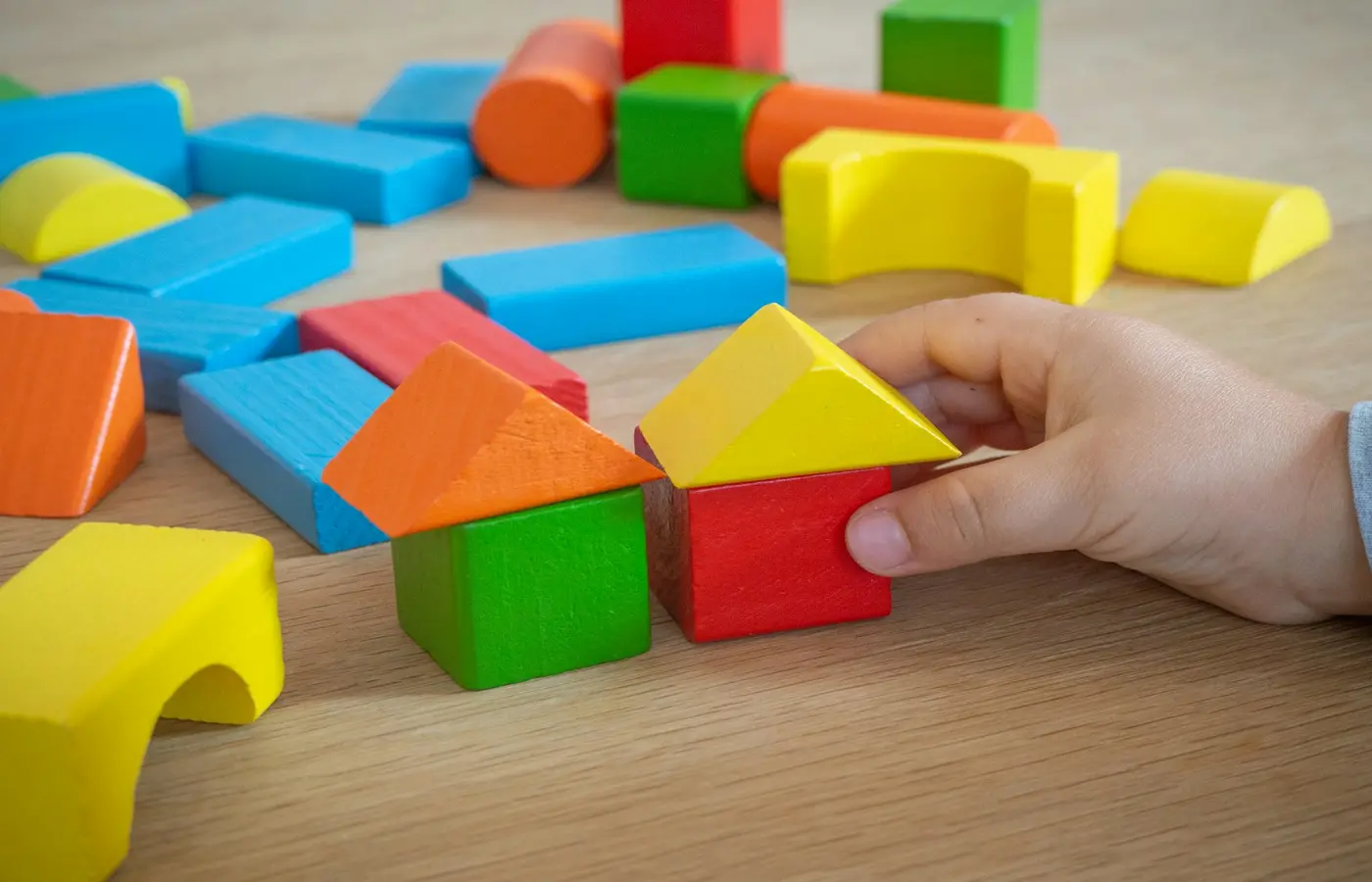
A toy does not need to work from babyhood through the school years to be worth having. In real homes, a useful toy may have a strong season: a child carries it, posts it, lines it up, builds with it, makes up a story around it, then moves on.
When people say a toy “grows with” a child, they usually mean the play can change over time. That may happen when a child finds new actions to try, adds their own rules, combines the toy with other materials, or returns to it with a new idea. It is not a safety classification, a promise that every child will stay interested, or proof that the toy produces a particular developmental outcome.
One boundary stays firm: a child’s changing interest or ability does not override the toy’s age label, warnings, instructions, condition, or supervision needs. Check those before bringing an older sibling’s toy back out, handing it down, or mixing its pieces with materials for a different age group.
Start with the play, not the “grows with” label
A better question than “Will this last for years?” is: What does my child do with this now, and is there still a safe, workable next way to use it?
A child may use the same material quite differently at different times. A set of large figures might first be carried from room to room, later arranged in rows, and later included in an elaborate pretend game. A construction material may move from knocking down an adult’s tower to making a chosen structure, sorting pieces, or inventing a rule about what can be built.
That change is possible, not guaranteed. A study of children’s toy use found that how fully children used a toy varied with the child’s age, the toy category, and how well the toy fit the child’s age group. In other words, a toy’s possibilities are partly about the object, but also about the particular child and moment. The study does not show that any toy follows a predictable series of stages or remains engaging for every child. Read the study here.
Age guidance works differently from marketing language. The U.S. Consumer Product Safety Commission (CPSC) considers children’s characteristics, skills, play behaviors, and interests when making age determinations. It is not simply an upper limit on who may enjoy an item. Age labels also matter because they can relate to hazards, including small-parts hazards for children under 3. The CPSC age-determination guidelines explain this approach.
So it is reasonable to keep a toy because your child still chooses it or changes how they use it. It is also reasonable to let it go when the fit is gone. Neither choice means you have missed an opportunity.
Four signs play is changing, not just repeating
Repetition can be satisfying play in its own right. A child may enjoy filling and dumping a container many times, or carefully putting the same animals in the same order. You do not need to turn every repeated action into a more advanced challenge.
But these observations can help you notice when a familiar toy still has room to change.
1. The child changes the action
Look for a shift in what the child physically does with the toy. They may move from carrying pieces to connecting them, from pressing one button to using several parts together, or from making a pile to sorting by a feature they have chosen.
The CPSC’s age-determination guidance describes broad changes in children’s manipulation and play behavior across early childhood. Those descriptions help manufacturers and regulators consider intended users; they are not deadlines for an individual child. One child may enjoy a detailed building task early, while another may prefer broad movement or pretend play with the same materials much later.
2. The child adds a story, role, or rule
A toy can keep changing when the child supplies the structure. A vehicle becomes part of a delivery game. Figures become a family, rescue team, or parade. Blocks become a boundary for an invented game.
You do not have to ask, “What are you making?” or suggest a theme each time. A quiet observation is often enough. If a child invites you in, you might follow their lead: “Where does this one need to go?” If they do not, the story can remain theirs.
3. The toy connects with other materials
Many toys become more useful when they can sit beside compatible materials. A stuffed animal near pretend food may prompt caregiving play. Toy vehicles beside cardboard, paper, or large blocks may suggest roads, garages, or delivery routes.
The practical guidance in Adapting Toys and Play Materials recommends grouping related materials to suggest a theme and help children make play connections. This is an invitation, not a prescription. If adding materials creates clutter, conflict, or a cleanup problem that outweighs the play, keep the setup smaller.
4. The child returns for a self-chosen challenge
A child may revisit a toy because they want to solve a problem that matters to them: balancing a piece, completing a route, organizing a collection, making something stand, or changing a pretend scenario.
The useful signal is not how long they stay with it or whether they finish an adult-defined task. Notice whether they return voluntarily and whether the material leaves room for choices. A brief, lively five minutes can be plenty.
Signs a child may have outgrown the toy—or needs a different setup
A toy can be temporarily uninteresting without being permanently finished. Before donating or storing it away, consider whether the barrier is the toy itself or the way it is currently available.
A child may need a different setup when:
- too many pieces are spread out at once and choosing feels overwhelming;
- an important part is missing, tangled, hard to reach, or difficult to operate;
- the toy is always stored where the child cannot access it safely;
- the play depends on a partner, but no one is available at that moment;
- the child needs a more stable surface, a larger handle, fewer pieces, or another access adaptation;
- the toy is competing with a louder, more immediate activity nearby.
The adaptation resource notes that materials can be adjusted when a child needs additional assistance or another way to access them. That might mean reducing the number of pieces offered, placing items within easier reach, or grouping related toys together. It does not mean altering a toy in a way that defeats its safety design, removes a protective feature, or creates a new hazard.
A toy may be ready to leave the regular rotation when it is consistently frustrating, offers no meaningful play possibility for this child, takes up more space than it earns, or is damaged beyond safe repair. There is no research-based universal checklist that can tell you exactly when a child has outgrown a particular toy. Your observations of interest, access, safety, and household reality matter.
It is fine to:
- put the toy away for a few weeks and see whether it is missed;
- save it only if you can store it safely and keep all relevant warnings and instructions with it;
- donate or pass it on when it remains complete and appropriate for another household;
- recycle or dispose of a damaged item according to local options.
Age grades still set the safety floor
A child who can create a more elaborate story or construction is not automatically ready for every toy aimed at older children. Likewise, a younger child should not be moved into a toy with hazards beyond its labeled age just to make a purchase “last longer.”
Age grading is product-specific. ISO/TR 8124-8:2024 notes that toys within the same broad subcategory can have different appropriate age grades because of factors including size, complexity, number of pieces, dimensions, weight, detail, realism, and special functions. See the ISO technical report.
Before reintroducing, combining, or handing down a toy, check:
- the exact product’s age label and warnings;
- the instructions, including assembly and supervision directions;
- whether any part is cracked, loose, sharp, swollen, leaking, or otherwise damaged;
- whether all required components remain present and working as intended;
- whether small pieces could be accessible to a child under 3 in the home;
- current recall information for the specific product.
The CPSC guidance is especially relevant in mixed-age households. A toy may be suitable for an older child while loose components create a small-parts hazard for a younger sibling or visiting child. Keeping age-graded sets in a lidded, higher storage space can be a practical control when younger children are around, but it does not replace active adult judgment about the play setting.
No toy is absolutely safe in every circumstance. Safety depends on the exact product, its condition, the children present, and how it is used and supervised.
Ways to extend play without buying an “upgrade”
If a toy is safe and the child still shows some interest, you may be able to refresh the setup without buying a newer or more complicated version. Choose one small change rather than turning play into a project.
Change the setting
Move a portable toy from the table to the floor, from indoors to an appropriate outdoor surface, or from a crowded play area to a quieter corner. Make sure the new setting still suits the toy’s instructions and does not introduce hazards such as water, stairs, pets, or younger children with access to unsuitable pieces.
Offer a related open-ended material
Cardboard, paper, fabric scraps, large empty containers, or washable markers can sometimes give a familiar toy a new context. Keep the materials age-appropriate and manageable. A large floor setup may invite ideas, but it can also create a cleanup burden; a tray or small rug can set a useful boundary.
Try a sorting, care, or repair task
Some children enjoy matching pieces, putting materials back in a set, wiping sturdy washable surfaces according to instructions, or helping identify which part belongs where. This can be a real contribution to the household rather than a disguised lesson.
Do not ask a child to repair damaged components that need adult inspection, and do not use tape, glue, or improvised substitutions to bypass a safety warning or replace a structural part.
Reduce, rather than add
A smaller selection can be more inviting than a full bin. Put out a few pieces, one vehicle, or one figure-and-accessory set. Store the rest and rotate later. This approach can reduce noise, missing-piece frustration, and cleanup without requiring a child to play alone or for a particular length of time.
Put it away on purpose
Rotation is not a test of whether a child deserves a toy or is sufficiently grateful for it. Sometimes familiar materials become interesting after a break; sometimes they do not. Either result gives you useful information.
A simple keep, adapt, rotate, or pass-on decision
When a toy is taking up space or you are considering a replacement, use this practical rule.
Keep it when the child still chooses it, uses it in more than one way, or has an idea they want to return to—and the product remains safe, complete enough for its intended use, and workable in your home.
Adapt the setup when the child appears interested but access, clutter, reach, stability, or the number of available pieces gets in the way. Keep adaptations within the product’s safety directions.
Rotate it when interest seems temporarily low, the toy is safe to store, and you have room to put it away without creating a forgotten pile of loose parts.
Pass it on when the toy is unsafe, persistently frustrating, incomplete in a way that affects safe use, or no longer offers a useful play possibility for that child. Before handing it down, review the exact toy’s instructions, age label, condition, and current recall information.
The goal is not to make every purchase last forever. A toy has done enough if it supported worthwhile play for the season it fit your child and household. Start with one toy that is currently in question, check its safety information, and watch what your child actually does with it before deciding whether to keep, change, store, or release it.
Sources and research note
- Children’s Utilization of Toys is Moderated by Age-Appropriateness, Toy Category, and Child Age. This study supports the limited point that children’s use of toys varies with age, toy category, and age-appropriateness. It does not establish that toys marketed as “grow with” products produce particular developmental outcomes.
- CPSC Age Determination Guidelines. Guidance on how children’s characteristics, skills, play behaviors, and interests inform age determinations, including small-parts considerations.
- CPSC: Updating Age Determination Guidelines for Toys. Background material on children’s abilities, preferences, and play behaviors used in age-determination work.
- ISO/TR 8124-8:2024. Technical guidance explaining why the appropriate age grade for a specific toy can vary within a broad toy category.
- Adapting Toys and Play Materials. Practical ideas for making play materials more accessible or refreshing familiar materials without assuming every child needs the same setup.
These sources support a contextual view of changing play and age appropriateness. They do not prove that a toy will remain suitable, engaging, or beneficial for every child over time. Always consult the exact product’s current warnings and instructions.