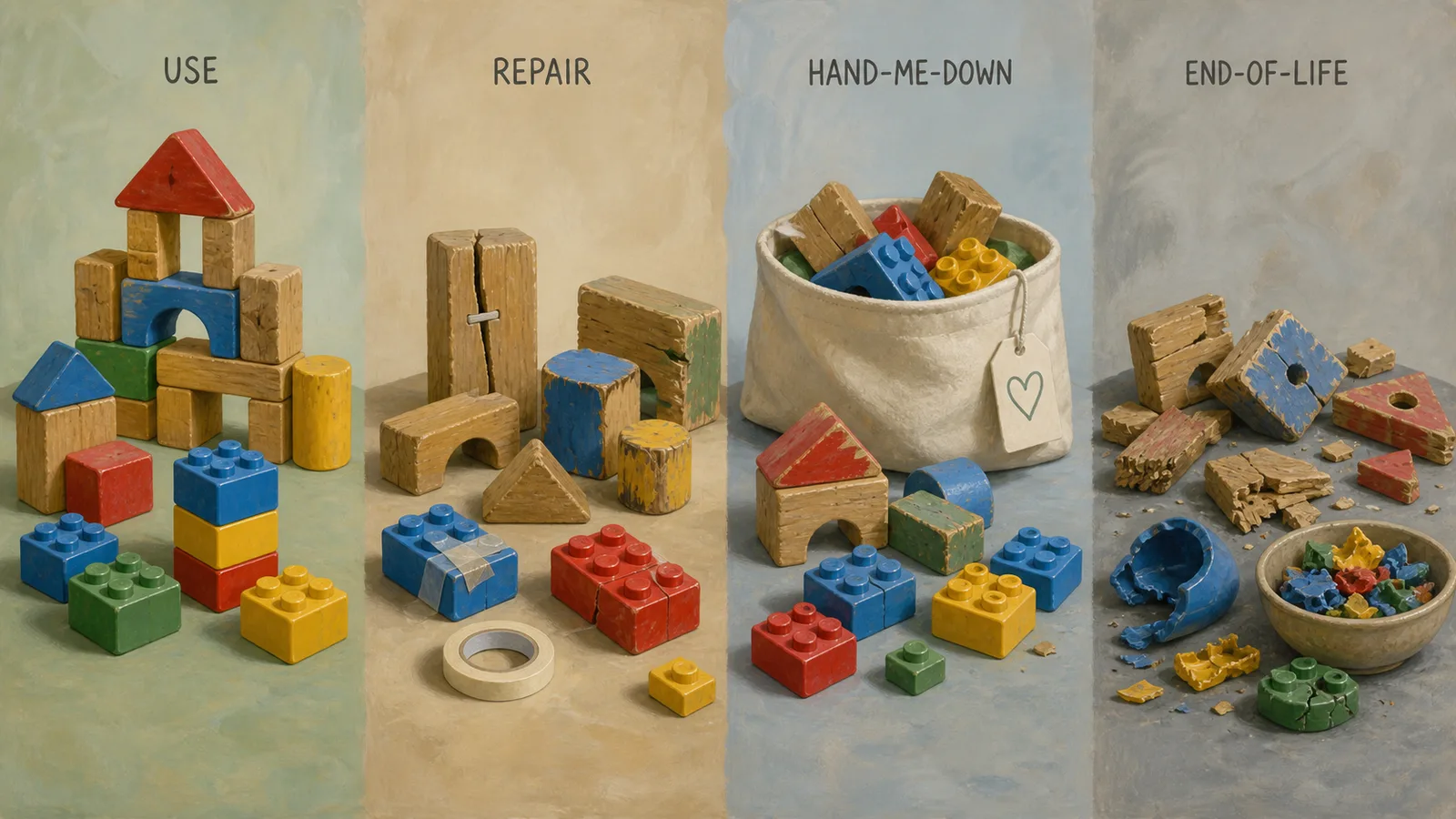
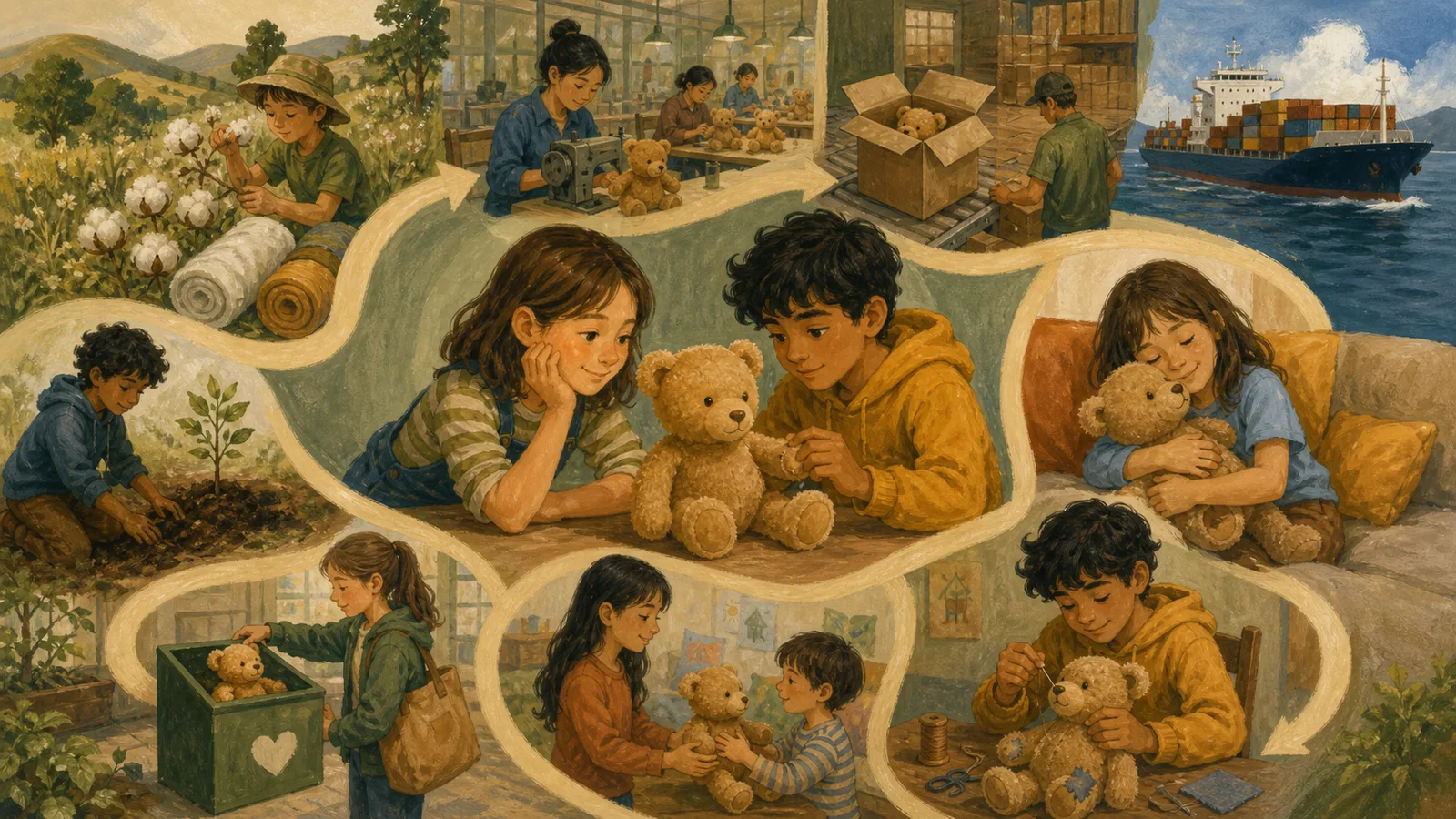
Every toy has a story before the box opens and after play ends. A life-cycle investigation follows that whole story instead of judging one visible feature, such as “wood,” “recycled,” or “made nearby.”
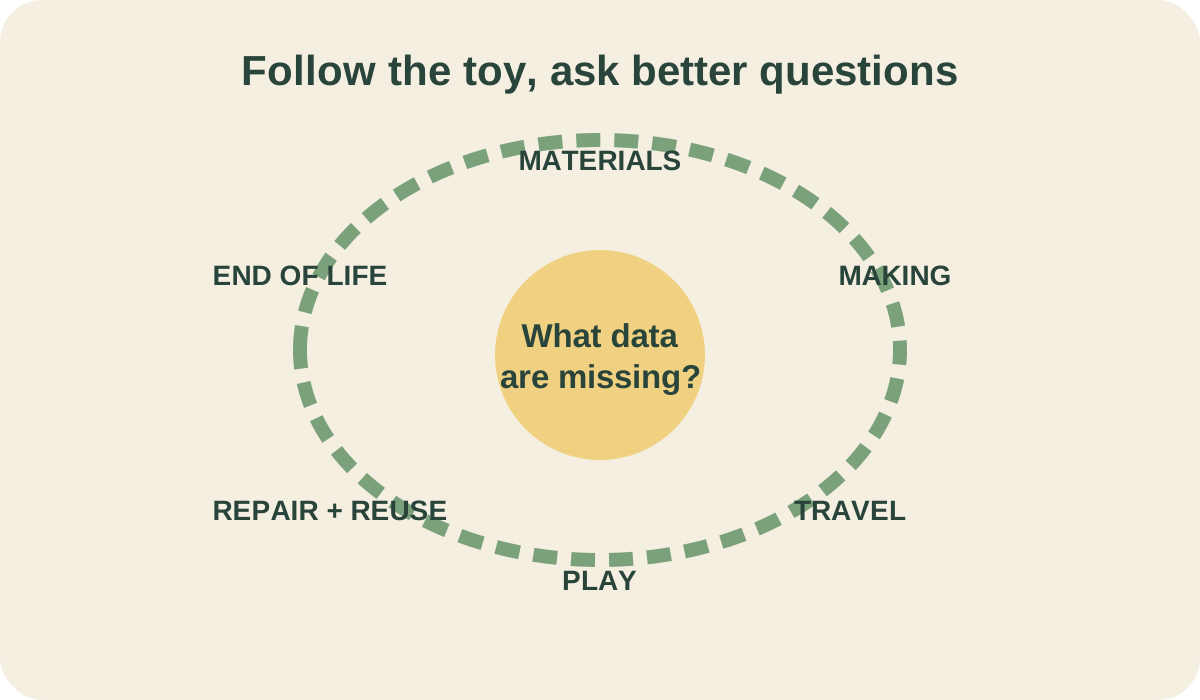
Stage 1: materials
List what you can see: wood, plastic, cotton, metal, paint, rubber, cardboard. Then list what may be hidden: glue, screws, electronic boards, batteries, coatings and ink. Ask where each material came from and whether the company provides a specific certification or only a broad phrase.
Material labels do not settle the comparison. Our wood-versus-plastic guide explains why mass, finish, construction and useful life can change the result.
Stage 2: making
Raw material is shaped, molded, cut, painted, sewn or assembled. Each process uses energy and may create waste. Factory location alone does not reveal working conditions or energy source. A credible product report should define what it measured.
Ask:
- How many parts are there?
- Can they be separated without destroying the toy?
- Are fasteners visible or is everything permanently bonded?
- Are replacement parts offered?
Design choices here affect repair years later.
Stage 3: packaging and transport
Packaging protects a product from damage but also adds material. A lighter box is not automatically better if it causes more products to break. Transport depends on distance, mode, product weight and how efficiently items are packed.
Do not try to calculate an exact footprint from a country label. Instead, record what is known and mark what is missing.
Stage 4: play and maintenance
Use is where families have influence. A toy that supports years of changing play may spread its production impacts across many sessions and children. That does not erase manufacturing; it makes durability and use part of the denominator.
Document one month:
- how often the toy is used;
- whether play changes;
- what cleaning it needs;
- which component wears first;
- whether storage protects it.
This is a household observation, not a universal product test.
Stage 5: repair and reuse
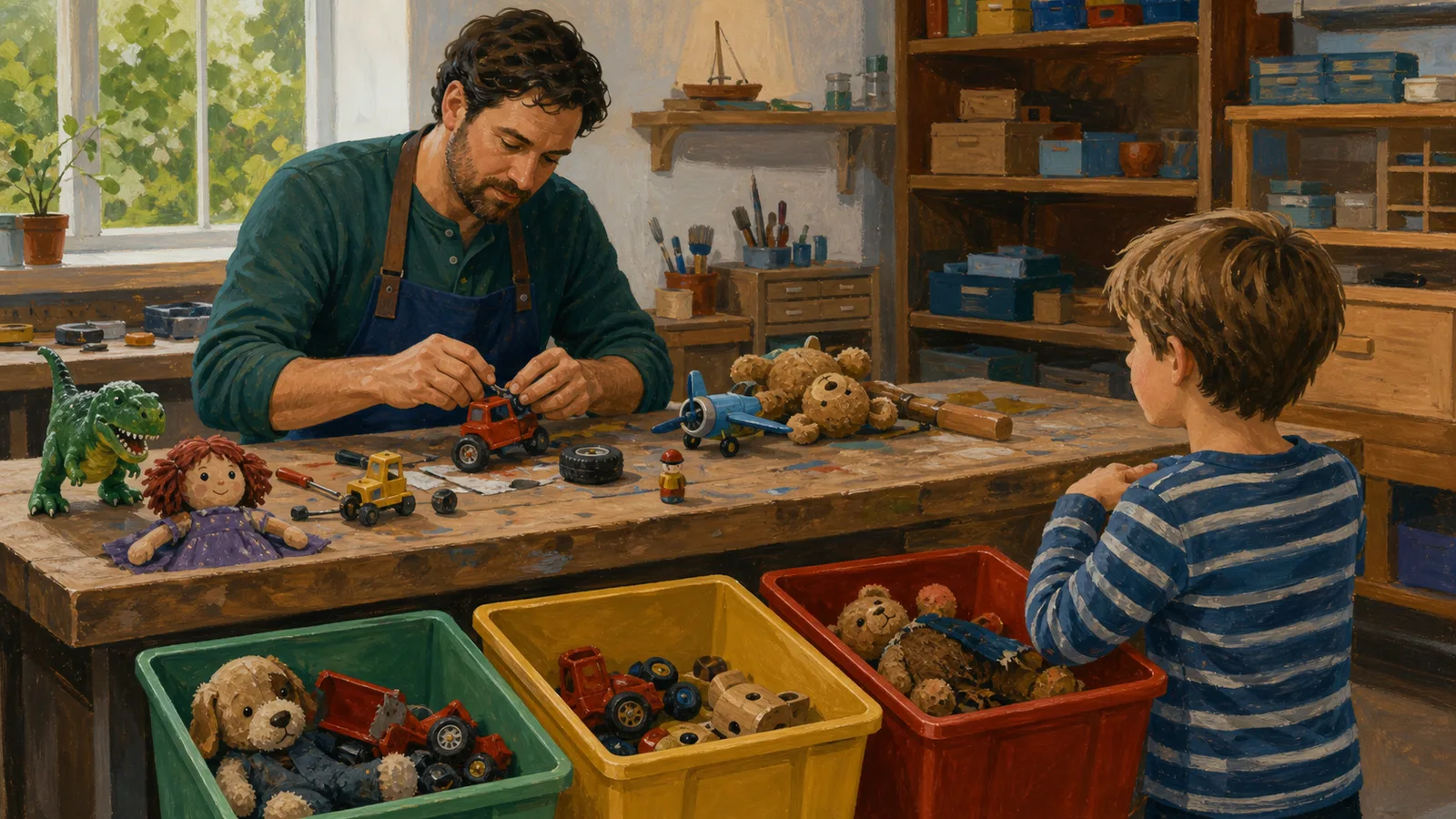
Look for manufacturer parts and instructions before a failure. A system with replaceable wheels, cords or tiles can have a different future from a sealed product. Safety still comes first: our repair decision guide separates serviceable wear from critical failures.
Reuse needs the next person’s needs and safety check. A complete, identifiable product in sound condition is more passable than a mystery item. Baby toys require the stricter secondhand screening process.
Stage 6: end of life
“Recyclable” does not mean curbside recyclable. Local programs differ, and mixed plastic, metal, fabric and electronics may need separation or special collection. Batteries and electronic waste should follow local hazardous/e-waste instructions.
Use this order:
- keep using safely;
- repair through a safe supported method;
- pass on a complete, safe item;
- separate accepted materials where possible;
- use local disposal guidance for the rest.
Never pass on a recalled or hazardous toy to avoid waste.
A mini life-cycle investigation
Choose one toy and make seven columns: stage, known facts, source, missing facts, likely trade-off, question for the maker, and action. A label is a source; a company sustainability page is a source; a guess is marked as a guess.
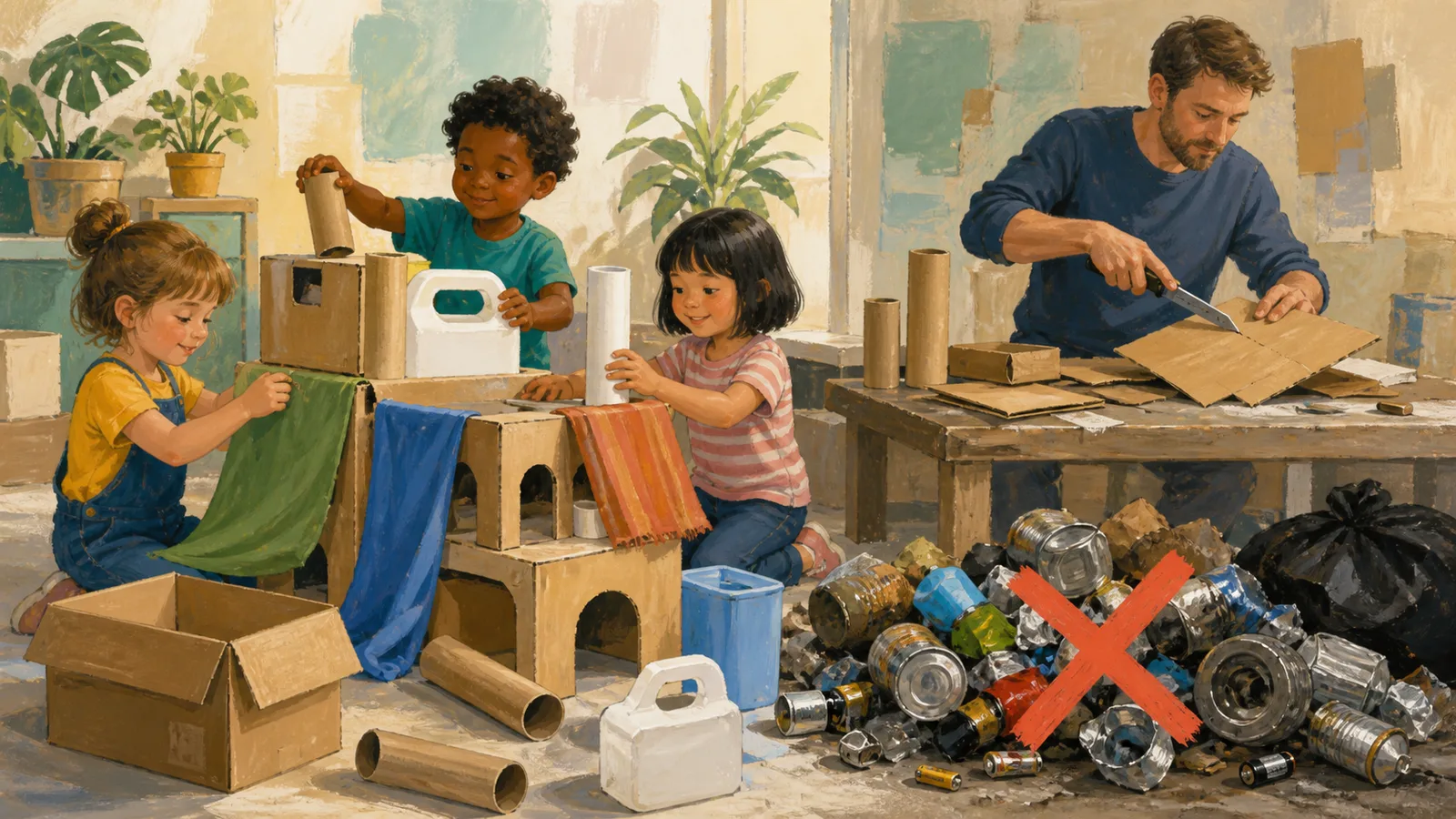
Then redesign one choice. Could packaging become storage? Could one commonly broken component be replaceable? Could mixed materials use screws instead of permanent glue? Build a prototype from the screened materials in our recycled-material maker guide.
How to read green claims
The U.S. FTC Green Guides warn against broad, unqualified environmental claims. Ask what “eco-friendly” specifically means, which part of the product it covers, and whether evidence is public. “Made with recycled plastic” should identify an amount and scope; it does not describe durability, labor, transport or end of life.
The honest answer may be “we do not have enough product-level data.” That is better science than inventing certainty.
Sources and research note
This framework draws on a 2022 peer-reviewed life-cycle assessment of children’s toys, a DePaul comparative toy LCA, and research on toy-industry circularity. Claim evaluation uses the FTC Green Guides; disposal guidance uses the EPA’s recycling overview. The article teaches investigation and does not calculate a footprint for any unnamed product.