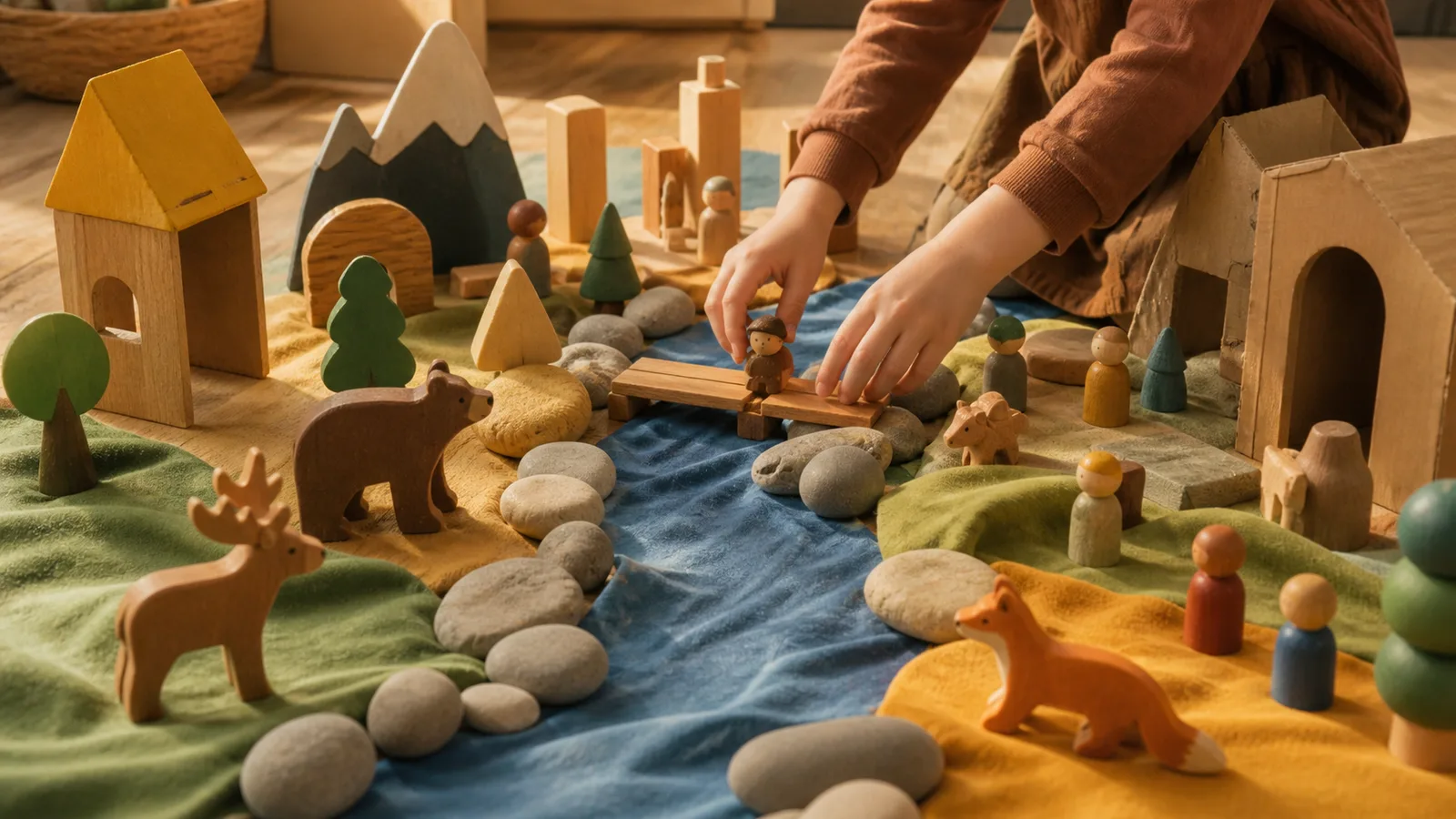
A pretend-play prop does not need to entertain a child on its own. For many children around ages 5–7 who enjoy make-believe, the useful prop is one that gives a story somewhere to go: a sign becomes a mission notice, a box becomes a repair shop, and a piece of fabric becomes a river, roof, cape, or creature habitat.
The quick answer: choose materials that can change jobs when the children change the plot. Start small, especially if space and cleanup are already tight. Check the condition of household materials before offering them, and follow the instructions, warnings, and age grades for any commercial toy you are considering.
Not every child wants to act out stories with other people. Some prefer constructing a setting, drawing maps, arranging figures, reading, collecting, moving their bodies, or playing alone. A prop shelf should make room for those preferences rather than turn pretend play into an expectation.
Start with the story already happening
Before looking for imaginative play toys for ages 5–7, watch what your child actually returns to. You are not looking for a developmental milestone. You are looking for a usable clue about what might fit your child and your home.
A child may:
- replay a familiar routine, such as running a café, clinic, garage, delivery route, or animal shelter;
- make up a fantasy world with rules, creatures, maps, and changing dangers;
- use figures or vehicles while narrating quietly rather than acting out a role;
- spend most of the time building a fort, town, stage, track, or habitat;
- enjoy costumes but lose interest once the costume has only one obvious job;
- prefer solitary play, games with rules, crafts, outdoor movement, or something else entirely.
These patterns can help you avoid buying a large role-play set simply because it is labeled for a particular age. A child who repeatedly builds rescue bases may get more use from blocks, paper signs, vehicles, and figures than from a fully themed costume. A child who loves restaurant stories may appreciate a few menus, paper, containers, and a place to carry orders more than a large permanent play kitchen.
Shared sociodramatic play—play in which children take roles within an imagined situation—can include talk about characters, settings, and what happens next. The available University of Alabama repository item concerns sociodramatic play and early language, but the supplied research package does not provide enough accessible detail here to make a precise claim about outcomes. It is safer and more useful to notice the visible opportunity: when children choose to sustain a shared scenario, they may need ways to explain a plan, add a rule, send a message, or resolve a story problem.
That is an invitation, not a promise. Some stories are loud and collaborative; others are quiet, repeated, or mostly internal.
Choose props that can change roles as the story changes
A flexible prop does not arrive with one fixed script. Its meaning can shift as children use it.
The loose-parts idea is often used to describe variable materials that can be used in more than one way. The supplied scoping review listing discusses loose parts in the context of physical-activity participation. It should not be read as proof that loose parts improve imagination, language, cooperation, or any other developmental outcome. Still, the basic practical definition is useful when choosing props: can this item become more than one thing?
A practical flexibility test
Before adding a prop, ask:
- Can it have at least two roles? A fabric square might be a blanket, flag, pond, costume piece, or roof. A narrow object that can only be one branded tool may have a shorter path into new stories.
- Can it move between settings? A small clipboard can work at a check-in desk, veterinary clinic, train station, investigation office, or construction site.
- Can children combine it with what they already own? A prop that works with paper, blocks, figures, dolls, vehicles, or outdoor materials is often easier to revisit.
- Does it leave some work for the child? Children may enjoy deciding what a symbol means, where a road leads, or why a character needs help.
- Can your household live with it? Consider floor space, noise, loose pieces, storage, damage, cleanup, and how much adult setup it requires.
A highly themed kit is not automatically limiting. A child may genuinely want recognizable tools for a familiar interest. The difference is whether the set supports the child’s current kind of play or expects the child to follow its script.
Look for story tools, not only costumes and job labels
Costumes can be enjoyable, but a shared story often continues because children have something to do inside the setting. Props for messages, repairs, routes, clues, collections, and deliveries can give a group a next action without dictating the whole premise.
Useful categories include:
| Story tool | What children might do with it | Possible settings |
|---|---|---|
| Paper, cards, and markers | Draw maps, make tickets, write menus, label discoveries, create clues | Shop, expedition, museum, train station, secret base |
| Small containers and trays | Sort supplies, carry orders, collect specimens, pack travel items | Café, laboratory, post office, campsite |
| Fabric pieces | Mark boundaries, make a shelter, wrap a package, create a landscape | Kingdom, animal habitat, stage, rescue site |
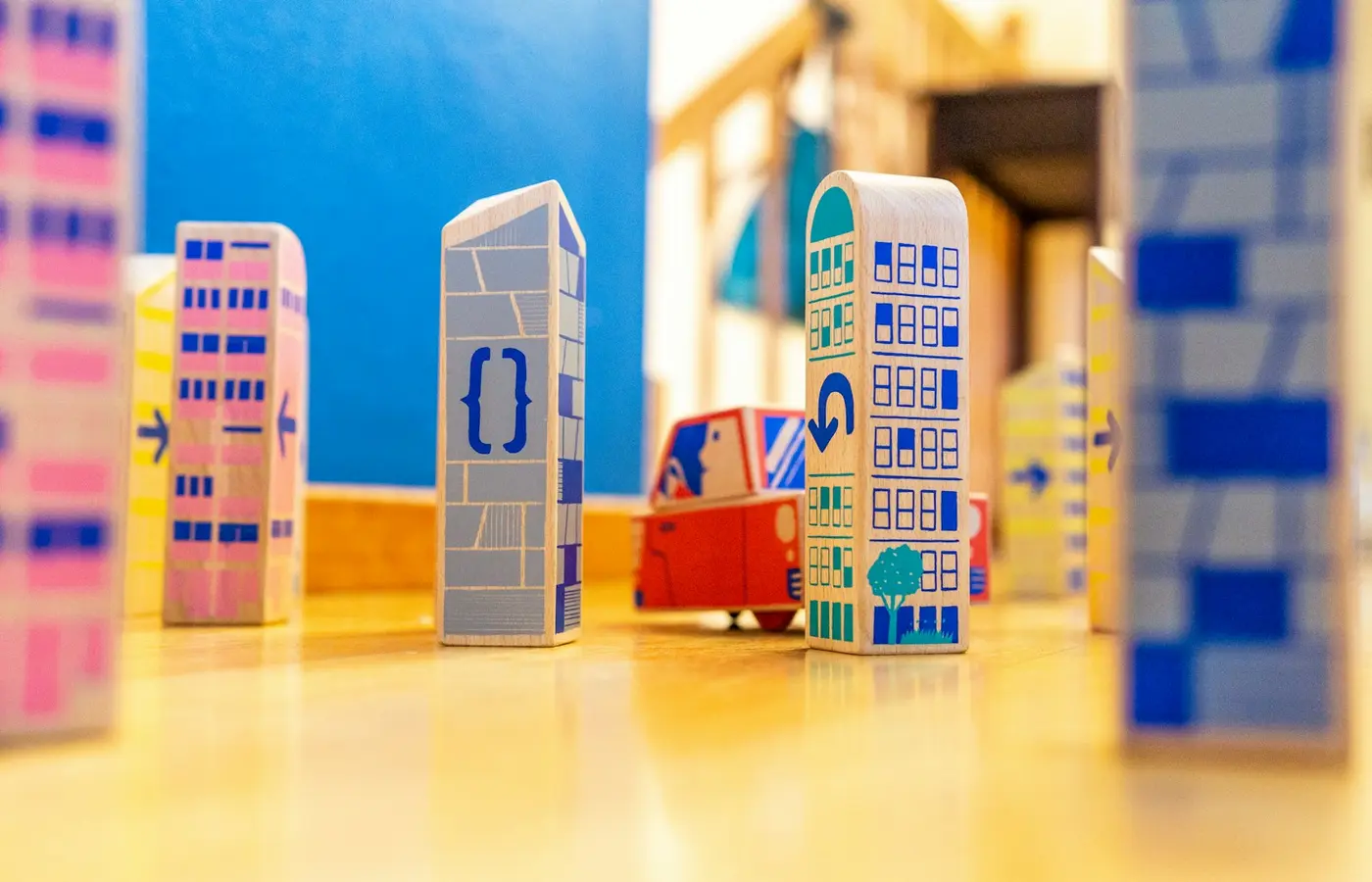
| Blocks or other building materials | Build a gate, bridge, counter, enclosure, repair bay, or home | Town, garage, airport, zoo, fantasy world |
| Figures, animals, or simple vehicles | Move characters through a setting or create a problem to solve | Any child-chosen world |
The point is not that every story needs a problem or lesson. A child may be content posting letters, lining up animals, serving the same meal, or rebuilding a bridge several times. Repetition can be part of what makes a play idea feel manageable and satisfying.
When more than one child is involved, neutral props can be especially helpful because they give each person something to handle without assigning a permanent identity. One child can make signs while another carries supplies and a third decides where the road goes. Roles can change without anyone needing to abandon the story.
Build a low-clutter prop shelf from household materials
You do not need a dedicated playroom or a large playset to offer a starting point. A small bin, drawer, or shelf can hold a modest rotation of materials. The practical examples below are inspired in part by Child Streets’ pretend-play guide, which mentions items such as scarves, blankets, boxes, paper bags, and clean containers. That source is useful for idea generation, not for safety guidance or evidence of developmental benefits.
A low-clutter starter collection might include:
- a few clean fabric pieces without loose cords or damaged trim;
- sturdy cardboard boxes that are dry, clean, and free of staples, sharp tears, or packing materials;
- plain paper, index cards, and washable markers used according to their labels;
- a small number of clean, undamaged containers that do not create trapping or sharp-edge concerns;
- building materials already appropriate for your child under their manufacturer instructions;
- a limited selection of figures, animals, or vehicles that your child already uses.
Safety check before adding household materials
Household objects are not automatically play materials. The research package does not include authoritative, current safety guidance that would let this article declare particular objects safe for all children ages 5–7.
Use your judgment about the individual item and child, and skip materials that involve:
- small detachable pieces that could be a concern for younger siblings or visiting children;
- staples, splinters, sharp edges, cracked plastic, broken lids, or damaged parts;
- plastic bags, long cords, loops, strings, or straps that can create entanglement or suffocation hazards;
- containers that a child could climb into, become stuck in, or use unsafely;
- chemical residue, unknown contents, peeling coatings, or materials not meant to be handled by children;
- tape, cutting tools, hot glue, or other supplies that need adult setup or supervision.
Keep the collection contained. A lidded bin may reduce visual clutter, but an open basket can make independent choosing easier. If a material creates more cleanup than play in your home, it is reasonable to offer less of it, rotate it, or put it away.
Make shared play easier without directing the whole plot
Adults do not need to perform a story for children. A light touch can be enough, particularly when children want a starting point but not a director.
Try one of these openings:
- Put out two or three related items rather than an entire shelf: perhaps paper, a box, and a few figures.
- Name a setting without deciding the plot: “This could be a station, workshop, or somewhere else.”
- Ask an observable question: “What needs to happen before this can open?”
- Offer practical help: “Would a sign, map, or delivery label help?”
- Help a child rejoin without assigning blame: “There is room for another job here. What would you like to add?”
- Step back once the children have a direction.
You can also protect the conditions for play. Give the group enough floor space to spread out, set a noise boundary if needed, and decide where constructions can stay up. If a story becomes frustrating or conflict-heavy, it is fine to pause, separate materials, change the activity, or end it. Shared play is not more valuable simply because it lasts longer.
Some children want an adult nearby; others prefer that adults do not enter the story at all. Following that preference can be more helpful than trying to make play look collaborative or educational.
When a themed kit is still the right choice
A focused pretend-play set can make sense when a child repeatedly returns to a particular role, routine, or fictional world and wants tools that are easy to recognize. A child interested in caring for animals may enjoy animal figures and a carrying case. A child who repeatedly sets up a shop may want a simple counter or basket system. Familiarity can lower the barrier to starting.
Choose a themed kit because it matches a real interest and household reality, not because the packaging promises learning. Before evaluating a specific commercial item, check its official instructions, warnings, age grade, materials, piece count, dimensions, and current recall information. Those details are not available for any specific product in the supplied research package, so this guide does not recommend particular kits.
You can keep a themed set from becoming the only possible story by pairing it with neutral materials:
- Add paper for signs, schedules, labels, tickets, or maps.
- Add blocks to make a new location rather than using only the built-in setting.
- Add fabric to create weather, borders, beds, costumes, or terrain.
- Add empty space so children can rearrange the scene.
- Rotate some accessories instead of leaving every piece out at once.
A themed set is also optional. If your child has little interest in role play, there is nothing to fix. They may be more engaged by construction materials, art supplies, board games, sports equipment, books, puzzles, music, collecting, or unstructured outdoor time.
A simple selection rule for ages 5–7
Choose a pretend-play prop if it passes three tests:
- The child can use it in more than one possible story—or is clearly asking for it for a specific, recurring interest.
- It fits your household—including supervision, floor space, storage, noise, loose pieces, and cleanup.
- It leaves room for the child to decide what it means—whether they are acting, building, drawing, arranging, narrating quietly, or inviting someone else in.
If a new prop does not meet those tests, try borrowing, rotating what you already have, making a small setup from safe materials you already own, or choosing a different kind of play material. The best next purchase is not necessarily the biggest set. It is the one your child can make their own and your household can realistically keep using.
Sources and research note
- University of Alabama repository item: “sociodramatic play and the potentials of early language”. This item is relevant background on sociodramatic play and language, but the supplied package did not provide enough reviewed full-text detail to support precise developmental claims in this guide.
- “Let the Children Play: Scoping Review on the Implementation and Use of Loose Parts for Promoting Physical Activity Participation”. Used here only for the practical concept of loose parts as variable materials that can be used in more than one way. Its focus is physical-activity participation, not evidence that loose parts improve imaginative play or developmental outcomes.
- Child Streets: “The Ultimate Guide to Pretend Play for Kids of All Ages”. Used as non-authoritative practical inspiration for household-material examples, not as safety, age-appropriateness, or developmental evidence.
Specific product warnings, age grades, instructions, materials, and recall information should always be checked separately before choosing a commercial toy or adapting a household object for play.