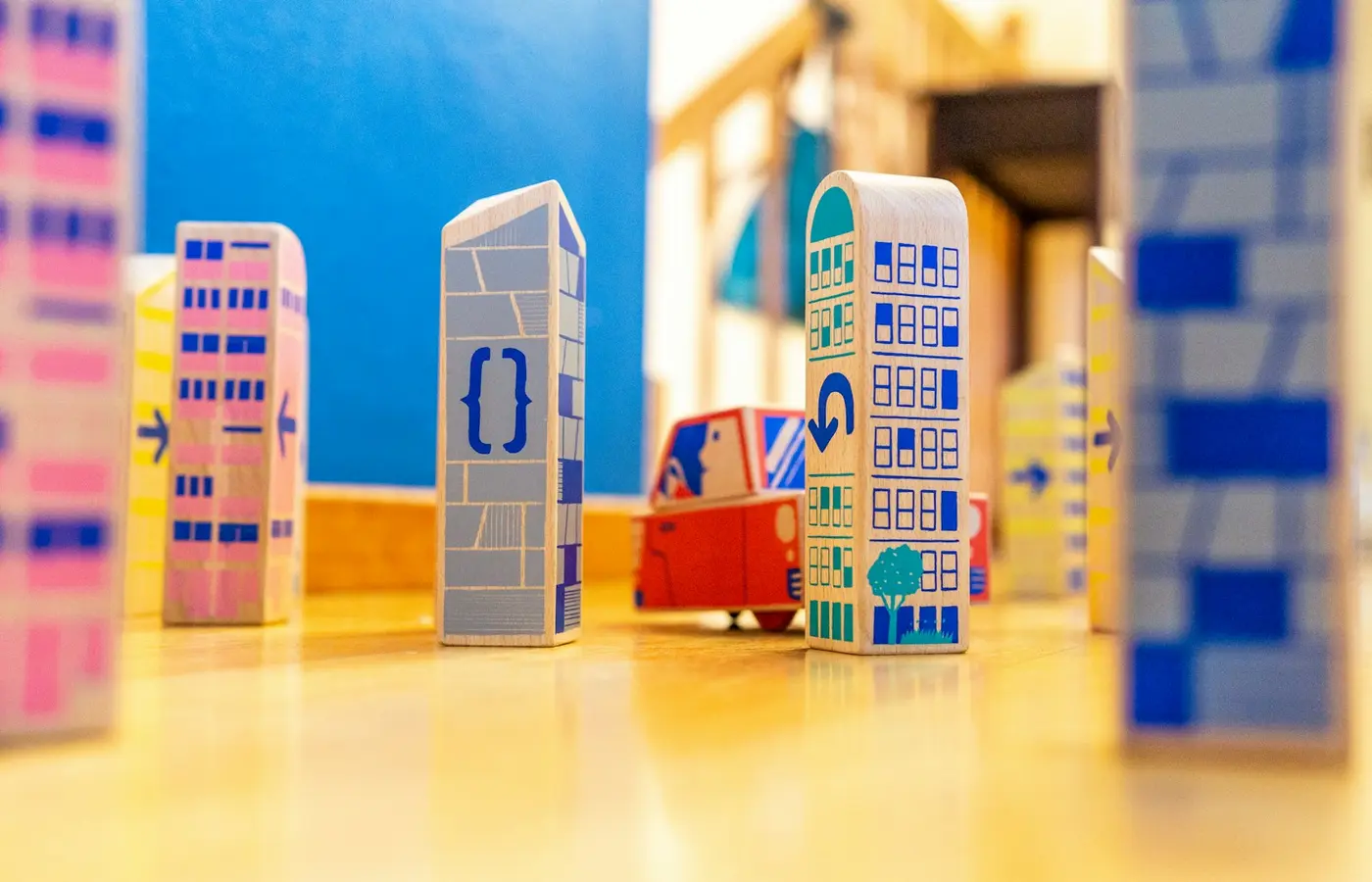
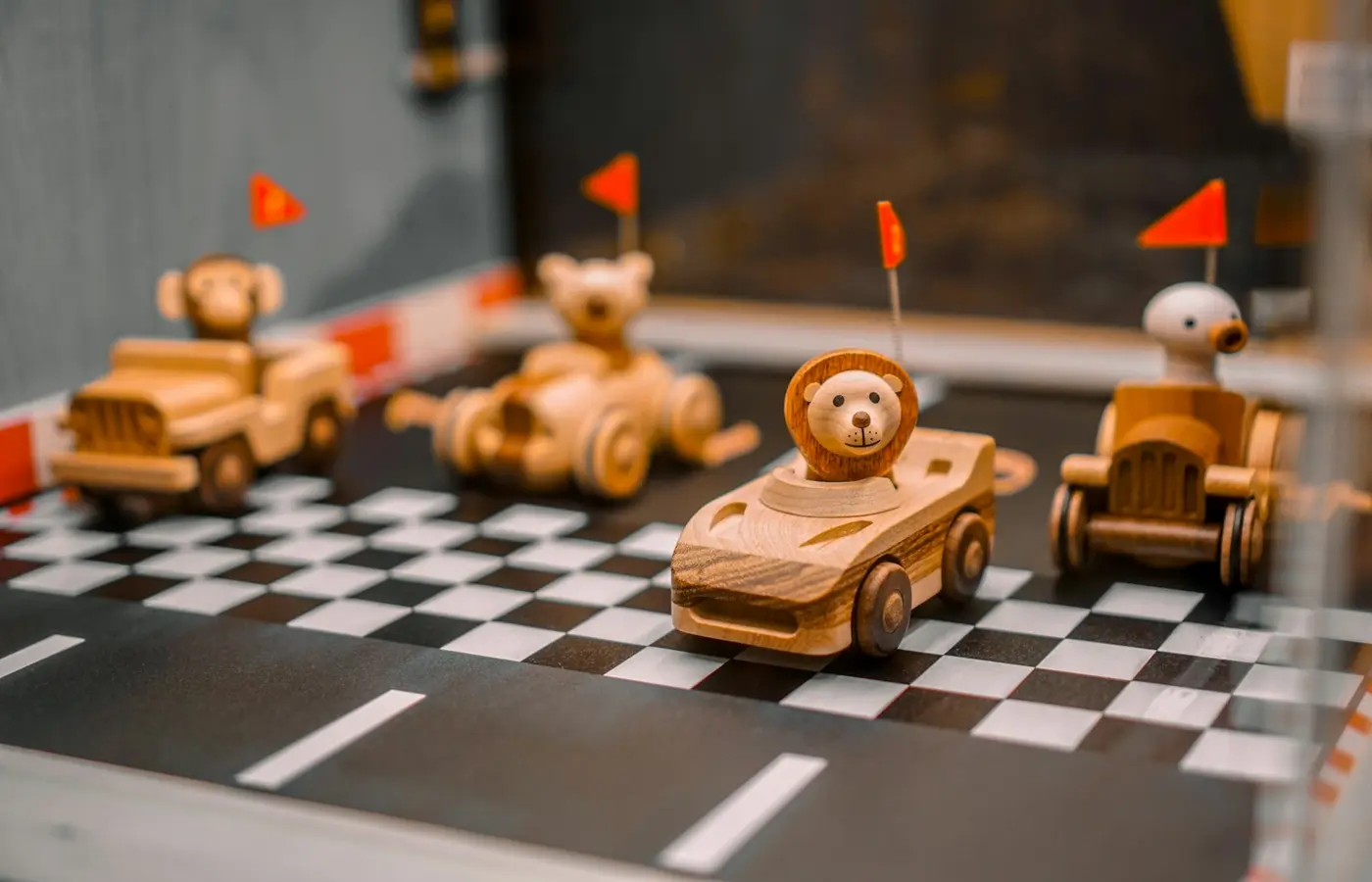
A road, train track, buildings, and a few people or animals can become a busy little world—but only if the pieces are usable together in your home. Before buying a large matching-looking collection, start with what your child is already trying to do: drive to a shop, send a train to a station, build a neighborhood, carry figures between places, or tell a rescue story.
The quick answer: modular play systems for kids do not need to physically connect to support shared play. A road can sit beside a train line, and figures can travel between separate buildings and track layouts. Physical connections are useful only when they are documented, stable, reachable, and not more frustrating than helpful.
Safety comes first. Follow the age grade, warnings, and instructions for every individual product in a combined setup—not just the largest set. Small figures, loose scenery, vehicle accessories, magnets, and track parts may have different warnings than the road or building they sit beside.
Start with the scene your child wants to make
A mixed setup works best when it gives a child something they already want to do, rather than asking them to use every piece in a particular way.
You might notice that your child is mostly:
- pushing vehicles along routes
- lining up trains or cars
- moving figures in and out of buildings
- arranging shops, homes, animals, and trees
- creating a destination, such as a farm, fire station, market, or airport
- taking a layout apart and making a new one
Those actions can guide the first materials you choose.
For a child who wants to drive from place to place, a few roads, vehicles, and one destination may be enough. For a child who is absorbed in rail play, a small track layout with a building or two nearby may make more sense than adding a full road system. A child who spends most of their time arranging people, animals, and furniture may use roads and tracks mostly as scenery.
This approach also gives you permission not to buy an all-in-one world. As Life With Toys’ guide to combining modular roads, tracks, buildings, and figures notes, shared themes do not guarantee physical compatibility—and side-by-side play can be the more practical choice.
For example, the manufacturer describes the PlanToys My Little Neighborhood Roadway Playset as a 79-piece set with wooden road tracks, vehicles, buildings, figures, animals, furniture, market accessories, and farm elements. That is a broad starting point for a child who likes building a town scene. It does not, however, establish that the roads will connect to another brand’s track or that another brand’s figures will fit its buildings.
Check whether pieces can actually connect
“Wooden,” “modular,” or “town-themed” are not compatibility standards. Two systems may look alike in a product photo but have different connector shapes, widths, heights, track profiles, or tolerances.
Before adding an expansion set, look for documentation that answers these questions:
- What is the connection method? Does the set use tabs and slots, pegs, magnets, puzzle-like road edges, built-in channels, or no connector at all?
- Does the manufacturer name compatible systems? A general claim that a set is “universal” is less useful than a list of specific models or brands.
- Are adaptors included, and what do they adapt? An adaptor may connect one track profile to another without making roads, buildings, or vehicles compatible.
- Which version is being discussed? Product lines change. A current-looking set may not use the same connector as an older set from the same brand.
- Can the joined pieces stay level? A connection that technically fits but makes a bump, gap, or unstable transition may not be useful for rolling vehicles.
One documented example is the discontinued Fisher-Price Thomas & Friends Wood Family Farm Set, model GGB84. Mattel states that the set included two track adaptors compatible with classic Thomas & Friends Wooden Railway, BRIO, Melissa & Doug, and Imaginarium wood track systems. That statement applies to the named set, the specified wood-track systems, and its included adaptors—not to every Thomas product, all wooden tracks, or unrelated road systems. Mattel lists this particular product as discontinued and ages 3 years and up in its product documentation.
When compatibility is not documented, treat the systems as separate materials that may still share a play surface. Put the road near the train station rather than trying to force the edges together. Place a building beside a track rather than over it. This can preserve the story without creating a weak connection that needs constant adult repair.
Use a small trial layout before expanding
If you already own the pieces, make the smallest scene that includes the connection you are considering:
- one road or track route
- one transition or crossing point
- one building or destination
- one or two vehicles
- a few figures or animals, if relevant
Then watch the mechanics rather than judging how impressive it looks. Can a vehicle roll across the join? Does a track stay together when a child reaches across it? Can a figure enter the building or stand nearby without knocking it over? Does the child have enough room to turn a vehicle around?
A small test layout can show that the best answer is a bridge between systems, a strip of open floor between them, or two separate trays or rugs that sit side by side.
Use scale, clearance, and reach as the next filter
Physical connection is only one part of compatibility. A setup can connect neatly and still be difficult to use.
Check the vehicles and buildings
Look at the pieces your child is likely to move most often. A train may fit the rails but hit a bridge, tunnel, platform, or building roof. A car may fit the road but be too wide for a parking area. Figures may be too large to sit in vehicles or enter doorways.
You do not need every element to be perfectly to scale. Children often use a large figure as a bus passenger or a small animal as a shop customer. The question is whether the size difference creates repeated practical problems: blocked routes, falling buildings, inaccessible doors, or a child asking for help every time a vehicle reaches a tight space.
Check clearance at crossings and edges
A road placed beside or across a rail line can create pinch points and bumps. Before committing to a bigger layout, check whether:
- train cars clear bridges, tunnels, and nearby scenery
- cars have room to turn without pushing track pieces apart
- buildings can stand without leaning into a route
- children can reach the center without resting their weight on the layout
- vehicles can stop at a destination instead of rolling off the play surface
The Melissa & Doug Take-Along Town is an example of a compact, self-contained scene. Its manufacturer describes a fold-out wooden case with an illustrated play surface, built-in road tracks, three wooden wheeled vehicles, a helicopter, a bridge, a city tunnel, a monorail, and loose wooden play pieces including buildings, traffic signs, and a tree. Because the routes are built into the case, it may work as a neighboring town scene rather than an expansion meant to connect directly to separate road or rail pieces.
Make the layout reachable
A large floor city can look inviting to an adult and feel inaccessible to a child who cannot reach its center. A table layout may solve one problem while creating another if the child cannot comfortably see or access the far side.
Try a route, a destination, and an open working area rather than filling every inch. Leave room for a child to pick up a vehicle, place a figure, repair a derailment, or move a building. If reaching the middle causes repeated bumps, shorten the route or divide the scene into smaller zones.
Make sure the layout stays usable, not just impressive
A play system is more likely to be reused when it can survive ordinary play and be reset without a major project.
Consider the adult work as honestly as the child’s interest:
| Home question | What to notice |
|---|---|
| Floor space | Can the layout stay out, or will it need to be rebuilt each time? |
| Stability | Does one bumped track or road section undo a large area? |
| Setup | Can your child place some pieces independently, or does every session require detailed assembly? |
| Cleanup | Are there many loose signs, figures, trees, and accessories to gather? |
| Storage | Can parts go in a bin, case, drawer, or shelf without becoming a tangled pile? |
| Noise | Will hard vehicles, loose wood pieces, or rolling track play be difficult in your shared space? |
Independence does not mean a child should be expected to assemble everything alone. It may mean they can choose a few buildings, position a vehicle, or pack familiar pieces into a container while you handle a complex track connection. A child may also prefer having a simple scene ready to alter rather than starting from a completely empty floor.
Storage features can matter as much as expansion options. Melissa & Doug says the Take-Along Town’s pieces store in its fold-up case, which also has a carrying handle. That does not guarantee quick cleanup in every household, but it tells you where the included pieces are intended to go.
If a sprawling layout repeatedly collapses, gets in the way, or leaves everyone tired at cleanup, simplify it. Keep a road scene and train track in separate containers. Offer fewer buildings at one time. Use a tray or rug to define one part of the town. A smaller setup that returns to play often is usually more useful than a complicated one that needs a special occasion and extensive adult rebuilding.
Treat each set’s age grade and loose parts separately
Combining toys does not combine their safety guidance. Check the label and instructions for every product that enters the play area, especially when siblings or visiting children of different ages share the space.
Pay particular attention to:
- small figures, animals, signs, furniture, and food pieces
- removable wheels, couplers, and vehicle accessories
- magnets or magnetic connections, where present
- track adaptors and short connector pieces
- loose scenery, such as trees, fences, or lamp posts
- storage containers that may make small parts easy to access
An older child’s road-and-track setup may include accessories that are not appropriate for a younger sibling. In that case, separating the materials, using the set only with close supervision, or putting small accessories away after play may be more realistic than trying to make every item available all day.
Use the official age grade as one condition, not as a promise that every child of that age will find assembly easy or enjoy the same kind of play. Mattel’s documentation lists the Thomas & Friends Wood Family Farm Set as ages 3 years and up, but a child’s readiness to manage track pieces, stories, and cleanup will still vary.
Choose a first setup that leaves room to reuse pieces
A useful first purchase or first combined layout does not need every category. It needs a clear role in play.
A practical selection rule is: choose one core system that works on its own, then add only pieces that are either documented as compatible or comfortable to use alongside it.
For many families, that can look like:
- One route: a road system or a train track.
- One destination: a station, garage, house, farm, shop, tunnel, or bridge.
- A small moving group: a few vehicles, figures, or animals.
- Open space: room to rearrange, add a block, or invent a new destination.
The IKEA RÄVUNGE 23-piece car track set is described by IKEA as a modular car track set with curves, straight sections, and junctions that can be arranged in different configurations. That kind of documented configuration flexibility may be useful if your child enjoys changing routes. It does not establish compatibility with a train track, building set, or another manufacturer’s road pieces.
As play changes, you can add a building to give cars somewhere to go, figures to create a story, or scenery to mark a boundary. Or you may find that the child is happiest with just the track and a handful of vehicles. Both are valid outcomes.
The next move is simple: make one small scene with a route, a destination, and a few movable pieces. If it stays stable, reachable, and enjoyable to reset, it has earned the right to grow. If not, separate the systems or reduce the pieces before buying more.
Sources and research note
This guide uses current manufacturer product descriptions and product documentation supplied for this article to distinguish included features, age grades, storage details, and explicitly named compatibility statements. Manufacturer compatibility information applies only to the models, versions, and systems the manufacturer specifies; it should not be extended to similar-looking products.