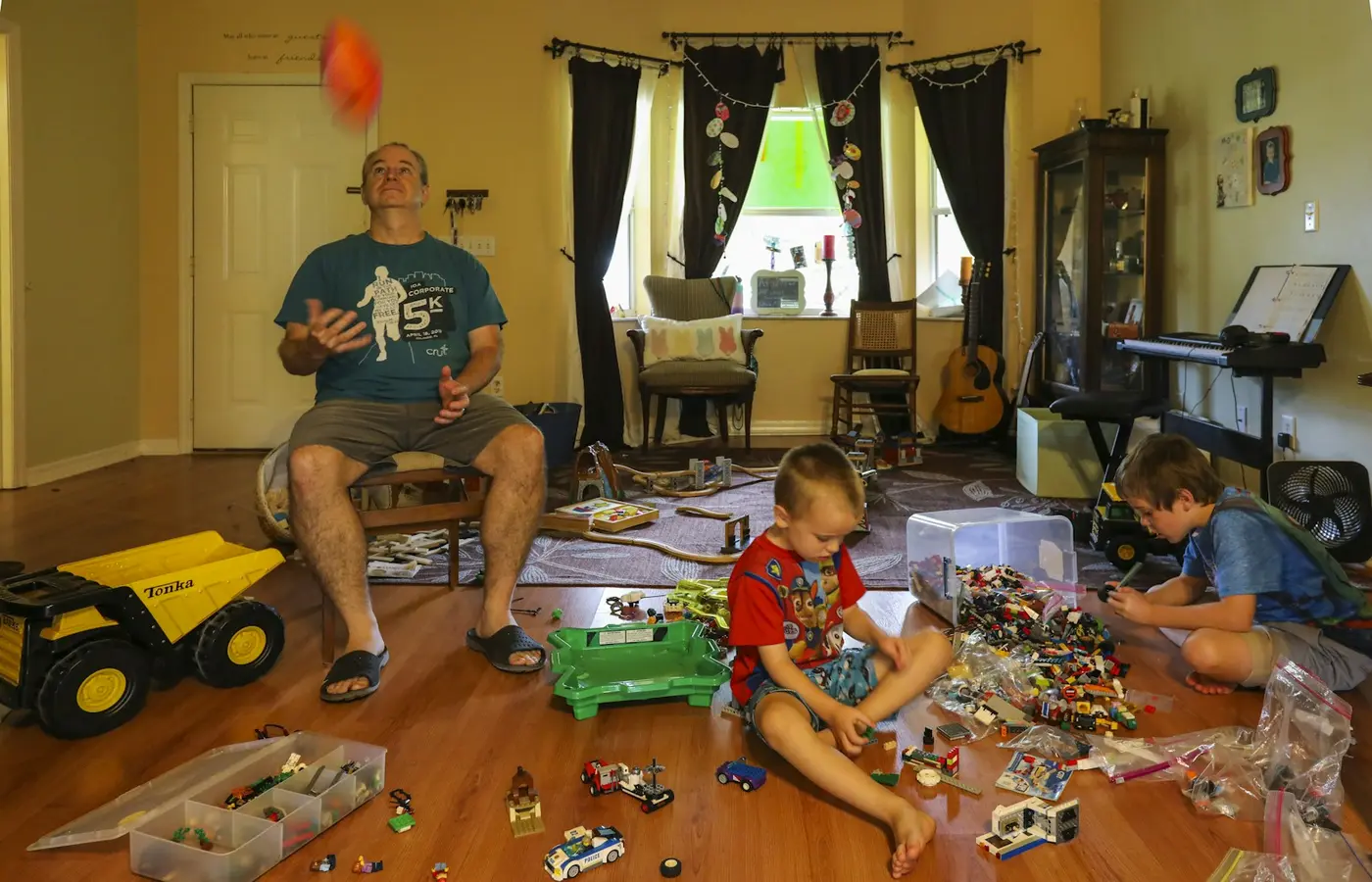

When one child still explores by putting objects in their mouth and an older sibling loves tiny figures, beads, puzzle pieces, or game tokens, shared play can feel like a constant negotiation. The practical answer is not necessarily to separate siblings into different rooms or buy only large toys for everyone.
Instead, make the youngest child’s access the starting point. Small-part materials need to stay physically unavailable to the child who may mouth, carry away, or later find them. Siblings can still share a room, a story, a pretend-play idea, or an adult’s attention while using different materials.
This matters especially during the transitions: when a container is opened, when pieces spill, when the older child walks away, and after play appears to be over. Head Start’s toddler safety guidance notes that young toddlers may still put objects in their mouths and that areas they use should be free from small choking hazards.
Start with the youngest child’s access, not the oldest child’s ability
An older child may be ready to follow the rules of a miniature-building set or a detailed craft kit. That does not make its small pieces appropriate in a space a younger sibling can freely enter.
This distinction can be useful when household rules start to sound unfair: the older child is not being told they are too young for their own materials. The material is being managed around the youngest child’s current access and play behavior.
Age grades are part of that decision. The U.S. Consumer Product Safety Commission’s Age Determination Guidelines describe toy age grading in relation to children’s characteristics, skills, play behavior, and interests. An age grade is not a measure of intelligence, maturity, or what a child “should” be able to do. It can also reflect hazards, including the size of components.
For a mixed-age home, the useful question is:
Can the younger child reach this material now, get to it when an adult turns away, or find a piece after the older child has left?
If the answer is yes, treat the material as inaccessible during that time, even if the older child is careful and understands the rule.
Treat age grades and warnings as access rules
Before bringing a toy, game, or craft material into a shared area, look at the manufacturer’s age grade and any warnings on the packaging or instructions. Follow them rather than assuming an older sibling’s presence makes a younger child’s access acceptable.
A toy designed for an older child can be perfectly reasonable for that child while still needing a protected setup. Supervision can help you manage a changing situation, but it does not remove a warning or turn a small-part toy into a suitable material for a younger child.
It also helps to inspect materials regularly. The University of Michigan Pediatric Trauma program advises families to check that toys are in good condition, without loose parts or chipping paint, and to use manufacturer labels as a guide for age and developmental appropriateness. This is particularly relevant for hand-me-downs, older sets with missing packaging, and toys that have been heavily used.
A quick check before shared play
Before the older child opens a small-piece activity, consider:
- Is the manufacturer’s age grade and warning available and still relevant to the set?
- Does the set have loose, broken, cracked, or detached components?
- Can the younger child enter the activity area or reach the work surface?
- Is there a closed place for every piece when play pauses?
- Can you stay close enough to respond if the younger child heads for the materials?
If not, the answer may be to save that activity for nap time, another room, outdoor table time, or a moment when the younger child is occupied with an appropriate material nearby.
Build a shared-play setup with a real small-piece boundary
A boundary works when it prevents access. It is less reliable when it depends only on repeated reminders such as “Don’t touch your sister’s pieces.” Young children move quickly, change direction, and may be especially interested in the item an older sibling is concentrating on.
The setup does not need to be elaborate. It needs to match your home and the children’s current movement patterns.
Use separate materials in the same shared space
One simple arrangement is a protected small-piece activity for the older child and a large-piece activity on the floor for the younger child. The children are together, but they do not need identical tools.
For example:
- An older child completes a puzzle or builds with small components at an adult-selected work surface while the younger child stacks large blocks nearby.
- An older child arranges mini figures in a contained play scene while the younger child uses large vehicles, soft dolls, or other age-appropriate props in the same pretend-play theme.
- An older child sorts game pieces or works on a craft while the younger child carries large cushions, posts large objects into an appropriate container, or looks through a board book beside you.
The goal is not equal roles or matching output. One child may be building while another is carrying, watching, narrating, or using a different material alongside them.
Choose a boundary you can maintain
Possible approaches include:
- a work surface the younger child cannot access;
- a separate activity area that is supervised for the duration of small-piece play;
- a lidded container that is closed as soon as the activity pauses; or
- different timing for materials that cannot be kept separate in the available space.
A floor setup can work for large, age-appropriate shared materials. It is not the place for loose small pieces if a child who mouths objects can crawl, walk, or wander into the area.
Children’s access changes quickly. A boundary that worked when a younger child stayed on a blanket may not work once they can pull up, climb, open containers, or follow an older sibling from room to room. Reassess the setup when play behavior changes rather than relying on last month’s routine.
Make cleanup and storage part of the safety plan
The most vulnerable moment may not be the planned activity. It may be the five minutes after the older child loses interest, gets called to dinner, or leaves a half-finished project behind.
In homes with children of different ages, the University of Michigan Pediatric Trauma program specifically advises caregivers to make sure older children put toys away when they are done playing. That can be a family responsibility, but it should not be the only safety control. Adults still need a storage system that works when a child forgets, is interrupted, or needs help.
Use a close-down routine
A brief, repeatable routine is often more workable than a perfect cleanup expectation. For small-piece activities, try this sequence:
- Pause the activity before anyone leaves the area. If the younger child approaches, close or move the small-piece material first.
- Look for obvious loose pieces. A visual sweep around the work surface, floor, and nearby seating can catch spills or pieces that rolled away.
- Return the set to a closed container. Keep components together rather than leaving them in an open tray for later.
- Store it where the younger child cannot access it. The important point is preventing access between sessions, not just putting materials in a tidier pile.
- Inspect damaged sets. Remove or address pieces that have become loose, broken, or otherwise changed from their intended condition.
Counting every component may be realistic for some games or puzzles and unrealistic for a large building set at the end of a busy day. Do what is practical, but do not substitute a quick glance for secure storage when the younger child can access the room.
If a toy includes a registration card, the University of Michigan guidance also recommends registering it so families can receive recall information. For secondhand or older toys with no documentation, it may be harder to confirm the original warnings or whether all components are intact. In that case, simpler use or storing the item for later may be the calmer choice.
Supervise the changing moments, not just the activity
Active supervision means more than being in the room. In this context, it means paying close enough attention to notice access changing: a toddler crossing the room, a lid opening, a piece rolling away, or an older child abandoning a project to answer the door.
Head Start describes active supervision as close attention that helps keep children safe, particularly when they are active or likely to take risks while exploring. For mixed-age play, it is most useful at the handoff points rather than as a promise that you can watch every second perfectly.
You might decide that a small-piece activity is workable only when:
- the younger child is engaged with a safe material within your view;
- the older child is using the small pieces at a protected surface;
- you can intervene promptly if the boundary fails; and
- the container can be closed and removed immediately if you need to step away.
If you cannot maintain that separation at the moment, pause the small-piece activity. That is not a failure of supervision or sibling play. It is a practical adjustment to the space, timing, and attention available.
Let siblings participate differently
Children commonly encounter toys that are not perfectly matched to their age in homes with siblings and in mixed-age settings. The study “Children’s Utilization of Toys is Moderated by Age-Appropriateness, Toy Category, and Child Age” discusses these mixed-age toy environments and the importance of age appropriateness in how children use toys.
At home, shared play does not require everyone to touch the same object. A safer approach is to share the activity idea while keeping materials matched to each child’s access and needs.
Shared themes, separate materials
Try activity pairings such as:
- Building: The older child makes a detailed structure with their small pieces at a protected surface; the younger child stacks large blocks or cups nearby.
- Pretend play: The older child creates a miniature scene; the younger child uses larger, age-appropriate dolls, animals, fabric pieces, or play dishes that are appropriate for them.
- Sorting and collecting: The older child organizes a collection in a contained tray; the younger child helps carry the closed container before or after play, or sorts large safe objects in a separate basket.
- Puzzles: The older child works on a detailed puzzle away from younger-child access; the younger child has a sturdier, age-appropriate puzzle or book alongside them.
- Art time: The older child uses the materials appropriate to their project in a managed area; the younger child uses a separate, appropriate activity with materials that can safely be available to them.
It is fine if the younger child mostly watches, imitates broad actions, or moves in and out of the activity. It is also fine if the older child wants uninterrupted time with their more detailed set. Shared family play can include parallel play, short interactions, and separate projects in the same room.
A simple decision rule for overlapping toys
When you are unsure whether an activity can happen during shared family time, use this rule:
If the younger child can reach, mouth, carry away, or later find a small piece, the activity needs a stronger boundary, different timing, or different materials.
That rule keeps the focus on access rather than on whether an older sibling can be trusted or whether a younger child “should know better.” It also leaves room for connection. Siblings can share space, pretend-play themes, conversation, music, books, and larger materials without giving the younger child access to hazardous small components.
The next useful step is to choose one small-piece category in your home—such as mini figures, beads, game tokens, or a detailed building set—and decide where it will be used, where it will be closed, and where it will live between sessions. A clear routine for one category is often easier to sustain than trying to solve every toy at once.
Sources and research note
- Head Start: Tips for Keeping Infants and Toddlers Safe—Toddlers. Used for guidance on mouthing behavior, small choking hazards in toddler-used areas, and active supervision.
- U.S. Consumer Product Safety Commission: Age Determination Guidelines Relating Consumer Product Characteristics to the Skills, Play Behaviors, and Interests of Children. Used for context on toy age grading and changing child characteristics and play behavior.
- University of Michigan Pediatric Trauma: Safety at Home. Used for household guidance on checking toy condition, following manufacturer labels, storing older children’s toys after play, and registering new toys for recalls.
- Children’s Utilization of Toys is Moderated by Age-Appropriateness, Toy Category, and Child Age. Used as context for the reality that children may encounter toys in mixed-age environments and for the importance of age appropriateness in toy use.
- The Toy Association Statement on Toy Safety, Age Grading and Small Parts. Industry context only; it is not used here as a substitute for regulator or pediatric safety guidance.