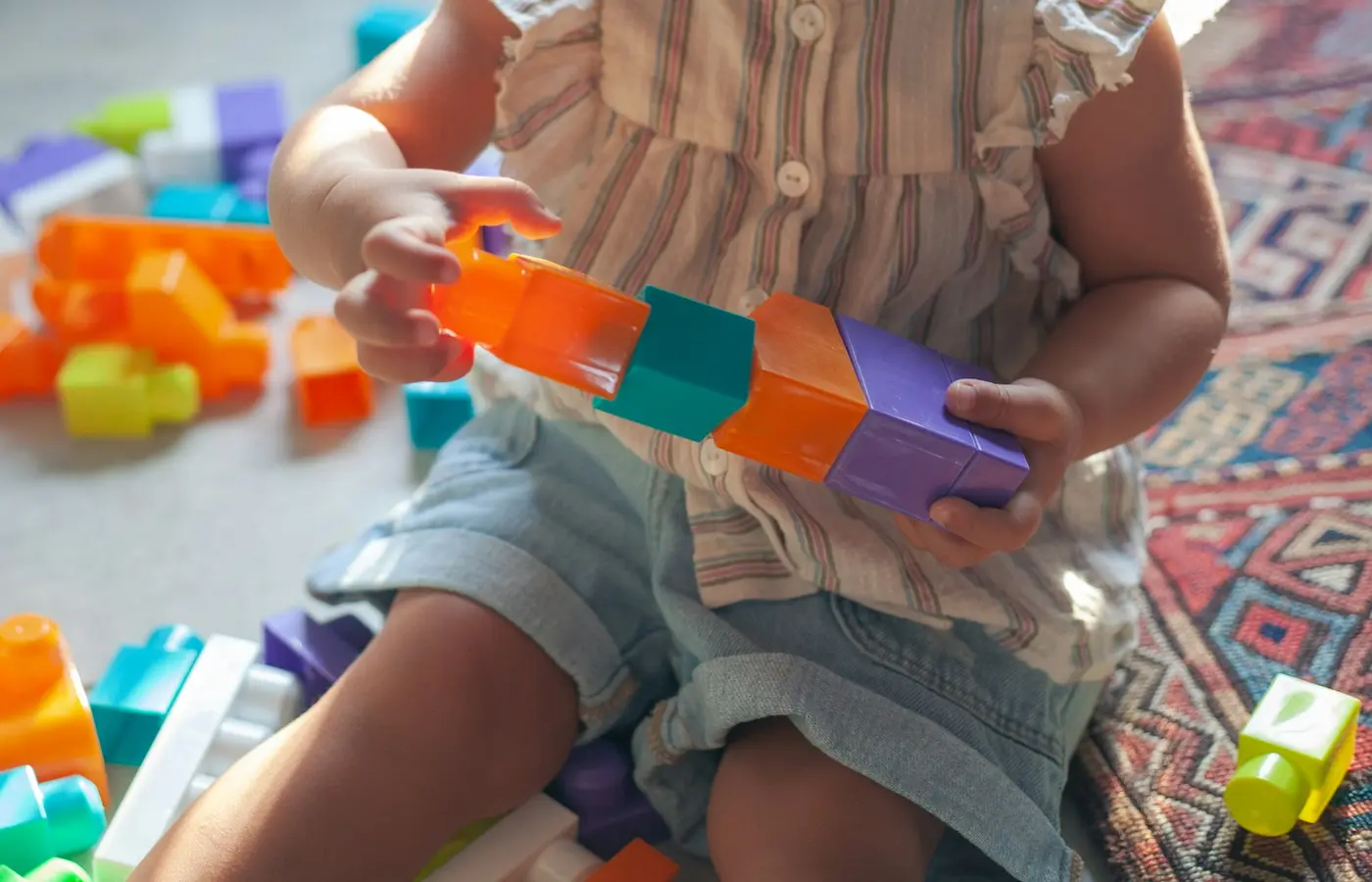

A child who repeatedly joins two pieces, pulls them apart, and starts again may not need a large construction set. They need a connection they can operate, pieces suited to the way they play, and enough room to explore without every attempt turning into an adult repair job.
Start by watching the action the child enjoys. Do they press, snap, hook, stack, balance, or make magnetic connections? Then check the exact product’s age grade, warnings, instructions, and included accessories. Only after that safety gate should you compare piece scale, set size, storage, compatibility, and possible expansions.
The simplest suitable system is often a better starting point than the one with the most pieces or the broadest educational claims.
Start with the kind of connecting the child enjoys
“Building toy” covers materials that behave quite differently. Retail catalogs place magnetic tiles, interlocking bricks, wooden blocks, and planks in the same broad category, but the child’s actions are not interchangeable.
Look at what the child is doing now:
- Pressing pieces together: They may enjoy a direct push-and-pull connection and repeat it without trying to make a recognizable object.
- Snapping or interlocking: They may like the click or resistance of a secure join, provided they can also separate the pieces.
- Balancing and stacking: They may prefer loose blocks or planks that do not connect at all. Positioning and rebuilding after a collapse can be the main play.
- Making magnetic connections: They may enjoy bringing edges together quickly and changing a structure without prying apart tight joins.
- Copying a small model: They may want a clear visual starting point and a limited group of pieces.
- Building outward or upward: They may need enough repeated shapes to make a road, wall, enclosure, tower, or larger structure.
None of these styles is inherently more educational or advanced. Repeating one connection, sorting pieces, dismantling a structure, or making a long line can be the whole activity rather than preparation for a “proper” build.
If possible, let the child handle a demonstration piece or begin with a modest set. That is not a formal test of ability. It is simply a way to see whether this particular joining action fits the child’s hands, interest, and tolerance for resistance today.
Apply the safety and age-grade gate first
Before considering play value, inspect the current packaging and instructions for the exact product, model, and market in which it is sold. Check:
- The manufacturer’s stated age grade
- All warnings and supervision instructions
- Whether accessories have separate restrictions
- Whether every component is present and in good condition
- Whether the child still mouths toys or other objects
- Whether a younger child shares the play area
- Whether pieces can be reliably collected after play
- What the instructions say to do with worn, cracked, loose, or otherwise damaged components
An age filter on a retail site is not a substitute for the product label. Nor do phrases such as “safe material,” “rounded edges,” “STEM,” or “toddler-friendly” establish suitability, standards compliance, or freedom from a particular hazard.
This guide cannot provide one minimum age for construction toys as a category. The supplied research did not include regulator guidance, recall records, standards documentation, or official instructions for specific systems. Products that look similar may have different pieces, accessories, warnings, and age grades.
That limitation is especially important in a shared home. A set chosen for one child still has to fit the youngest person who can reach the pieces, or it needs a controlled play and storage plan that follows the product instructions. If you cannot confirm the label or keep track of the components, it is reasonable to choose a simpler material or postpone the purchase.
Match connection force to the child’s experience
Different joining designs involve different motions and resistance. The relevant question is not whether a connection is generally described as “easy,” but whether this child can join and separate it often enough for the play they want.
Signs that the connection may be too demanding
The fit may be poor if:
- An adult has to complete nearly every join
- The child can connect pieces but cannot dismantle them
- Separating parts appears uncomfortable
- Pieces must be aligned with more precision than the child currently wants to use
- The joining effort interrupts the pretend scene or structure the child was trying to make
- The child repeatedly switches to carrying, sorting, or scattering the pieces because connecting them is not workable
Sorting or carrying can still be valid play. The question is whether the product supports the connecting action that prompted you to choose it.
Signs that the connection may not suit the intended structure
A connection can also be manageable but poorly matched to the build. If pieces separate or structures collapse before the child can extend them, consider whether the system is intended for that direction, span, or type of structure. A wider base, shorter wall, or different building surface may help without requiring a new set.
Frustration is individual and situational. Hunger, fatigue, unfamiliar pieces, a crowded table, or an adult-led model can all change the experience. You can reduce the number of pieces, connect the first two, offer a flat build instead of a tall one, or stop and return another day. A toy does not have to remove every challenge, but the joining mechanism should not make the child dependent on adult hands for the entire activity unless shared construction is what both of you want.
Choose piece scale and set size for the structure—and the home
Piece size and piece count answer different questions.
Larger pieces can create a visible wall, path, or enclosure with fewer joins. Smaller pieces can allow more detail, but they can also mean more items to sort, find, and return to storage. Neither scale is automatically better; each changes both the building and the household work around it.
Retail listings illustrate how widely counts can vary. For example, one marketplace listing describes a Plus-Plus set as containing 240 small interlocking pieces. That description tells you how the item is marketed, but it does not establish safety, quality, suitability, or what cleanup will be like in your home.
Before choosing a quantity, picture an ordinary play session:
- Surface: Will building happen on a table, tray, rug, or open floor?
- Footprint: Is there room to build outward, or does the material work better for compact structures?
- Unfinished builds: Can a structure remain overnight, or must the surface be cleared each time?
- Dropped pieces: Are pieces easy enough to notice and retrieve in that room?
- Noise: What will repeated tipping, sweeping, dropping, or dismantling sound like on the available floor?
- Sorting: Does the child care about finding particular shapes or colors, and how much adult help will that require?
- Storage: Can one container hold the set without precise packing?
- Inventory: Does your household need to count every component, or is a visual floor check realistic and consistent with the instructions?
A shallow tray or defined mat can create a building boundary and make gathering pieces easier. A lidded bin may suit loose blocks, while a divided container can help when a build depends on finding particular connectors. Dividers also add sorting work, so they are not automatically an improvement.
More pieces do not guarantee longer, more creative, or more complex play. A small collection that makes the child’s preferred structure may be enough. Add quantity when the existing limit is observable—for example, the child regularly runs out of the same basic shape while extending a wall—not simply because a larger set is available.
Check compatibility before planning an expansion
Two construction systems can look alike without being documented as compatible. Similar colors, shapes, dimensions, or photographs do not show that pieces will connect correctly or produce a stable structure together.
Before mixing sets, look for a current manufacturer statement that identifies:
- The exact system or product line
- Model names or numbers
- Compatible generations or versions
- Any excluded pieces or accessories
- The market to which the statement applies
Compatibility within a brand should not be assumed across every product the brand has made. Versions can change, specialty parts may work only with certain bases, and replacement pieces may not match an older set. Combining products could also change how firmly pieces connect or how a structure behaves.
The supplied research included a comparison-oriented search result about magnetic-tile brands, but it did not provide adequate official documentation for cross-brand compatibility. Customer reports and visual comparisons can reveal a question worth asking; they cannot confirm fit for your exact products.
If compatibility matters because you already own a set, verify it before buying an addition. If it cannot be confirmed, treat the new product as a separate system with its own storage needs. Buy for useful play now rather than relying on a promise that a system will inevitably “grow with” the child.
Plan one first build, then extend without buying more
Opening every bag at once can make the first session harder to read and harder to clean up. Start with enough pieces to try the main connection.
A simple sequence might be:
- Put out a small group of basic pieces.
- Join two pieces and separate them.
- Make a short line, low wall, or flat shape.
- Pause and see what the child changes, repeats, or abandons.
- Add more pieces only when they have a purpose in the emerging play.
If the child wants an invitation, you might suggest:
- A wall or enclosure for a familiar figure
- A bridge over a strip of fabric
- A path between two cardboard boxes
- A small shelter for a toy animal
- A structure using only one repeated shape
- A build that can be dismantled in a chosen way
These are play prompts, not required stages. The child may copy your example, use the pieces as pretend food, sort by color, repeatedly connect the same pair, or leave the structure unfinished.
You can also extend the play with materials already at home. Cardboard can become a base or ramp; fabric can mark water, grass, or a roof; paper signs can turn a wall into a station or shop. Familiar figures can add a reason to adjust the size of a doorway or enclosure. Check that any added material is suitable for the child and does not conflict with the toy’s instructions.
Common questions about choosing building toys
Are bigger construction pieces always better for younger children?
No universal rule can replace the exact product’s age grade and warnings. Larger pieces may create a substantial structure with fewer joins, but overall suitability also depends on the joining mechanism, weight, accessories, condition, and instructions. Use the current label rather than choosing by size alone.
What should I do if connecting pieces frustrates my child?
First, reduce the task. Offer fewer pieces, make one starting connection, or try a flat line instead of a tall structure. Check whether alignment, joining, separation, or repeated collapse is causing the difficulty. If an adult must operate every connection and the child wants to build independently, choose a different mechanism rather than treating the struggle as a deficit.
Can similar-looking building systems be mixed together?
Only rely on cross-system fit when the manufacturers provide an exact compatibility statement for the relevant models, versions, and market. Appearance and customer reports are not enough to establish compatibility.
How many pieces does a child need to start building?
Enough to complete one satisfying action or small structure, with a cleanup load your household can manage. There is no evidence here for an ideal count. Begin with a manageable group, then add pieces if the child repeatedly reaches a clear structural limit.
A short decision sequence
Before choosing among toys for kids who love building, ask:
- What connecting action does the child seek: pressing, snapping, hooking, stacking, balancing, or magnetic joining?
- Does the exact product label fit the intended child and everyone who can access the play area?
- Can the child join and dismantle the pieces with a manageable amount of force?
- Does the piece scale suit the structures they currently attempt?
- Can your available table or floor hold those structures?
- Can you store and retrieve the quantity without an unreasonable cleanup burden?
- If expansion matters, is compatibility officially documented for the exact versions?
- Would a small set or materials already at home meet the need first?
The practical selection rule is simple: choose the least complicated suitable system the child can meaningfully manipulate in the space your family actually has. You can add pieces later if the play—not the packaging—shows you what is missing.
Sources and research note
- Play Therapy Supply building-toy catalog: Used only to document the variety of formats and marketed set sizes within the broad building-toy category. Its statements about collaboration, patience, problem-solving, or independent play were not treated as established evidence.
- Amazon Plus-Plus product listing: Used only for the attributed marketplace description of a 240-piece interlocking set. The listing does not establish safety, suitability, quality, developmental benefit, or typical cleanup experience.
- Deaf Vibes feed result: Reviewed as evidence that caregivers may encounter cross-brand comparison claims, but it was insufficient to establish compatibility, connection performance, or quality.
- Good Housekeeping building-toy result: Reviewed but not used to establish age appropriateness, safety, or developmental effects because the supplied material was only a brief, dated search snippet without sufficient product-level documentation.
The available research was primarily retailer, marketplace, review, and search-result material. No regulator guidance, recall database entry, official product instructions, primary study, or systematic review was supplied. For that reason, this guide does not make product-specific safety findings, exact age recommendations, compatibility assurances, or developmental promises.