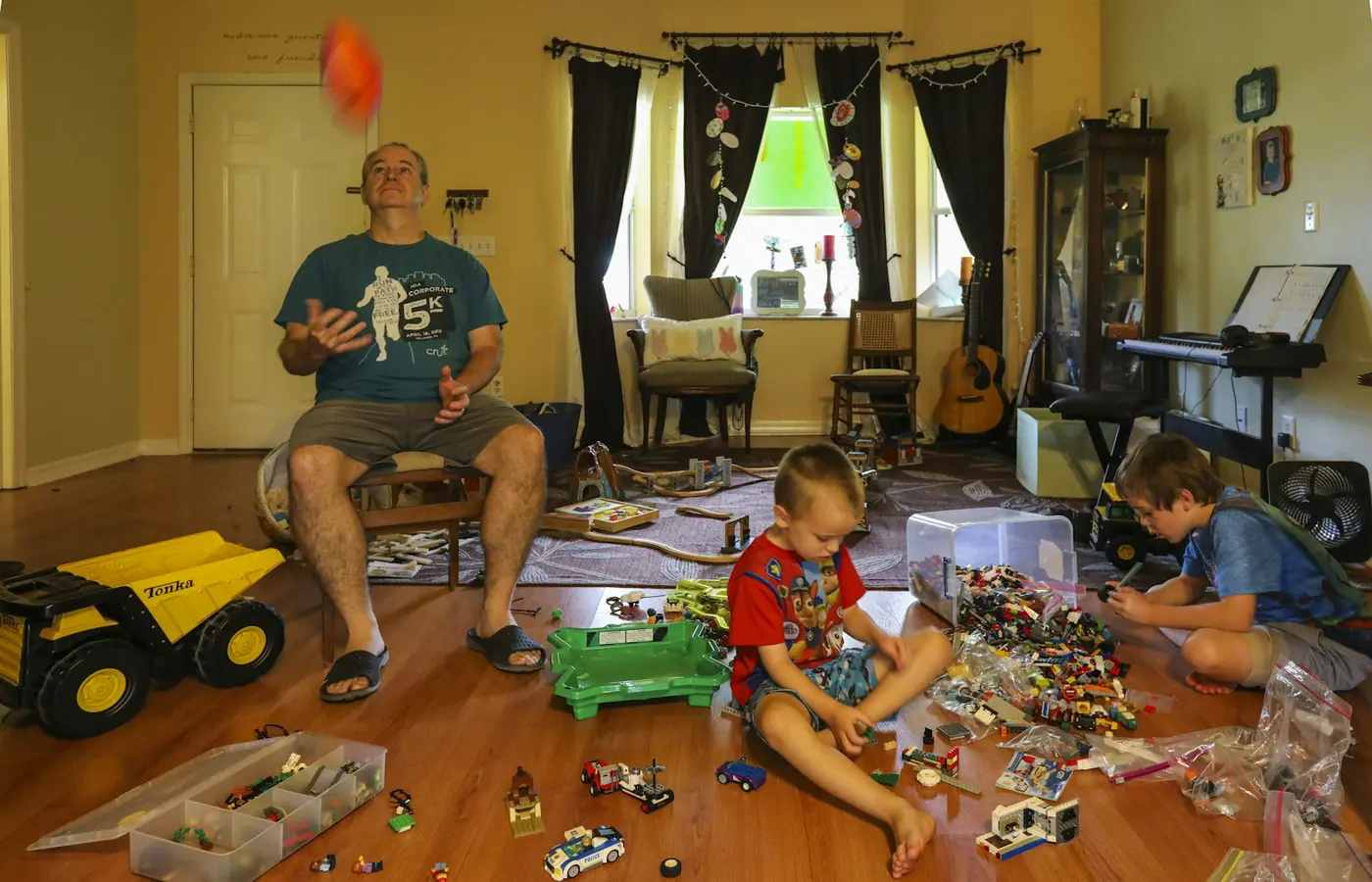
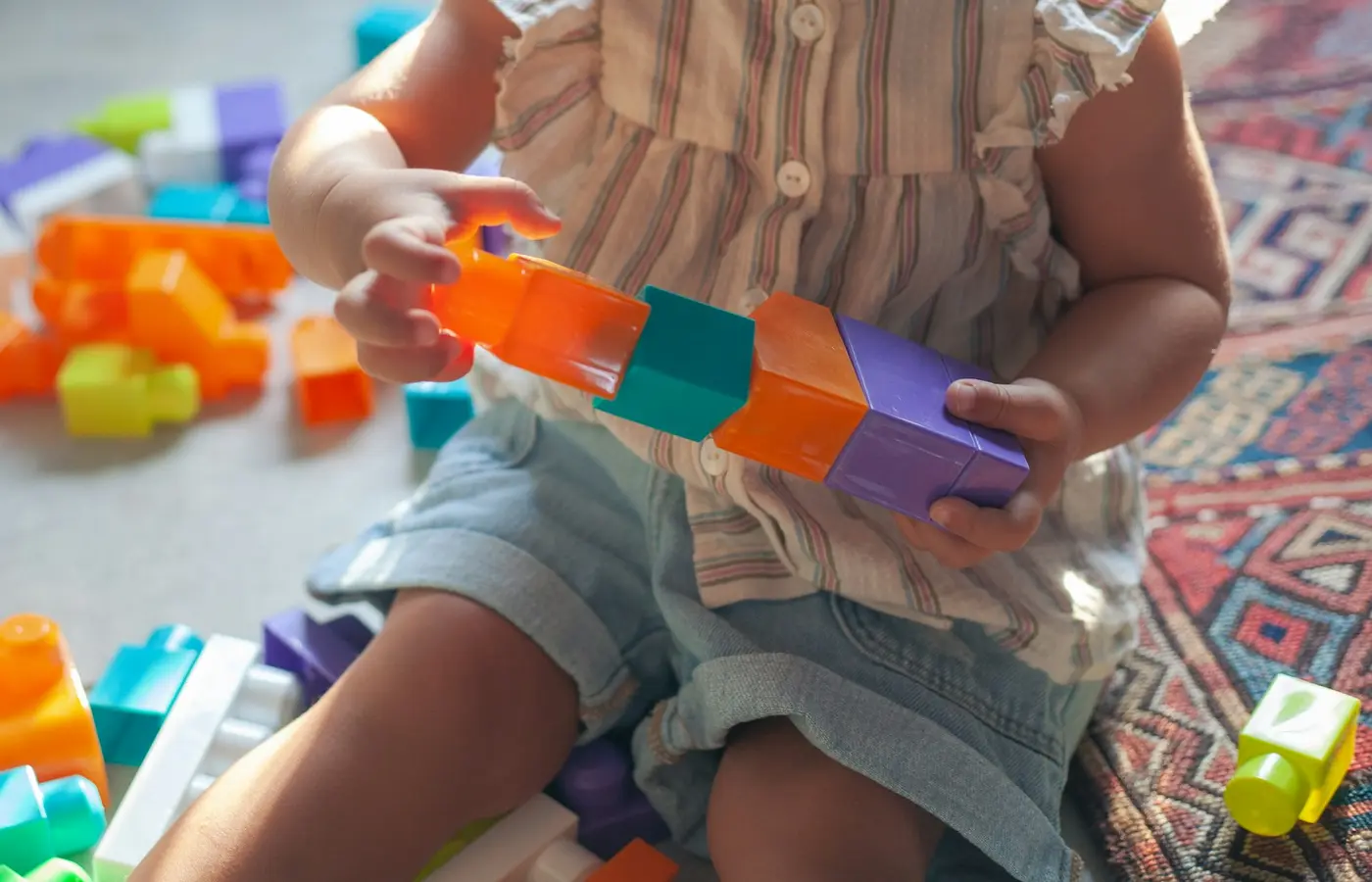
A child who builds confidently with chunky blocks may be curious about smaller interlocking bricks—but that does not mean a birthday automatically makes the switch appropriate. Start with the exact set’s age grade and small-parts warnings. Then watch what your child does: whether pieces still go into their mouth, whether they can connect and separate them, how they respond when a build does not work, and whether the household can reliably contain the smaller parts.
There is no need to retire chunky blocks when small bricks arrive. The two formats can overlap, and staying with larger pieces is a reasonable choice when they better suit the child, the available floor space, mixed-age siblings, or the amount of cleanup you can manage.
The quick answer: use age guidance as a floor, then watch the play
For LEGO products specifically, the manufacturer says age four is the earliest it advises introducing standard LEGO bricks. LEGO also recommends waiting if a child is not ready or still prefers DUPLO sets. That is manufacturer guidance for those product lines in the US market, not a universal minimum age for every interlocking-brick system.
For any brand or set, check the current packaging and instructions rather than relying on a retailer’s age filter or a general statement about “preschool bricks.” Age grades, piece sizes, build complexity, and warnings can differ among sets—even within the same brand.
Once a particular product clears that first safety check, practical readiness is less about proving a skill and more about whether the play seems manageable. Useful questions include:
- Does your child still put blocks or other play pieces in their mouth?
- Can they line up and press together smaller connectors?
- Can they pull pieces apart without using their teeth?
- Can they retry or ask for help when a connection fails?
- Can the pieces be kept away from younger children or anyone else likely to mouth them?
- Can your family contain and clean up pieces small enough to disappear under furniture?
These are selection clues, not developmental tests. A child does not need to “graduate” from larger blocks, and difficulty with small bricks does not mean they are behind.
Check the small-parts safety gate first
Dexterity comes after safety. Small interlocking pieces can be swallowed, so do not introduce a set when the intended child still regularly mouths play materials. Adult supervision is useful, but it does not cancel an age grade or small-parts warning on the product.
The same caution applies when a younger sibling, visiting child, or another household member may pick up and mouth the pieces. A child may be able to build with small bricks while the home is not yet a workable place to store and use them.
Before opening a set, check:
- The exact age grade and warnings: Read the box and instructions for that product, market, and version.
- Who can reach the play area: Consider siblings, visiting children, and pets that may carry or scatter pieces.
- Where building will happen: A tray or table can reduce spread, although it cannot guarantee that every piece stays contained.
- Where the set will be stored: Use a container that closes securely and can be kept out of reach when necessary.
- Whether cleanup can happen immediately: Small pieces left on a floor are easier to overlook than chunky blocks.
If you cannot keep the pieces away from someone likely to mouth them, wait. Choosing a larger format is a practical safety decision, not a missed opportunity.
Readiness signs you can observe during ordinary block play
You do not need a formal assessment. Watch how your child handles the blocks already available and, if appropriate under the product’s labeling, a small number of the new pieces.
Grasping and positioning
Small bricks require a child to pick up individual pieces, turn them, and bring connecting surfaces together. Look for whether your child can position a piece intentionally rather than only scooping, dropping, or scattering it.
This does not need to look precise or polished. The useful question is whether the pieces allow the child to act on an idea without the size itself becoming a constant barrier.
Connecting pieces
Notice whether your child can align studs and openings and apply enough pressure to make a connection. They may use both hands, brace a build against the table, or ask you to hold the base. Those adaptations are all compatible with meaningful play.
LEGO’s own transition guidance identifies attaching and pulling apart DUPLO bricks as one sign caregivers can observe before introducing smaller LEGO bricks. That is a manufacturer-identified clue, not a validated developmental milestone.
Separating pieces safely
Taking a build apart matters as much as putting it together. A child should be able to separate at least some pieces by hand or use the manufacturer-provided tool when one is included and age-appropriate.
Using teeth to pry bricks apart is a stop sign. Step in, separate the pieces yourself, or return to larger blocks rather than allowing biting to become the usual solution.
Responding when a connection fails
Small bricks can be less forgiving than chunky ones. A piece may be turned the wrong way, attached off-center, or difficult to remove. Watch whether your child can try a different position, accept brief help, change the plan, or move on to another part of the play.
The goal is not prolonged attention or cheerful persistence at all costs. Some frustration is ordinary, but an activity that repeatedly ends in distress may simply be a poor fit right now. You can simplify it or put it away without turning the session into a lesson about perseverance.
Managing pieces with support
Cleanup reliability matters because small bricks spread easily. A child does not need to clean independently, but they should be able to participate in a routine appropriate to your home—placing pieces in a bin, checking a play mat, or pausing while you collect stray parts.
If every session creates more searching and sorting than your household can reasonably handle, larger blocks may remain the better choice even when the child can manipulate smaller ones.
Try a small, low-pressure transition
A limited trial can tell you more than replacing an entire block collection. This is practical editorial guidance, not a tested readiness protocol.
- Choose an age-appropriate product. Confirm the label and warnings on the exact set first.
- Offer only a small selection. Fewer pieces make it easier to see how the child handles them and easier to account for them afterward.
- Use a defined surface. A shallow tray, low-sided bin, or play mat can reduce floor spread.
- Show one connection and one separation. Then let the child explore rather than requiring a model.
- Keep the first session short and supervised. Stop before tiredness turns every connection into a struggle.
- Collect the pieces together. Check the immediate floor area, under nearby furniture, and any clothing folds or containers used during play.
A finished object is not the measure of success. Connecting two pieces, taking them apart, carrying them between containers, or incorporating one small build into pretend play can all be worthwhile uses.
Return to chunky blocks if the smaller pieces are mostly mouthed, thrown beyond the play area, impossible for the child to separate, or consistently upsetting. You can try again later if the label still fits and circumstances change. You can also decide that the smaller format adds more work than value for your family.
Ways to extend chunky-block play first
Smaller pieces offer more compact connections, but they are not the only route to varied construction play. Before buying another system, try changing what the child can do with the larger blocks already at home.
You might invite—not require—the child to:
- Build a bridge wide enough for a favorite vehicle.
- Make an enclosure for toy animals or figures.
- Copy a short color pattern that you start.
- Build a tall structure, dismantle it, and reuse the pieces for something low and wide.
- Sort pieces into containers as part of setup or cleanup.
- Draw a road or landscape on paper and add block structures.
- Tell a story in which a wall, house, ramp, or tower changes purpose.
- Combine blocks with compatible figures or vehicles, provided every item suits the child and does not introduce separate hazards.
These are play possibilities, not promises that the blocks will produce particular learning or developmental outcomes. Larger blocks may remain easier for quick building, shared play, visible structures, and faster cleanup. A child may also prefer the physical feel of pushing together bigger pieces.
Keeping chunky blocks available after introducing smaller ones gives the child options. It also lets you choose the format that fits the moment: larger pieces during a busy afternoon, for example, and a contained small-brick session when close supervision and careful cleanup are possible.
Plan for compatibility, cleanup, and mixed-age homes
Readiness is partly a household question. Small bricks can increase sorting, storage, and supervision work even when the child enjoys them.
Verify compatibility rather than assuming it
Brands, product lines, specialized elements, and product generations may connect differently. Check the official documentation for the exact products you own. Pieces that appear similar are not necessarily designed to fit together, and a general claim that one brick system is “compatible” may not cover every element.
If joining old and new collections matters, test only after confirming that both products remain suitable for the children using them. Do not force a connection that does not fit; stressed or damaged pieces should be removed from play and handled according to the manufacturer’s instructions.
Start with less than you think you need
A modest number of bricks can support posting, connecting, stacking, building, pretending, and dismantling while making supervision and cleanup more realistic. A large collection is not required for a useful first experience.
Starting small also helps you learn whether your child prefers free building, figures and scenes, instructions, sorting, or simply attaching and removing pieces. You can extend the available materials later rather than committing storage space immediately.
Give every piece a landing place
Choose storage based on how your family actually tidies up. One broad bin may be easier than detailed sorting. A play mat that gathers into a bag can reduce handling, while a shallow tray may work better on a table. Whatever you use, the closure and storage location should prevent access by younger children when the bricks are not in use.
After play, use a simple visual floor check rather than depending only on the child to remember every piece. Look around chair legs, rug edges, baseboards, and under nearby furniture. This lowers the chance of leaving pieces behind but cannot guarantee that none are missing.
Common questions about moving to smaller bricks
Is age four automatically the right time?
No. LEGO describes four as its earliest advised age for introducing its standard bricks, but that does not establish a category-wide rule or mean every four-year-old will enjoy or manage them. Follow the exact product label, then consider mouthing, manipulation, frustration, cleanup, and the needs of everyone in the home.
Can supervision make small bricks appropriate when a child still mouths toys?
No. Supervision is an added control, not permission to ignore the product’s age grade or warning. If the intended child still puts play pieces in their mouth, choose larger age-appropriate materials and revisit the decision later.
Should chunky blocks be removed once small bricks are introduced?
No. Keeping both formats is often the simplest transition. Chunky blocks may remain preferable for larger structures, quicker setup, easier cleanup, or days when close supervision is not practical.
Do chunky blocks and small interlocking bricks work together?
Sometimes particular elements or product lines may connect, but compatibility should not be assumed across brands or collections. Check current official documentation for the exact products. Even when two formats connect physically, each item’s own age grade and warnings still apply.
A useful final rule is simple: choose small bricks only when the exact set is appropriately labeled, mouthing is no longer part of the play, pieces can be contained around younger household members, and connecting them creates more exploration than distress. Until then, extending chunky-block play is not merely a substitute—it may be the better fit.
Sources and research note
- LEGO, “Transitioning your child from LEGO DUPLO to LEGO bricks”, US page, accessed September 17, 2026. Used for LEGO’s statement that four is its earliest advised age for introducing standard LEGO bricks, its suggestion to watch whether a child can attach and pull apart DUPLO bricks, and its advice to wait when a child is not ready or still prefers DUPLO.
This source is manufacturer guidance, not independent safety or developmental research. The supplied research package did not include a product-safety regulator’s guidance, a standards document, a recall record, an exact package warning, or an independent developmental study. For that reason, this article does not claim a universal minimum age, product compliance, recall status, or developmental benefit. Caregivers should check current packaging and instructions for the exact product, version, and market they intend to use.