Toddlers do not need to march precisely on every beat for music-and-movement play to work. They may sway, bounce, stop, speed up, vocalize, watch, or repeat one favorite action. Treat rhythm as something to notice and share, not a score.
Before you start
Clear a space away from furniture edges, stairs, hot drinks, cords, and slippery rugs. Bare feet or secure footwear should suit the surface. Keep music low enough for everyone to hear ordinary speech. Choose one game for two or three minutes rather than planning a class.
1. Copy my one sound
Clap once and pause. If the child responds with two claps, copy their two. The game becomes a conversation instead of an adult pattern test.
Quieter version: tap one finger into your palm.
Easier: copy any response, including a stomp or vocal sound.
Harder: alternate one loud-enough clap and one quiet clap without approaching uncomfortable volume.
2. Scarf up, scarf rest
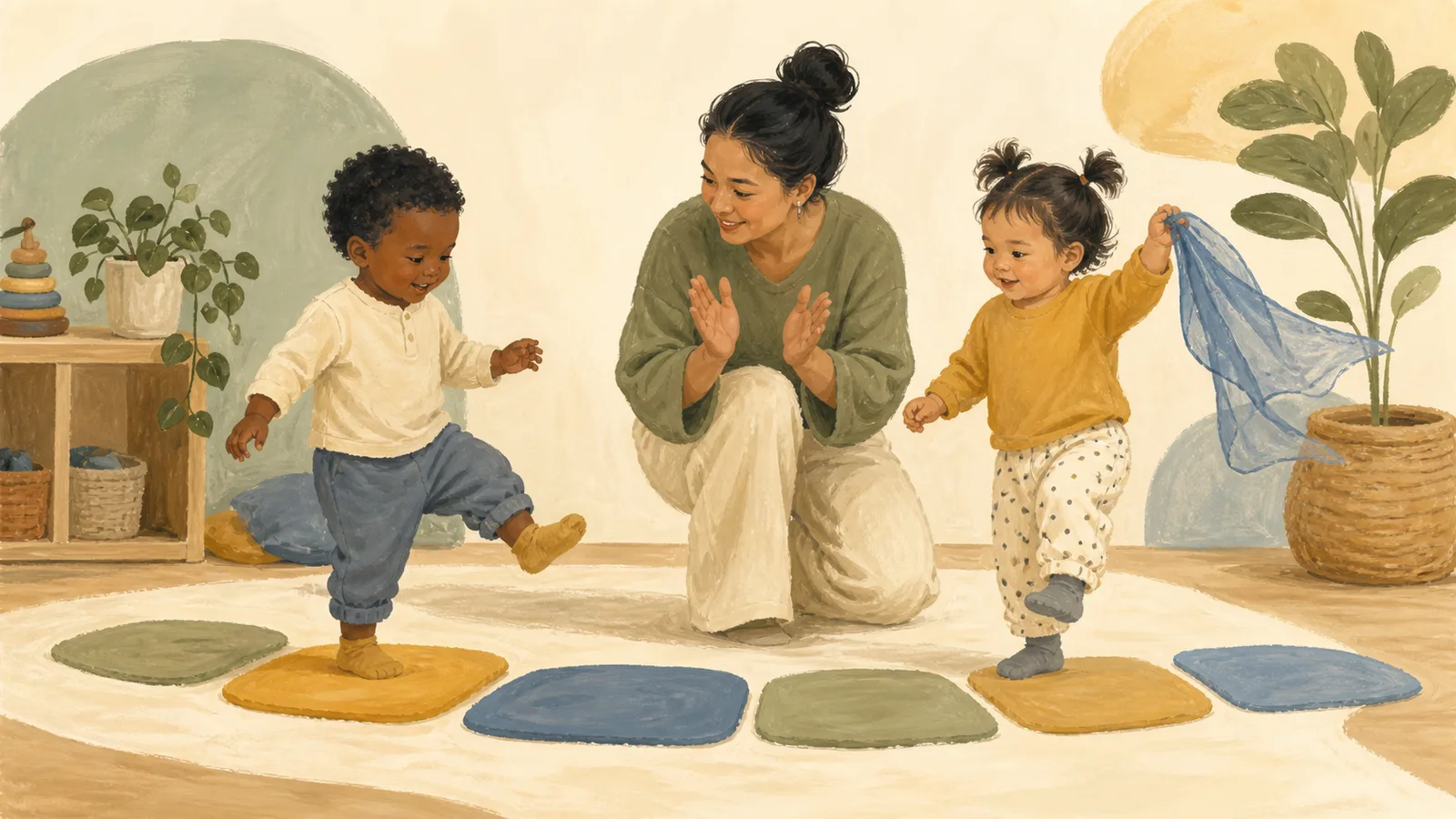
Move a light scarf upward while humming and place it on the floor when the sound stops. The toddler can lead movement while the adult follows.
Do not cover faces or wrap fabric around necks. Put the scarf away after supervised play, particularly around younger siblings and sleep spaces.
3. Two-step path
Put two large paper shapes or mats on a non-slip floor. Step from one to the other with a slow spoken pulse: “step, wait.” Add a third marker only when the route remains easy.
Seated version: tap left and right knees.
Mixed-age version: an older child changes the route but cannot change the speed without agreement.
4. Animal tempo
Choose one animal and one movement: slow elephant steps, quick mouse fingers, long snake arms. Tempo becomes visible through the body. Avoid stereotyped “correct” movements; the child can redesign the animal.
5. Rolling pulse
Sit facing each other and roll a large ball back and forth. Add a short phrase that fits each journey. Distance and ball speed matter more than musical precision.
This is useful in apartments because the motion stays low. Choose an age-appropriate ball and keep it away from stairs.
6. Start, fade, finish
Pat knees while singing one line. Repeat more quietly, then end with hands resting. Unlike abrupt freeze dance, the cue gives time to prepare for stopping.
If the toddler keeps moving, describe it—“Your feet are still going”—and begin again. Do not label the child as failing self-control.
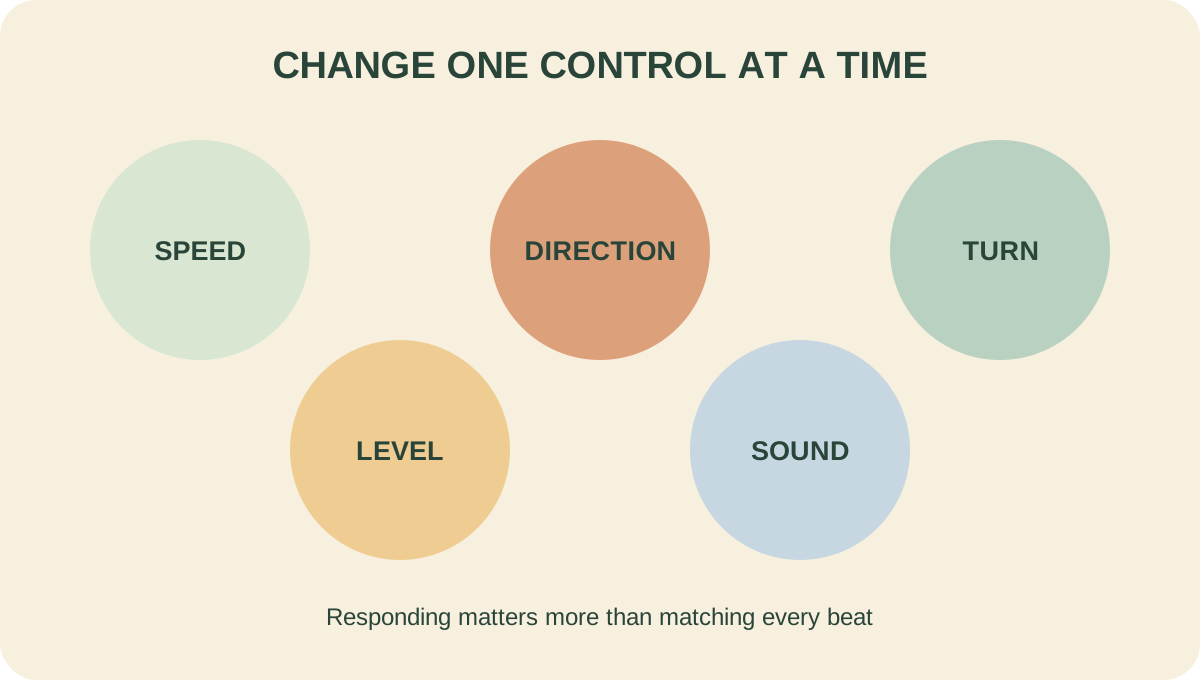
Change one difficulty lever
| Lever | Easier | More complex |
|---|---|---|
| speed | slow, steady action | gentle contrast between slow and quick |
| level | seated or floor movement | stand, crouch, rise |
| direction | one repeated route | forward/back or side changes |
| sound | voice or one instrument | alternate two sound sources |
| turn | adult follows child | exchange a short pattern |
When every lever changes at once, children may copy the spectacle without detecting the pattern.
Instruments are optional
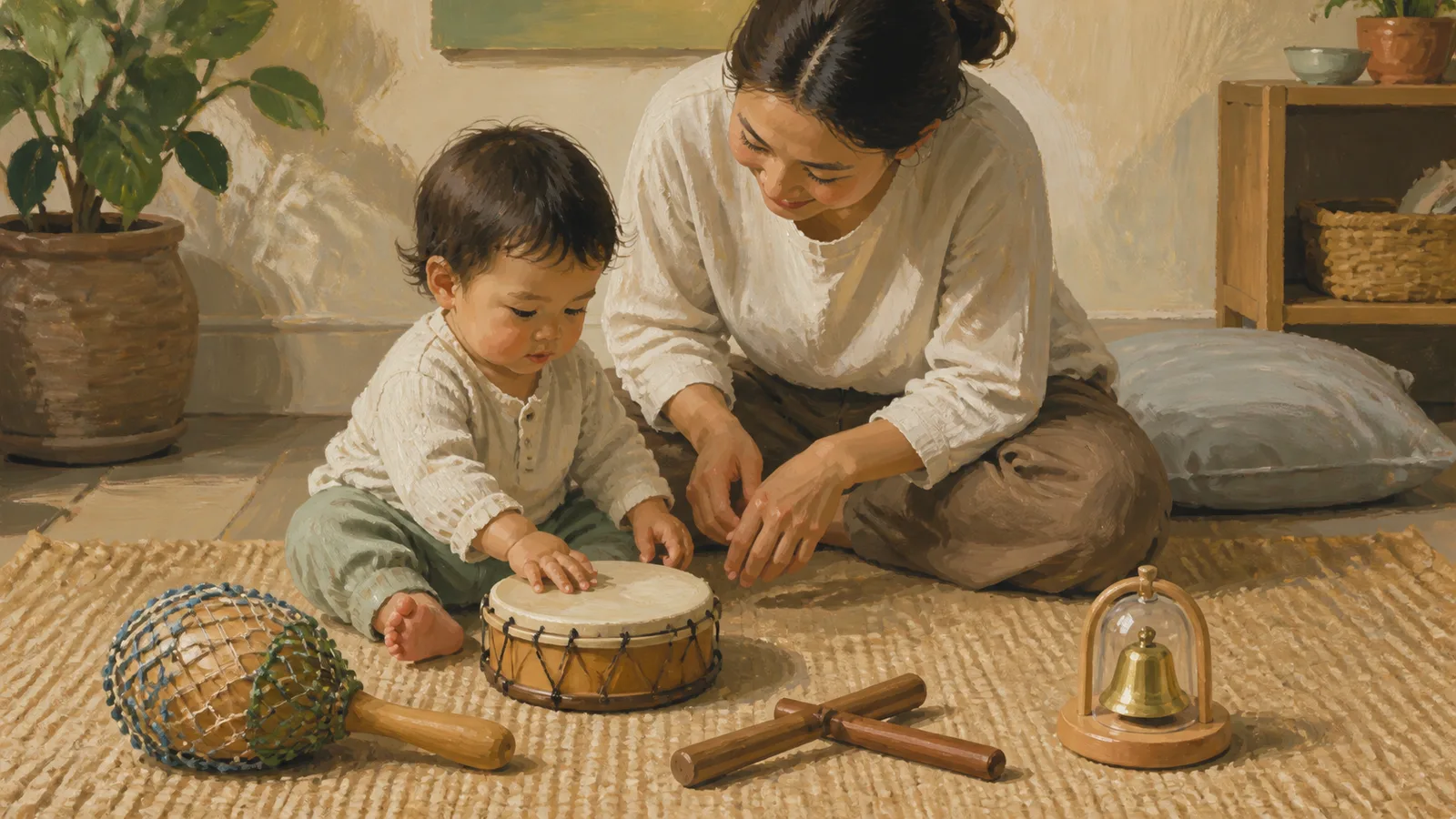
Body percussion, voice, a ball, and a scarf are enough. If you add a drum or shaker, inspect it and manage proximity and volume using our first musical-instrument guide. For younger siblings, baby music play centers live singing and cue-based pauses.
What the research means here
A preschool clustered randomized trial reported benefits from a teacher-delivered rhythm and movement program for children in disadvantaged communities. Other studies have examined social context and synchronization. These are structured interventions, not proof that a round of freeze dance will improve executive function.
They do support taking rhythm-and-movement activity seriously as coordinated, social, embodied practice. The immediate aim at home can remain enjoyment, connection, and exploration.
Sensory and access adaptations
- Replace recorded music with humming or visual scarf cues.
- Let the child watch before joining.
- Use predictable repetitions and announce changes.
- Offer a stable chair, wall support, or seated movement.
- Avoid touching or moving the child’s body without permission.
- Create distance from speakers and offer a quiet retreat.
- Accept finger movement or eye gaze as participation.
The sensory play guide can help separate a child’s preferences from a requirement to tolerate more stimulation.
Frequently asked questions
Should a two-year-old keep a steady beat?
Accurate synchronization is still developing and varies with task and social context. Responding to music through movement is not the same as matching each beat.
Is freeze dance good for self-control?
It involves listening and changing action, but one game does not establish broad self-regulation. Keep it playful, predictable, and free from shame when stopping is late.
What if my toddler only spins?
If the space is safe and the child remains comfortable, spinning may be the movement they prefer. You can match the rhythm to it rather than redirecting immediately.
How long should a movement game last?
Stop while coordination and enjoyment remain. A few engaged minutes can be enough; duration depends on the child, space, temperature, and intensity.
Sources and research note
Research context includes a clustered trial of teacher-delivered rhythm and movement, a paper on music, rhythm, movement, and self-regulation, and research on social context in joint drumming. Practical age context comes from PBS Kids’ Music and Movement at Age 2, while noise guidance follows the AAP’s How Noise Affects Children.