Water beads may look like a simple sensory-play material: small, colorful balls for scooping, pouring, sorting, or filling a container. But their central feature—absorbing liquid and growing—also creates a serious household hazard.
For homes with babies, toddlers, children who still mouth objects, or children who may put small items in their ears or nose, the cautious choice is not to bring water beads home. The U.S. Consumer Product Safety Commission (CPSC) warns that water beads can be deadly if swallowed, and reports severe injuries, lifelong health impacts, and deaths associated with ingestion. Water beads can also be inhaled or inserted into an ear or nose.
Package age labels and close adult supervision may reduce some risks, but they do not make a loose, expandable material a good fit for every home. A bead can be missed during cleanup, carried into another room, accessed by a younger sibling or visiting child, or come out of a damaged toy later.
What makes water beads hazardous
Water beads are made from superabsorbent polymers. They are often sold dry and small, then placed in water to expand. That change in size is why a bead that seems easy to overlook can become dangerous after it reaches a wet part of the body.
The main concerns are not simply that a bead is small. They are that it can be small enough to access or swallow before expanding, and that it may continue to take in fluid afterward.
Swallowing and intestinal blockage
If swallowed, a water bead can absorb fluid and grow inside the digestive tract. Poison Control says this can cause a life-threatening intestinal blockage. The concern is particularly acute for young children, who may be drawn to the bright colors or mistake the beads for candy.
It is not possible to use a simple household rule such as “only one bead” to decide that an exposure is harmless. The risk depends on factors that cannot be reliably assessed at home, including the particular bead, whether it has already expanded, and where it may be in the body. If a child may have swallowed a water bead, contact Poison Control promptly for case-specific guidance.
Inhalation
A child may inhale a small bead while handling, mouthing, tossing, or blowing it. CPSC’s water-bead safety information includes inhalation among the potential hazards. A bead that enters an airway is not a cleanup problem; it needs immediate medical attention.
Ears, nose, and other body openings
Small, smooth objects can invite experimentation, especially during independent play or when a child is curious about putting things into holes and containers. Water beads add a separate concern because they can absorb moisture and enlarge after insertion.
The American Academy of Pediatrics’ parent site, HealthyChildren.org, notes that children have put water beads in their ears and inhaled them, as well as swallowed them. Poison Control specifically advises against putting water beads in the nose, ears, or other body openings.
Why age labels and supervision may not settle the decision
An age grade is useful product information, but it is not a description of every child or every household. It cannot account for a crawling sibling, a visiting child, a pet, a child who has recently started mouthing objects again, or a few beads that roll beneath furniture.
Supervision also has practical limits. An adult can sit nearby and still need to answer the door, help another child, prepare food, or deal with a spill. Water beads are easy to scatter, hard to count, and sometimes used in larger sensory bins or water-bead-filled toys. Their small size means a single missed bead can remain accessible after the planned activity ends.
Dried beads can be reused, according to HealthyChildren.org. That may be appealing from a waste or cost perspective, but it also means the material can remain in the home long after one play session. Reuse adds storage and access questions: Where will the beads go? Can every household member keep the container closed? What happens if some are left in a toy, vase, garden arrangement, or drain area?
This is why a family may reasonably decide that the safest setup is one that does not require perfect containment or perfect supervision.
What the newer U.S. water-bead standard changes—and what it does not
In the United States, a federal water-bead safety standard applies to water beads manufactured after March 12, 2026. The CPSC announcement says the standard includes requirements for maximum expansion size, limits on allowable acrylamide, visible warning labels, and testing.
This is meaningful consumer protection work. In particular, it recognizes that the risks are not limited to a bead’s original dry size or to a warning printed on a package.
It does not mean that every water-bead product currently sold is interchangeable, that older products meet the new requirements, or that water beads are risk-free in a home. The date is tied to when a product was manufactured, not simply when it was purchased. A product may have been made before the standard took effect, and a retailer listing may not make its manufacturing date easy to verify.
The federal rule also does not remove hazards created by access, loose beads, insertion into ears or noses, or an activity shared across ages. The Federal Register notice for the rule explains that earlier expanding-material requirements in ASTM F963-23 were not sufficient to address all known water-bead toy hazards. Read the Federal Register document here.
CPSC has also warned about acrylamide findings in some water-bead products. That does not tell you the amount in any particular product or predict the effect of a specific exposure. It is another reason to avoid treating broad marketing terms such as “non-toxic” or “sensory” as a complete safety assessment.
A practical decision rule before you buy
You do not need to prove that a child will swallow or insert a bead before deciding against water beads. It is enough to notice that the material does not fit your current household conditions.
Avoid bringing water beads into the home if any of these apply:
- A baby, toddler, or young child can access the play area or its cleanup leftovers.
- A child currently mouths small objects, even occasionally.
- A child may put small objects in their ears, nose, or other body openings.
- The activity would take place in a shared room where beads could roll away or be overlooked.
- You cannot reliably collect, contain, and securely store every bead after play.
- The beads would be used in a toy that could split, leak, or release them.
- Pets may have access to dropped beads or storage containers.
That is not a judgment about a child’s maturity or a caregiver’s attentiveness. It is a match between a material’s hazard and the reality of a home.
For households that nevertheless choose to use water beads, precautions can reduce access but cannot eliminate risk. Follow the product’s instructions and age information, do not allow unsupervised play, and store the beads securely away from children and pets. Poison Control also advises discarding a water-bead-filled toy if beads begin to come out. Do not assume that a sealed-looking toy will remain sealed after rough play, wear, or a damaged seam.
A useful question is: Could one loose bead be found by the wrong person or pet after this activity is over? If the answer might be yes, choose another material.
Safer ways to offer scooping, pouring, sorting, and sensory play
Often, the play need is not “water beads.” It is an action: transferring objects between cups, running hands through a material, filling containers, hiding and finding, or arranging items by color.
Choosing a different material can preserve some of that play without using objects that expand after contact with liquid. The best option depends on your child’s age, mouthing behavior, allergies, mess tolerance, and the supervision available.
Consider these simpler setups:
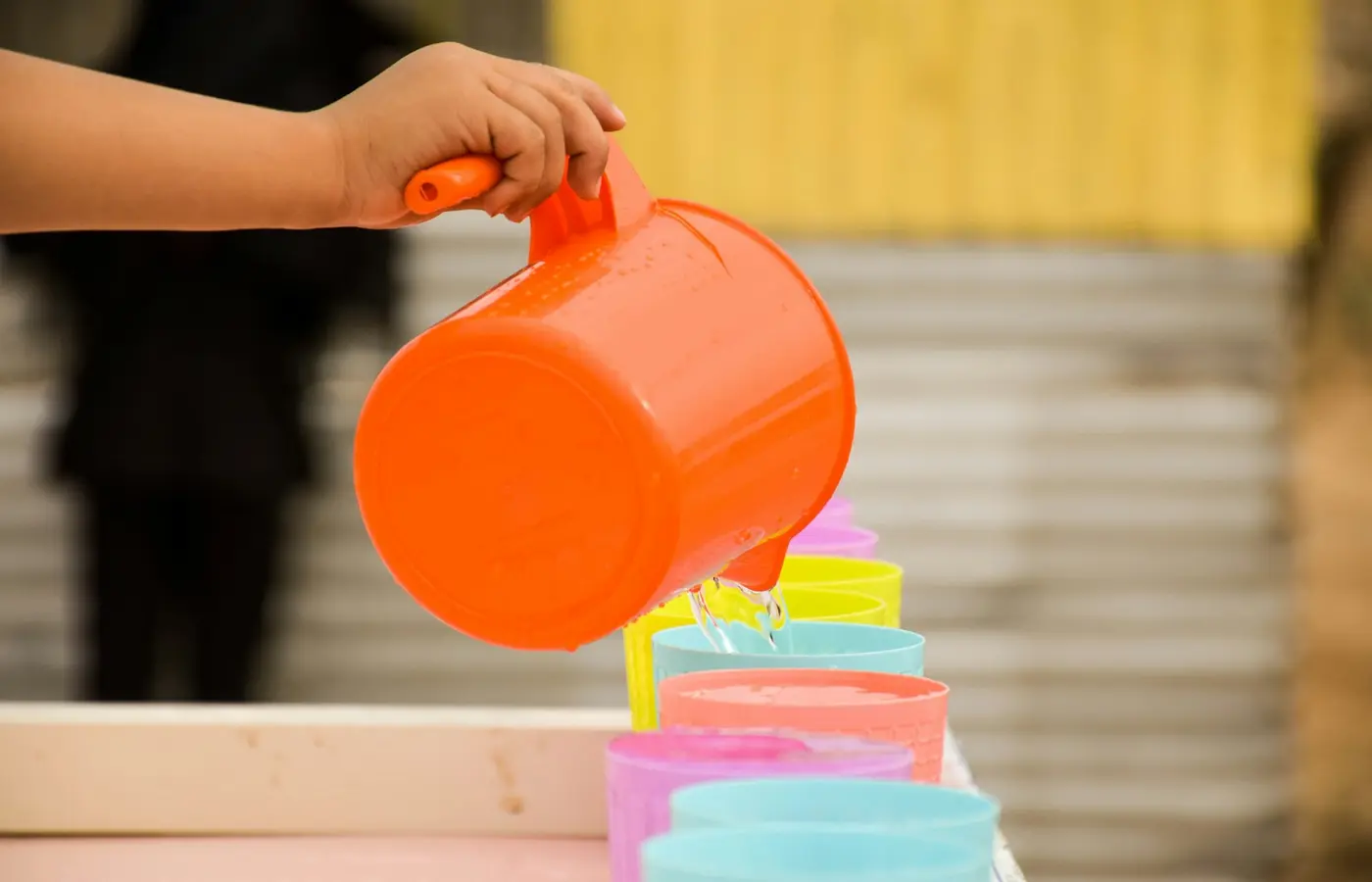
- Water in a shallow tray or sink: Add cups, ladles, funnels, and washcloths for pouring and squeezing. Use only the amount of water you can actively supervise, and empty it when play ends.
- A damp cloth and a few containers: A child can squeeze, wipe, fill, and transfer water with less loose-material cleanup.
- Large household containers: Nesting bowls, measuring cups, colanders, and large spoons can support filling, stacking, carrying, and dumping during dry play.
- Large, age-appropriate objects for sorting: Use items that are too large to be swallowed for children who still mouth objects. Keep the activity simple rather than adding many small pieces.
- Play dough or another familiar modeling material: For a child who can use it appropriately, it offers pressing, rolling, poking, and pretend-food play. Follow its label and store it out of reach when not in use.
- A supervised bath or water-table routine: If water play is the appeal, a short, contained routine may be easier to end and clean up than a bin full of loose expanding beads.
None of these materials is automatically right for every child. Water requires close supervision; play dough may not suit children who eat it; and any small object can become a hazard for a child who mouths items. The aim is not to find a perfect sensory material. It is to choose one whose risks are easier for your household to manage.
If a child may have swallowed, inhaled, or inserted a water bead
Treat a possible water-bead exposure as a reason to get expert help promptly rather than waiting to see whether the bead passes or trying to manage it at home.
- If a child may have swallowed a water bead, contact Poison Control right away for guidance.
- If a child may have inhaled a bead, seek emergency medical care.
- If a bead may be in an ear or nose, contact a medical professional promptly rather than attempting to remove it yourself.
- If you have the package or know the product name, keep that information available for the professionals you contact.
CPSC notes that water-bead ingestion has been associated with severe injuries and death. It is better to ask for help early than to rely on the bead’s original size or appearance.
Common questions about water bead safety
Are water beads safe for toddlers?
For toddlers and other young children, water beads present a serious concern because they can be swallowed, inhaled, or inserted into an ear or nose, then expand with liquid. CPSC describes water beads as a danger to young children. In homes where a toddler can access them, avoiding water beads is the cautious choice.
Can a child get hurt from swallowing just one water bead?
A single suspected ingestion should not be dismissed. Water beads can expand after exposure to liquid, and Poison Control warns that they can cause life-threatening intestinal blockage if swallowed. Contact Poison Control for guidance specific to the child and product involved.
Do the new U.S. rules mean water beads are safe to use at home?
No product standard can make a loose expanding material risk-free in every home. The U.S. standard that applies to products manufactured after March 12, 2026 adds expansion, acrylamide, warning-label, and testing requirements. It does not guarantee that an older product meets those requirements or eliminate risks from access, missed beads, inhalation, or insertion.
What should I do if my child puts a water bead in their ear or nose?
Seek prompt guidance from a medical professional. Do not try to manage removal yourself. Water beads can absorb moisture and grow, which makes this different from an ordinary loose small object.
Sources and research note
This article uses U.S. regulator and medical guidance. The federal standard discussed above applies in the United States to water beads manufactured after March 12, 2026. Product packaging, instructions, and rules may differ by product and jurisdiction.
- U.S. Consumer Product Safety Commission: Water Beads Information Center
- U.S. Consumer Product Safety Commission: New Federal Water Beads Safety Standard Takes Effect
- Federal Register: Safety Standard for Water Beads (PDF)
- HealthyChildren.org: Water Beads: Harmful if Swallowed, Put in Ears
- Poison Control: Are Water Beads Dangerous?
If water beads do not fit your home right now, you do not need to replace them with another elaborate sensory product. Start with the action your child enjoys—pouring, carrying, squeezing, sorting, or pretending—and choose the simplest material you can supervise and clean up with confidence.