A wooden toy can be a good choice for toddler group play, but the material alone does not make it suitable. Look first at what two or more children can do with it, whether the pieces and age guidance fit the group, and whether an adult can realistically supervise, clean, and store it.
For many toddlers, the most realistic goal is not effortless cooperation. It is comfortable play alongside one another, with adult-supported turn-taking when children want the same piece. A set with several entry points, visible pieces, and manageable cleanup may work better than a beautiful toy built around one prized object.
Start with the kind of group play you actually need
Before choosing a toy, picture the setting. Are two toddlers likely to play near one another for ten minutes? Will several children use the toy during an open play period? Is an adult available to narrate turns and move pieces when frustration rises? These questions matter more than whether the toy is wooden, plastic, or made from another material.
It helps to distinguish three types of participation:
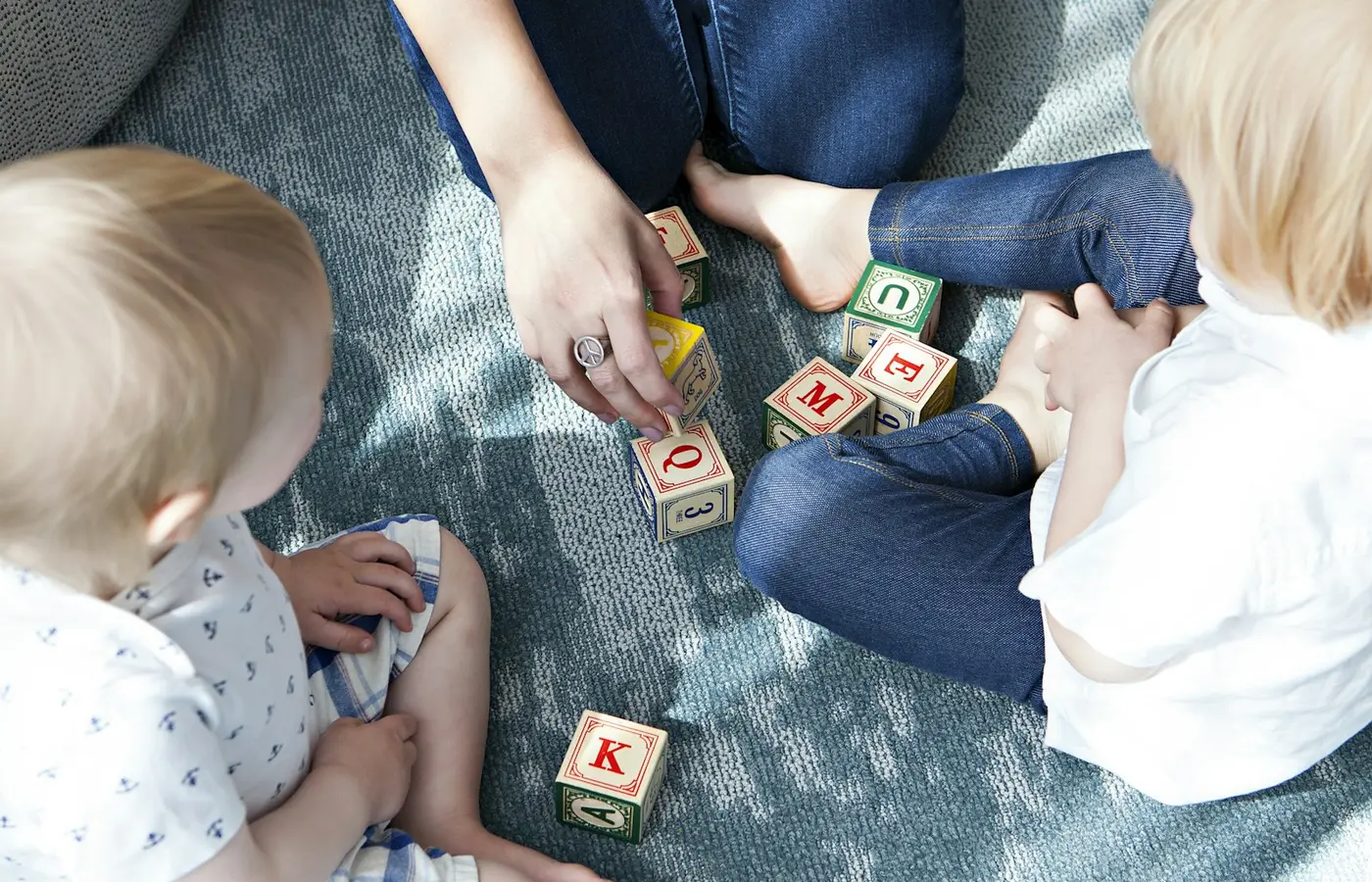
- Parallel play: Children use similar or nearby materials without needing to coordinate their actions. One child stacks blocks while another carries them or makes a separate structure.
- Supported turn-taking: An adult helps children wait, exchange a popular piece, or use a shared activity in short turns.
- Cooperative play: Children coordinate toward a shared idea, such as building one structure or acting out a joint pretend scenario.
Toddlers vary widely, but many children roughly under two and a half to three commonly play alongside others rather than reliably sharing on demand. This is a broad pattern, not a deadline or a test. The Tiny Learns guide to toys for sharing usefully frames toddler sharing as turn-taking, waiting, and coping with strong feelings rather than simply handing over an object.
So choose for the kind of participation the children are ready for now. A toy does not need to produce cooperative play to be worthwhile. A child carrying pieces from one basket to another, watching another child build, or protecting a small project can all be valid ways to take part.
Look for multiple entry points, not one prized piece
The strongest group-play question is simple: What can two or more children do at the same time?
A toy has multiple entry points when children can approach it through different actions or levels of participation. Depending on the design, that might include:
- carrying and placing pieces;
- stacking, nesting, or lining up;
- posting or sorting;
- connecting and taking apart;
- adding pretend-play props to a structure;
- watching, imitating, or dismantling another child’s construction.
An open-ended set can support parallel use because one child does not have to control the entire activity. Blocks, larger construction pieces, simple pretend-play props, and some track or connector sets may allow children to make separate things in the same space. The Original Toy discussion of mixed-age toys describes this as offering multiple entry points: younger children may explore basic features while older or more experienced children use the same materials in more complex ways.
That does not mean every open-ended set will work for every group. A large number of nearly identical pieces can scatter across the floor, and a set with one essential base or special figure may still create a bottleneck. A toy with many parts can also make it harder for an adult to see what is happening.
Duplicate the popular action when you can
If children repeatedly want the same scoop, vehicle, animal, connector, or large block, duplicates may reduce some disputes. Two similar pieces can let children carry out the same action nearby instead of waiting for one object.
Duplicates are not a promise of peaceful play. Toddlers may still want the exact piece another child is holding, or one child may want to control the whole set. Think of duplicates as a setup choice that creates more options, not as a way to remove conflict.
When buying a set, ask:
- Are there several pieces that serve the same function?
- Can children begin without waiting for one central piece?
- Is there a nearby role for a child who does not want to build?
- Can an adult remove a few pieces without making the toy unusable?
- Are the pieces large and visible enough to count before and after play?
Retailer-style descriptions of open-ended play can be helpful for generating ideas, but they are not independent evidence that a toy improves creativity, attention, cooperation, or development. The practical benefit here is narrower: more entry points may make it easier to arrange parallel participation.
Check age fit, piece safety, and supervision first
Safety is the gate before play value. The exact product’s manufacturer age grade, warnings, instructions, dimensions, materials, finish information, and care guidance should be checked before group use. The available research package does not include an official safety document or product-specific record for a named toy, so those details cannot be assumed here.
For a toddler group, check specifically for:
- small parts or detachable decorations that may create a choking risk;
- rough edges, splinters, cracks, or breakable components;
- pieces that could become hazardous if chewed, bent, or broken;
- strings, cords, magnets, or other features covered by the product warnings;
- an age grade that fits the youngest child who can access the toy;
- instructions about cleaning, water exposure, disinfectants, or inspection;
- whether the finish or surface changes after repeated handling and cleaning.
Do not treat wooden as a synonym for non-toxic, safer, durable, hygienic, or compliant. A wooden toy may have a sturdy design, but the word itself does not verify its finish, construction, or suitability for a particular age. Likewise, do not use a retailer’s age filter as a substitute for the manufacturer’s instructions and warnings.
Supervision depends on the exact toy, the children present, and the setting. A chunky set with no detachable parts may need different oversight from a construction toy containing small connectors. Mixed-age access changes the calculation: a toy used safely by older toddlers may not be appropriate when a younger child can reach the pieces.
If you cannot identify the product’s instructions, warnings, and care requirements, pause before using it with a group. That is a reason to seek better documentation or choose a simpler, clearly labeled option—not a reason to guess.
Assess the room: visibility, noise, space, and adult work
A toy that works in a one-child playroom may be awkward in a living room, playgroup, classroom, or daycare. Group use adds movement, dropped pieces, competing hands, and repeated cleanup.
The Wow Toys guide to daycare toy selection notes that group-use toys may be dropped, stepped on, stacked, scooped, tossed into bins, and cleaned repeatedly. Those conditions are useful to consider, but they do not prove that any particular wooden toy will withstand them. Durability and cleanability still need product-specific documentation and inspection.
Visibility and floor space
Choose a setup where an adult can see the important pieces and reach the children without leaning over a crowded construction. A large set may invite more participation, but it can also create scattering, blocked pathways, and arguments over a central pile.
Try laying out only part of the set at first. Keep the remaining pieces in a nearby container and add them if the group needs more options. This can make counting easier and reduce the amount of material that has to be gathered later.
Noise
Wooden does not automatically mean quiet. Blocks can be banged, pieces can be dropped, and a wooden vehicle can be pushed across a hard floor. If noise is a concern, consider a rug, a defined play mat, or a rule that pieces stay on the play surface. Check whether those adaptations are realistic for your space rather than promising a silent activity.
Storage and cleanup
Before buying, decide where the toy will live. A container that is too small encourages overfilling and makes damaged pieces harder to spot. A container without a lid may keep pieces visible but allow them to spread through the room. Countable pieces, a simple storage location, and a quick inspection routine are often more useful than elaborate organization.
Follow the manufacturer’s care instructions. Do not assume that a wooden toy can be soaked, sprayed, or disinfected in the same way as a plastic one. If the product has no clear cleaning guidance and will be shared by many children, that uncertainty belongs in the buy-or-skip decision.
Plan for conflict without making sharing the success test
A group-play setup can support children without demanding that they surrender an object immediately. The Tiny Learns guidance emphasizes that toddler sharing often means waiting and taking turns, with adult support, rather than instant cooperation.
Practical steps include:
- Name the problem plainly. You can say, “You both want the blue truck.” This acknowledges the conflict without declaring one child good and the other difficult.
- Offer a nearby action. Point to another truck, a loading piece, or a separate building space if one is available.
- Make the next turn visible. A short, concrete sequence is easier to follow than an open-ended promise to share later. You might say, “Sam has it. Then it is your turn.”
- Protect an active project when possible. A child who is still using a structure does not necessarily need to hand it over because another child is interested.
- Stop or simplify when frustration rises. Remove a few pieces, move the activity farther apart, or offer a different play area.
These are caregiver strategies, not guarantees or research-proven outcomes for a particular toy. Conflict can happen even when there are duplicates. A finished tower, quiet behavior, or uninterrupted sharing is not the only measure of success. Children may participate briefly, change activities, watch, dismantle, or need help leaving the play space.
A short buy-or-skip checklist
Choose a wooden toy for toddler group play when you can answer yes—or find a practical plan—to most of these questions:
- What can two or more children do at the same time?
- Does the set offer parallel actions as well as a possible shared activity?
- Are there duplicates or complementary pieces for the most popular actions?
- Is the manufacturer’s age grade and warning information clear for the youngest child present?
- Are pieces large enough and secure enough for the stated age range, according to the product documentation?
- Can an adult see, count, inspect, and retrieve the pieces?
- What happens if an edge becomes rough or a piece breaks?
- How does the manufacturer say to clean and store it?
- Is the noise and floor footprint manageable in your setting?
- Is the necessary supervision realistic during the time the toy will be available?
Skip, modify, or postpone the toy when the answer depends on guessing. You might offer fewer pieces, create two play stations, keep the set away from younger children, or choose a toy with simpler documented care and safety information. Adaptation is part of choosing well; it is not a sign that the group has failed to play correctly.
Frequently asked questions
Are wooden toys safer than plastic toys for toddler group play?
Not automatically. Safety depends on the exact design, age grade, warnings, construction, finish, parts, breakage risk, and care instructions. The material category alone does not establish that a toy is safer, non-toxic, more durable, or easier to clean. Check the manufacturer’s documentation and inspect the toy before group use.
How many duplicate pieces do toddlers need for shared play?
There is no universal number. Start with the actions children most often compete for and consider whether two children can do that action at once. Two similar pieces may reduce waiting, but they cannot guarantee cooperation or prevent every dispute. The size of the group, the children’s ages, and the available space all matter.
Are toddlers expected to share wooden toys?
Toddlers are not expected to share on demand simply because a toy is labeled for group use. Many young toddlers play alongside one another, and turn-taking may require adult support. You can set up duplicates, narrate short turns, and protect an active project without forcing a child to hand over a toy immediately.
What should I check before using a wooden toy with mixed ages?
Use the youngest child’s access as the safety starting point. Check the age grade, warnings, small parts, detachable features, breakage risk, and supervision needs. Also consider whether older children can use the toy in a more advanced way without leaving younger children exposed to pieces they should not handle. Keep all pieces visible and inspect them regularly.
Sources and research note
This guide uses the following sources for practical context:
- Tiny Learns: The Best Toys for Toddlers to Share, for discussion of parallel play, toddler turn-taking, duplicates, open-ended sets, and supported sharing.
- Wow Toys: Choosing Toys for Daycare, for practical considerations around repeated handling, mixed ages, cleanup, small pieces, and group-use conditions.
- Original Toy: Choosing Mixed-Age Toys, for the idea of multiple entry points in mixed-age play.
- Oddblocks: Best Wooden Toys for Toddlers, used only as contextual material about open-ended wooden play. Retailer- or manufacturer-style developmental and duration claims are not treated as independent evidence here.
The supplied research package does not include an official regulator, standards body, recall database, manufacturer instruction sheet, or product-specific safety record. It therefore cannot establish the safety, compliance, recall status, finish, materials, or age suitability of any named wooden toy. Verify those details for the exact product before introducing it to a toddler group. The practical selection rule is simple: choose the toy only when its documented safety information and group-play design fit the children, room, supervision, and cleanup you can realistically provide.