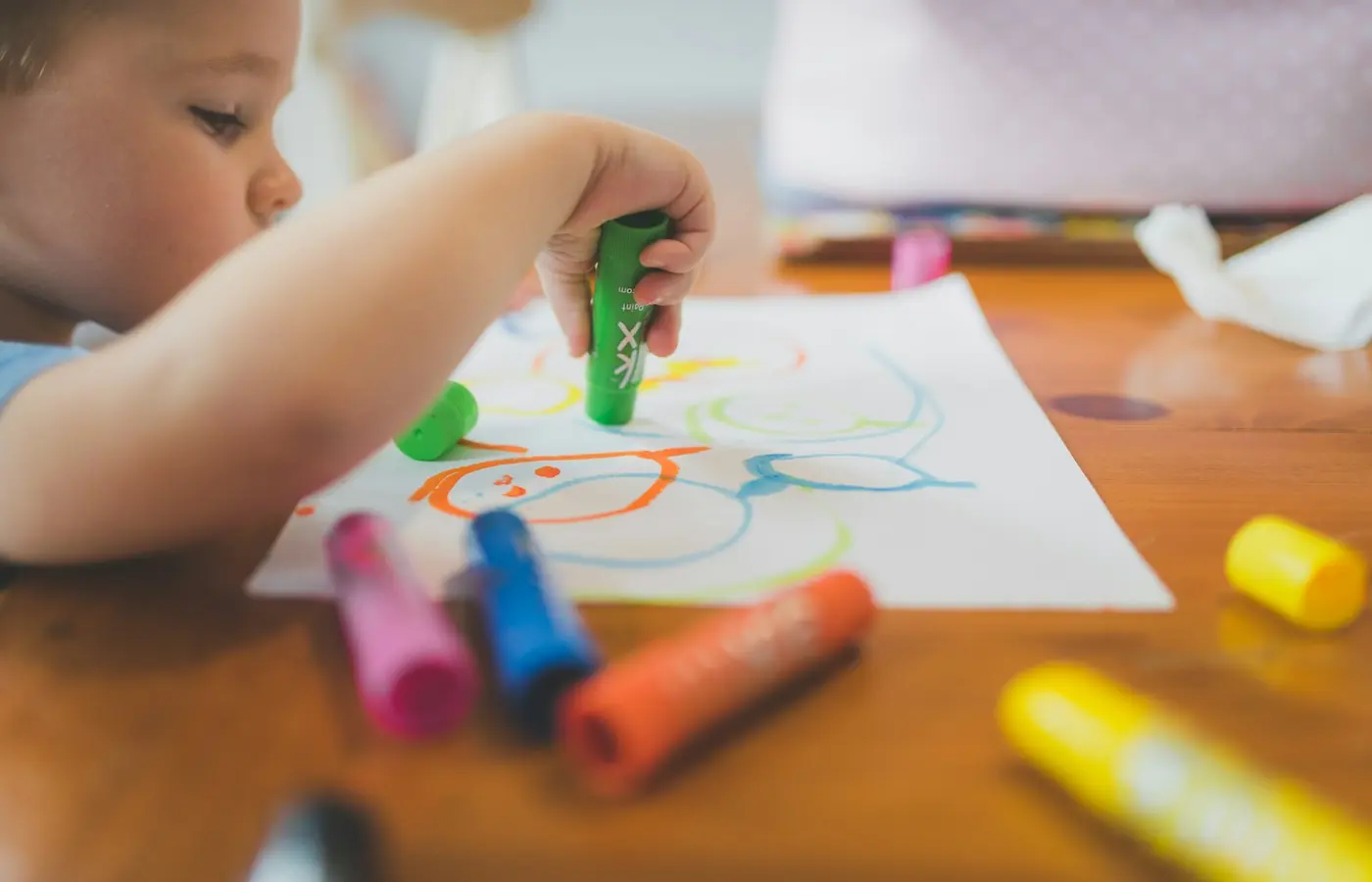
A child wants to make marks, fill a page with color, or copy what an older sibling is doing. You want an art material that will not turn a ten-minute activity into an hour of laundry and scrubbing.
For many short, everyday art moments, crayons are the simpler first choice. They are dry, quick to set out, easy to pause, and usually involve less washing afterward. Washable paint can be a good fit when you have time to protect the work area, remain nearby, and wash hands, tools, and surfaces when the session ends.
The word washable matters, but it is not a promise that every mark will disappear from every surface. Check the exact product package for its age grade, warnings, intended use, and washing directions. A child’s current habits matter too: a child who mouths tools, throws containers, or is likely to rub paint into their eyes needs closer supervision with either material.
The quick choice: match the material to the moment
Choose crayons when you need:
- A low-prep activity before dinner, during travel, or while you are nearby doing another task.
- A dry material for making lines, dots, circles, scribbles, or blocks of color on paper.
- A setup that can be put away quickly if the child loses interest.
- Fewer supplies on the table and less washing after play.
Choose washable paint when you can offer:
- A protected table or floor area.
- Paper, a stable paint container, and any brushes or tools the product calls for.
- Close enough supervision to respond to spills, paint on faces, or a tipped container.
- Time for handwashing, tool washing, and cleanup after the activity.
Neither choice should rest on an age label alone. Product labels and instructions are the authority for a particular set’s age grading and warnings. Then consider the child in front of you: how they hold tools, whether they mouth objects, how they respond to wet or sticky materials, and how much adult help is workable today.
What each material invites a child to do
Crayons and paint can both support open-ended mark-making. The difference is less about a right way to make art and more about the actions each material makes available.
Crayons: direct marks with little preparation
A crayon lets a child pick up a color and make a mark immediately. They may press hard, make quick back-and-forth lines, trace around a shape, layer colors, or spend a long time on one small part of a page. Some children prefer a small handful of familiar colors; others enjoy sorting through a larger set.
Crayons also make it relatively easy to stop and restart. You can offer one sheet of paper and a few crayons, then return the materials to a container when the child moves on.
That does not mean crayons are mess-free. They can roll under furniture, snap into smaller pieces, leave marks beyond the paper, or be carried from room to room. For a child who still mouths objects, broken pieces can be a reason to stay close and remove damaged crayons promptly. Check the package warnings for the particular product rather than assuming every crayon format is suited to the same child.
Washable paint: brushing, dabbing, spreading, and mixing
Paint invites a different sequence of actions. A child may dip a brush, drag it across paper, dab with a sponge, make handprints, spread color with a tool, or watch two colors meet. Crayola describes its washable paint as blendable and washable from skin and surfaces, while its paint guide distinguishes washable paint from more permanent acrylic and tempera options. That distinction is useful: not every bottle labeled as children’s paint behaves the same way.
Paint can feel especially appealing to a child who wants a more physical process than drawing. It can also be frustrating for a child who dislikes wet hands, becomes upset when colors mix, or wants immediate control over a brush loaded with paint. A small amount of one or two colors can be enough for an early session; more containers do not necessarily make the activity easier.
Some washable paint products are described by the manufacturer as not readily dripping from brushes. That is a characteristic to verify on the exact package or product instructions, not a reason to assume spills cannot happen. A brush can still be swung, a container can still be tipped, and paint can still travel from paper to clothing, faces, furniture, or floors.
Supervision and setup: crayons are simpler, paint needs a plan
The central difference is adult workload. Crayons can often be offered with a modest setup. Paint usually works better when the adult has prepared for what happens before, during, and after the painting.
The Poison Control guidance on art products recommends reading labels, following instructions, avoiding eating or drinking while using art products, and washing skin, equipment, and the play area afterward. Those are sensible baseline steps even for products marketed for children.
A practical crayon setup
For crayons, try a bounded invitation:
- Put paper on a defined surface, such as a placemat, tray, or cleared portion of the table.
- Offer a small selection of crayons rather than the entire box if choices tend to become dumping, sorting, or scattering.
- Sit nearby if the child is still likely to mouth crayons, snap them, or draw on nearby surfaces.
- Keep the storage container within adult reach if you need to control how many pieces are out at once.
If drawing at a table is not comfortable or workable, paper can be taped to a sturdy vertical surface only if you can supervise the setup and avoid placing materials where the child may climb to reach them. A simple lap tray or floor-level drawing surface may suit some families better than a formal art station.
A practical washable-paint setup
For paint, reduce the number of variables. Cover the work surface, use clothing you are prepared to wash, and begin with a small amount of paint. Have paper ready before opening containers. If the product instructions call for brushes, water, or particular surfaces, follow those directions.
A useful basic setup might include:
- A stable, wipeable work surface or a protective covering.
- Paper that can stay flat while paint is applied.
- One or two paint colors at a time.
- A brush, sponge, or other tool only if it is appropriate for the product and child.
- A damp cloth or access to a sink for prompt hand cleanup.
- A place where wet artwork can dry without being touched, stepped on, or transferred onto other belongings.
Stay close enough to intervene before paint reaches eyes, mouths, or unsuitable surfaces. “Non-toxic” and “washable” do not mean edible, allergy-proof, or supervision-free. Poison Control notes that children may swallow art products or get them on their skin or in their eyes, and that irritation or other mishaps can occur.
Cleanup is different from stain-proof
Crayons generally create a pickup job: collect the crayons, save or recycle the paper, and check the immediate area for stray marks. Paint creates a washing job: hands, brushes or other tools, containers, the work surface, and sometimes clothing all need attention.
That difference can matter more than the materials themselves. If your child enjoys painting for five minutes but cleanup repeatedly feels unmanageable, crayons may be the more sustainable option for ordinary weekdays. Paint may fit better on a day when an adult has room for the full process.
What “washable” can tell you—and what it cannot
Crayola’s washable paint information says its washable paints are designed to wash from skin and surfaces. Its paint-type comparison also makes clear that acrylic and tempera paints have different permanence characteristics from washable paint.
Those are product-category claims, not a guarantee about a particular sofa, painted wall, antique table, carpet, or garment. Results can vary with the exact paint, the surface or fabric, how long paint sits before cleaning, the washing method, and the item’s care instructions.
Before assuming a paint is suitable for a particular situation:
- Read the paint’s package and instructions for washing directions and exclusions.
- Check garment and upholstery care labels.
- Do not treat a washable claim as permission to use paint on every household surface.
- If the manufacturer permits it and the surface is suitable, consider a small, inconspicuous test rather than beginning on a visible or difficult-to-clean area.
- Avoid substituting a different paint type because the bottles look similar.
For both media, wash hands and clean the play area afterward, as Poison Control advises. This is useful even when the session looked tidy; residue can move from hands to faces, food, furniture, or other toys.
Storage, noise, and returning to art later
Crayons usually have the easier storage story. They are dry, can be placed in a box or pouch, and are ready again with paper. Their practical drawbacks are small pieces, rolling crayons, broken wrappers, and the possibility of marks appearing somewhere other than the intended page.
Paint asks for more parts to stay organized. Containers need to be closed securely. Brushes or tools need to be cleaned and dried. Wet paintings need a safe place to dry. You may need to find the surface cover, paper, water access, and cleanup cloth before the child can begin.
That does not make paint a poor choice. It simply means paint is often less spontaneous in a busy home. If you want it to be easier to return to, keep a small paint kit together: protected surface covering, paper, a wipeable tray, and only the tools you regularly use. Store it where an adult can access it without turning preparation into a large project.
Noise can be different too. Crayons tend to bring quieter sounds but may invite dropping, snapping, or repeated requests for new colors. Paint can bring water, containers, brushing, and more conversation or protest around waiting for artwork to dry. Neither pattern is inherently better. The better material is the one your household can use without creating more stress than it offers in play.
Which material supports less adult help?
If by “independent art” you mean a child can start and stop with fewer adult tasks, crayons are usually the easier option. A child may still need help retrieving paper, opening a container, staying on the intended surface, or using materials safely. But crayons do not require rinsing brushes, handling open paint containers, or managing wet artwork.
Washable paint can become more manageable as a child becomes familiar with the routine and can participate in parts of it, such as choosing paper or carrying finished work to a drying spot. For a young child, though, an adult should still plan to supervise and complete the safety and cleanup steps.
It is fine if your child is not ready to use either material with much independence. Art does not have to be a solo activity to be worthwhile. You can make marks beside them, offer one tool at a time, or stop after a few minutes when the process has run its course.
A simple selection rule for your next art session
Start with crayons when the goal is a brief, dry chance to make marks on paper and you need minimal setup and cleanup. Set out washable paint when the child seems interested in a wetter, more hands-on process and you have time to stay nearby, protect the workspace, and wash up afterward.
If you are unsure about interest, mess, or storage, open or buy one material first rather than building a large art supply collection. A small crayon-and-paper routine can show you whether the child enjoys making marks at all. A small, closely supervised paint session can show whether the extra setup feels worthwhile in your home.
Whichever you choose, let the specific label and instructions guide safe use. The best next material is not the one that promises the most; it is the one that fits the child, the moment, and the cleanup you can realistically handle.
Sources and research note
- Crayola: Washable Paint — manufacturer information on washable paint characteristics, including washability claims for skin and surfaces.
- Crayola Canada: Differences between acrylic, tempera, and washable paints — manufacturer comparison of paint types and their differing permanence characteristics. Product information can vary by market and product version.
- Poison Control: Safe use of art products — general guidance on reading labels, following instructions, avoiding food and drink during use, and washing skin, equipment, and the play area afterward.
This comparison uses manufacturer documentation for washable-paint claims and Poison Control for general art-product safety guidance. It does not establish universal washing performance, a universal minimum age, or instructions for a particular crayon set. Check the current package for the exact product’s age grade, warnings, intended use, storage directions, and cleanup limits.