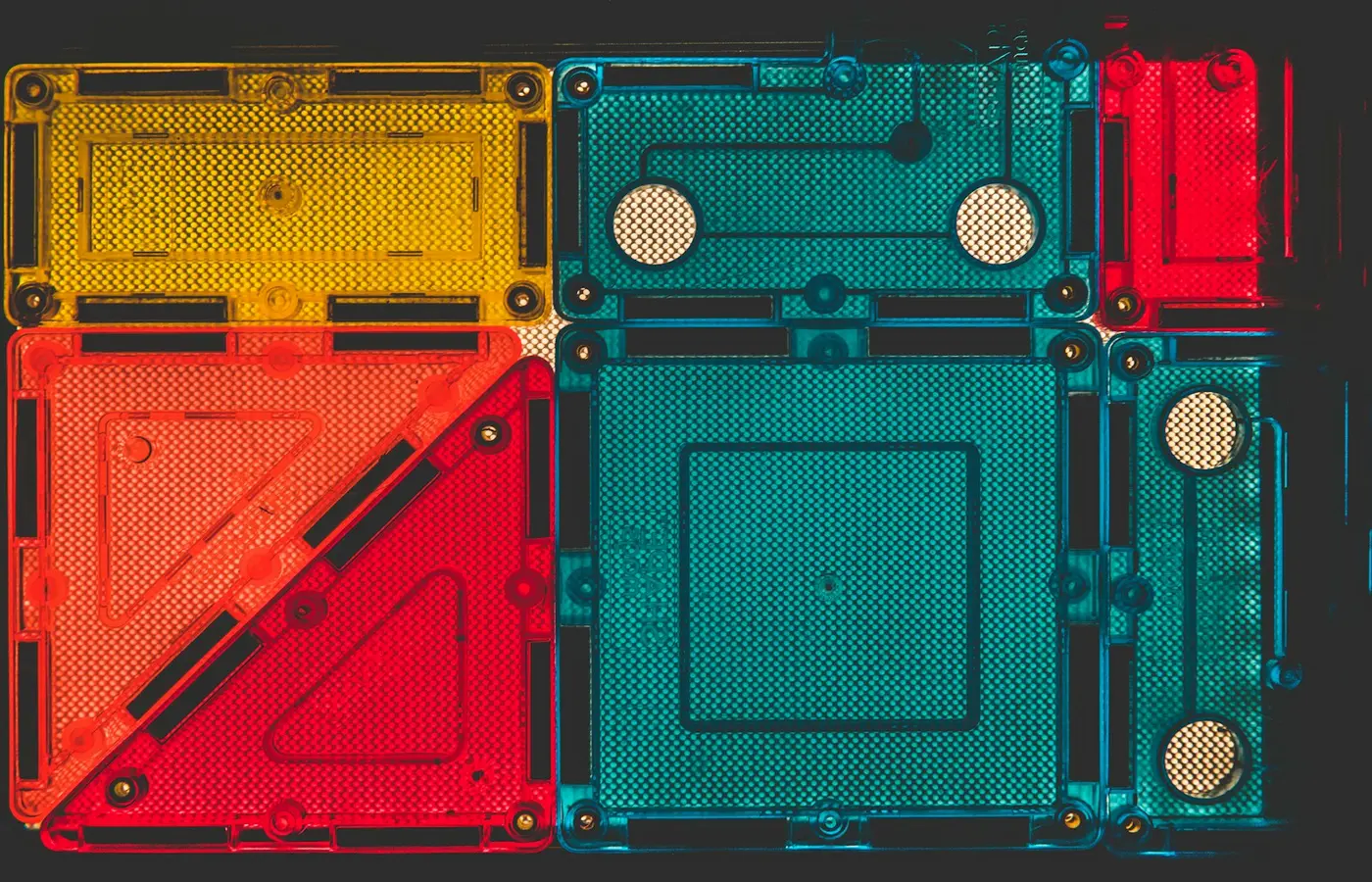

A child who unscrews every removable part, separates carefully built models, or wants to see what is behind each panel may be showing you the kind of play that interests them. You do not have to stop that curiosity—but you do need materials designed to handle it.
The quick selection rule is simple: choose a toy whose intended play includes opening, separating, unscrewing, inspecting, or rebuilding. Do not substitute an unwanted electronic device, appliance, or household object whose internal parts were never meant for children to access.
Before considering play value, read the exact age grade, warnings, and instructions for the model you are considering. Confirm which components are supposed to detach and whether the intended sequence can expose batteries, magnets, sharp edges, broken plastic, or unsuitable loose hardware. If the documentation is unclear, choose a simpler option.
Start with something designed to come apart
Taking apart a purpose-built construction set is different from prying open a toy with a sealed casing. In the first case, separation is part of the intended use. In the second, dismantling may defeat the features intended to keep internal components inaccessible.
Look for documentation that clearly shows the child doing the desired action. Depending on the product, that might include:
- Pulling apart large connected pieces
- Opening and closing reusable panels
- Turning oversized fasteners with an included tool
- Removing designated wheels, panels, or body sections
- Separating pieces and arranging them without rebuilding
- Reassembling parts in the same or a different permitted configuration
Packaging words such as “STEM,” “educational,” or “Montessori” do not answer the important questions. The instructions should identify what comes apart, how it comes apart, which tool is used, and what must remain closed.
You can also watch what your child is trying to do. A child who mainly pulls pieces apart may not need a detailed model with many screws. Someone fascinated by turning may prefer a few large reusable fasteners. A child who likes inspecting mechanisms may need visible, simple moving parts rather than access to a real motor or circuit board.
The closest match is often the least frustrating—and may require fewer pieces, less adult resetting, and less money.
Screen for inaccessible components before play value
A toy can have an appealing take-apart action and still be a poor fit for your child or household. Review the official instructions and warnings before offering it, especially when the product includes power, magnets, tools, or small hardware.
Batteries and powered parts
Find out whether the toy uses batteries or charging components. The documentation should make clear where the power source is located, how its compartment opens, and whether opening it is part of the child’s intended play.
A take-apart sequence should not provide unintended access to a battery compartment, wiring, charging cell, or electronic module. If a child can reach one of these areas after removing an intended panel, stop using the toy and consult the manufacturer rather than improvising a repair or new play mode.
Charging also adds household work. Consider whether the toy still supports the desired dismantling play when it is unpowered. A manual set may be a better fit if you do not want another cable, charging routine, or electronic component to monitor.
Magnets
Do not assume every magnetic connection is meant to be opened or removed. Check whether magnets are permanently enclosed or are documented as detachable play pieces. If a magnet becomes loose, breaks out of its housing, or appears where the instructions do not show a removable component, stop using the item and follow the manufacturer’s directions.
This distinction is especially important in a mixed-age home or when a child mouths objects, throws pieces, or shares a play area with someone who does.
Edges, points, and breakage
Inspect the toy in both its assembled and intended disassembled states. Look at the surfaces created when a panel, wheel, connector, or fastener comes off. The child should encounter only the parts and surfaces shown in the instructions.
Retire the toy from play if dismantling produces a crack, pointed fragment, exposed wire, splinter, or other unintended damage. Tape, glue, and replacement household screws can change how a toy behaves; do not use them as a substitute for product-specific repair instructions.
Screws and other loose pieces
Some take-apart toys use fasteners designed as reusable play pieces. Others contain structural screws that are not meant to be removed. The instructions—not the appearance of the screw—should determine which is which.
Before play, establish:
- Which pieces the child is intended to remove
- Whether the included tool is the only tool permitted
- Whether adult assembly or supervision is specified
- How many removable pieces should be present
- What to do if a fastener no longer tightens correctly
Do not give a child a household screwdriver to explore sealed toys. Keeping toy tools visually distinct from household tools can make the boundary easier to understand.
Match the action to the child’s readiness
The printed age grade and warnings are required starting points, but they cannot describe every child or setting. Within those conditions, consider how your child currently handles parts, tools, instructions, and frustration.
Readiness may look like being able to use the intended tool without forcing it, keep removable parts on the play surface, and stop when a component will not move as expected. A child does not need to rebuild a model independently for the toy to be worthwhile. Separating, inspecting, sorting, and asking an adult to reset it are all possible forms of play.
Choose according to the action your child seeks:
For pulling and separating
Start with large pieces connected by joints intended for repeated separation. Fewer pieces make it easier to see where everything went and reduce the adult work needed before another round.
For opening and closing
Look for reusable doors, latches, flaps, and panels that reveal ordinary play spaces rather than internal power or structural components. Check whether a latch can be reset without an adult taking the entire toy apart.
For turning fasteners
Choose a purpose-built set with the supplied tool and documented removable fasteners. Consider grip size, the force needed to turn, and whether each fastener stays attached or becomes a separate piece.
If tight turning regularly causes frustration, you might hold the base steady, begin loosening a permitted fastener, or switch to larger connectors. These are practical experiments, not developmental exercises the child must complete.
For sorting removed parts
A modest set with visibly different components may work better than a large kit. Sorting can be the play rather than preparation for a finished model. Use the categories the child notices—shape, color, imagined purpose, or simply “favorite pieces”—without requiring a correct system.
For inspecting how things move
Choose a toy that intentionally leaves its simple moving relationships visible. Gears, wheels, axles, or linkages should be accessible only in the way shown by the manufacturer. Curiosity about a mechanism does not make a real appliance or discarded electronic device an appropriate substitute.
Compare formats by the work they create at home
Broad toy categories vary, so verify every exact product separately. This comparison can help you decide which documentation and household details to examine.
| Format | Best-matched action | Check before choosing | Likely household work |
|---|---|---|---|
| Large-piece construction system | Pulling apart, connecting, rearranging | Age grade, component size, compatibility instructions | Floor space, sorting, finding pieces |
| Purpose-built take-apart model | Unscrewing, removing panels, rebuilding | Intended removable parts, included tool, power source, warnings | Resetting the model, tracking hardware |
| Reusable fastener board | Turning, matching, opening and closing | Fastener design, loose parts, mounting or stability instructions | Table space, collecting pieces |
| Simple modular mechanism | Inspecting movement, changing configurations | Intended access, enclosed components, assembly directions | Adult help with alignment or reset |
| Caregiver-made reusable setup | Separating, posting, sorting, arranging | Suitability of every material and connection | Preparation, close oversight, disposal |
A low piece count is not automatically better, but it is easier to manage. Before buying, imagine the toy fully dismantled. Where would every component go? Could you identify a missing critical part? Would rebuilding become your nightly job?
Noise matters too. Hard pieces dropped into a container can be loud, and tool play may involve repeated tapping or turning. A mat or folded towel may soften the sound and keep pieces from rolling, provided it does not interfere with stable use.
Set the boundary before the first screw comes out
Supervision is more useful when it is translated into a setup rather than repeated as “be careful.” Follow any supervision conditions in the product instructions, then add boundaries that fit your home.
A workable take-apart station might include:
- A table, tray, or defined section of floor
- A shallow container for removed pieces
- The product’s intended tool only
- A separate cup for designated fasteners
- A clear place for the instructions or an intact reference image
- Enough time to stop safely without rushing through reassembly
Keep household tools, damaged toys, spare batteries, unrelated hardware, and devices waiting for repair outside that space.
For a child who throws pieces or frequently carries them away, begin with fewer components and a contained play area. If objects are still being mouthed, use only products whose exact age grade, warnings, and detachable parts fit that situation. The presence of an older sibling does not make a set suitable for a younger child who can reach it.
If turning is difficult, stabilize the toy or offer a larger permitted grip when the manufacturer allows it. Do not extend a tool, drill a starter hole, substitute a sharper implement, or modify a compartment unless the official instructions explicitly provide for that action.
Stop the session if:
- An unintended compartment becomes accessible
- A designated part cracks or changes shape
- A magnet, battery component, wire, or internal fastener appears unexpectedly
- The included tool no longer fits correctly
- You cannot tell whether a loose piece belongs to the intended play system
- The play has moved beyond the level of supervision you can provide
Stopping is not a punishment. You can place the toy aside, check its documentation, and offer a simpler dismantling material.
Make parts control easy enough to maintain
A complicated inventory system may last one afternoon. Use the lightest method that lets you notice when an important piece is gone.
Try one or two of these:
- Photograph the complete set before first use.
- Keep each system in its own labeled container.
- Use a light-colored tray so small pieces are visible.
- Place removed screws directly into a divided cup.
- Store the included tool with the toy rather than with household tools.
- Keep incomplete or damaged sets in a separate adult-controlled location.
- Follow the manufacturer’s replacement-parts guidance rather than improvising hardware.
You do not need to count every interchangeable block after every session. Focus on components that the instructions identify as necessary, distinctive, or subject to inspection. If you cannot confirm that a set remains complete and usable as directed, pause it until you can.
Extend the interest without continually buying more
Novelty is not required. The same suitable set can support different questions on different days:
- Take off only one type of designated part.
- Arrange removed pieces in the order they came off.
- Use a photo of the intact model as an optional rebuilding reference.
- Build a permitted variation rather than restoring the original.
- Sort pieces before putting them away.
- Let the child explain what they think each visible part does.
- Reset only part of the toy and leave the rest dismantled for later.
Combine systems only when their instructions confirm compatibility. A connection that happens to fit may not be an intended use.
It is also fine if rebuilding never becomes the main attraction. A finished object is not the only sign that the material was engaging. Your household boundary can still require pieces to return to their container even when the model does not return to its original form.
Questions caregivers ask about take-apart play
Is it safe to let a child take apart an old electronic device?
Do not use an old electronic device as the default answer to dismantling interest. Unless the exact item is documented as a children’s product intended to be opened in that way, you cannot rely on its casing, internal components, battery access, edges, or breakage behavior being appropriate for play.
Offer a purpose-built manual model or construction system instead. Adults handling electronic repair or disposal should follow the instructions applicable to the exact device.
What if my child dismantles toys that are not designed to come apart?
Set a neutral boundary: “This one stays closed; this set is for taking apart.” Move sealed, damaged, or powered toys out of reach if the child repeatedly opens them, and make the permitted alternative easy to find.
If a toy has already been forced open, do not simply snap it together and return it to play. Set it aside until you can inspect it against the manufacturer’s instructions and determine whether it can still be used as intended.
How can I keep screws and removable pieces from getting lost?
Use a rimmed tray and one small cup for fasteners. Start with only the number of pieces needed for the current model, and photograph the complete set. If the instructions specify an inventory or inspection routine, follow that rather than creating your own threshold.
Choose captive pieces—parts designed to remain attached—when verified product documentation offers that feature and loose hardware would be hard to manage in your home.
When is a take-apart toy with tools appropriate?
Use the exact product’s age grade, warnings, and tool instructions as the first screen. Then consider whether your child can use the included tool as intended, keep track of detachable parts, and accept help or stop when something jams.
Available supervision matters as much as enthusiasm. If you cannot oversee the instructed activity today, a large-piece pull-apart set may be the better choice. You can revisit tool-based play later without treating the delay as a missed milestone.
The most useful next move is to observe the action your child repeats—pulling, opening, turning, sorting, or inspecting—then choose the simplest documented play system that permits that action while keeping everything else closed.