
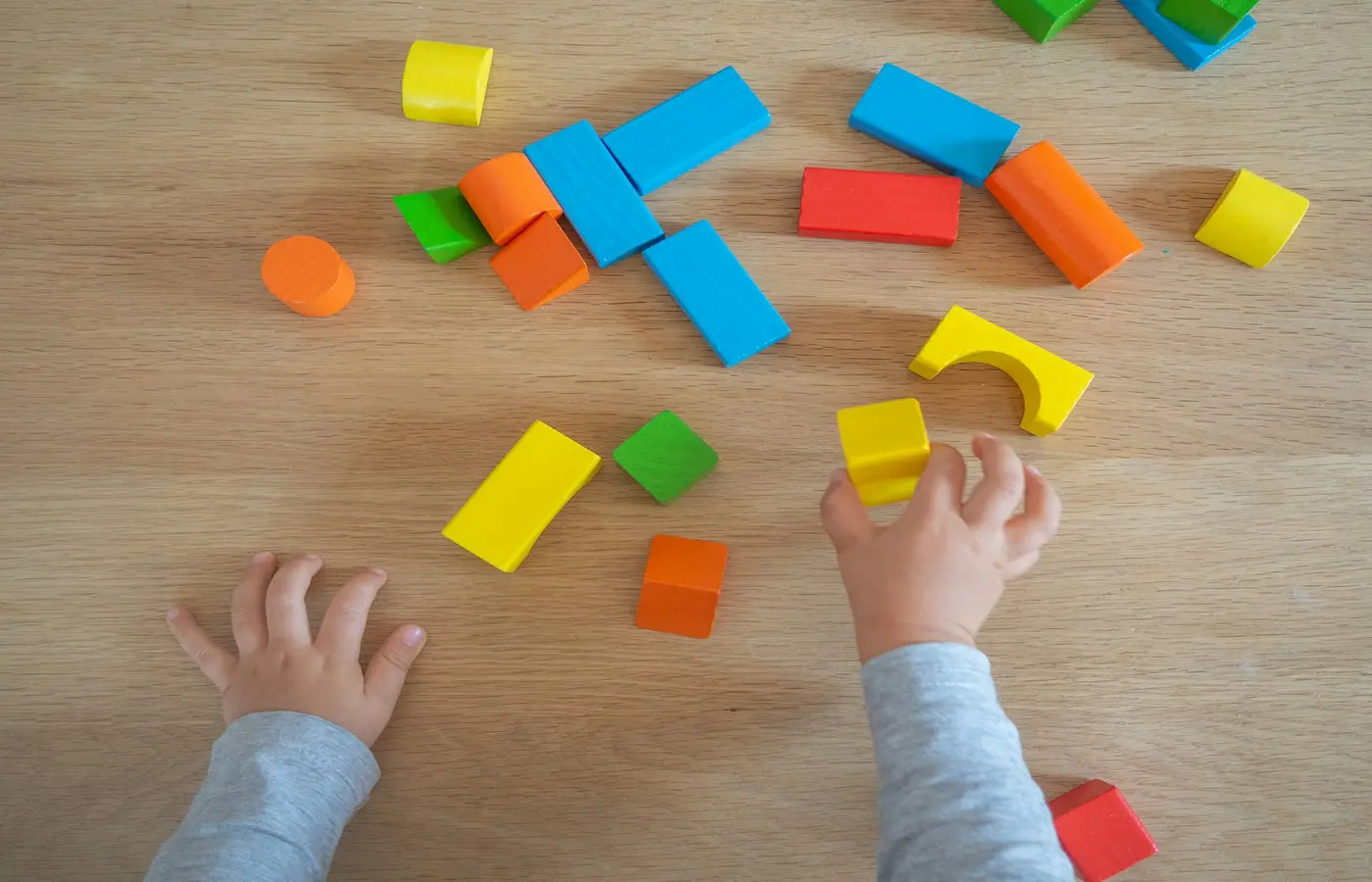
A crawling baby can reach a surprising amount of floor in a few minutes, including the tiny connector, wheel, brick, or figure accessory an older sibling dropped beside a build. If your older child enjoys small construction pieces, the practical goal is not to make them give up the set. It is to keep the baby’s access to those pieces genuinely separate.
For children under 3, small objects can present choking, aspiration, or ingestion hazards. The U.S. Consumer Product Safety Commission (CPSC) explains that its small-parts protections are intended to address those risks for young children. Health Canada also advises keeping small items out of reach of children under 3.
The most dependable household approach is a separate play location, followed by a short routine for bringing pieces out, pausing play, checking the area, and storing everything before the baby can enter. Watching closely matters, but it works best as support for a setup rather than the only thing standing between a baby and a loose piece.
Start with separation, not a promise to watch every piece
Small-piece construction play and a mobile baby can coexist in the same home, but usually not in the same accessible floor area at the same time. A baby does not need to be interested in the build to pick up a piece. Crawling, cruising, mouthing, and investigating what is under furniture are ordinary ways young children explore their surroundings.
The CPSC states that the small-parts ban is intended to prevent choking, inhalation, and swallowing hazards for children under 3. Under 16 CFR Part 1501, the regulatory context also includes components that can detach or break off during normal or reasonably foreseeable use. That is one reason an intact-looking set still needs a check for damaged pieces.
In everyday terms, plan around access:
- Can the baby physically get to the pieces?
- Could a piece roll, fall, or be carried outside the older child’s play area?
- If an adult needs to answer the door, make food, or change a diaper, does the separation still hold?
- Can the older child stop and pack up before the baby returns to shared floor space?
If the answer to those questions is uncertain, change the setup rather than relying on repeated reminders such as “keep it away from the baby.” Reminders can help an older child learn the family routine, but they are not a barrier.
Choose a play location the baby cannot enter
The best location is the one that creates real separation in your home without making the older child feel banished for enjoying their toys. There is no single room arrangement that works for every family, so assess the route a crawling baby can actually take.
A floor-based build in a shared living room is generally a poor match for a mobile baby in that same accessible space. Pieces spread during building, dismantling, searching, and imaginative play. Even a careful older child may not see a part that rolls under a sofa or sticks to a sock.
More workable options may include the following.
A separate room with a closed door
A room the baby cannot enter while the set is out can give an older child space to build and sort. This can be useful for a child working on a longer project, provided the adult can still offer the level of support the children need.
Before using the room, consider whether the older child can safely manage the arrangement, whether doors and hardware work as intended, and what will happen if they need help. A closed room is an access-control strategy, not a substitute for ordinary supervision of either child.
An elevated work surface that stays inaccessible
A table or desk may reduce the number of pieces on the floor, but it is only useful if the baby cannot reach the surface or pull materials down. Look beyond the tabletop: chairs, loose containers, dangling baseplates, and pieces dropped during play can all bring small items back within reach.
If you use a table, give the older child a tray, shallow bin, or work mat with a defined edge. The purpose is not to guarantee that nothing falls. It is to make loose pieces easier to see and collect before the baby enters the area.
A separate gated area, checked in your own home
Some families have a gated play area that keeps the baby away from an older child’s materials. Whether this is workable depends on the gate, the room layout, how each child uses the space, and whether loose pieces can travel beyond the boundary. Do not assume that a gate makes small pieces safe; treat it as one part of a setup that needs checking.
Health Canada recommends looking at a home from a child’s point of view, including getting down on hands and knees to identify hazards. That is a useful check after you establish any boundary: crawl or kneel along the baby’s likely route and look for gaps, fallen pieces, reachable containers, and objects under furniture.
Use the age label as a boundary, not an older sibling’s permission slip
An age grade or choking-hazard warning is about the child who might access the item, not only the child intended to build with it. An older sibling may be ready for a detailed set while a baby in the household is not ready to have any access to its pieces.
That distinction can be easy to miss in sibling homes. “It is my eight-year-old’s toy” does not answer the more important safety question: “Can my crawling baby reach it?”
Follow the manufacturer’s age guidance, warnings, assembly instructions, and maintenance information for the particular set. The ACCC’s babies’ toys guide similarly advises caregivers to check age-grading labels and follow product guidance for a child’s age, size, and development.
Avoid trying to use regulatory size rules as a home pass-or-fail test for individual pieces. The procedure in 16 CFR Part 1501 is a regulatory method, not a caregiver checklist. A practical home rule is simpler: if a set carries an age grade or warning indicating small-parts concerns and a child under 3 can access it, separate the child from the pieces.
Set up a short, repeatable sibling-play routine
A routine reduces the number of decisions you have to make while managing two children. It also gives the older child a clear role without asking them to carry all the responsibility for safety.
Try a sequence that fits your household:
- Choose the separate location first. Decide where the baby will be and where the building set will be before opening the container.
- Bring out only the pieces needed now. A whole collection spread across a room is harder to track than one set, tray, or small selection.
- Keep the container in the older child’s zone. An open bin on a shared floor invites pieces to migrate during play and transitions.
- Pause before a predictable interruption. Snacks, bathroom trips, diaper changes, school pickup, and bedtime are good moments to stop rather than leaving an open build behind.
- Store before shared access resumes. Put pieces away before the baby returns to the room or floor area.
For some families, it helps to make “pause and pack” part of the language of play rather than a punishment. The older child can save a build in a closed container, place it on an out-of-reach surface, or photograph it before dismantling it. An unfinished build does not need to stay on the floor to count as meaningful play.
If a child becomes frustrated by frequent pauses, consider reserving detailed sets for a time when another adult is available, the baby is asleep, or the older child can use a separate location. On more crowded days, larger-piece materials or another activity may simply fit the household better.
Make cleanup a safety check, not just a tidy-up
Cleanup matters because a small part can remain after the activity appears finished. It also matters because damaged components may create hazards that were not present when the set was intact.
Keep the end-of-play check calm and specific. You do not need to turn every session into a lengthy inspection. Focus on the places where pieces usually travel:
- the floor within and just outside the play boundary
- under tables, chairs, sofas, and shelves
- beside the baby’s usual crawling route
- inside blankets, cushions, clothing, and bags
- around the container, where parts may have spilled while packing
Then check the set itself. Look for cracked pieces, loose attachments, broken accessories, or components that have separated. The ACCC advises choosing sturdy, well-made toys and avoiding toys that look likely to break into small parts. If an item is broken, do not return it to the set until you have checked the product instructions or otherwise determined how it should be handled.
Close the container and store it out of the baby’s reach. Afterward, do the child-level scan again if play has moved into a shared room. Health Canada’s guidance is especially useful here: look from the young child’s point of view and remove small hazards you find.
Is playing at a table enough?
Sometimes, but not automatically. A table can be part of a safer setup when the baby cannot access the building surface and loose pieces are collected before the baby enters the area. It is not enough if pieces are routinely dropped, if the baby can pull on the table or reach a chair, or if the open container ends up on the floor.
Think of the table as a work surface, not a complete safety plan. Add a contained tray, a defined storage place, and a pause-and-check routine. If those pieces are hard to manage in the moment, choose a different activity for that time.
What to do with an unfinished build
When the baby needs the room, the safest practical choice is to remove access to both the build and its loose pieces. Depending on the set and your space, that may mean:
- placing the build and remaining pieces in a closed container and storing it out of reach
- moving the project to a separate room before the baby enters
- putting the materials away and returning to the project later
Avoid treating a partly completed build on a low coffee table, rug, or open shelf as safely “out of the way.” A crawling baby may reach it, pull it down, or find a piece that has already fallen nearby.
When the setup is not working, pause the small-piece set
A routine should make family life easier, not create constant conflict. If the separation keeps breaking down, pausing the set is a reasonable safety decision, not a failure by the older child or caregiver.
Put small-piece play away for now when:
- the baby can enter the play zone or reach the materials
- an adult needs to leave the area and the separation cannot be maintained
- pieces are spreading beyond the boundary faster than they can be collected
- the older child is too absorbed, tired, or frustrated to manage the pack-up routine
- shared floor time needs to begin before cleanup can happen
- broken pieces or missing components turn up during play
Choose a different option for that moment: larger-piece construction materials, drawing, books, pretend play, or a building activity in a separate location. The goal is not to make every toy available all day. It is to match the materials to the space, supervision, and children who are present.
A useful selection rule is this: if you cannot confidently keep the baby from reaching the pieces and cannot complete a quick cleanup before shared access resumes, save the small-piece set for another time or place.
Sources and research note
This guide addresses household access management for small construction pieces. It does not replace a specific product’s instructions, age grade, warning label, maintenance guidance, or recall information.
- U.S. Consumer Product Safety Commission: Small Parts and Choking Hazard Labeling FAQs
- Electronic Code of Federal Regulations: 16 CFR Part 1501, small-parts hazards for children under 3
- Health Canada: Is Your Child Safe? Play Time
- ACCC Product Safety: Babies’ toys guide
- U.S. Consumer Product Safety Commission: For Kids’ Sake — Think Toy Safety