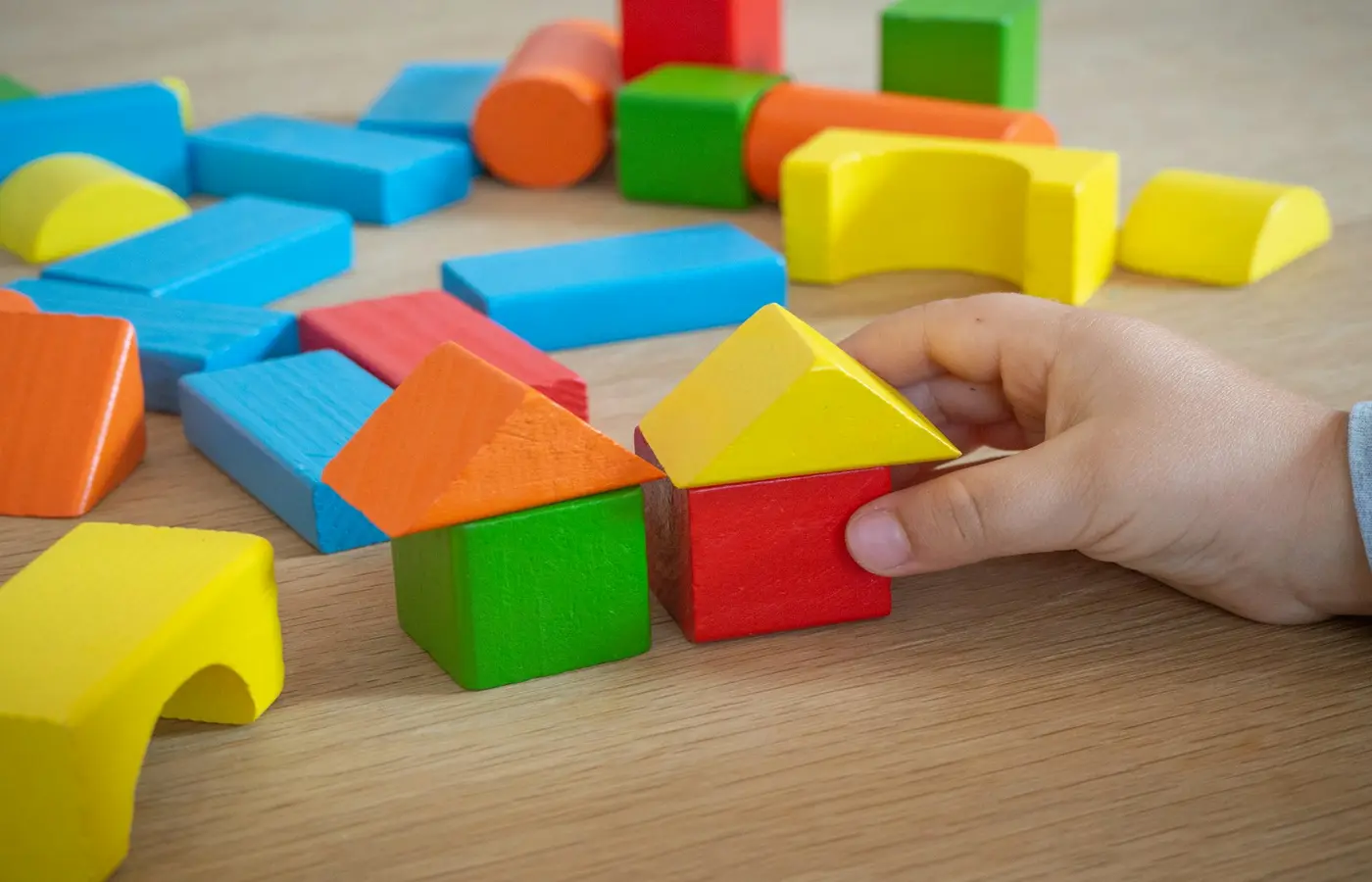
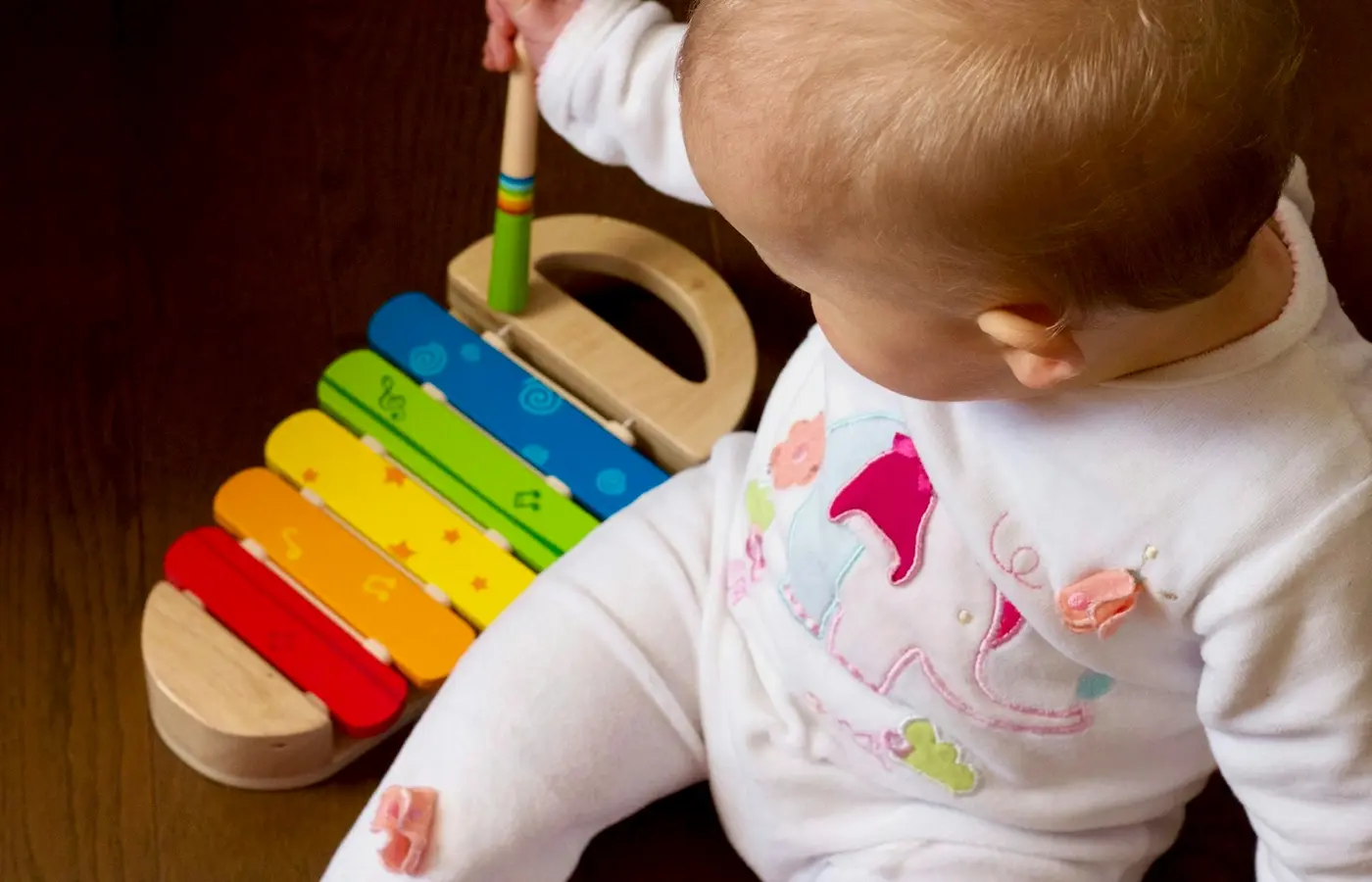
A baby who mouths, drops, bangs, turns over, and repeatedly studies a toy is doing ordinary early exploration. The useful question is not whether wood is a “better” material, but whether this specific toy is designed, labeled, and still in good enough condition for that kind of use.
For babies, start with the manufacturer’s age grade and warnings. Then check the toy’s size, shape, attached parts, edges, paint or finish information, and condition after it has been chewed or dropped. A wooden toy can be a reasonable option when it is intact and appropriate for the baby using it. Wood alone does not make a toy safe.
If a toy is cracked, splintered, chipped, shedding paint, or developing a loose part, take it out of use rather than hoping it will hold together for one more play session.
Start with how your baby explores right now
Babies often explore objects with their whole bodies. They may grip a piece briefly, bring it to their mouth, knock it against the floor, release it from a high chair, or pass it from hand to hand. The same toy may be used very differently by a younger baby, a mobile baby, and an older toddler.
That is why a toy’s stated age grade matters. Age grades are safety guidance, not a test of whether your baby is advanced enough for a particular toy. They are intended to reflect safety factors including the skills children commonly have at different ages. Seattle Children’s advises choosing toys that match a child’s age and skills.
For a baby who mouths objects, look beyond an attractive shape or a “natural” label. Ask:
- Is this toy specifically labeled for my baby’s age range?
- Does it have parts that could loosen with chewing, pulling, or repeated drops?
- Are there narrow ends, projections, or openings that concern me when I imagine the toy in my baby’s mouth?
- Does it still look and feel smooth and intact?
- Can I supervise this toy’s use in the places where my baby is likely to use it?
You do not need a large collection to meet this moment. A few objects you can inspect easily may be more manageable than a basket of decorative toys with many small details.
Check the label and product information before the material
A wooden toy may be painted, stained, sealed, glued, assembled with hardware, or made from several materials. “Wooden” tells you what some of the object is made from; it does not answer every safety question.
Before bringing a new toy home, look at the packaging or official product information for:
- The recommended age and any warnings
- The maker or manufacturer identification
- Directions for intended use, assembly, care, or cleaning
- Information about components, coatings, or finishes when the maker provides it
- Any instructions about inspection, replacement, or parts
Treat an age grade as an important starting point, not a guarantee. A toy labeled for a particular age still needs adult judgment about the individual child, the toy’s condition, and the setting. A baby who mouths every object may need closer supervision with a toy than an older child who uses the same item differently.
In the United States, certain children’s products are subject to mandatory small-parts requirements under 16 C.F.R. part 1501, described in CPSC toy safety business guidance. That regulatory context is useful, but it does not replace reading the age label and warnings for the exact toy in front of you.
A retailer’s age filter, an “educational” badge, or a general brand statement is not the same as product-specific documentation. If information about a toy’s intended age or construction is missing or unclear, it is reasonable to skip it—especially for a baby who will put it in their mouth.
Look for a baby-safe shape and secure construction
Before offering a wooden toy, inspect it as a baby might investigate it: pull at details, rub a finger along seams, and look at the object from all sides. You are not trying to prove that a toy is risk-free. You are looking for obvious reasons it may not suit a child who mouths, drops, and bangs it.
Nemours KidsHealth recommends that toys for babies and toddlers be unbreakable and strong enough to withstand chewing. Its guidance also says to avoid sharp ends and small parts—such as eyes, wheels, or buttons—that could be pulled loose.
Check for parts that could detach
Some wooden toys include glued-on eyes, wooden pegs, wheels, fabric accents, bells, elastic cords, magnets, or decorative buttons. These may be appropriate only for children above a stated age, or only when the item remains sound and is used as instructed.
For a baby who mouths toys, pause over any part that appears attached rather than formed from one solid piece. Check whether it moves, lifts, twists, or has gaps around it. Do not assume that a detail is secure simply because it looked secure when the toy was new.
The CPSC’s guidance notes that mouth-actuated toys intended for children under 3 must not release loose components when subjected to the applicable test. That does not mean every object a baby may mouth is a mouth-actuated toy, but it underlines why loose components deserve attention.
Check ends, corners, and projections
Run clean fingers slowly over the toy’s edges and around holes, handles, cutouts, and joins. Look for:
- Sharp points or rough corners
- Narrow protrusions or ends
- Cracks around handles, wheels, knobs, or seams
- Openings that could catch a finger or make cleaning difficult
- Areas where glue, paint, or a coating appears to be lifting
A smooth-looking toy may still have a rough point at a seam or an edge that became damaged after a hard drop. If the form seems unsuitable for mouthing, choose another object rather than trying to make it work for a baby stage it was not designed for.
Inspect the surface every time the toy changes
Wood can change with use. Repeated chewing, moisture, knocks against hard floors, and contact with other toys can affect the surface. A quick check before play becomes especially useful after a toy has been dropped, washed, stored in a damp place, or used by another child.
Look for splinters, cracks, dents with rough edges, lifting paint, chipped coatings, and loosened attachments. Nemours KidsHealth specifically advises that wooden toys should not have splinters and recommends checking toys regularly for damage.
A simple condition check can take less than a minute:
- Look closely. Check all sides in good light, including the underside and around attached pieces.
- Feel the surface. Run your fingers over edges, joins, and areas your baby has chewed.
- Check what moves. Gently examine wheels, pegs, strings, and decorative pieces without forcing them.
- Notice what changed. Compare the toy with how it looked when it was sound: new cracks, roughness, missing pieces, or exposed layers all matter.
- Remove damaged toys from circulation. Put them somewhere a child cannot retrieve them while you decide whether the manufacturer offers a safe, specific remedy.
Avoid assuming that a broad term such as “non-toxic” tells you all you need to know about a paint, stain, sealant, or finish. It is a marketing phrase unless it is backed by exact information for that product. Likewise, do not infer that a toy meets a particular standard from a retailer description or a logo without product-specific documentation.
Older wooden toys need extra caution. Seattle Children’s advises avoiding old wooden toys with chipped paint because the paint may contain lead. If a secondhand toy has chipped, unknown, or deteriorating paint or finish, it is not a good candidate for a baby who mouths objects.
Plan for drops, banging, cleanup, and supervision
A toy can be in good condition at breakfast and become unsuitable after an energetic drop onto tile. That does not mean babies should never bang or release toys; those are common ways of exploring cause and effect, sound, and movement. It means the adult’s job includes checking what the toy becomes after that use.
Seattle Children’s notes that no toy is totally safe and that toys can become dangerous when broken or misused. For wooden toys, the practical concern is often what happens after impact: a new crack, a split seam, a loosened part, or a roughened edge.
Make the play setting easier to manage
A few small adjustments can reduce avoidable problems:
- Offer hard wooden objects on a play mat or other softer surface when practical.
- Keep baby toys separate from small-piece toys used by older siblings.
- Pick up dropped toys before a baby mouths them again if they have landed near pet bowls, outdoor shoes, or visibly dirty areas.
- Keep a small “check later” basket or shelf for toys that need inspection after a hard fall.
- Rotate a limited number of sturdy, age-appropriate objects rather than leaving every toy available at once.
These are not rules for perfect play. They are ways to make it easier to notice when an object needs to leave the play area.
Cleaning is not the same as restoring a damaged toy
Follow the manufacturer’s care instructions when they are available. If a toy’s construction or finish is damaged, cleaning it does not necessarily make it suitable for mouthing again. A crack may hold moisture or create a rough edge; a chipped painted area may expose an unknown layer; a loose feature may become more unstable with further use.
The available pediatric guidance supports promptly discarding or repairing broken toys. For a baby’s wooden toy, however, do not rely on an improvised home repair unless the manufacturer provides instructions that apply to the specific product. A repair that looks neat may not restore the toy’s original construction or make it appropriate for mouthing.
Secondhand wooden toys need a higher bar
A used wooden toy can be appealing because it is inexpensive, sentimental, or already in the home. But a baby’s mouthing stage calls for a careful condition and information check.
Consider passing on a secondhand wooden toy when:
- The age grade, maker, or original intended use is unknown
- Paint, stain, or finish is chipped, worn, sticky, or unidentified
- Parts have been reglued, replaced, or altered
- There are cracks, splinters, deep dents, or loose components
- The toy has small decorative details that could detach
- You cannot tell whether it was made as a toy or as a decoration
This is not a judgment on family hand-me-downs. It is simply an acknowledgment that a baby who mouths and drops toys needs a different level of certainty than an older child using an object for pretend play on a shelf or table.
A simple selection rule for wooden toys for babies
Choose a wooden toy for a baby only when all of these are true:
- Its stated age grade and warnings fit your baby’s current stage of use.
- It has no concerning small, loose, or easily detachable parts.
- Its shape has no sharp ends, rough projections, or features that worry you for mouthing.
- The wood, edges, paint, and finish are smooth and undamaged.
- You have enough official information to understand what the toy is and how it is intended to be used.
- You can inspect it regularly and supervise it in your home.
If one of those answers is unclear, you do not need to solve the uncertainty by buying it anyway. Choose a simpler object, wait until the toy better fits your child’s stage, or leave it out of the play rotation.
The most useful wooden toy is not necessarily the most elaborate one. For a baby who is busy carrying, mouthing, dropping, and banging, a suitable toy is one that is age-appropriate, intact, easy to inspect, and uncomplicated enough for you to manage calmly.
Sources and research note
This guide uses general toy-safety guidance rather than claims about developmental benefits of wooden toys. Product-specific statements about paint, finishes, materials, certifications, testing, or regulatory compliance should be confirmed through exact manufacturer documentation for the individual toy.
- U.S. Consumer Product Safety Commission: Toy Safety Business Guidance — Regulatory context on toy requirements, including small-parts provisions for certain children’s products.
- Seattle Children’s: Toy Safety — Pediatric safety guidance on age grading, maintaining toys, and avoiding old wooden toys with chipped paint.
- Nemours KidsHealth: Choosing Safe Toys for Toddlers and Preschoolers — Pediatric guidance relevant to baby and toddler toy construction, chewing resistance, loose parts, sharp ends, splinters, and regular toy checks.
- The Toy Association: Statement on Toy Safety, Age Grading and Small Parts — Industry context on caregiver attention to age grading and small-parts considerations; this is not independent regulatory guidance.