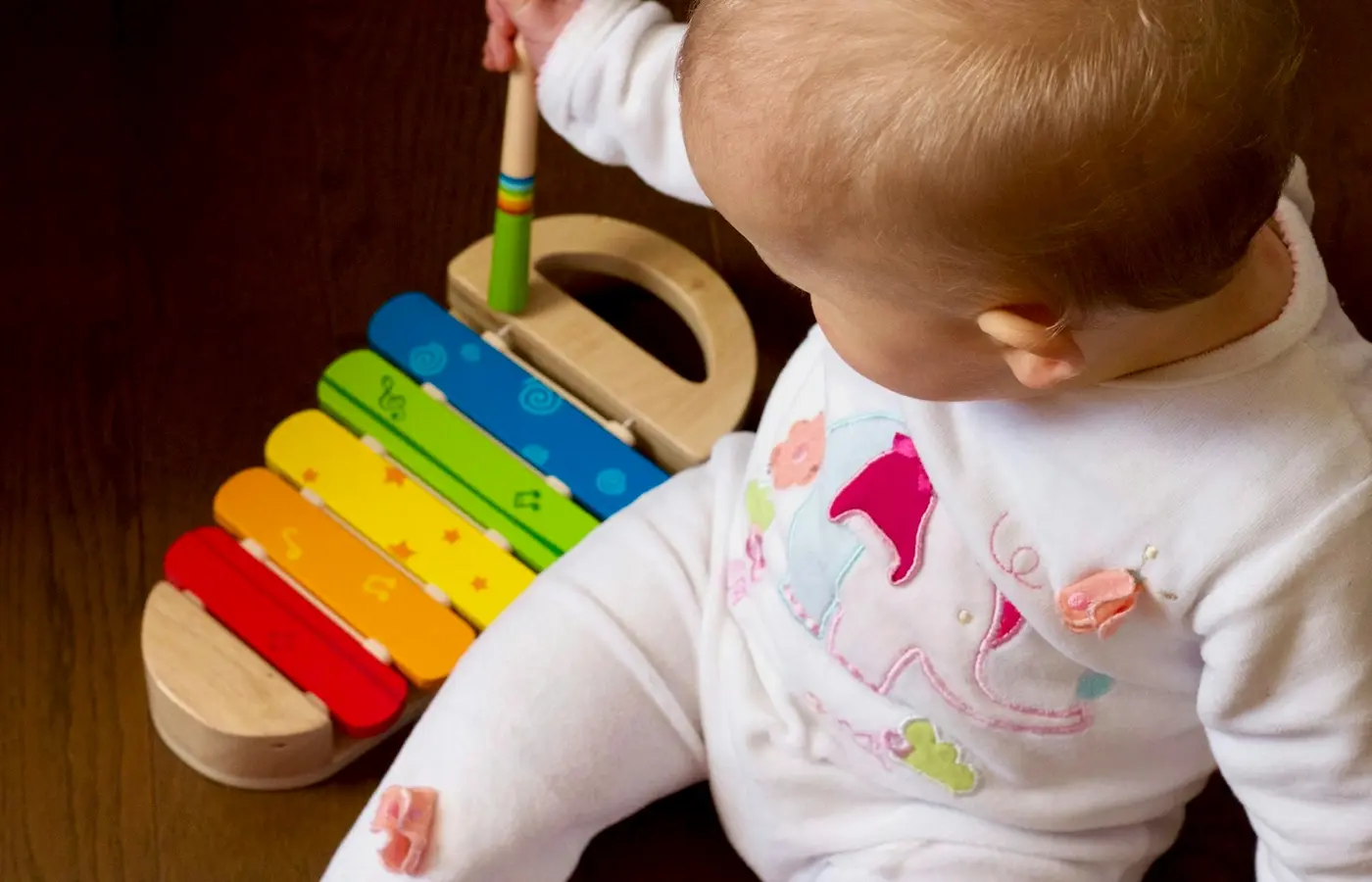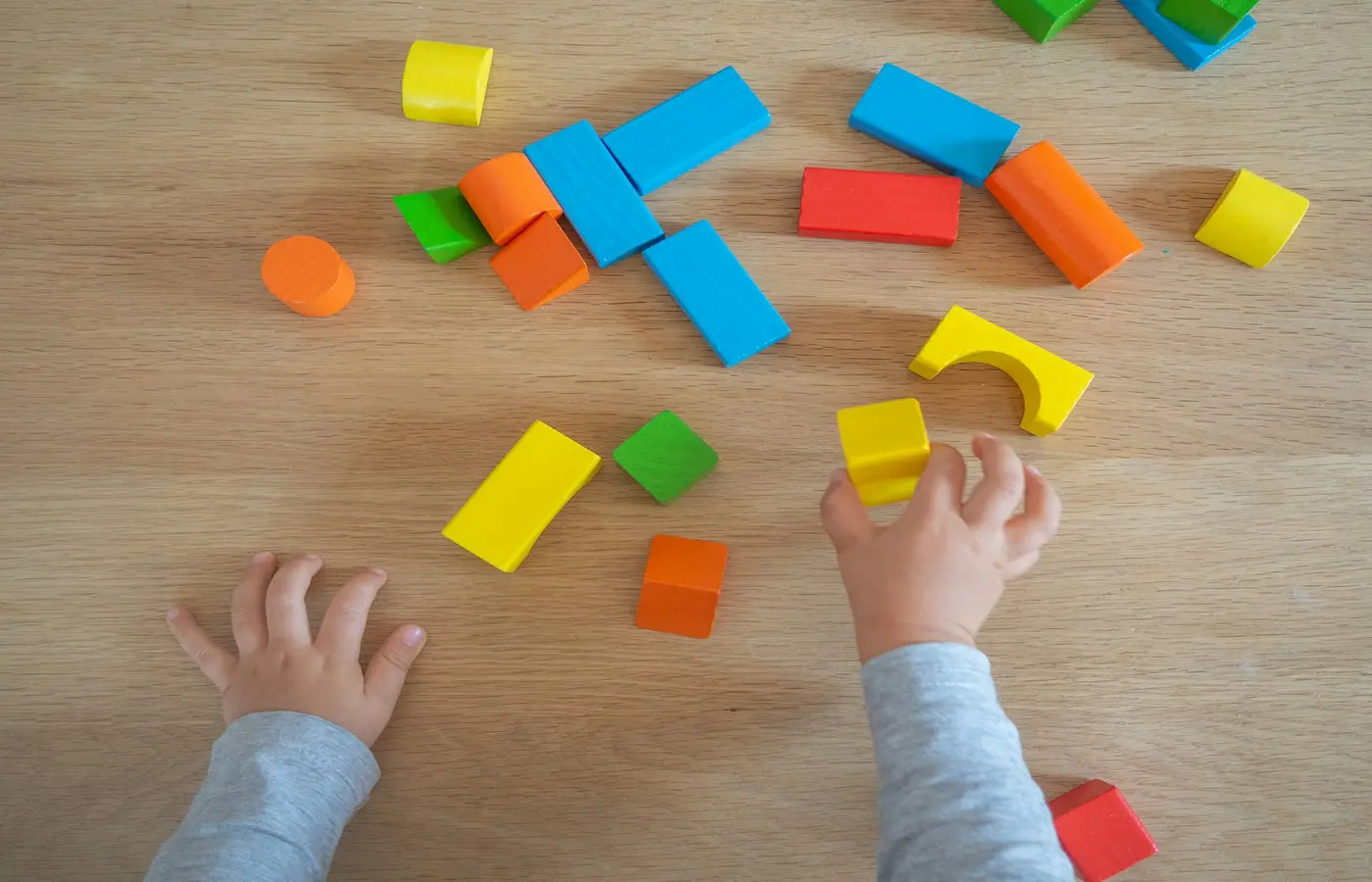
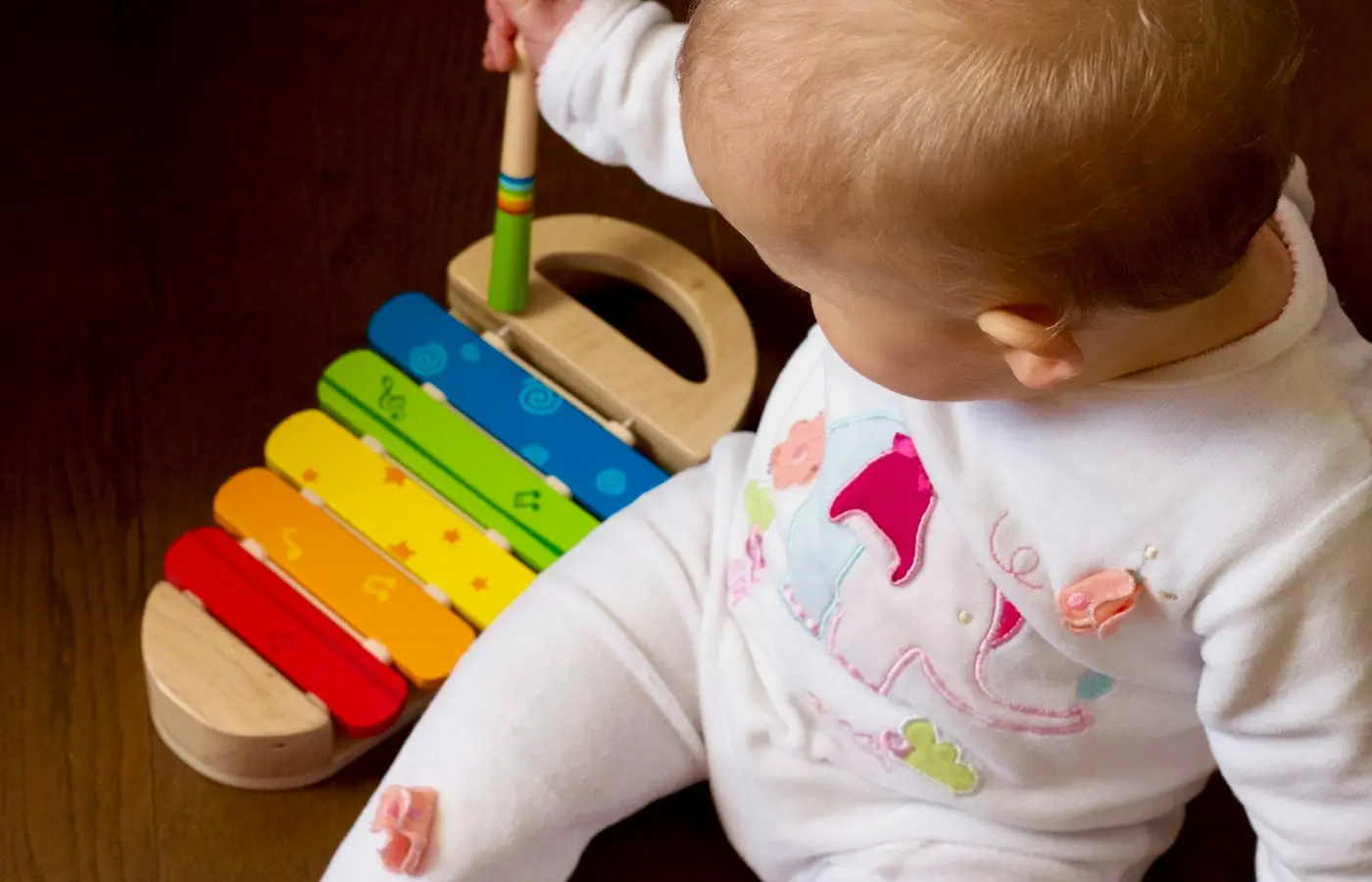
A baby who mouths, chews, bangs, drops, and carries toys needs more than a toy made from a material that looks natural. A wooden toy can be a workable choice, but wood alone does not tell you whether that particular object is suitable for a baby.
Start with the exact toy’s age grade, warnings, and care instructions. Then look closely at its whole construction: its size and shape, any attached pieces, joints, surface condition, coatings, and whether you can keep it in usable condition in your home. If the information is vague, the toy is damaged, or you are unsure how it will hold up to your child’s current style of play, it is reasonable to leave it for later.
Supervision still matters. A toy intended for babies can be dropped, chewed, soaked with saliva, or damaged in ways that change its condition over time.
Start with the age grade and your baby’s current way of using toys
Age labels are a first screen, not a prediction of what every child should be doing. They help identify the manufacturer’s intended user group and may point you toward relevant warnings or supervision directions.
Before bringing home a wooden toy, find the age grade on the packaging, the manufacturer’s product page, or the instructions for that exact model. Look for clear answers to these questions:
- Is the toy intended for babies, or is it marked for older children?
- Does the manufacturer include warnings about small parts, cords, magnets, or adult assembly?
- Does it give care or cleaning instructions?
- Does the description show all included pieces, including removable accessories?
- Is the product information for the version sold in your market?
A baby may use a toy very differently from an older sibling. A set made for arranging wooden animals on a shelf, for example, may include small figures, detachable decorations, or accessories that do not suit a child who explores by putting the entire item in their mouth.
This is why a beautiful wooden object is not automatically a baby toy. A decorative block, a handmade keepsake, a dollhouse accessory, or a toy intended for a preschooler may be made of wood and still be the wrong fit for a mouthing baby.
Choose for the use you expect now: holding, mouthing, dropping, shaking, banging, and passing from hand to hand. Later, the same child may be ready to sort, stack, connect, pretend with, or build more elaborate wooden materials. There is no need to hurry that transition.
Check the whole object before focusing on the finish
When a caregiver is worried about mouthing, it is easy to focus only on paint or varnish. Coatings matter, but the physical object deserves attention first.
Look at the toy as your baby will encounter it—not just as it appears in a product photo. A safe-looking main piece can still have an attached bead, wheel, peg, cord, fabric loop, metal fastener, or glued-on decoration that changes the risk.
Look for pieces that could detach
Before each use, check whether anything appears loose or likely to work free. Pay particular attention to:
- Beads, knobs, pegs, wheels, and wooden balls
- Glued-on eyes, ears, letters, shapes, or decorations
- Metal hardware, screws, pins, or staples
- Cord loops, elastic, ribbons, and straps
- Magnets or magnetic pieces
- Removable lids, inserts, puzzle pieces, and accessories
Do not try to judge suitability by guessing whether a piece seems “big enough.” The relevant requirements can vary by product and market, and a caregiver cannot confirm compliance with a visual check alone. Instead, use the age grade and warnings for the specific toy, then remove the toy from use if a component becomes loose, exposed, or damaged.
A simpler object is often easier to evaluate. For a baby who mouths toys, a solid, age-graded piece with few attachments may give you fewer parts to monitor than a more detailed toy with many decorative elements.
Notice openings, handles, and unusual shapes
Also consider how the toy’s form works with your baby’s current habits. A baby may attempt to mouth a handle, push a finger into an opening, or try to fit a narrow end farther into their mouth than you expected.
You do not need to diagnose every possible hazard at home. The useful question is more practical: does this object have an unusual shape, opening, cord, or attached component that makes you uncertain about how it will be used? If so, choose something with clearer documentation and a more straightforward design.
Inspect construction and surface condition regularly
A toy that looked sound when new can change after repeated drops, chewing, moisture, or cleaning. Wood can dent, crack, swell, roughen, or split. Coatings and glue can also wear over time.
You cannot certify a toy’s safety through a home inspection, but you can spot obvious changes that mean it should be set aside.
Before offering a wooden toy to a mouthing baby, run your eyes and fingertips over it. Check for:
- Cracks, splits, chips, or lifting layers
- Splinters or rough patches
- Sharp corners, edges, or broken areas
- Loose joints or separation at glued seams
- Wobbly wheels, pegs, handles, or decorative pieces
- Flaking paint, lifting varnish, or peeling decals
- Swelling, warping, or softened wood after getting wet
- Visible hardware that was previously covered or recessed
If the toy fails this basic check, take it out of rotation. Do not assume that a quick repair with household glue, tape, paint, or finish restores it to its original condition. A repair may introduce a new weak point or make it harder to know how the finished object will behave when chewed and cleaned.
It can help to keep a small “not for baby” basket rather than making a final decision immediately. A damaged toy may be unsuitable for mouthing now but may be worth revisiting only if the manufacturer gives a clear, appropriate remedy—or when the child is older and uses it differently. If you cannot confirm that, replacement or disposal is often the simpler choice.
Treat paint, stains, and coatings as product-specific questions
Words such as “natural,” “unfinished,” “non-toxic,” “water-based,” and “food-grade” can sound reassuring. They are not a complete safety answer.
A label about a coating does not tell you whether the toy has durable construction, detachable parts, an appropriate age grade, or cleaning instructions. Nor does a bare-wood appearance tell you what materials, adhesives, dyes, preservatives, or treatments may have been used in the finished product.
Instead of relying on a broad marketing term, look for documentation from the manufacturer about the exact toy. Useful information may include:
- The recommended age range and warnings
- The materials used in the finished product
- Whether the item is painted, stained, sealed, dyed, or left without a surface coating
- Any compliance statement that identifies the product or market
- Care instructions that address ordinary cleaning and drying
- A way to contact the manufacturer with a product-specific question
If a seller says only that a toy is “safe,” “eco-friendly,” or “non-toxic” without giving an age grade, warnings, or care details, that leaves important questions unanswered. It does not mean the toy is necessarily unsafe; it means you have less information for deciding whether it suits a baby who mouths toys.
In the United States, toy-safety discussions often refer to ASTM F963, a toy-safety standard that addresses a range of toy hazards. But a general statement that a brand or product is “ASTM compliant” should not replace checking the age grade, included parts, instructions, and present condition of the exact toy in front of you. A standard or testing claim also cannot guarantee that a toy will remain undamaged after repeated chewing, dropping, or soaking.
Cleaning is part of whether a toy works for your home
For a mouthing baby, cleaning is not an afterthought. If you cannot maintain a toy according to its instructions, it may not be a practical choice right now.
Do not assume all wooden toys can be treated the same way. Some may tolerate a damp wipe; others may have specific limits around soaking, dishwashers, disinfectants, or cleaning products. Prolonged moisture can affect wood, glued joints, paint, and protective coatings.
Follow the maker’s instructions for that model. If instructions are not available, ask the manufacturer before using a cleaning method that could change the surface or construction.
After cleaning, allow the toy to dry as directed and inspect it again. Set it aside if you notice:
- Raised grain or a newly rough surface
- Cracking, swelling, or warping
- Paint or varnish lifting away
- A glued piece loosening
- A joint opening or hardware becoming exposed
A toy does not need to be difficult to clean to be a poor fit. Sometimes the most practical option is simply a different toy—one with clearer care information, fewer seams, or a construction that is easier for you to inspect.
A simple yes-or-not-yet decision
Before offering a wooden toy to a baby who puts things in their mouth, use this short check.
Choose it now only when you can answer yes to all of these:
- The exact toy is age-graded for your baby’s stage of use. You have read its warnings and know whether it is intended for babies.
- The full object looks sound. Nothing is loose, cracked, splintered, peeling, rough, or exposed.
- There are no questionable attachments or accessories. You have considered the whole set, not just the largest piece.
- The surface is intact. Paint, stain, sealant, and glue are not lifting or deteriorating.
- You can find usable care information. The manufacturer explains how to clean and maintain the toy.
- You can supervise and recheck it. The toy fits your household’s routines, including floor mess, pets, older siblings, and regular inspection.
If one of those answers is no—or even “I am not sure”—make the decision easier: choose another option or save this toy for later. You do not need to find the perfect material. You need a toy whose intended age, condition, construction, and care instructions make sense for the child using it today.
Common questions about wooden toys and mouthing
Are unfinished wooden toys safer for babies who mouth toys?
Not automatically. “Unfinished” may describe appearance rather than the complete manufacturing process, and it does not answer questions about size, construction, adhesives, damage, age grading, or cleaning. Use the manufacturer’s documentation for the exact product, and inspect the toy’s present condition.
How often should I inspect a wooden toy a baby chews?
Check it before offering it and after events likely to affect its condition, such as a hard drop, a period of heavy chewing, getting wet, or cleaning. A quick regular look is more useful than waiting for obvious breakage.
Can I wash a wooden baby toy with soap and water?
Only if the manufacturer’s instructions permit that method. Wooden toys vary in their coatings, glued joints, and care requirements. Avoid assuming that soaking, dishwashing, sanitizing products, or a particular household cleaner is suitable without product-specific directions.
What should I do if paint, varnish, or a glued piece starts to lift?
Remove the toy from use. Do not let a baby continue to mouth an item with a changing surface or loose component. Check the manufacturer’s instructions or contact the manufacturer for guidance; if a safe remedy is not clear, replace the toy or reserve it for a later stage only if that is appropriate.
Sources and research note
The available research package for this guide included limited primary regulatory and manufacturer documentation. For that reason, this article focuses on practical evaluation, following the exact manufacturer’s instructions, and setting aside damaged toys rather than making broad claims about particular woods, coatings, or certifications.
- Oddblocks: Wooden Toy Safety Certifications Explained — background discussion of ASTM F963 and toy-safety topics; this is a commercial source and should not replace product-specific documentation or applicable regulatory guidance.
- Playroom Collective: Wooden Toys Safety Guide — general retailer guidance on checking construction, age suitability, and surface condition; use as context rather than as proof that an individual product is appropriate.
- Sawdust Journey: Toy-Safe and Crib-Safe Wood Finishes — background discussion of finishes and untreated wood; legal and compliance questions should be confirmed through current primary sources and the documentation for the specific product and market.