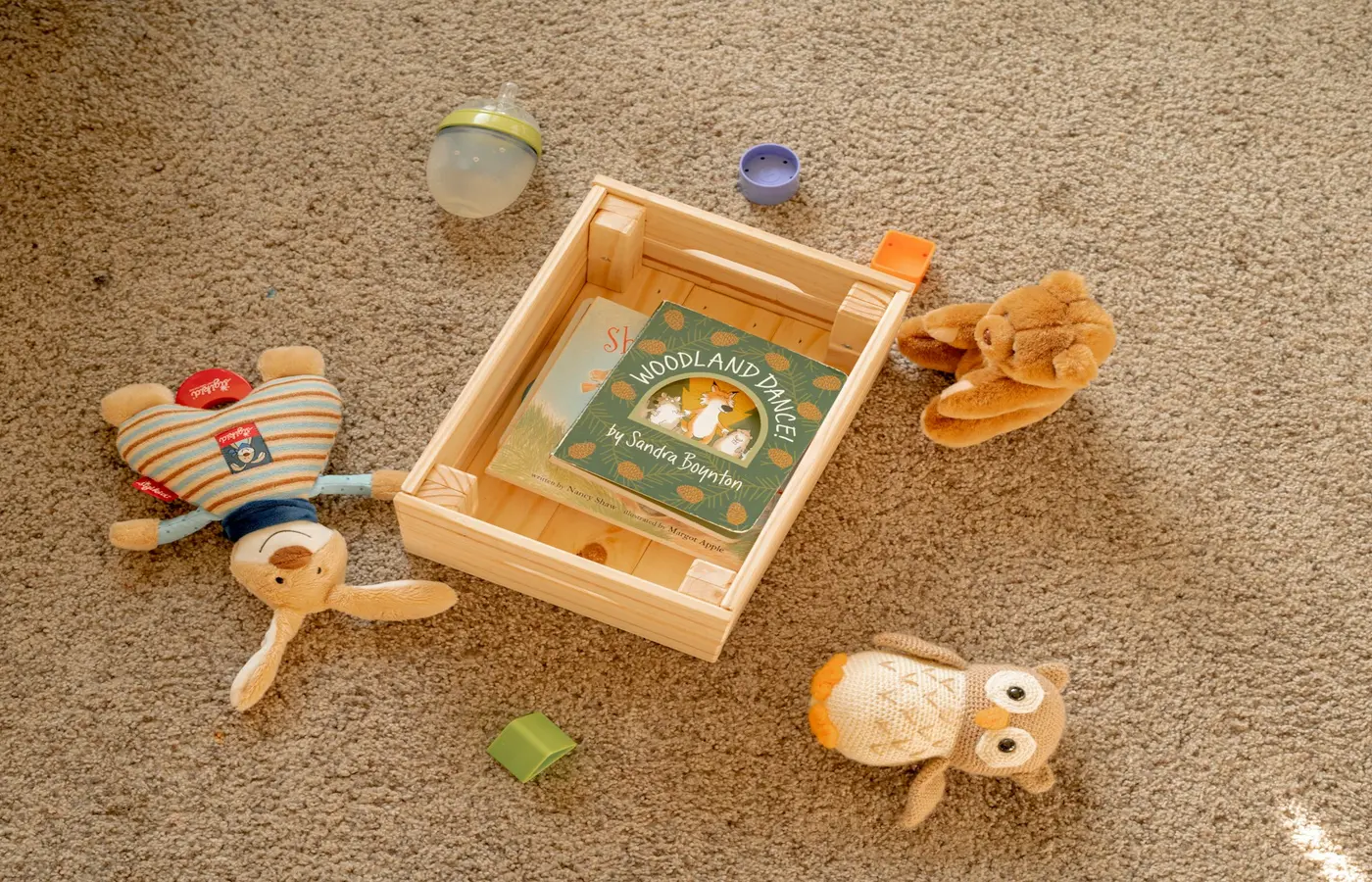
A 2-year-old does not need a full play kitchen, market stand, or doctor’s office to begin pretending. A few large, familiar, age-graded props can be enough for short routines such as feeding a doll, stirring an empty bowl, putting an animal to bed, or talking on a toy phone.
For a small home, the useful goal is not to build a miniature room. It is to choose a compact set of props your child can hold, carry, return to a basket, and use in more than one simple scene. Start with safety: follow the exact manufacturer age grade and warnings for each item, inspect toys regularly for damage or detachable pieces, and keep any item that is not appropriate for a child who mouths objects out of reach.
Early pretend play can be brief, repetitive, and closely tied to what a child sees at home. That is a normal way to play, not a sign that you need more equipment or a more elaborate setup.
Start with a routine your child already notices
A useful first question is not, “Which pretend-play set should I buy?” Try asking: “What does my child already watch us do?”
At this age, a child may be interested in everyday actions such as eating, caring for a baby, making a phone call, tidying, shopping, bathing a stuffed animal, or putting something to sleep. Seattle Children’s guidance for 1- and 2-year-olds describes play materials that suit this period as simple, hands-on, and appropriate for a child’s stage.
You might notice your child:
- putting a spoon near a doll’s mouth
- carrying a stuffed animal from room to room
- copying a phone conversation
- stirring, pouring, or serving with an empty play container
- wrapping an animal in a cloth
- placing objects in a bag and taking them back out
- repeating the same action many times
These are enough to guide a purchase. If your child repeatedly feeds a stuffed animal, a small caregiving setup may make more sense than a large vehicle set. If they carry objects and imitate errands, a bag and a few large, safe props may offer more possibilities than a dedicated play kitchen.
You do not need to wait for a long story with characters and dialogue. A child may simply stir, offer you an empty cup, then walk away. The play can return later in a different form.
The supplied research on toddler pretend play is limited, so it is best not to treat a particular prop as a way to produce language, independence, or a developmental outcome. Familiar props can invite imitation because they connect to routines a child sees; they do not guarantee a particular kind of play.
Use a small-space filter before bringing props home
In a small apartment or shared family room, a toy can be appealing and still be a poor fit. A large themed station may demand permanent floor space, create many loose pieces, and be difficult to reset between meals, naps, and adult use of the room.
Before choosing a prop, consider five practical questions.
Can your child use it with one simple action?
For a young toddler, look for actions that are easy to understand without a demonstration: carrying, placing, feeding, covering, stirring, serving, dialing, or tucking in.
A prop does not need buttons, sound effects, or many accessories to be interesting. In fact, a single clear action can be easier to revisit than a toy that asks a child to manage several steps at once.
Can it play more than one role?
Flexible props tend to earn their storage space. A soft doll or animal might be a baby, a patient, a dinner guest, or someone going to bed. A sturdy, age-appropriate container might hold pretend food, laundry, groceries, or bedtime items.
This is not a promise that one toy will hold a child’s attention. It is simply a useful way to avoid buying several large sets that each support only one theme.
Can it live in one basket?
If a prop requires a dedicated table, wall mounting, a large box, or several sorting trays, decide whether that setup works in your home before you buy it. A small collection is easier to use when it has one clear home.
Measure the storage spot, not just the available floor. A toy that fits when open but has nowhere to go afterward often becomes clutter rather than an invitation to play.
How many pieces will you need to track?
Loose accessories can be fun, but they also create adult work. For a child who is still mouthing objects, loose pieces need especially careful review against the manufacturer’s age grade and warnings.
A set with fewer, larger components may be easier to supervise, clean up, and inspect. You can always add complexity later if it suits your child and the product documentation supports their use.
Is the noise optional?
Noise matters in small homes, particularly when siblings nap, adults work nearby, or the play area shares a wall with neighbors. If a toy makes sounds, check whether sound can be turned off, lowered, or avoided altogether. Quiet props such as soft figures, containers, and simple role-play items may make it easier to leave play available during more parts of the day.
Check age grading, small parts, and mouthing risks first
Age recommendations and warnings are not decorative packaging. Use the exact guidance supplied by the manufacturer for the specific version of the toy you are considering. Product versions can differ in included pieces, materials, and warnings.
For a 2-year-old who still mouths toys, be particularly cautious about props with small detachable accessories, tiny pretend food, miniature utensils, removable batteries, magnets, broken seams, or damaged plastic. Do not assume that an item is suitable because it looks like a toddler toy, appears in an online search for a toddler age, or is sold alongside children’s products.
The research package for this article does not include official manufacturer instructions, regulator guidance, standards documentation, or recall records for individual pretend-play products. That means this guide cannot verify the safety, material claims, compliance, or recall status of any named set or household substitute.
Use this simple check before an item enters the play basket:
- Find the manufacturer’s exact age grade and warnings.
- Confirm that every included piece is appropriate for your child’s current habits, including mouthing and throwing.
- Inspect the item for cracks, loose stitching, loose parts, exposed filling, sharp damage, or missing components.
- Keep play nearby when active supervision is needed.
- Remove or set aside anything damaged, incomplete, or no longer appropriate.
Supervision can still matter with an age-graded toddler toy. Age labels help you make a choice, but they cannot account for every child’s habits, every shared-age sibling situation, or every toy’s condition after months of use.
Build one compact prop kit instead of a themed set
A compact kit does not need to be a purchased bundle. Think in roles rather than matching accessories. Choose only items that are age-graded and documented as appropriate for your child.
A simple structure might include:
- One caregiving item: a suitably age-graded soft doll, doll, or plush figure.
- One serving or carrying item: a durable, age-appropriate bowl, cup, bag, or container designed for play.
- One comfort item: a small cloth or blanket only if it is appropriate for your child and can be used safely with supervision.
- One flexible prop: for example, a large age-appropriate phone-style toy, brush, or other familiar object with a clear action.
You do not need every category. Two well-chosen pieces may be plenty. The aim is to give your child something to do, not to reproduce every object in an adult kitchen, nursery, or shop.
The same small group of props can support different routines:
| Familiar routine | A simple play invitation |
|---|---|
| Mealtime | Offer the figure an empty cup or bowl. |
| Bedtime | Cover a doll or animal, say goodnight, and carry it to a resting place. |
| Visiting | Put a figure in a bag, wave goodbye, and bring it back. |
| Shopping | Place a few large, appropriate items in a container and carry them across the room. |
| Caregiving | Brush, feed, check on, or tuck in a doll or stuffed animal. |
Your child may use the props differently. They may fill the bowl with blocks, take the blanket away, or abandon the routine after one step. That is still play. There is no need to steer every action back toward the intended theme.
Set it up so your child can begin and put it away
The best small-space setup is usually easy to see and easy to reset. A single low basket can work when every item in it is appropriate for independent access. If some props need closer supervision, store those separately and bring them out when you are nearby.
Try a simple setup routine:
- Keep only a few props out at one time.
- Store them in one basket, tote, or lidded container that fits your actual storage space.
- Put the basket near where you spend time together, rather than creating a separate play zone you rarely use.
- Return items to the basket after play without requiring your child to reconstruct or “finish” a scene.
- Rotate one or two items when the current selection is no longer getting used.
Rotation is not a requirement or a strategy for making a child play longer. It is simply a way to reduce visual clutter and make it easier for your child to notice what is available.
Cleanup can be part of the reset, but it does not need to become a test. You might say, “The bear goes in the basket,” and place it inside together. If your child walks away, you can finish the reset yourself. The value of the basket is that play can begin again easily tomorrow.
Join briefly, then let the play stay simple
You do not need to perform a full pretend-play story. A short, observant response is often enough.
You could:
- name what your child is doing: “You are feeding the baby.”
- offer one simple choice: “Does bear want a cup or a bowl?”
- repeat a familiar phrase: “Night-night, bear.”
- wait and see whether your child wants you to continue
- accept a change in direction: “Now the bowl is a hat.”
A brief invitation can help a child get started, but it is also fine if they prefer to carry, stack, dump, or dismantle the props instead. The goal is not to make the play look realistic or to turn every moment into a lesson.
A toddler-focused article from Tovi offers examples of familiar imitation, such as stirring and serving. Those examples can be useful prompts, but its broader developmental claims should not be read as proof that a particular pretend-play activity produces specific learning outcomes.
If your child ignores a prop, you do not need to persuade them to use it. Put it away for now, offer it on another day, or let it go. A good toy fit is about the child, home, and moment—not about getting full use from every purchase.
Common questions about pretend-play toys for 2-year-olds
What pretend-play props are safe for a 2-year-old who still mouths toys?
Choose only products whose exact manufacturer age grade and warnings fit your child. Avoid assuming that miniature accessories, household objects, or older siblings’ toys are suitable. Check often for damage and detachable components, and keep close supervision where it is needed.
Do I need a play kitchen for pretend play in a small apartment?
No. A large kitchen can suit some homes, but it is not required for pretend play. A few age-appropriate props that support feeding, carrying, caring, or serving can offer familiar actions without taking over the room.
How many pretend-play toys should a 2-year-old have out at once?
There is no required number. For a small space, start with two to four larger, manageable props and see whether your child can reach, use, and put them back easily. Add only when there is a clear reason to do so.
What can I use instead of a large pretend-play set?
Choose a small collection of purpose-made, age-graded props with clear actions: one soft figure, one carrying or serving item, and one flexible familiar prop can be enough. Do not treat ordinary household objects as automatically safe substitutes; their size, material, condition, breakability, and intended use matter.
Sources and research note
- Seattle Children’s: Toys and Play: 1- and 2-Year-Olds was used for general age-stage context and examples of suitable hands-on play materials.
- Tovi: Pretend Play Activities for Toddlers was used only as contextual inspiration for familiar routines such as stirring, serving, and copying household actions. Its broad claims about developmental outcomes were not used as evidence.
This research package did not include product-specific manufacturer instructions, safety-regulator guidance, recall databases, or standards documentation. Before buying a particular item, check its current manufacturer age grade, warnings, included pieces, cleaning instructions, and any available recall information. In a small home, a practical selection rule is simple: choose the fewest props that your child can safely use, easily put away, and return to in their own way.