Water beads are not safe for toddlers or other children who may put small objects in their mouths. A swallowed bead can absorb fluid, expand, and obstruct the digestive tract. Water beads have also been inhaled or placed in ears.
The practical answer is to keep them out of homes, classrooms, and play spaces accessible to young children—not to rely on close supervision during a sensory bin activity. The UK Office for Product Safety and Standards specifically recommends that households and classrooms with children under 5 avoid having water beads, even when they are intended for an older child or adult. In the United States, the Consumer Product Safety Commission warns that they can cause choking, internal injuries, and death in babies and small children.
If you think a child swallowed a water bead, contact Poison Control or an appropriate medical service promptly rather than waiting for symptoms. Seek emergency help immediately if the child is choking, having trouble breathing, or appears seriously unwell. If a bead may be in an ear or nose, or may have been inhaled, obtain medical guidance rather than treating it as an ordinary play spill.
How a tiny bead can cause an intestinal blockage
Water beads—also called gel beads, hydro orbs, jelly beads, or crystal soil—are made from superabsorbent polymers. These materials take in and hold liquid. The dry beads can be extremely small, but they grow after contact with water.
There is no single useful expansion number for every product. Sources describe different maximums, likely because products, testing conditions, and ways of measuring expansion vary. What matters for a family’s decision is the shared mechanism: a bead that is easy to miss or swallow while dry can become substantially larger after absorbing liquid.
If that expansion happens in the digestive tract, the bead can become lodged and prevent material from moving through the intestine. Poison Control describes life-threatening intestinal blockage as the primary danger and notes that even a single swallowed bead can cause a serious problem. A 2025 article in Pediatrics also discusses the risks of ingestion, including greater concern when multiple beads clump together.
This does not mean every ingestion leads to an obstruction, surgery, or severe injury. Outcomes vary. It does mean that caregivers cannot tell from the bead’s tiny starting size whether swallowing it will be harmless—and should not wait for symptoms before seeking case-specific advice.
Chemical concerns sometimes appear in discussions of water beads as well. The CPSC has issued warnings about acrylamide levels in some particular products. That finding should not be generalized to every water bead on the market. For an accidental one-time ingestion, Poison Control identifies expansion and blockage, rather than chemical poisoning, as the main concern.
Why close supervision does not remove every risk
Supervision can reduce exposure during an older child’s planned activity, but it cannot make water bead play appropriate for a toddler. The difficulty extends beyond what happens while everyone is sitting at the table.
Dry beads may spill during setup. Hydrated beads can roll under furniture or into another room. A bead can remain in a container, toy, pocket, or cleaning cloth after the activity ends. Products bought for an older sibling, floral display, craft, or stress toy can become accessible later.
That creates several weak points:
- Setup: Tiny dry beads can be dropped before the activity begins.
- Play: Slippery beads can bounce or roll beyond the tray.
- Transitions: An adult may need to answer the door, help another child, or manage a spill.
- Cleanup: Transparent or scattered beads can be difficult to account for individually.
- Storage: A container placed “out of reach” may later be moved, opened, or forgotten.
- Shared spaces: An older child may carry beads into a bedroom, bathroom, car, or bag that a younger child can access.
The September 19, 2024 UK product safety alert tells adults supervising older children to limit the number of beads in use, check the area thoroughly, and account for beads that may have rolled away. Those controls may reduce risk for a child old enough to follow directions consistently. They do not remove the possibility that a younger household member will encounter a missed bead later.
Consumer Reports has also documented cases and caregiver accounts in which water beads purchased for older children reached infants and toddlers. Those reports provide context for how exposure can occur, while regulator guidance remains the basis for the safety decision.
If a toddler lives in or regularly visits the home, the simpler control is to eliminate the expanding, easily scattered material.
What age labels do—and do not—tell you
Follow the age grade and warnings printed on a product, but do not treat them as proof that the product is suitable around younger household members.
Age labels may reflect the intended user, identified hazards, or conditions in a particular market. They do not describe every child’s behavior or every family’s cleanup and storage conditions. A package marked for an older child does not make a loose bead harmless when a toddler finds it under a cabinet.
Guidance also varies by jurisdiction:
- United Kingdom: The Office for Product Safety and Standards alert dated September 19, 2024 says to keep water beads away from children under 5. It recommends avoiding them in households or classrooms with that age group, even when the beads are intended for an older child or adult.
- United States: The CPSC warns of ingestion, choking, internal injury, and death involving babies and small children. Its information center also covers water beads found in toys and other products.
The UK under-5 recommendation is not a worldwide legal age rule. It is still useful safety guidance because it accounts for indirect access and the tendency of young children to explore objects with their mouths. The Canadian Paediatric Society similarly points to mouthing behavior as a reason ingestion can be difficult to prevent.
Along with reading the label, consider the actual conditions in your home:
- Does any child still mouth toys or unfamiliar objects?
- Can the child reliably leave tiny items alone without repeated reminders?
- Are younger siblings or visitors present?
- Could beads roll into a shared play area?
- Can every bead be counted, contained, stored, and discarded securely?
- Does the activity require more uninterrupted supervision than you can realistically give that day?
Needing a lower-risk material is not a failure of supervision. It is a reasonable response to how family spaces work.
Choose a safer material for the action your child wants
You do not need to reproduce the exact slippery feel of water beads. Start with what the child is trying to do—pouring, squeezing, carrying, sorting, or pretending—and choose a material without the same expansion hazard.
For a child who mouths play materials
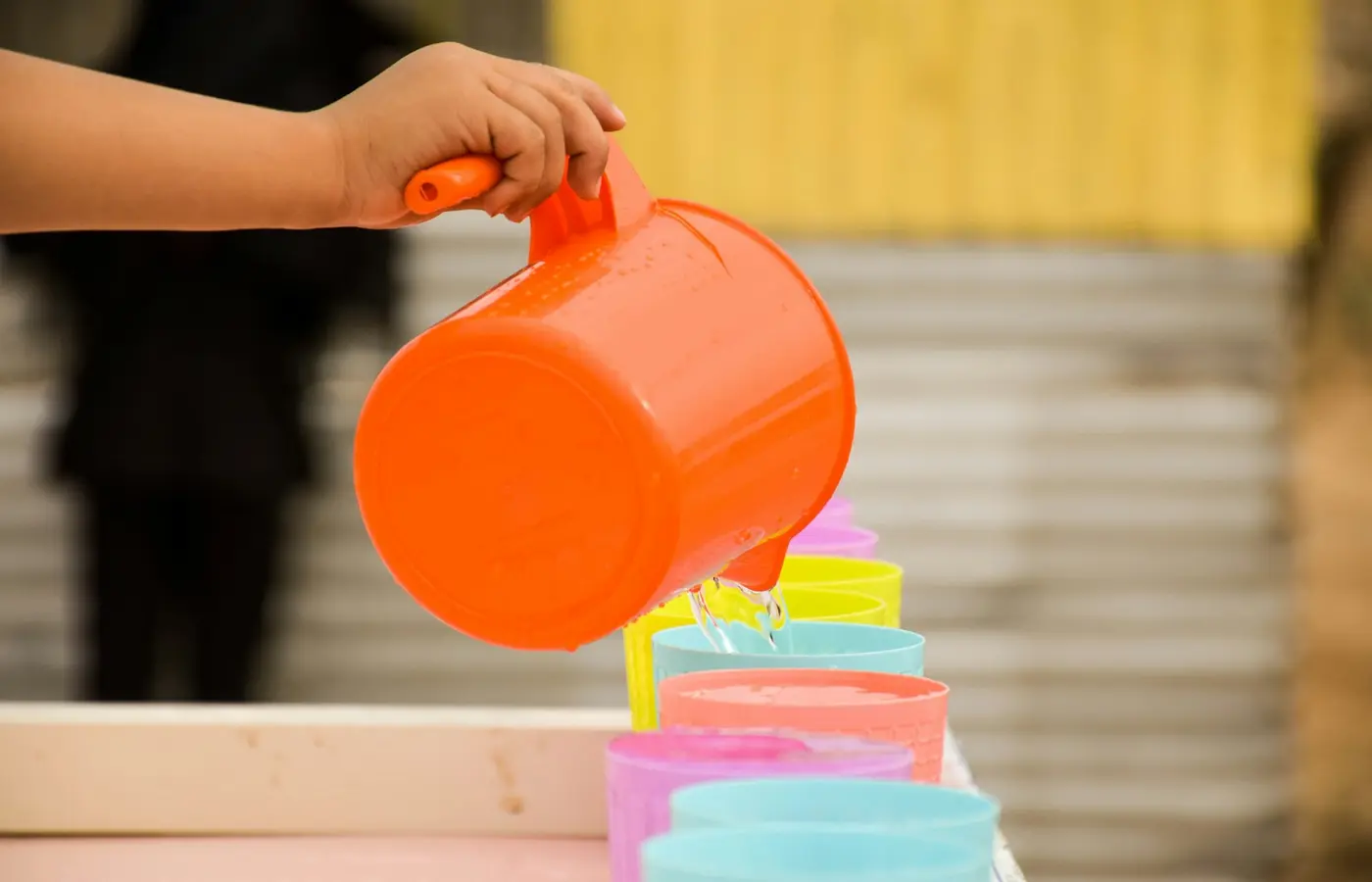
Use a shallow container of water with a few large, age-appropriate items, such as sturdy cups, a large spoon, or a sponge. Check that each item is in good condition and too large to swallow. Stay close enough to intervene, especially when water or containers are present.
A bathtub is not required. A small tray on a wipeable floor may be enough. Use only the amount of water needed for the action, wipe spills as they happen, empty the container after play, and leave cups and sponges open to dry.
Loose fillers are not a good substitute for a child who mouths objects. Rice, dried beans, pasta, tapioca pearls, and similar materials can bring separate choking, allergy, food-safety, or ear-and-nose insertion concerns. “Edible” does not automatically mean suitable for unsupervised sensory play.
For scooping and pouring
Try water with two or three large cups, a ladle intended for play, or large floating bath toys that meet the child’s product instructions and cannot fit fully in their mouth.
Fewer pieces make setup and cleanup easier. Put a towel or washable mat beneath the container, and choose a place where a spill will not create a slipping hazard or damage furniture. If pouring becomes mostly throwing, tipping, or leaving the area, you can end the setup and try again another time.
For squeezing
A damp sponge or folded washcloth allows squeezing, pressing, soaking, and wringing. A bowl for wet items and another for squeezed-out items adds a simple carrying or sorting action without hundreds of loose pieces.
Inspect sponges and cloths for torn sections, loose components, or deterioration. Rinse them after play and dry them fully before storage.
For pretend cooking, transporting, or sorting
Use age-appropriate play food, large blocks, nesting cups, or other pieces that are easy to see and count. A child can transfer them between bowls, load them into a toy vehicle, “serve” them, sort them by an invented rule, or dismantle the arrangement.
Check the manufacturer’s age grade and warnings for each item. Size, condition, detachable parts, and the individual child’s mouthing behavior matter more than a marketing label such as “sensory” or “educational.”
These alternatives are practical ways to offer particular play actions. They are not sensory therapies, and they do not guarantee a developmental outcome. The play can be worthwhile simply because the child wants to pour, squeeze, carry, pretend, repeat, or stop.
Questions caregivers often ask
Are fully expanded water beads safe for toddlers?
No. Hydrating the beads in advance does not make them an appropriate toddler material. A child can still swallow, inhale, or insert a bead into an ear or nose. Beads may also shrink as they dry and become easier to scatter or miss.
The safer decision is to replace them with larger, non-expanding items matched to the child’s play.
Can an older child use water beads if a toddler lives in the home?
The UK safety alert recommends avoiding water beads in households with children under 5, even when they are intended for an older child or adult. This accounts for beads that spill, roll away, or remain accessible after the planned activity.
If you already own them, keep the toddler away from the product and review the manufacturer’s current warnings and any applicable safety notices. Removing the beads from the household is easier to manage than trying to guarantee that every dry, hydrated, dropped, and stored bead remains inaccessible.
What should I do if my child may have swallowed a water bead?
Contact Poison Control or an appropriate medical service promptly, even if the child has no symptoms. Give them the product name or packaging if available and follow their case-specific instructions. Do not wait for the bead to expand or for symptoms to appear before asking for help.
Call emergency services immediately if the child is choking, struggling to breathe, or appears seriously unwell.
Should I discard toys or stress balls that contain water beads?
Water beads can be present inside stress balls and other products, not only in sensory-bin packets. Check the product instructions, current manufacturer notices, and relevant regulator warnings for the exact item.
If a product is damaged or leaking, stop access immediately and contain the loose material where children and pets cannot reach it. If young children live in or visit the home, removing products containing accessible water beads is the more manageable choice. Follow local disposal directions and do not pour beads down a drain, where their expansion may cause plumbing problems.
A practical selection rule
For a toddler or any child who may mouth small objects, skip materials that combine three features: tiny starting size, easy scattering, and expansion after swallowing. Choose a small number of larger, non-expanding play items that are easier to see, retrieve, wash, dry, and store.
You can still offer the action the child is seeking. Water and cups support pouring; a damp sponge supports squeezing; large play pieces support sorting and pretend cooking. The safer material does not need to imitate the bead to make room for satisfying play.
Sources and safety note
This article draws on regulator guidance, poison information, pediatric guidance, medical literature, and attributed specialist reporting. Sources were reviewed September 2, 2026. Product warnings, recalls, and regulations can change, so check current information for the exact product and your jurisdiction.
Product-safety regulators
- U.S. Consumer Product Safety Commission: Water Beads Information Center
- UK Office for Product Safety and Standards: Product Safety Alert PSA7, issued September 19, 2024
Poison and pediatric guidance
- Poison Control, National Capital Poison Center: Are water beads dangerous?
- American Academy of Pediatrics, HealthyChildren: Water Beads—Harmful if Swallowed, Put in Ears
- Canadian Paediatric Society: Sensory water beads—What parents and caregivers should know