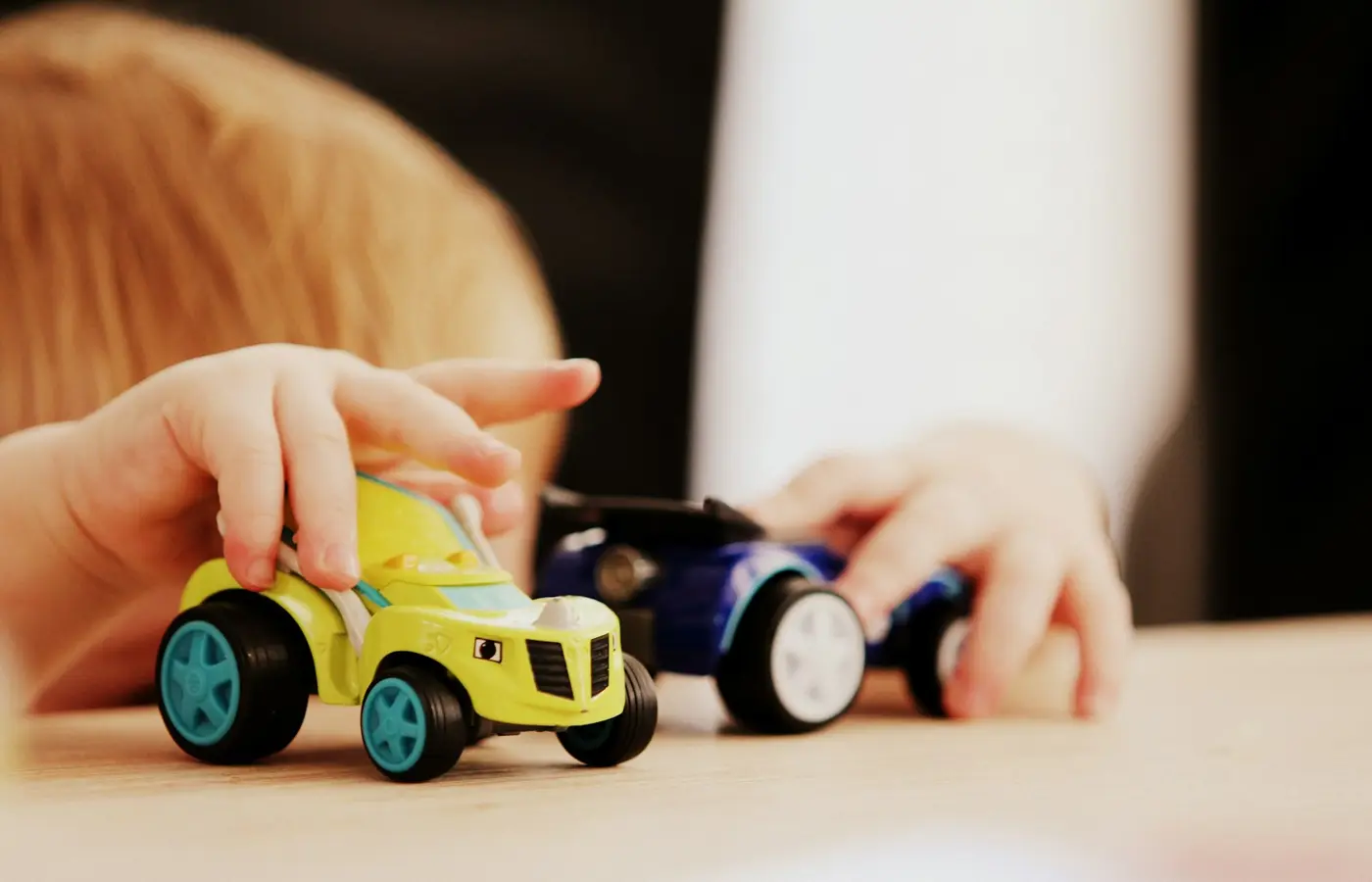
A row of cars across the rug, animals arranged nose to tail, or blocks placed carefully side by side can make a caregiver pause. You may wonder whether to admire the work, join in, suggest a new game, or worry that the play means something larger.
A useful short answer: a child lining up toys is one observable way of playing. By itself, it cannot tell you what a child is feeling, learning, or whether they have a developmental difference. You do not need to interrupt it or turn it into a lesson. Start by noticing what the child seems to want from the moment, then choose the least intrusive response that fits.
The materials still matter. Use items that match the child’s current ability to use them safely, follow the toy’s label and instructions, and consider mouthing, loose parts, younger siblings, pets, and where the line is spreading across the floor.
A row of toys is not a diagnosis or a developmental score
Children can use the same toys in very different ways. One child may line up vehicles, knock them down, and then carry them to another room. Another may arrange figures by color, rebuild the row after a sibling moves one, or quietly return to it several times in an afternoon. The visible row does not explain the child’s purpose.
It can be tempting to attach a fixed meaning to the arrangement: perhaps the child is sorting, seeking order, practicing a skill, or showing a particular trait. The available research package does not support those conclusions about an individual child. It also does not support treating lining up toys alone as evidence of autism, anxiety, obsessive-compulsive disorder, giftedness, developmental delay, or any particular learning outcome.
Some autism-focused therapy-provider articles frame lining up as something to interpret alongside a much wider picture of play, communication, social interaction, flexibility, and distress. That broader framing is more useful than trying to read a diagnosis from a line of cars. It is also important to keep the source type in view: therapy-provider pages are not diagnostic guidelines or screening tools.
You do not need to decide whether the arrangement is “normal” before responding kindly. It is enough to see it as play the child has chosen right now.
Start by watching what the child is doing
Before adding a road, asking a question, or moving a piece, take a small pause. Observation is not a test. It simply helps you avoid accidentally undoing something the child is concentrating on.
You might notice:
- What objects they chose. Are they using identical cars, a mix of animals, household objects, blocks, or anything nearby?
- How they place them. Are they carefully spacing each object, placing them quickly, matching colors, making several short rows, or changing the order repeatedly?
- What happens if the row changes. Do they laugh, rebuild it, invite you to help, ignore the change, or become upset?
- Whether they seem open to company. Do they look toward you, hand you an object, make room beside them, talk, or signal that they would rather work alone?
- What happens next. Does the line become a train, a display, a path, a pretend scene, a pile to carry away, or simply a finished arrangement?
These details are not a checklist for judging a child. They are practical information for choosing your next move.
A child may be focused and still welcome a nearby adult. Another may want uninterrupted time. Solitary play is not lesser play, and shared play is not automatically better. The question is not “How can I make this more educational?” It is “What response respects what this child is doing?”
Three reasonable responses to a line of toys
There is no need to make every line into a game. Often, the best choice is to protect the work and let it continue. At other times, the child may welcome a small, playful contribution.
1. Leave space for the play
Leave the arrangement alone when the child appears absorbed, is carefully placing objects, or has made it clear that moving the toys is unwelcome. You can be present without directing the activity.
Try simple, low-pressure responses:
- Sit nearby and do your own quiet task.
- Make room around the arrangement so feet, pets, or siblings are less likely to disrupt it.
- Say something observational, such as, “You put the red ones together,” without demanding an answer.
- Ask before moving anything: “Is this part of your line?”
- Take a photo only if the child wants one and your family’s privacy practices allow it.
A finished row does not need an adult extension to count as meaningful play. It may be enough that the child arranged it, looked at it, changed it, or chose to leave it there for a while.
2. Join carefully, without taking over
If the child watches you, offers an object, makes room, or otherwise seems interested in shared play, join at the edge rather than in the center. Let the child retain control of the arrangement.
You might:
- Ask, “May I put one here?” and wait.
- Hold out two objects and let the child choose one.
- Add your own short line nearby instead of changing theirs.
- Copy their action with one or two objects.
- Describe what you see: “This car is behind the bus.”
- Wait to see whether the child responds, changes the idea, or returns to independent play.
This approach is consistent with the general idea of following a child’s chosen activity rather than directing it immediately. A review of play therapy in children with autism describes child-led, non-directive therapeutic approaches in which a therapist follows the child’s choices and adapts the environment to therapeutic goals.
That review concerns therapy, not ordinary family play, so it does not show that joining a child’s line at home will produce particular social, communication, or developmental outcomes. Still, the underlying courtesy is useful at home: notice the child’s lead, offer rather than impose, and allow them to say no through words or actions.
3. Offer one small change, then wait
When a child seems receptive, one small invitation can open a new direction without making the original play wrong. Think of it as an option, not a task to complete.
For cars, you could place a scarf or strip of paper beside the line and say, “I wonder where this road goes.” For blocks, you might put one block next to the row and wait. For animals, you could ask, “Would this one like a place too?”
Other gentle invitations include:
- Adding an empty container nearby for “parking” or collecting.
- Offering a tray, piece of cardboard, or low box as a new surface.
- Wondering aloud where the first or last object might go.
- Starting a separate line that curves, stops, or leads to another room.
- Asking whether the child wants to make a path for a figure to walk along.
The child may accept, ignore, undo, or change your idea. All are valid responses. If they rebuild the original line or move away, take that as useful information: the invitation was not needed right then.
Practitioner-oriented autism therapy articles commonly suggest joining a child’s activity and introducing small variations, rather than abruptly stopping the activity. For example, ABA Centers encourages caregivers to look at a broader pattern and to join play gently. That is a practical suggestion, not independent evidence that changing a line into a road, story, sorting activity, or train improves development.
Keep the setup safe enough for the way your child plays
Lining up toys is not inherently a safety problem. The setup can create practical issues, though, especially when the line uses very small objects or stretches across a shared walkway.
Consider these home realities:
Match the materials to the child and household
Follow the manufacturer’s age grade, warnings, and instructions for each item. A child who still mouths objects may need larger, sturdier materials than an older child using the same kind of play idea. If pieces are damaged, loose, or small enough to create a concern for the child in front of you, choose a different material or supervise more closely.
The research package for this article does not include product-specific warnings, recall information, or regulator guidance for particular toys. That means there is no basis here to declare a specific item safe, non-toxic, recall-free, or appropriate for a certain age. When in doubt, check the documentation that came with the actual toy.
Protect feet and pathways
A long row across a hallway, stair landing, or busy kitchen floor can become a tripping problem. You do not have to end the play; you can help relocate it.
Try saying, “Your line needs a place where people’s feet will not bump it. Shall we move it to this mat or along this wall?” A baking tray, rug edge, low table, or piece of cardboard can give the arrangement a clear boundary and make it easier to preserve.
Plan for siblings, pets, and cleanup
A younger sibling may not understand that a careful arrangement is not a pile of available pieces. A pet may walk through it. An adult may need the floor clear before dinner. These are ordinary household constraints, not failures of child-led play.
Give notice when you can: “We need to clear this path in five minutes. Do you want to take a picture, move the line to the tray, or put the pieces in the box together?” If the child is disappointed, you can acknowledge that the interruption is frustrating while still keeping the home workable.
When a wider conversation may be useful
Lining up toys on its own is not a screening rule. There is no supported time limit, frequency, reaction to disruption, or play style in the supplied research that can confirm or rule out autism or another developmental difference.
Still, caregivers are allowed to seek support when questions extend beyond this one behavior. If you have ongoing concerns about a child’s communication, daily routines, distress, changes in functioning, or many aspects of play and interaction, bring those observations to the child’s pediatric clinician or another qualified local professional.
It may help to share concrete examples rather than a label: what you have noticed, when it occurs, what seems difficult, what the child enjoys, and what has changed. A clinician can consider the child’s broader history and current context in a way that one play behavior cannot provide.
This is not a reason to monitor every row of toys for hidden meaning. It is simply permission to ask for guidance when your concern is about the wider picture.
A simple next move: protect the line, then follow the invitation
When you find a child lining up toys, pause before changing anything. Ask yourself whether the line appears to be the play itself. If it does, protecting it may be the most respectful response.
If the child invites you in, add one small idea at the edge and wait. If they decline, return to being nearby. If the setup creates a safety or household problem, adapt the space or choose safer materials without treating the child’s interest as a problem.
The selection rule is simple: preserve the child’s control where you can, and make the smallest change needed for safety, shared space, or the next part of the day.
Sources and research note
- Play therapy in children with autism: Its role, implications, and limitations. This review was used only for context about child-led and non-directive therapeutic approaches. It concerns play therapy for children with autism and does not establish outcomes for everyday caregiver play at home.
- Toddler Lining Up Toys: Is It a Sign of Autism?. This therapy-provider article was used as context for common caregiver questions and practitioner-oriented suggestions to consider the broader pattern of a child’s experience. It is not treated here as diagnostic guidance or evidence of prevalence.
- Toddler Lining Up Toys: Autism Sign or Just Play?. This therapy-provider article was reviewed as context only. The article does not use its claims to set diagnostic thresholds, age ranges, or rules for when a child should be evaluated.
The supplied research did not include a pediatric clinical guideline, diagnostic manual, primary developmental study on lining up toys, product instructions, toy recalls, or regulator safety guidance. For that reason, this article keeps its conclusions narrow: a line of toys is one play behavior, and a respectful response can begin with observation, appropriate materials, and attention to the child’s cues.