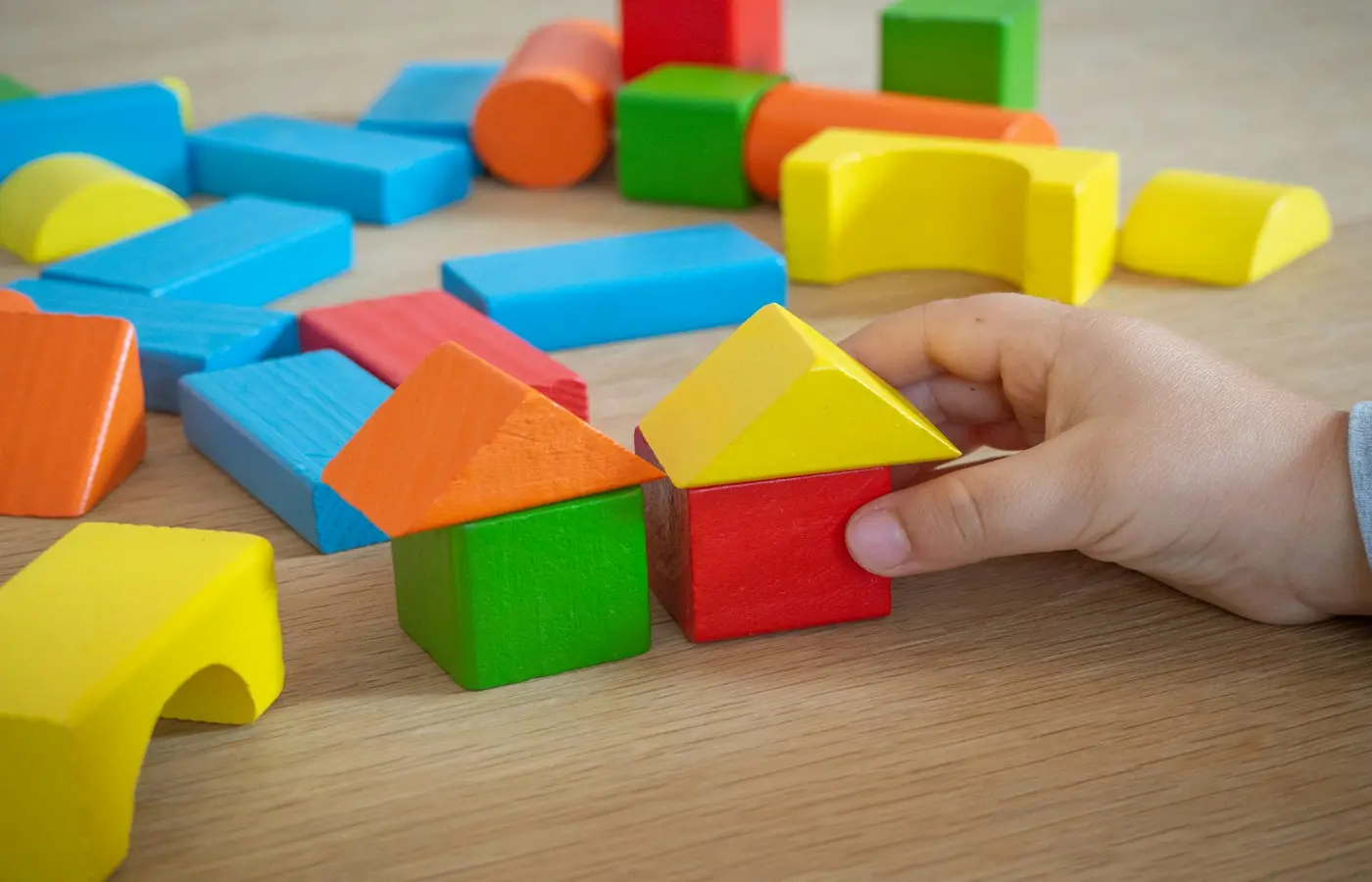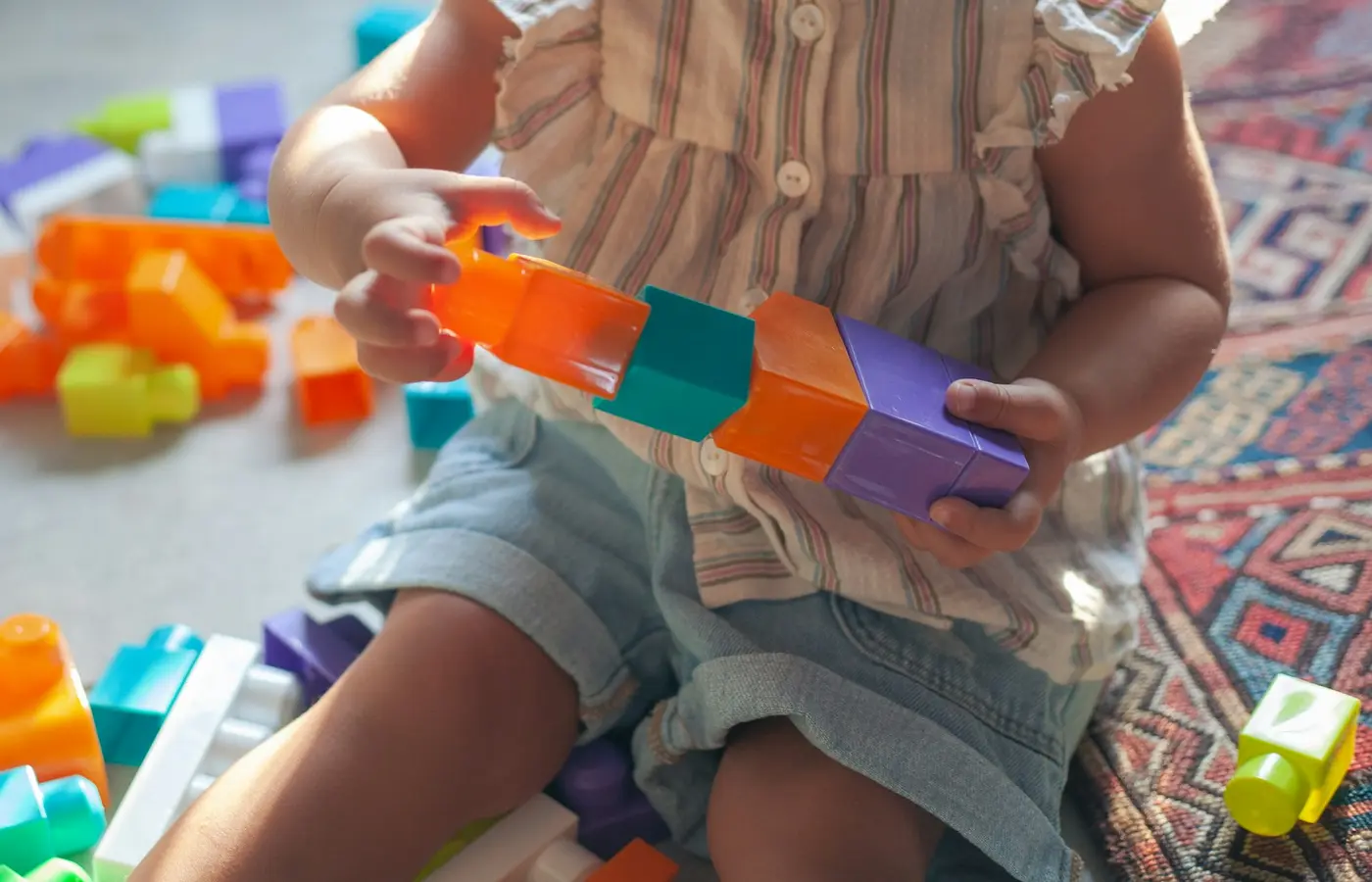
A child does not need to reach a particular birthday before trying smaller interlocking bricks. The more useful question is whether the child is interested in connecting pieces and can handle the actions involved without the pieces becoming a safety concern or a repeated source of frustration.
Start with the exact set, not the category. Check its manufacturer age grade, warnings, and instructions before offering it. Small pieces can change the safety decision, especially in homes with children who still mouth objects or younger siblings who share the play space. A child who can manage large chunky blocks may still need more time before a smaller-brick set fits safely and comfortably.
The goal is not to “move up” from one kind of block to another. Large blocks can remain satisfying building material for a long time. Smaller interlocking bricks are simply another option when their size, complexity, and household setup work for your child.
The short answer: watch the actions, then check the label
A brief, closely supervised trial may make sense when your child shows interest in smaller building pieces and can explore them by picking up, turning, lining up, pressing together, and pulling apart pieces. These are observations to use in the moment, not a checklist a child must pass.
Toy age grades are meant to reflect more than a child’s ability to understand a toy. The CPSC-hosted age-determination guidance describes age grading as a process that considers developmental characteristics, likely play patterns, and the nature of the toy. That is helpful context, but it is not a substitute for the label and instructions on the particular set in your home.
Before you offer any interlocking brick set, check:
- The manufacturer’s age grade for that exact set.
- Any warning statements on the box, packaging, or instructions.
- Whether the set includes very small elements, figures, accessories, or loose decorative parts.
- Whether younger children can reach the play area or storage container.
- Whether you can put all pieces away between play sessions.
An adult being nearby does not make a set appropriate if its warning or age grade says it is not intended for the child. Likewise, a child who seems highly capable may still be better served by a larger, simpler material if small pieces are likely to be mouthed, scattered, or mixed into another child’s toys.
Readiness signs to notice during everyday block play
You do not need to test a child or turn ordinary play into an assessment. Watch what happens when blocks are already available.
A child may be ready to explore a small, approved assortment of interlocking pieces when you regularly see actions such as these:
- Picking up a block, turning it over, and examining where it might fit.
- Using both hands together: one hand holds a piece steady while the other moves another piece toward it.
- Trying to line up two parts rather than only stacking one on top of another.
- Pressing pieces together with interest, even when the connection is not successful at first.
- Pulling connected pieces apart or asking for help to separate them.
- Returning to a building attempt after a miss instead of immediately abandoning the materials.
- Pointing to, asking for, or showing curiosity about smaller bricks used by an older child or adult.
None of these actions predicts a particular age or future skill. They simply tell you something practical: the child may enjoy trying a different kind of building action.
Interest matters as much as hand handling. Some children enjoy making a tall tower, knocking it down, carrying blocks around the room, or filling and emptying a container. Those are real forms of block play. A child does not need to prefer detailed construction for chunky blocks to be worthwhile.
It can also help to notice the effort required. With some interlocking systems, the challenge is not only pressing pieces together but separating them again. If the child can connect pieces but cannot pull them apart without becoming upset, the set may require more adult involvement than your household wants right now.
Small pieces change the safety decision
The shift from chunky blocks to smaller interlocking bricks is not only about dexterity. It is also about the size and number of pieces in the home.
A large block is usually easier for an adult to spot on the floor, easier for a child to pick up, and less likely to disappear into couch cushions, shoes, or another toy bin. A small building piece can be easy to lose, easy for a younger child to find, and hard to account for after play.
That is why it helps to treat the exact set as the decision point. One building set may contain mostly larger pieces, while another may include very small connectors, wheels, figures, tools, or decorative elements. Do not assume that a familiar-looking brick, a bigger box, or a claimed connection to another building system carries the same age grade or warnings.
Before a first session, take a few minutes to inspect what is actually in the container. Look beyond the main bricks for the smallest included items. Keep the packaging or instructions available, particularly if more than one adult sets up play or if the toys are stored in a shared space.
A practical home rule can be: small-piece building materials come out only when the adult who set them up can also help gather them. That is not a developmental rule. It is a way to reduce the chance that pieces migrate into a baby’s play area, a pet-accessible room, or a mixed toy bin.
If there are younger children in the household, separate storage is often more realistic than expecting everyone to remember which pieces belong where. A lidded, clearly labeled container placed out of reach may be more useful than an open communal bin.
Try a few pieces before opening a large bin
You do not need to buy a large, complex set to find out whether smaller interlocking bricks suit your child. If you already have an age-appropriate set with instructions and warnings that fit the child, begin with a small selection from it rather than tipping out every piece.
This kind of trial is household guidance, not a research-based readiness test. Its purpose is simply to let you see whether the materials work in real life.
Set up a contained first try
Choose a clear floor area or a table where pieces are easy to see. Avoid beginning beside a crowded toy box, under a dining table, or in a room where a younger child may crawl through unexpectedly.
Offer a few pieces from the approved set. Keep the rest stored away for now. A small assortment makes it easier to notice what the child is doing and easier to put the materials away afterward.
You might:
- Connect two pieces slowly where the child can see the action.
- Pull them apart and show that building can include dismantling, too.
- Offer the pieces without correcting the child’s ideas about what to make.
- Help only as much as needed if the child asks or becomes stuck.
- End the session when interest fades, rather than trying to complete a model or reach a certain amount of play time.
The first action may be as simple as connecting two bricks, pulling them apart, and repeating. Later, if the child remains interested, they may begin making rows, towers, enclosures, vehicles, creatures, or invented objects. There is no need to rush toward instructions, themed builds, or a finished display.
Notice the adult work, too
A successful trial is not only about whether the child connects pieces. It is also about whether the setup works for you.
Ask yourself:
- Can I supervise this type of play in the places where it is likely to happen?
- Can I find and gather the pieces without a long cleanup each time?
- Is the noise level manageable when pieces are dumped, dropped, or dismantled?
- Does the child want help often enough that this is currently shared play rather than independent play?
- Can this set stay separate from toys intended for younger children?
There is no prize for making a toy available before the family is ready to manage it. Putting a set away for a few months, saving it for adult-and-child building time, or choosing larger materials instead can be the better fit.
Signs to stay with chunky blocks for now
Sometimes a first try gives you a clear answer: not yet, or not in this setup. That is useful information, not a setback.
Consider pausing smaller interlocking bricks and returning to larger blocks if:
- The child mouths or chews the pieces.
- Pieces are regularly thrown, carried away, or dropped where they cannot be easily recovered.
- The child cannot use the set within its stated age grade and warnings.
- Connecting or separating pieces is consistently upsetting rather than mildly challenging.
- The child loses interest quickly but happily returns to larger blocks.
- A younger child, pet, or shared play environment makes reliable piece management unrealistic.
- You find yourself spending the entire session preventing access, retrieving pieces, or trying to protect an unfinished creation.
Frustration is not automatically a reason to stop. A child may enjoy asking for help, trying one more time, or using a brick in an unexpected way. But when frustration repeatedly overwhelms interest, simplify the materials rather than pushing through.
You could offer a taller stack of chunky blocks, add a ramp or container for transporting them, build a simple enclosure together, or bring out a larger connecting toy that is specifically labeled for the child’s age. Then revisit smaller bricks later, with the same label-and-observation approach.
Questions caregivers often ask
What age do children usually start using small interlocking bricks?
There is no single age that applies to every child or every interlocking brick set. Use the age grade, warnings, and instructions for the exact product first. Then consider the child’s current interest, how they handle pieces, and whether your home can safely manage small parts.
The CPSC-hosted age-grading material includes small interlocking bricks among toy categories considered in age-determination discussions, but it does not establish one universal transition age for all children or products.
How can I tell whether my child can manage interlocking bricks?
Look for practical actions: holding and turning pieces, bringing two pieces together, trying to press them into place, and showing interest in trying again. Also watch whether the child can cope with the effort of separating pieces. These are useful signs for a short trial, not milestones or proof that a child is ready for every set.
Can a child use small bricks if an adult is nearby?
Adult presence does not replace the manufacturer’s age grade, warnings, or instructions. If the set is appropriate for the child according to its documentation, supervision can help you observe how the child uses it and keep pieces contained. If the set is not intended for the child, choose a more suitable material instead.
What should I do if interlocking bricks cause frustration?
Reduce the number of pieces, offer a simpler connection, or help separate a stuck build. If the child remains upset or disengaged, put the set away without making it a problem. Large blocks, loose parts of an approved size, drawing, pretend play, or another building material may be a better choice that day.
Make the next step manageable at home
The best next building toy is not necessarily the one with the most pieces or the most detailed picture on the box. It is the one whose individual parts, age grade, instructions, storage needs, and cleanup demands fit the child and your household.
For a low-pressure next move, check the exact label on an approved set, choose only a few pieces for one short supervised opportunity, and watch what happens. If your child connects, separates, experiments, or simply enjoys looking closely at the pieces, you can offer the material again. If the pieces create a safety concern, too much adult work, or more frustration than interest, chunky blocks remain a perfectly good place to stay.
Sources and research note
- U.S. Consumer Product Safety Commission-hosted PDF: Updating Age Determination Guidelines for Toys. This 2018 draft guidance presentation provides context on toy age determination and the developmental characteristics and play patterns considered in age grading.
The available research package does not include product-specific manufacturer instructions, current recall information, or a regulator source establishing an exact age for moving from chunky blocks to smaller interlocking bricks. This guide therefore does not assign a universal transition age, state specific choking thresholds, or recommend a particular brick brand or set. For any toy you are considering, rely on its current packaging, warnings, and instructions.