
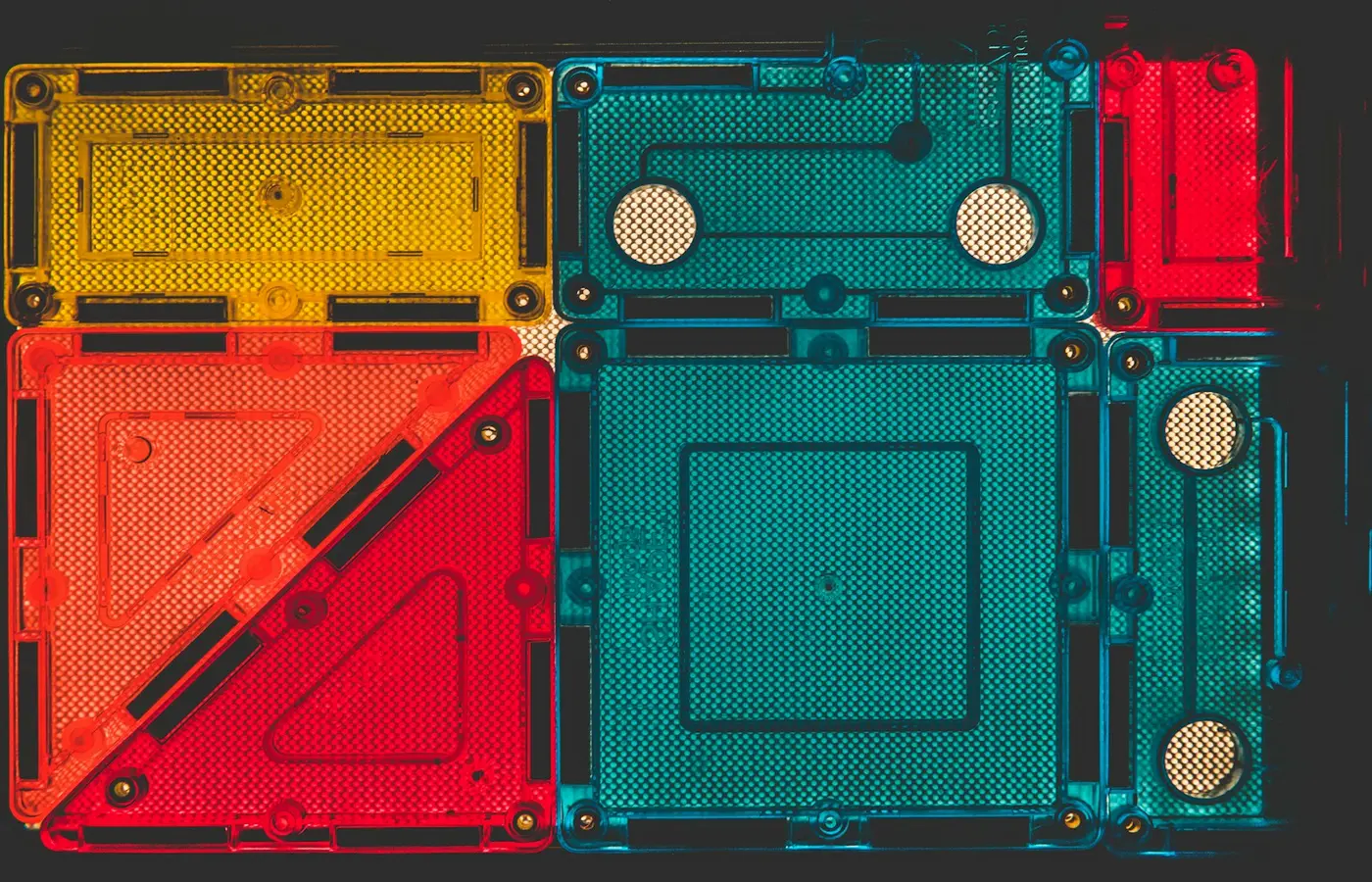
Magnetic pieces invite children to connect, stack, dismantle, sort, and build again. Before buying a set, however, look beyond the shapes and colors. The central safety question is whether every magnet is securely enclosed—and likely to remain enclosed through ordinary play, cleanup, and storage.
A useful first screen is straightforward: identify the exact set and market version, read its age grade and warnings, examine how the magnets are contained, and check whether that model has been recalled. Then consider your household. A set intended for an older child may still be accessible to a younger sibling who mouths objects, pulls constructions apart, or searches under furniture.
Enclosed magnetic pieces are not the same as loose magnets. Even so, an enclosed magnet should be treated as accessible if its piece cracks, opens, or loses a component. Before the first play session, decide how you will notice damage, limit access, and respond when something is missing.
Start with the exact toy, child, and household
Do not make the decision from a retailer category such as “ages 3–5” or from a broad claim that a toy is educational. Find the age grade and warnings attached to the exact product, model, and market version you would receive.
Before buying, look for:
- The manufacturer’s name and contact information
- A recognizable product or model name
- The stated age grade
- Specific warnings on the package or in the instructions
- A manual, parts list, or piece inventory
- Directions for inspection, cleaning, storage, and damaged parts
- Enough information to distinguish this set from similar versions
Age grading is a starting condition, not a promise that the toy suits every child of that age. Consider what the intended child currently does with objects. A child who mouths pieces, pries at seams, throws hard objects, or enjoys dismantling toys may need a different material or closer supervision. That is a practical fit question, not a judgment about development.
Include everyone who can reach the play area. Ask whether a baby, toddler, visiting child, or child who uses toys in an unexpected way could gain access. Also consider pets if they carry or chew small play materials.
If the set’s identity, warnings, or instructions are missing or difficult to verify, you do not need to resolve the uncertainty by buying it. Choosing a well-documented alternative—or skipping magnetic toys for now—is reasonable.
Distinguish enclosed pieces from accessible magnets
Magnetic construction sets use several forms, including tiles, blocks, rods, balls, and connectors. Their designs should not be treated as interchangeable.
In an enclosed design, magnets are intended to remain inside the building piece during use. The child handles the larger tile, rod, or block rather than the magnet itself. The buying question is therefore not simply, “Does this contain magnets?” It is, “How are the magnets contained, and what happens if the outer piece is damaged?”
A magnet should be treated as accessible when it is:
- Supplied as a separate play piece
- Designed to detach from its housing
- Visible through an opening that should not be present
- Exposed by a cracked seam, broken corner, missing fastener, or separated layer
- Found loose near the play or storage area
Product photographs may help you understand the general construction, but they cannot confirm the durability of an individual set. Statements about materials or compliance also do not show whether the particular box in front of you is complete and undamaged.
Avoid assuming that a familiar brand, certification-style logo, retailer badge, or high review score settles the question. Safety information needs to apply to the exact product and version. A recall or defect involving one model should likewise not be generalized automatically to every magnetic building toy.
Check the pieces and documentation before buying
Packaging and manufacturer documentation can reveal useful details, although they cannot replace independent testing or inspection of the delivered product.
Containment and construction
Look closely at official product diagrams and clear photographs. Check whether the magnets appear fully enclosed and whether the instructions explain what to do if a housing cracks or opens.
When the set arrives, inspect it before giving it to a child. Look for:
- Cracks, gaps, sharp damage, or layers beginning to separate
- Loose components or rattling that is inconsistent across matching pieces
- Missing corners, caps, plugs, or fasteners
- Pieces that do not match the documented inventory
- Packaging damage that may have affected the contents
Do not repair a magnetic piece with tape or glue unless the exact manufacturer instructions expressly provide an approved repair method. A home repair can hide continuing damage without restoring the original containment.
Piece size and shape
Use the product’s stated age grade and warnings rather than estimating suitability from appearance. A large-looking tile may contain smaller internal components, while some construction sets intentionally include small connectors or other separate parts.
Check every component, not just the largest pieces shown on the front of the box. Accessories, wheels, figures, rods, and decorative parts may have different shapes and handling requirements.
Inventory and support
A complete parts list makes it easier to notice when a component is absent. If the set has no documented inventory, counting pieces becomes less reliable because you do not have an authoritative total to compare against.
Before buying, see whether the manufacturer provides a usable support route and instructions for replacement or disposal. Save the model information, receipt or order record, manual, and a photograph of the identifying label. These details are useful if you later need to ask about a damaged piece or compare the set with a recall notice.
Plan supervision around access and condition
Supervision for a magnetic building set involves more than being somewhere in the room. It means paying attention to who can reach the pieces and whether their condition changes during play.
A manageable routine might include:
- Use the set in one defined area rather than carrying pieces throughout the home.
- Inspect pieces as you put them out, especially after the set has been dropped or stepped on.
- Watch for biting, forceful bending, prying, or repeated throwing.
- Remove questionable pieces immediately instead of returning them to the storage bin.
- Check the floor, cushions, and nearby furniture during cleanup.
- Store the set where children outside its intended age range cannot gain unsupervised access.
This routine needs to fit your real home. A large set spread across a shared room can create more inspection and cleanup work than a small set used at a table. Pieces may slide under furniture, become mixed with other toys, or remain inside an unfinished construction.
If you cannot reliably separate the set from a younger child’s play space, waiting may be the simpler choice. An older child can still build with cardboard, wooden blocks, cushions, or other materials that better fit the household right now.
Mixed-age play needs a household rule
When an older child uses the set in a home with a baby or toddler, decide in advance:
- Where building is allowed
- Who brings out and puts away the set
- Whether completed models may remain on display
- How the area will be checked afterward
- Where damaged or questionable pieces will be isolated
- How visiting children will be kept from accessing the set
A high shelf is useful only if pieces reliably return there. A closed container can make scattered parts easier to notice, but storage packaging by itself does not make an age-inappropriate set suitable for a younger child.
If a piece cracks, opens, or goes missing
Treat damage as a stop signal, not as an invitation to finish the build first.
If a piece cracks, separates, or appears to have lost an internal component:
- End access to the whole set.
- Keep children away from the immediate play and cleanup area.
- Place the damaged piece and any loose components in a closed container that children cannot access.
- Check nearby floors, furniture, clothing, storage bins, and other toys without allowing children to help search.
- Record the product name, model, market version, and identifying codes.
- Follow the exact manufacturer’s instructions for reporting, replacement, and disposal.
- Check the appropriate official recall database for that model and market.
Do not return the remaining pieces to play until you have accounted for the concern and can inspect the set against its documented inventory. If the official inventory is unavailable, contact the manufacturer rather than guessing what may have been inside the damaged piece.
If you think a child may have swallowed or inserted a magnet or magnetic component, use current official emergency-health or poison-control guidance for your location immediately. Do not wait for symptoms or improvise a home response. Exact contact routes and medical instructions vary by jurisdiction and must be verified from a current official source.
Check recalls by model and market
A recall check is most useful when you have more than a brand name. Record the model, set name, identifying number, purchase market, and any date or batch code shown on the package or product.
Search the official product-safety recall database for your jurisdiction and compare all identifying details. Do not assume a similarly named set is the same product, or that a notice from another country automatically covers your version. Products, warnings, and corrective actions can differ by market.
A recall search is not a one-time guarantee. Keep the identifying information so you can check again if a piece fails or the manufacturer sends a notice. Marketplace and retailer listings may help identify where an item was sold, but the official notice should provide the controlling model details and stated response.
Weigh safety management against play value
Once a set passes the initial safety screen, consider whether its everyday demands suit your home.
Magnetic connections can invite observable play actions: joining pieces, testing balance, enclosing spaces, sorting forms, dismantling structures, and incorporating buildings into pretend play. Children may use the same pieces differently from one day to the next. Those possibilities do not establish that a set will improve intelligence, attention, spatial ability, fine motor development, or school performance.
The practical trade-offs are easier to assess:
- Floor or table space: Large structures need room, and unfinished work may block shared areas.
- Cleanup: Pieces can spread beneath furniture or become mixed with other construction sets.
- Adult work: Inspection, retrieval, and controlled storage require time.
- Storage: The container needs to hold the complete set and limit access by younger children.
- Frustration: Connections may separate when a structure becomes tall, wide, or heavily handled.
- Cost: A smaller, well-documented set may be more manageable than a large collection with an unclear inventory.
- Compatibility: Do not assume pieces from different brands or versions are designed to be mixed unless the manufacturers document that use.
You do not need the largest set to find out whether this kind of play fits. A smaller inventory is often easier to inspect, contain, and clean up. It can still support building, sorting, connecting, and pretend play without creating as much household management.
A simple buying rule
Choose a magnetic building set only when you can answer five questions:
- What is the exact product and market version?
- What age grade, warnings, and use instructions apply?
- Are the magnets intended to remain fully enclosed?
- Can your household inspect, supervise, retrieve, and store every piece realistically?
- Do you know what you will do if a piece breaks or a component may be missing?
If one answer depends on a retailer badge, an unsupported safety claim, or a guess, pause. Ask the manufacturer, consult the relevant official regulator, choose a better-documented set, or use a nonmagnetic building material instead.